UNIFINplatform

Solution

Unifin Derivatives Exchange

A derivatives trade is a chain, and supervision grows in value along it.
The suite carries the exchange from the order gateway through matching to margin and clearing.
Margin runs on the portfolio, and delivery and settlement close the contract inside the suite.

  • Money path SLO Tier 1
  • SPAN-style margin
  • Sharded matching
All solutions

Live screens from the product terminals

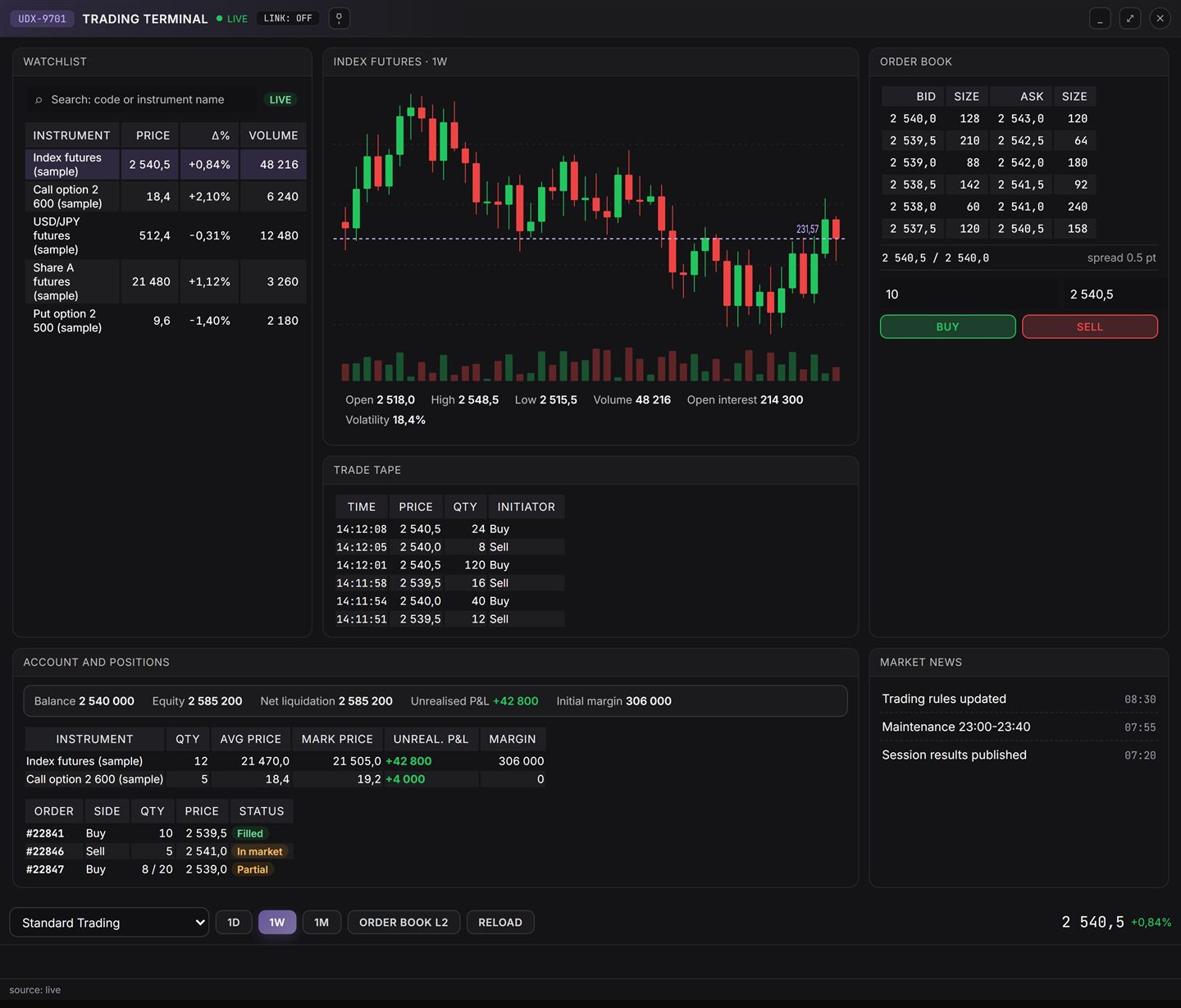
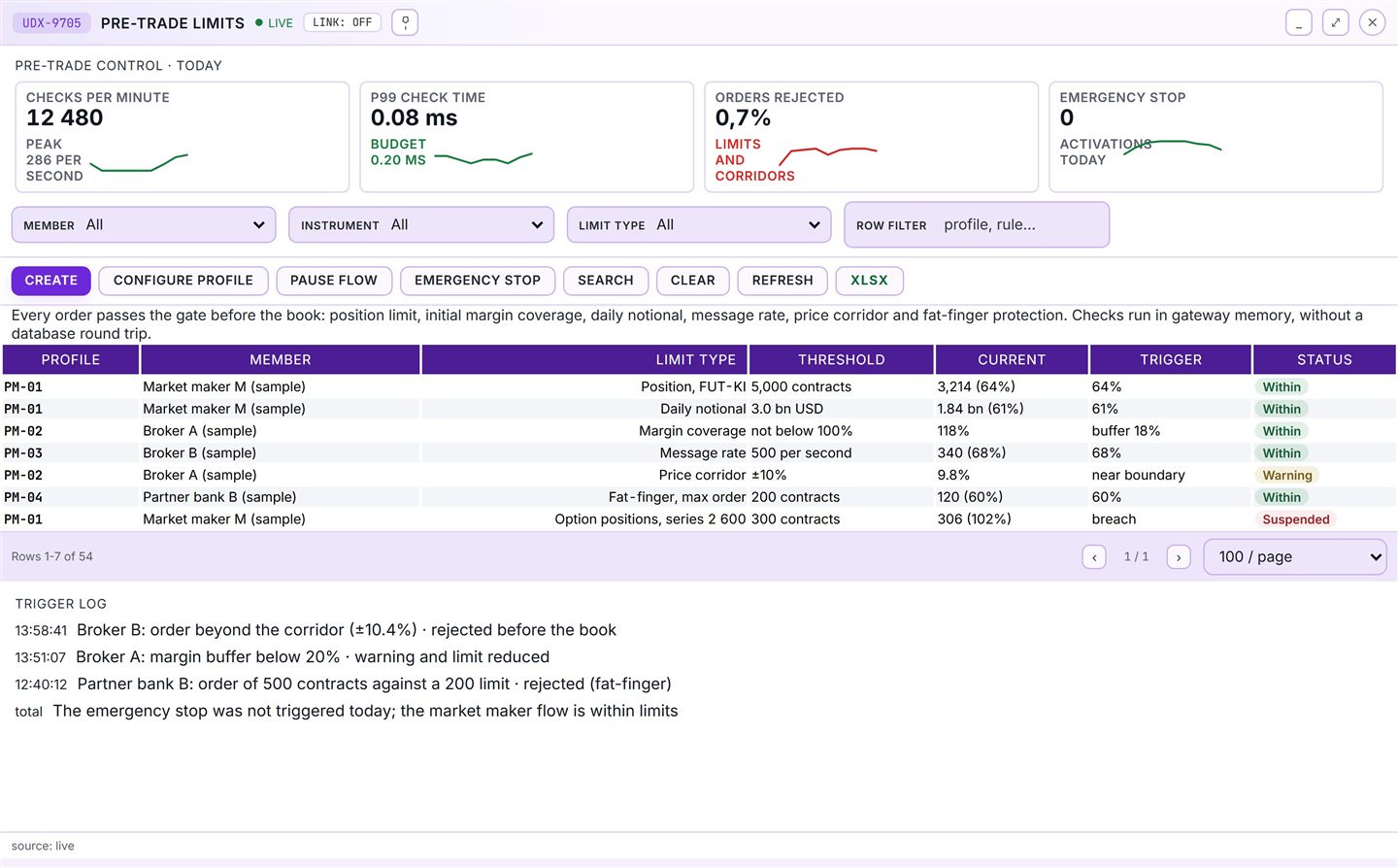
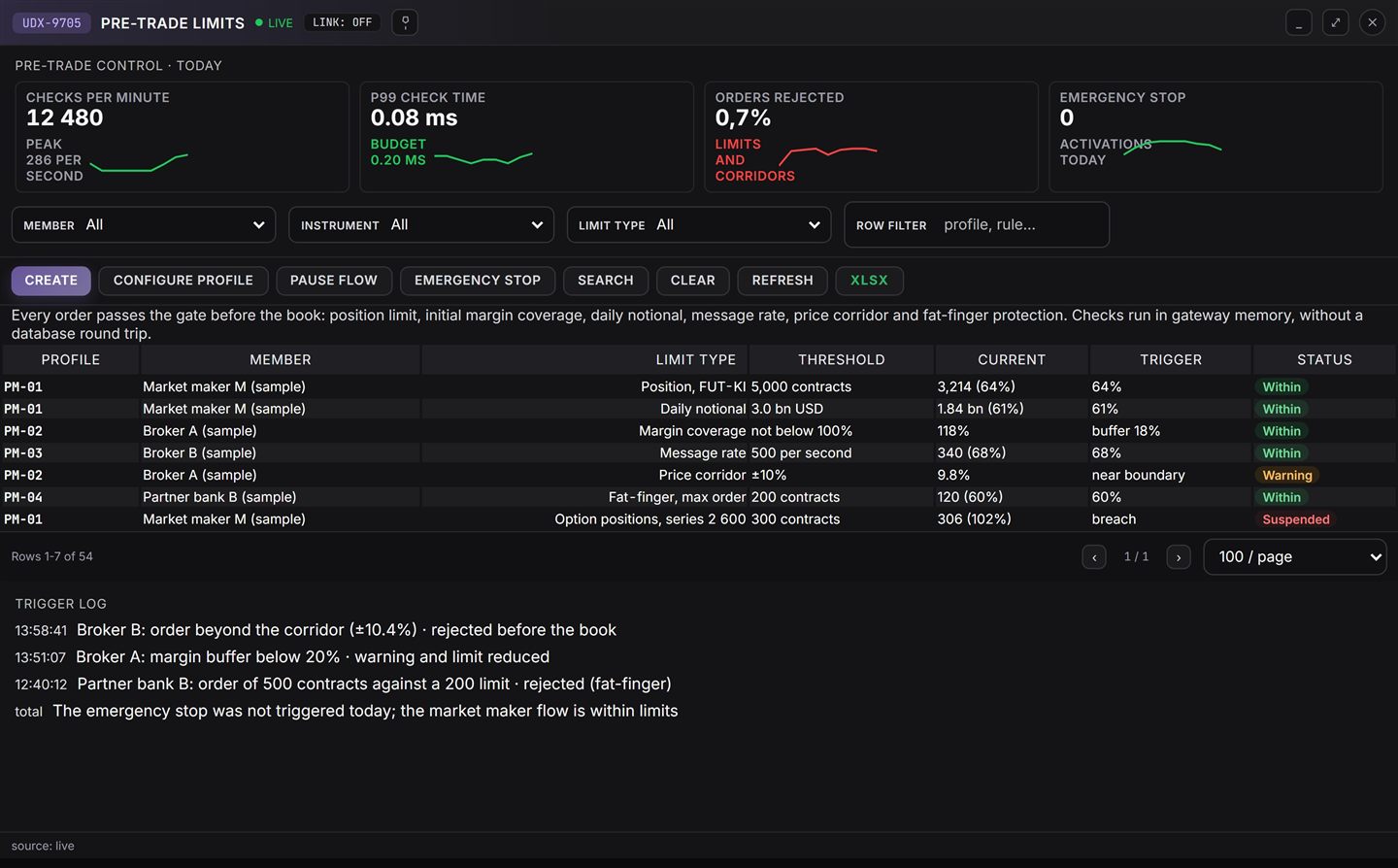
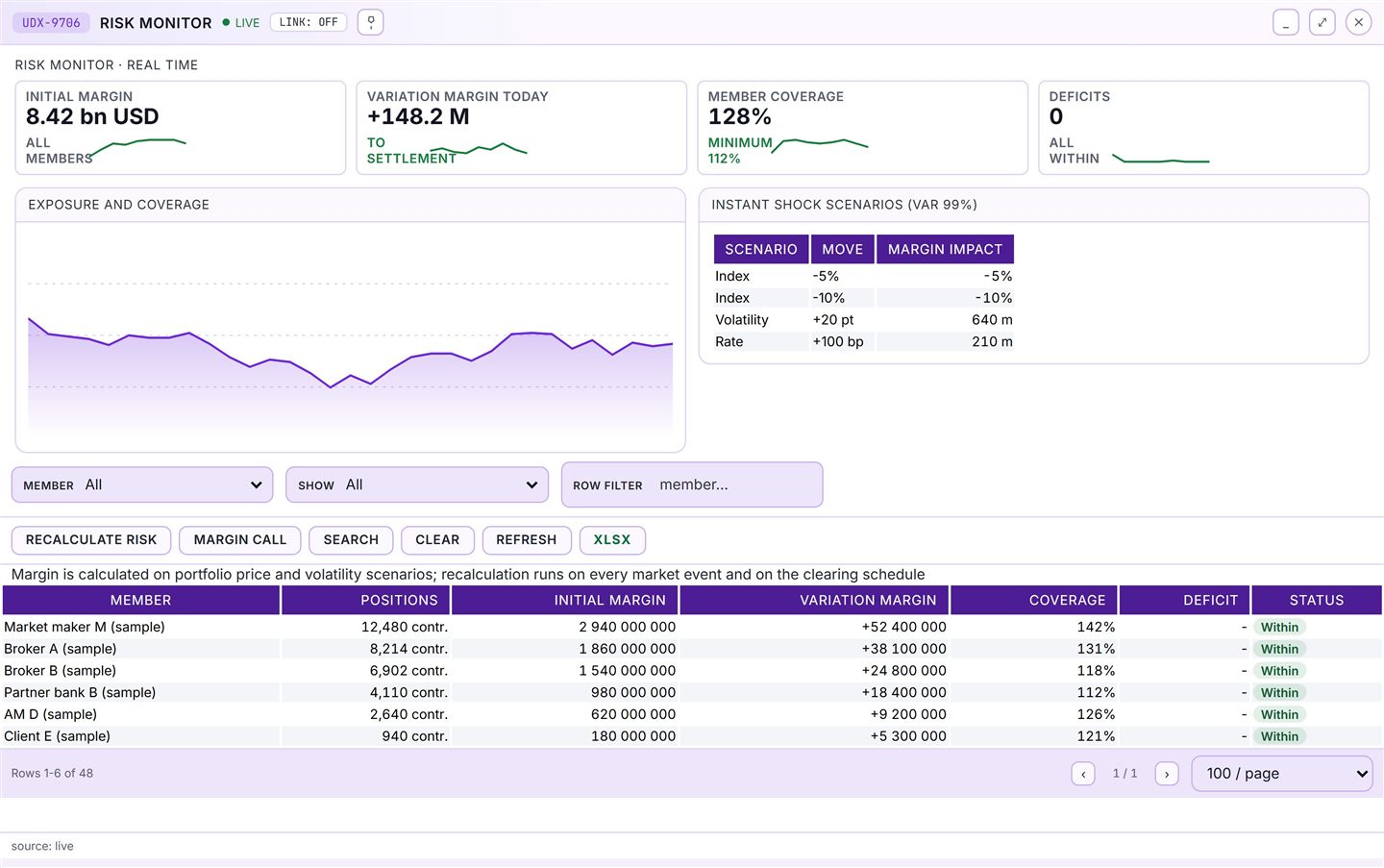
Trading terminal screen with the order book Trading terminal screen with the order book Pre-trade limits screen with a reject Pre-trade limits screen with a reject Risk monitor screen with portfolio margin
Demo Unifin Derivatives Exchange Theme Open separately
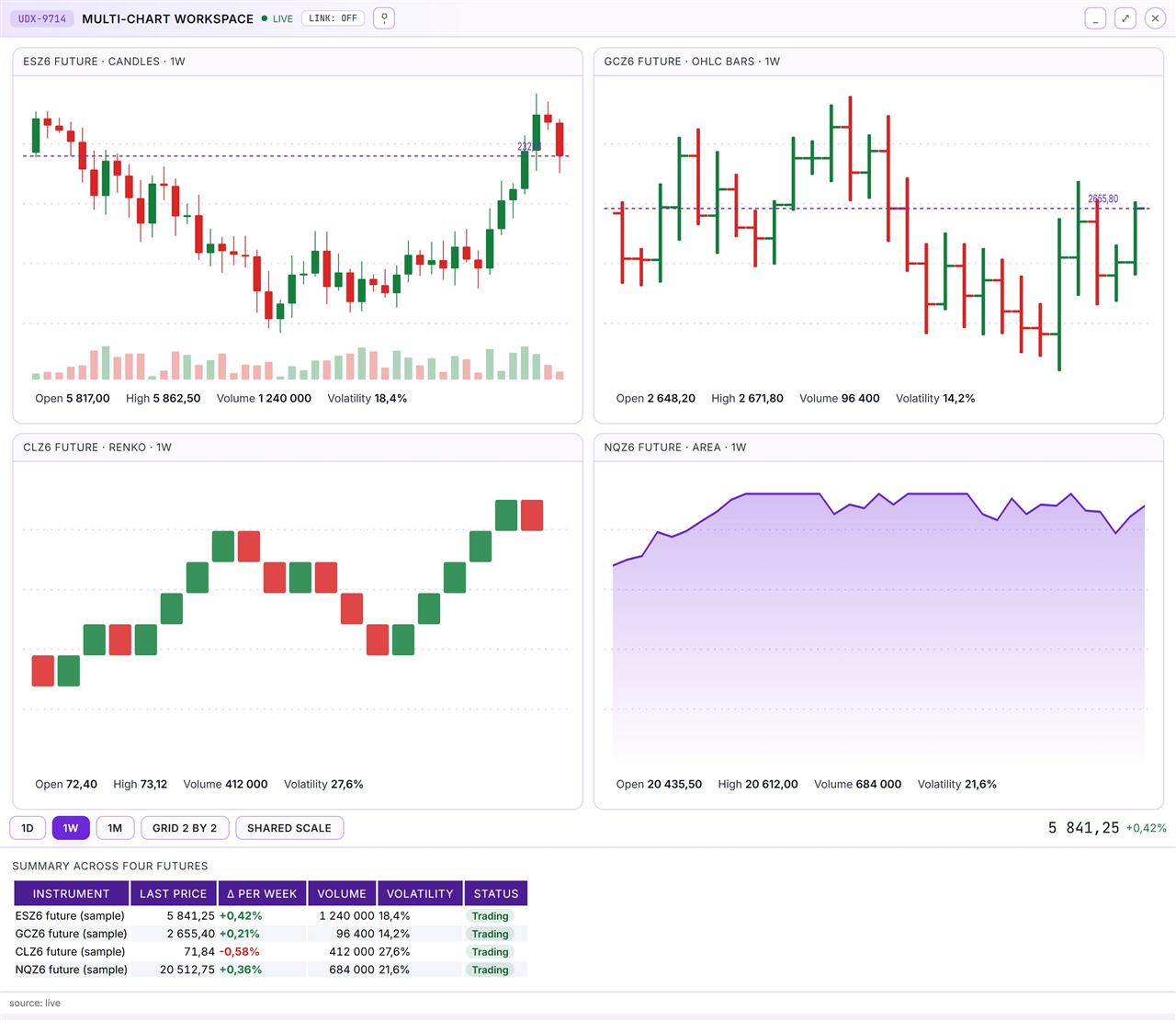
Multi-chart workspace

This is an interface demonstration: the real solution will differ in colours and content for a specific project.

Functions at a glance

Business functions at a glance

From pre-trade control to reporting.

Pre-trade control
Checks margin and limits before the order book
No order enters the market without collateral
Matching
Matches orders in a sharded book
The hot path holds speed under load
Positions and margin
Computes SPAN-style margin over the portfolio
The venue sees exposure before the problem
Margin calls
Raises calls with deadlines and a default waterfall
Deficits close by the rulebook
Clearing
Runs novation and multilateral netting
The trade tape becomes obligations
Delivery and settlement
Runs delivery to the CSD and money through the bank
The contract closes without leaving the suite
Reporting
Builds regulator extracts from live data
The regulator sees the derivatives day in full

What runs today

The derivatives chain, already running

Options and futures on the platform: the live chain.

Pricing

Black-Scholes and binomial trees price listed options.

IV surface

The implied volatility surface builds and interpolates.

Greeks

Greeks stream over WebSocket to desks and terminals.

Expiry cycle

Expiries, assignment and futures settlement run in the suite.

Margin

Portfolio margin runs SPAN-style stress on positions.

Roadmap

SABR and Heston models plus exotic payoffs are next.

Solution description

Capabilities and overview

Key features

  • Pre-trade control: margin and limits before the order book
  • Sharded order matching with a continuous book
  • Positions and SPAN-style margin over the portfolio
  • Margin calls with deadlines and a default waterfall
  • Clearing with novation and multilateral netting
  • Delivery to the central depository and money through the bank
  • Market data and quotes to participants and portals
  • Regulator reports from the live data of the suite
  • Order gateway: FIX and native participant protocols
  • Calendars of trading days and contract series
  • Event journal and audit for every trade
  • Deployment: by configuration, within the UniFin platform

Product overview

Unifin Derivatives Exchange is the UniFin platform exchange trading system for derivatives venues that need a full-cycle derivatives market.

The suite carries the exchange from the order gateway through pre-trade control and matching to margin, clearing and delivery.

Margin runs over the portfolio in SPAN style, margin calls carry deadlines, and novation and netting close the obligations.

Delivery comes to the central depository, the money leg runs through the bank, and reporting is built from live data.

The solution is deployed by configuration and runs within the UniFin platform without rewriting the trading core.

What it delivers

What the solution delivers

Pre-trade control

Margin and limits are usually checked after an order has entered the market, and a breach is caught by a trade. The solution checks the initial margin of the order against the collateral and applies contract and participant limits before the book. With the solution breaches are not caught after the fact, and the venue risk stays inside the rules. In setup the reason of every rejection is visible as a line in the tape, and the limits come as reference data.

Matching

Under load, matching usually loses predictability: the queue grows and orders age silently. The solution splits the book into shards with one thread per shard and a bounded queue that fails loudly on overflow. With the solution speed at peak is stable, and behaviour under load is clear. In setup the shard configuration and queue metrics are visible, and the shard layout comes as reference data.

Positions and margin

Margin is usually computed per position in isolation, and option series live apart. The solution recalculates SPAN-style margin over the portfolio with series and stress scenarios on events. With the solution the exposure of a participant is visible before it becomes a problem. In setup the calculation for every series and scenario is visible, and the model parameters are set in configuration.

Margin calls

A collateral deficit usually surfaces during an incident review, and the deadlines of calls live in e-mail. The solution raises a margin call with a deadline, tracks its statuses and keeps the default waterfall ready. With the solution deficits close by the rulebook, with no improvising under stress. In setup the call queue and the action history are visible, and the deadlines and thresholds are configured per segment.

Clearing

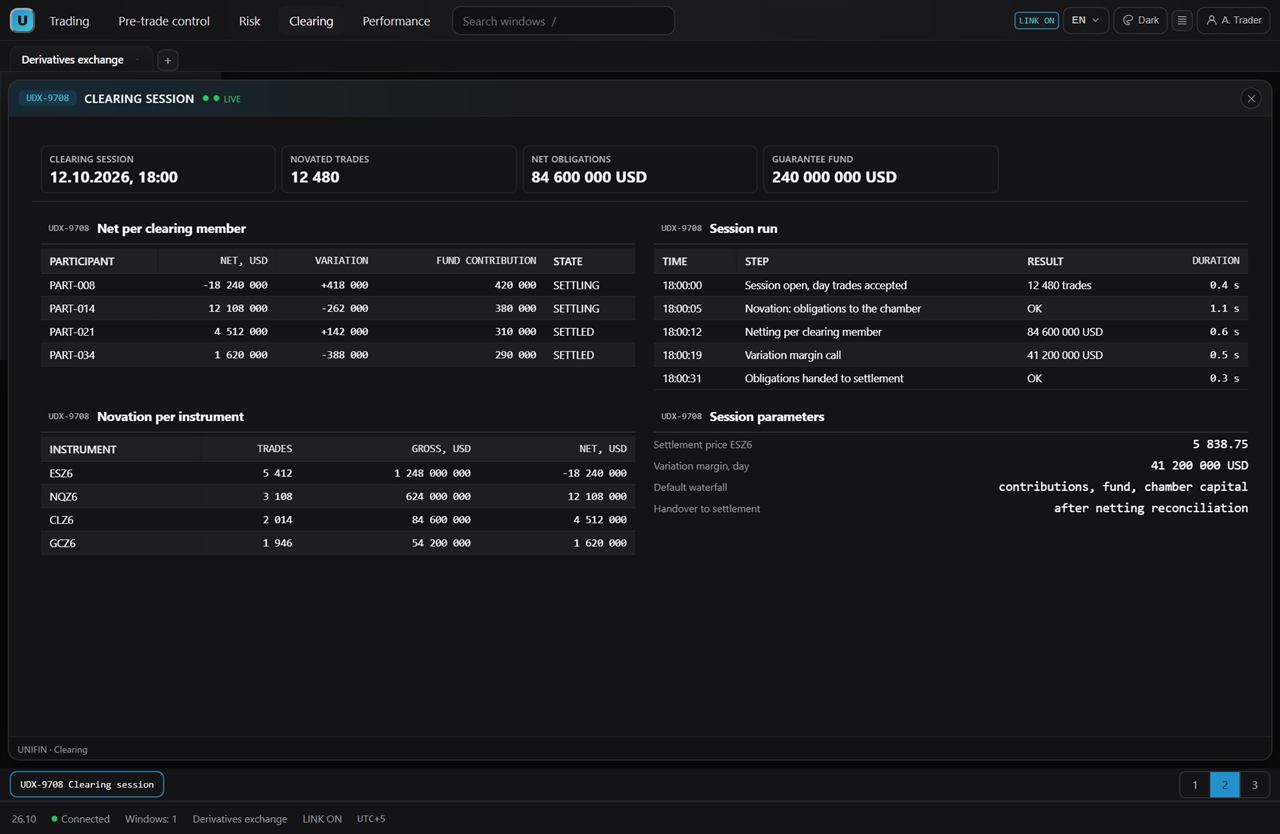
Clearing is usually computed in a nightly batch, and obligations that appear by the morning are already detached from trading. The solution runs novation and multilateral netting in a clearing session on schedule. With the solution obligations and net positions are visible on the same day. In setup the session scope and settlement instructions are visible, and the session schedule comes as reference data.

Delivery and settlement

Delivery and money are usually run between systems by hand, and a contract hangs at the seam. The solution runs delivery to the CSD and the money legs through the bank, returning statuses to the journal. With the solution the contract closes on time, and every settlement seam is visible. In setup instruction statuses and divergences are visible, and the delivery routes come from the setup.

Reporting

Regulator extracts are usually assembled from different tables, and the data diverges from trading. The solution builds the reports from live trade, margin and clearing data. With the solution the regulator gets venue figures, and reviews pass along the journal. In setup the report scope and the dispatch history are visible, and the schedule comes as reference data.

Coverage

What it covers

Trading core: futures and options, the book, risk in the hot path.

Gateway

FIX 4.2/4.4/5.0 for members and API; drop copy for supervision.

Matching engine

The book is sharded; a bounded queue rejects explicitly instead of losing orders.

Pre-trade control

Margin versus collateral checks in the hot path; limits before the book.

Risk and margin

SPAN-style initial margin, daily variation margin, stress scenarios and the margin call lifecycle.

Clearing

Novation, multilateral netting, margin accounts and settlement instructions.

Market data

Quotes, order book snapshots and trades for portals and external subscribers.

Portals

Trader, risk, clearing and administration workplaces on one sign-on.

Stand

Screens of the solution

The trading terminal, the risk monitor, the clearing session, the auction card and the portfolio.

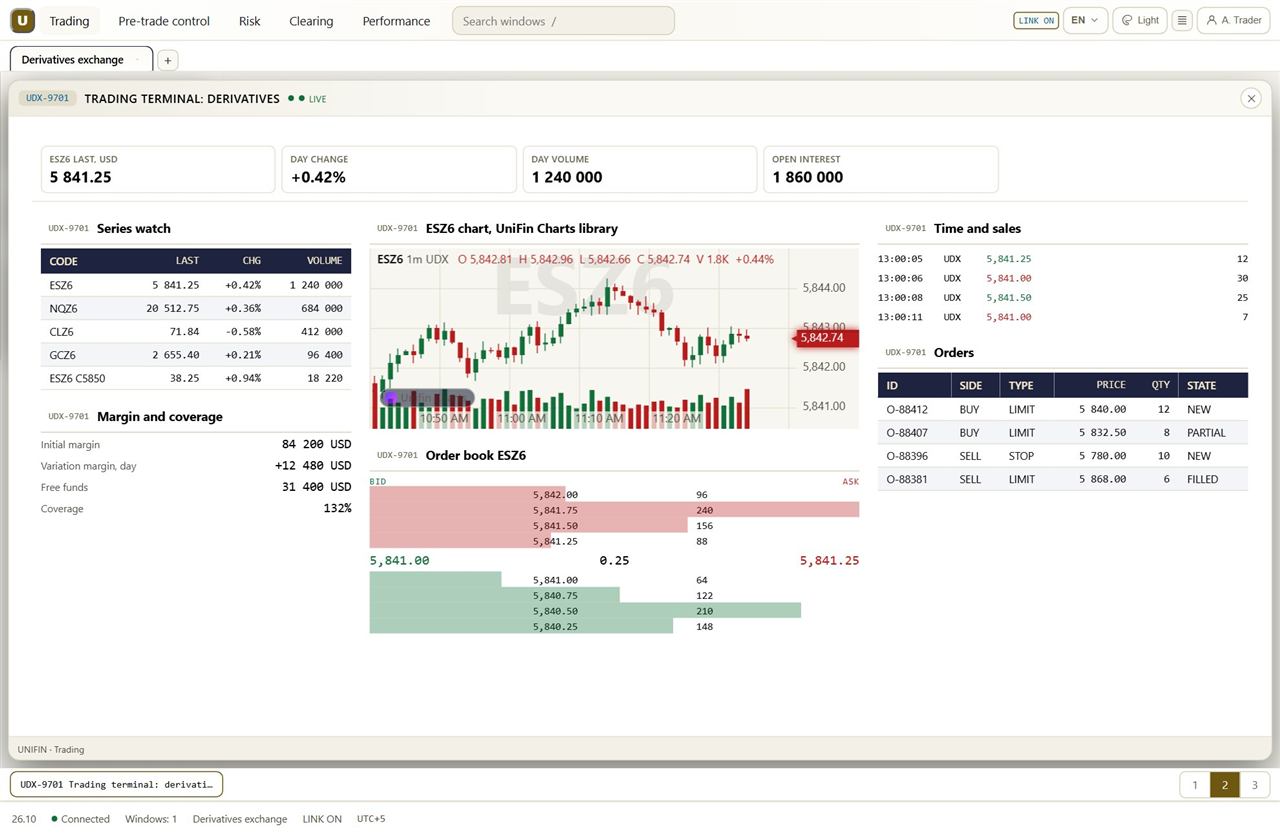
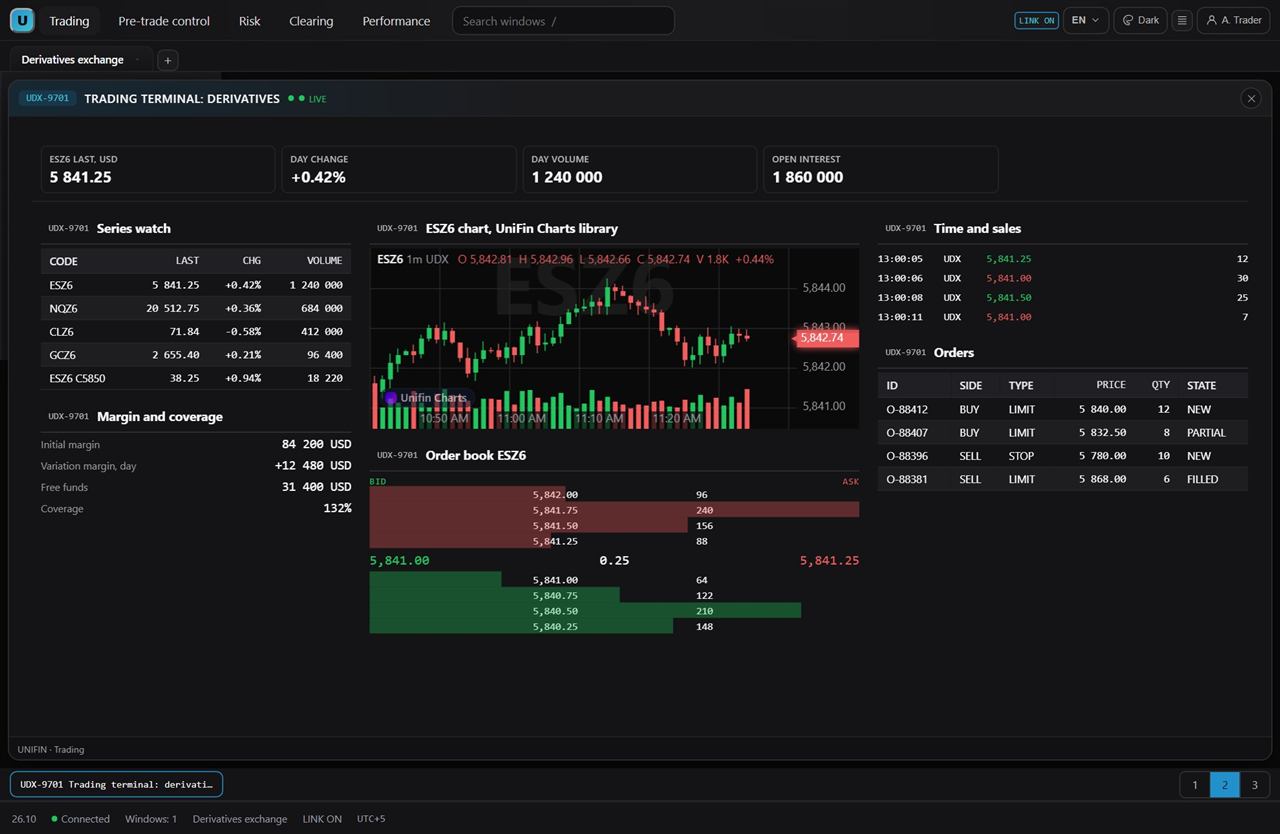
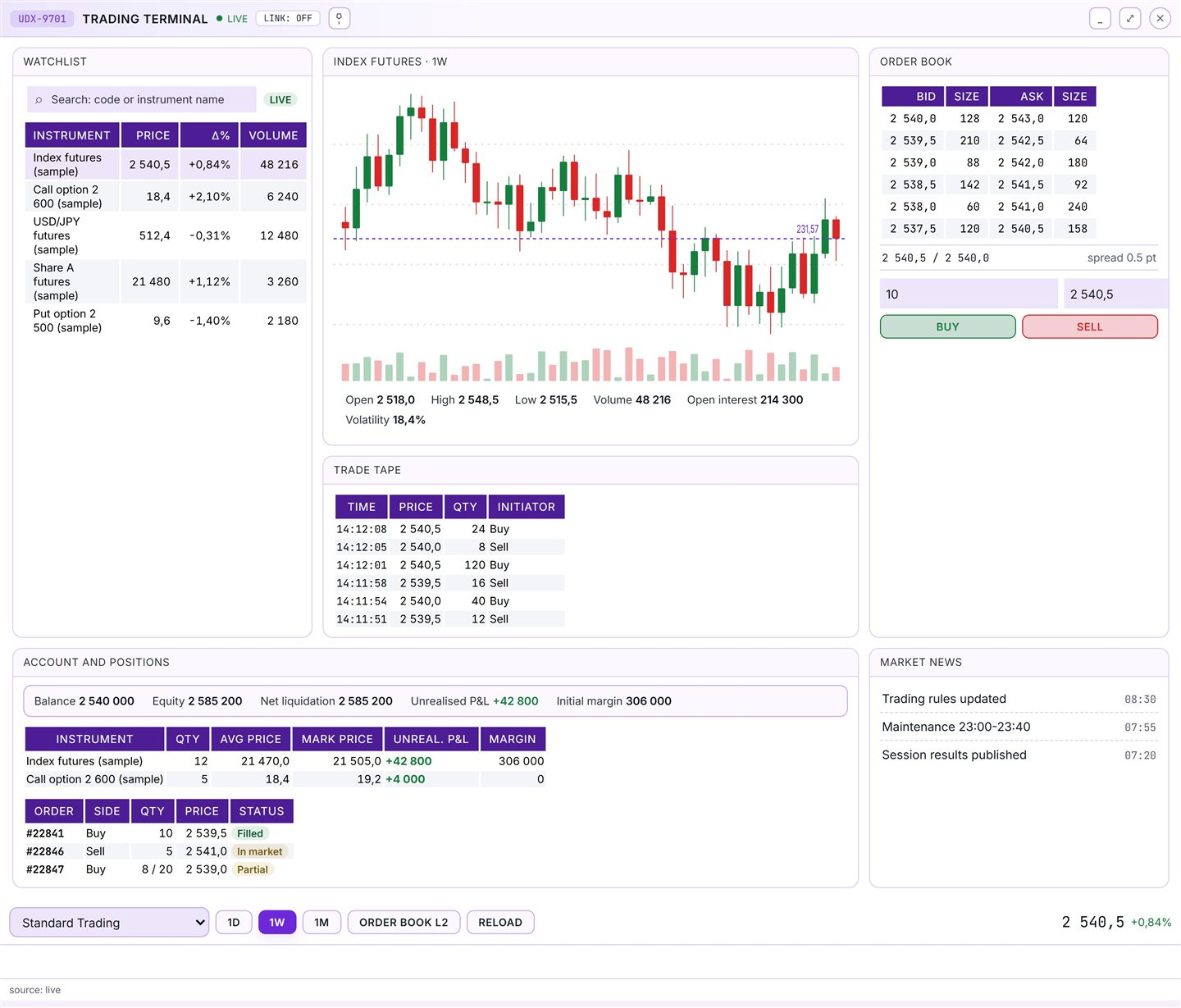
Trading terminal screen with the order book
Trading terminal: watchlist, chart, order book and tape
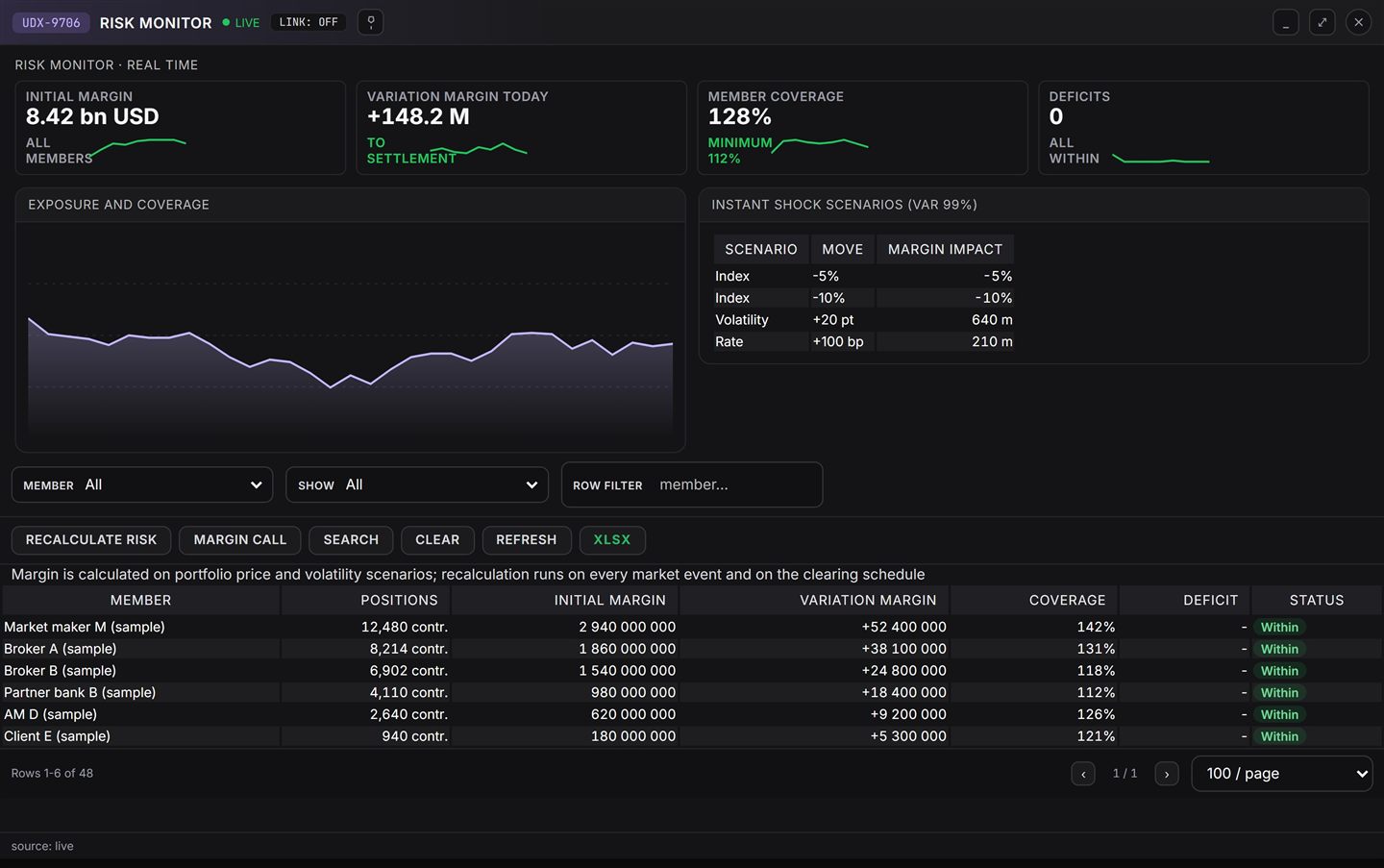
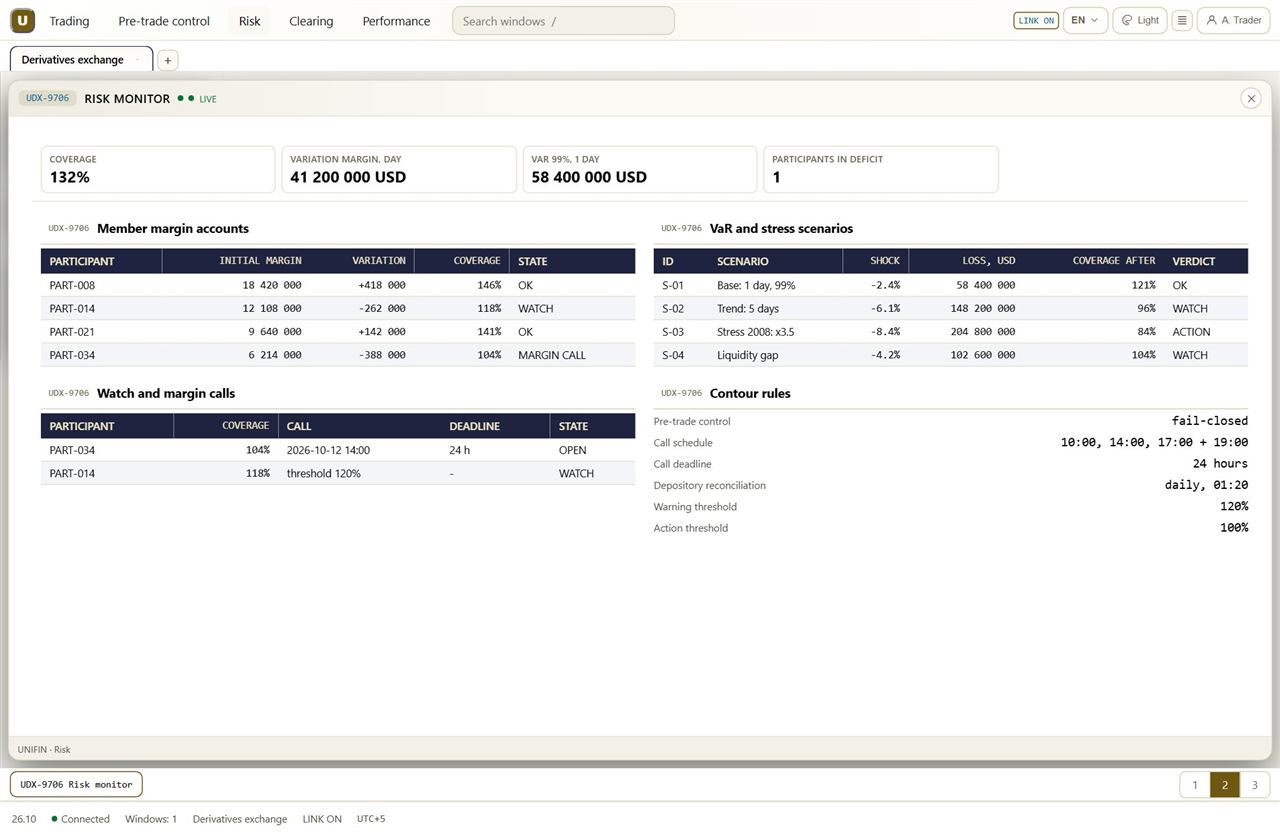
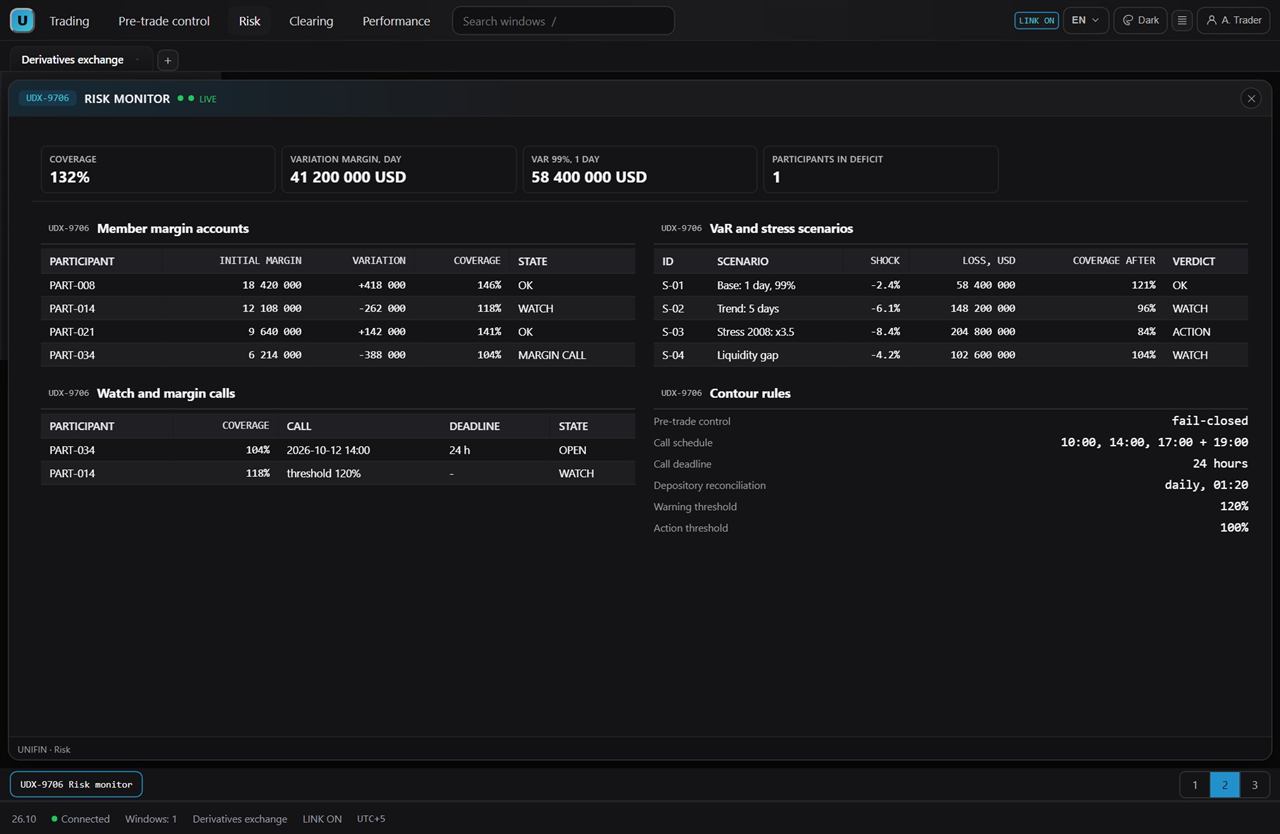
Risk monitor screen with portfolio margin
Risk monitor: portfolio margin and the margin call
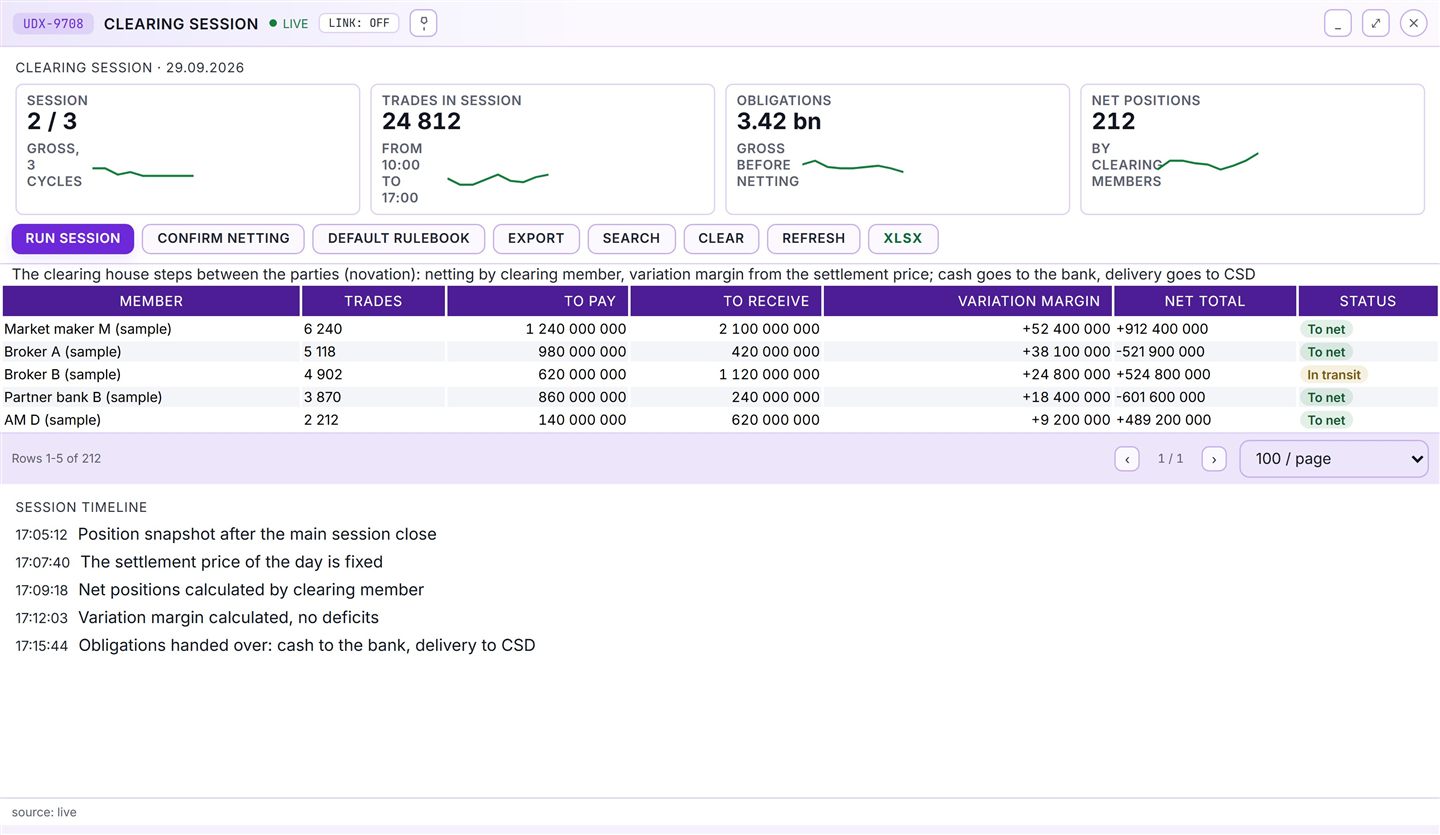
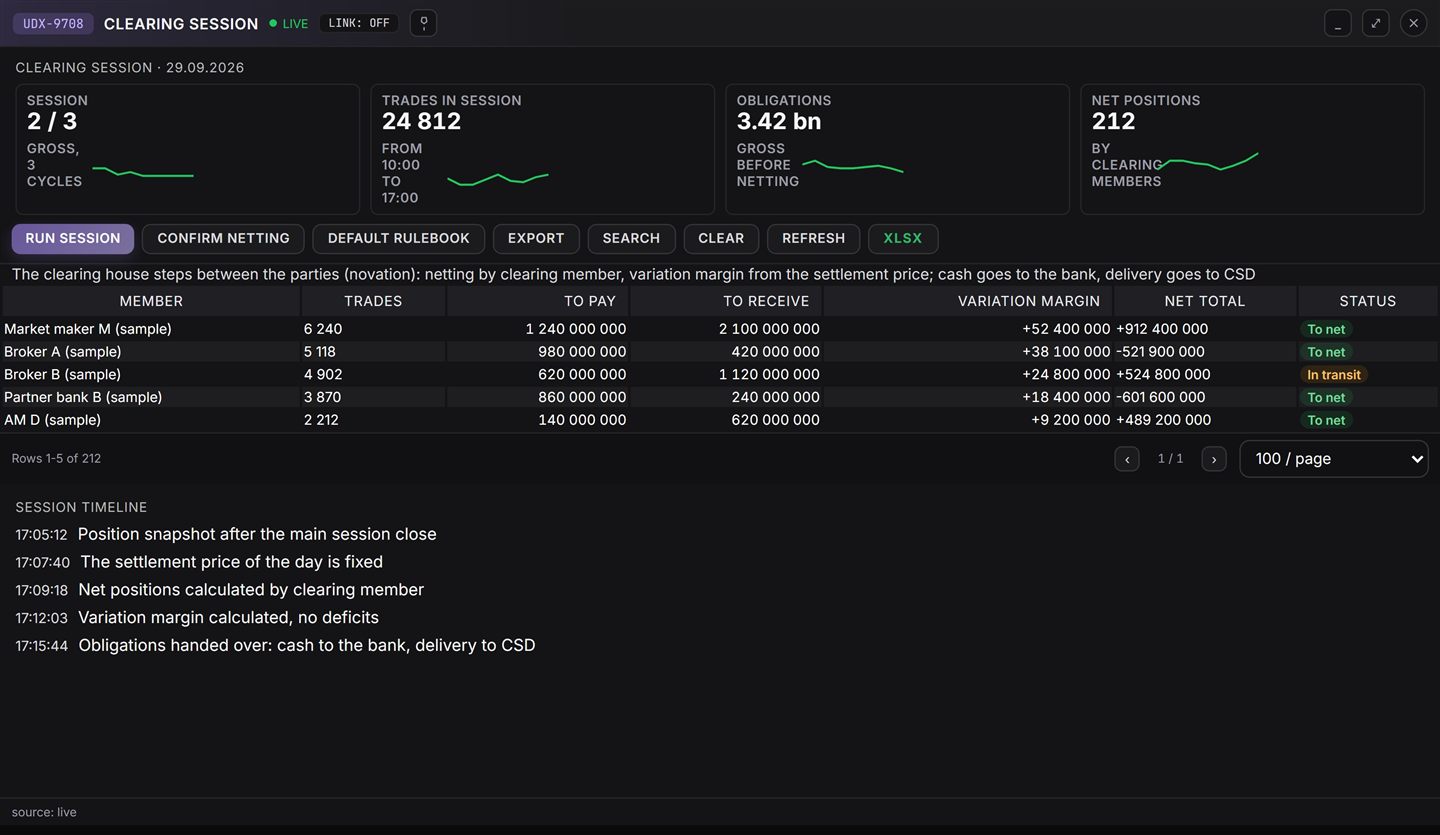
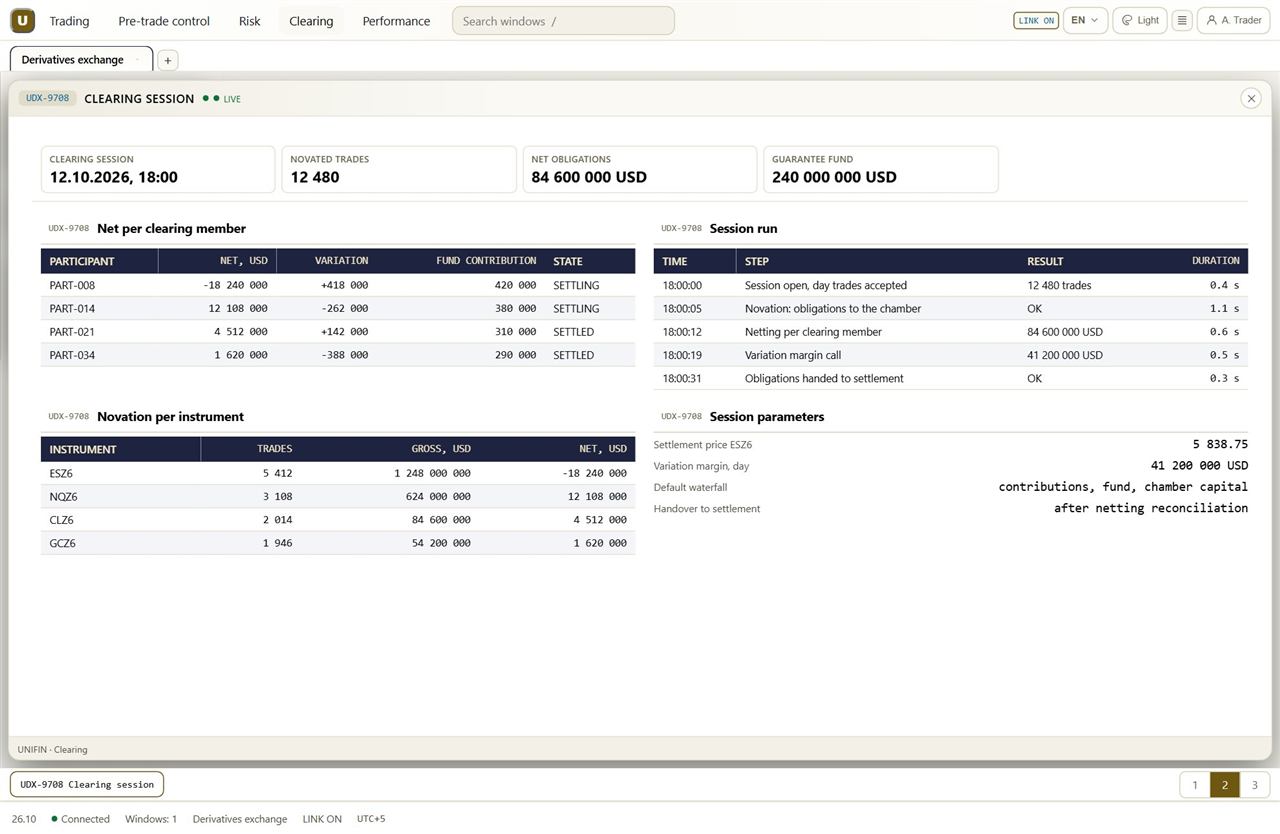
Clearing session screen with netting
Clearing session and netting
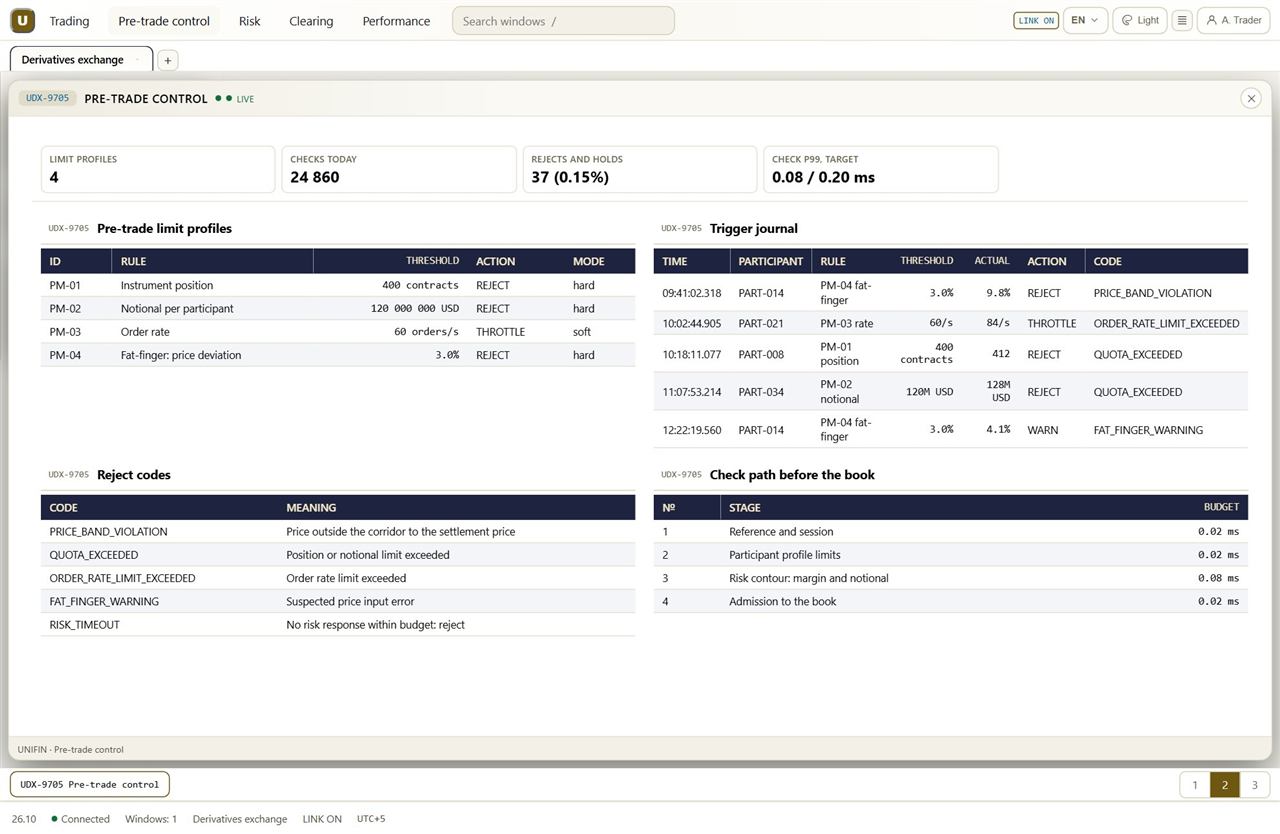
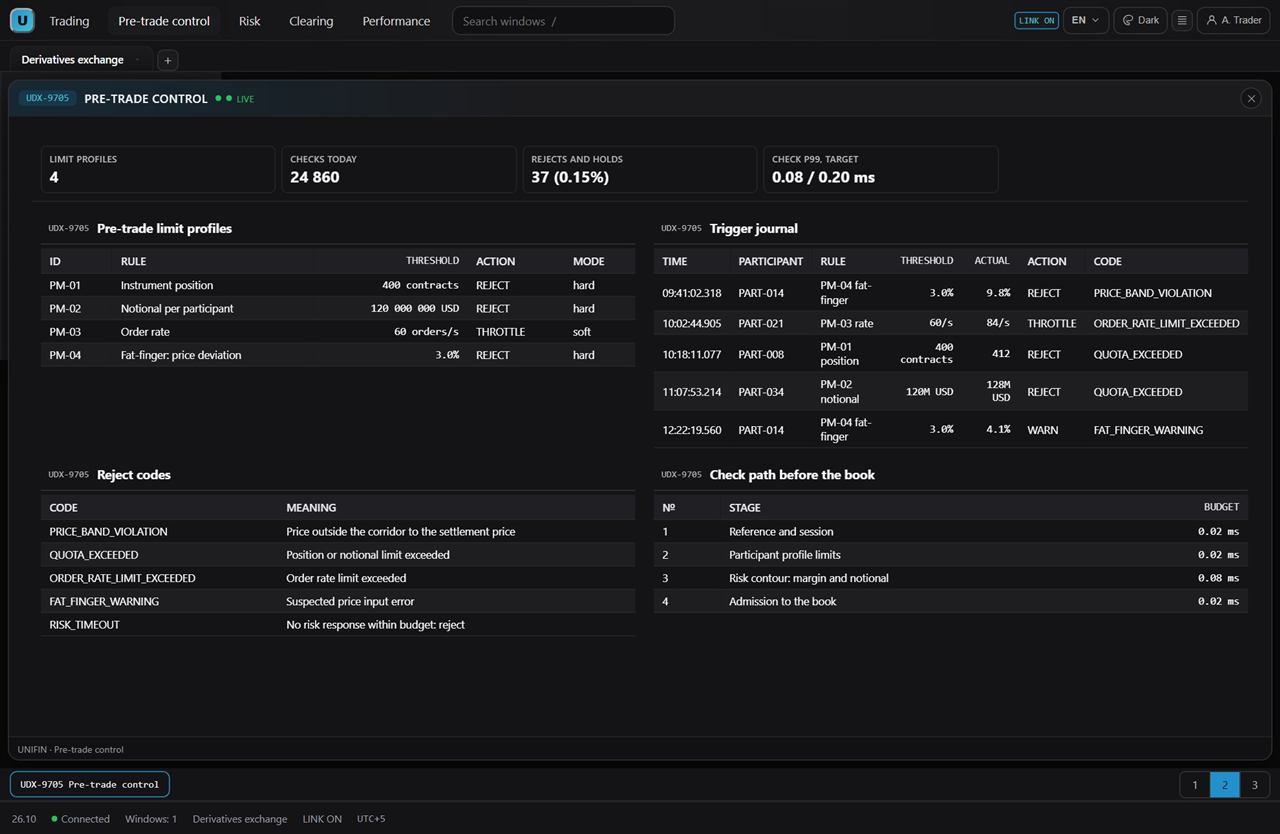
Pre-trade limits screen with a reject
Pre-trade limits and the reject before the book
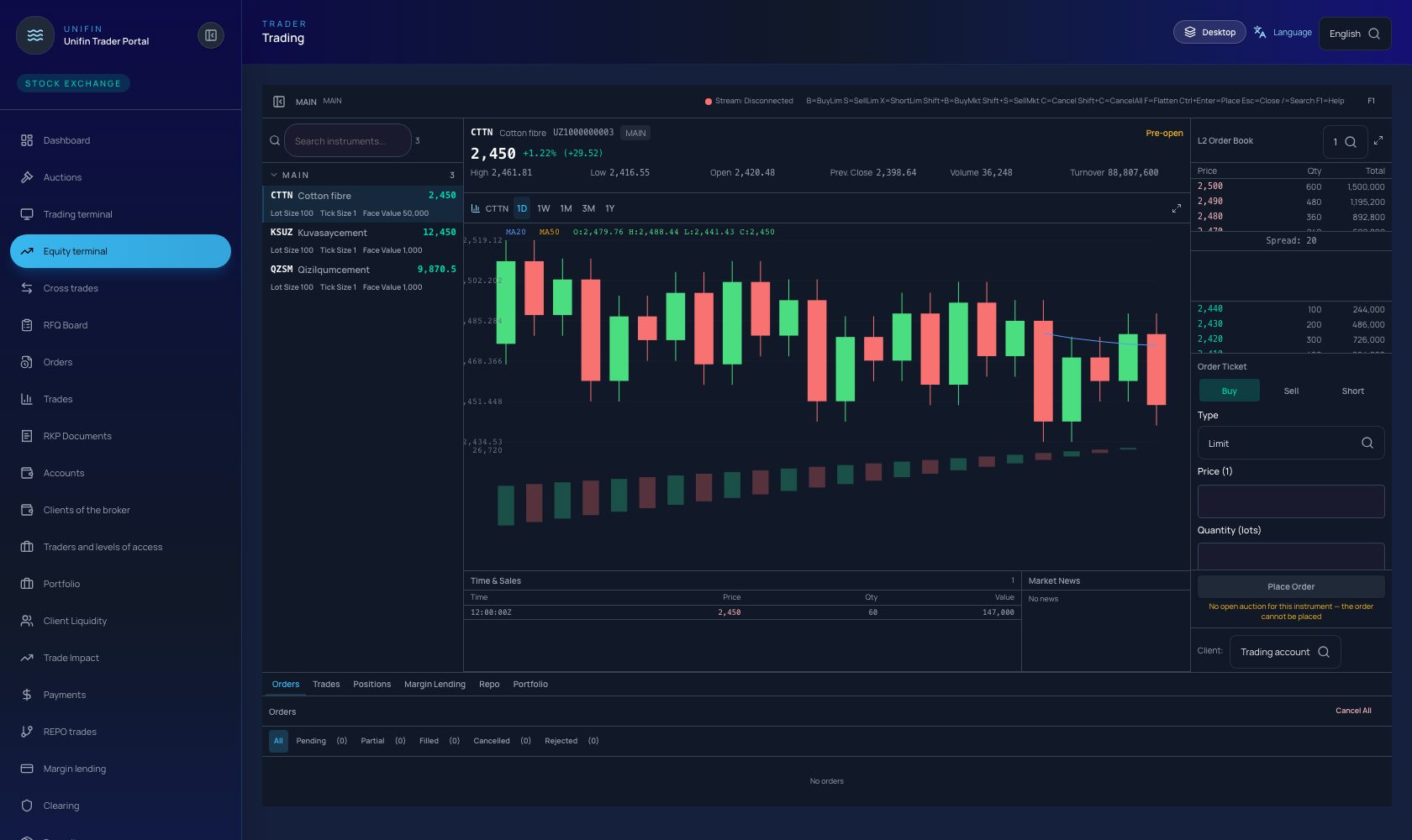
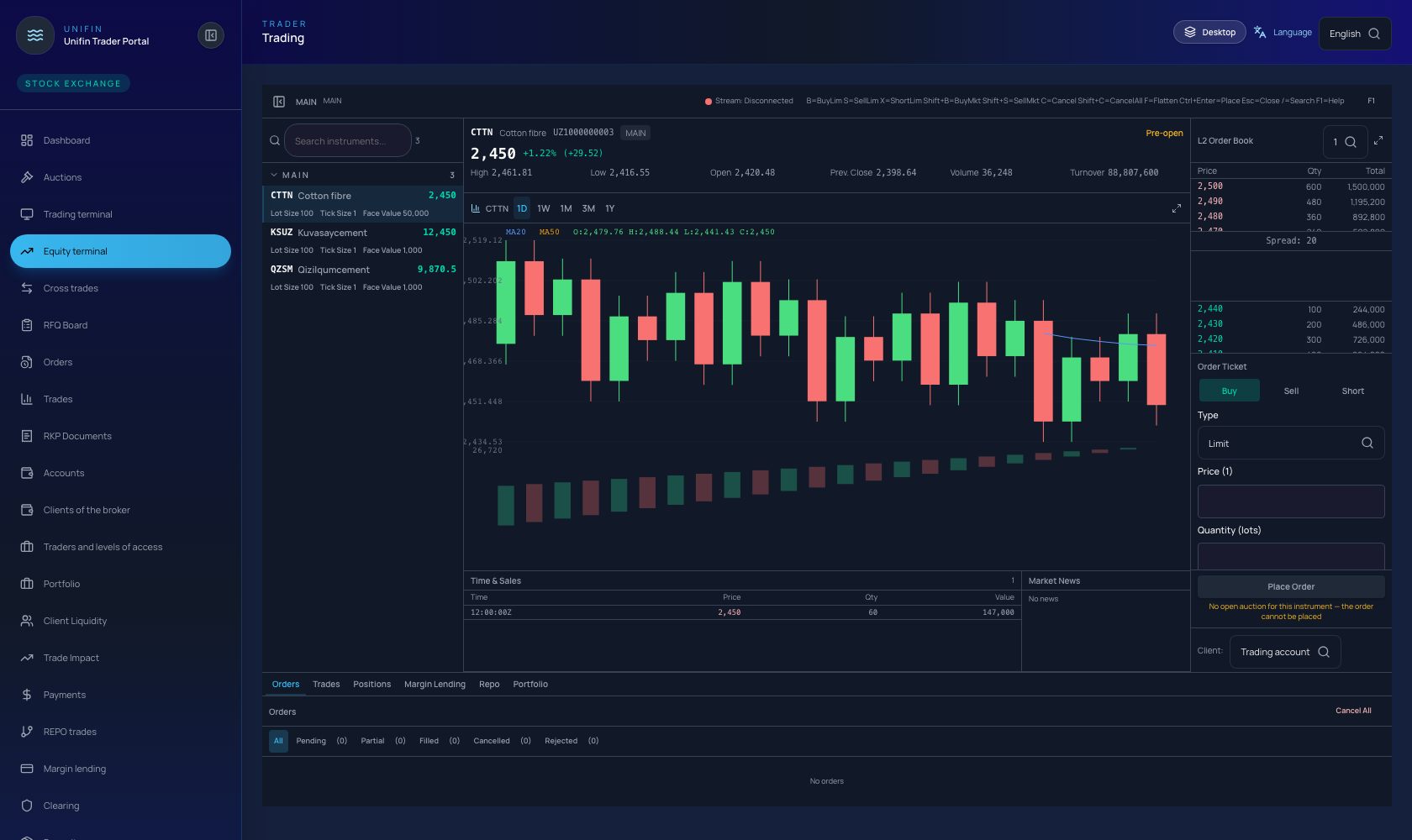
Trader terminal screen of the equity desk with quotes and the order ticket
Trader terminal: the equity desk with quotes and the order ticket
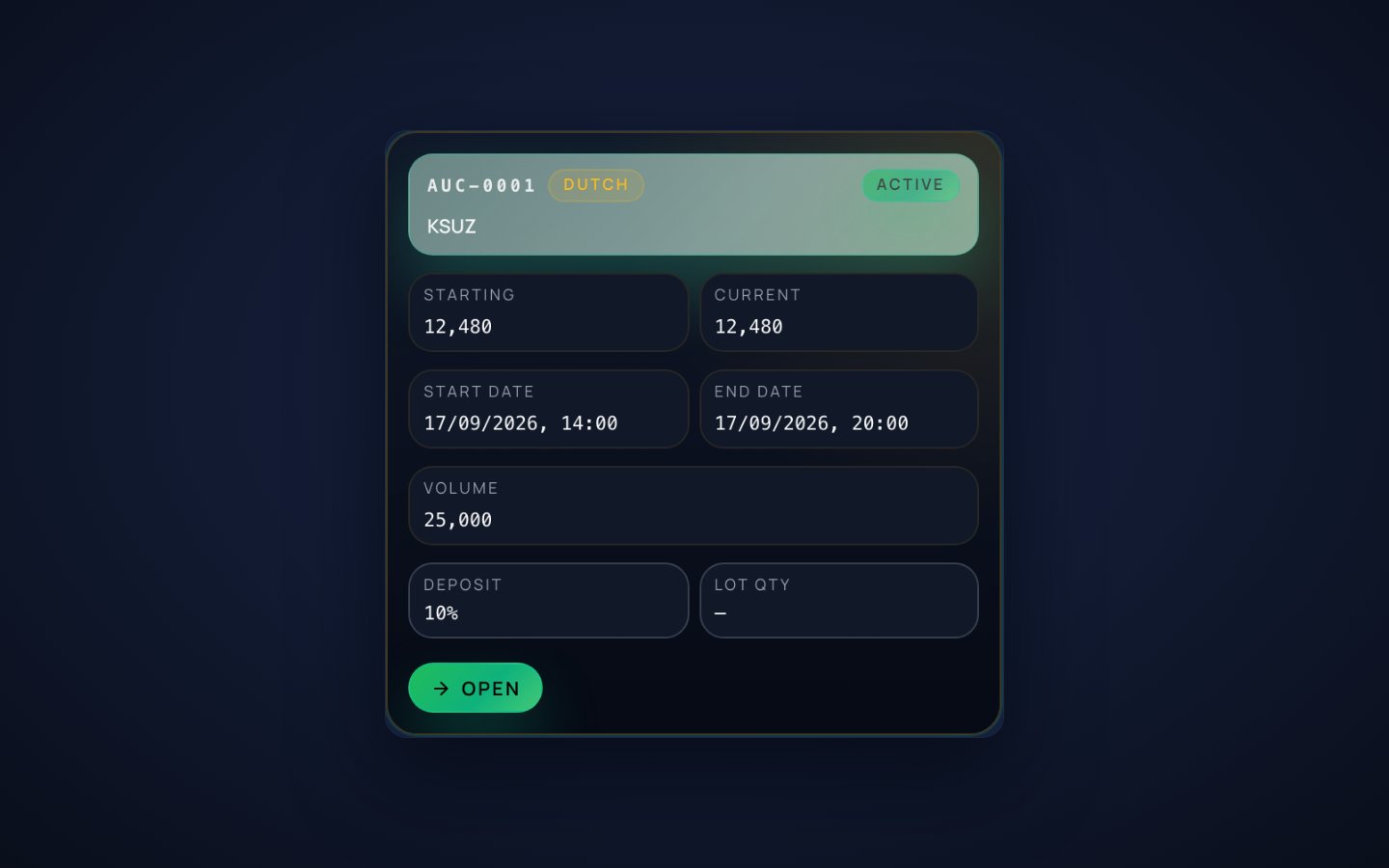
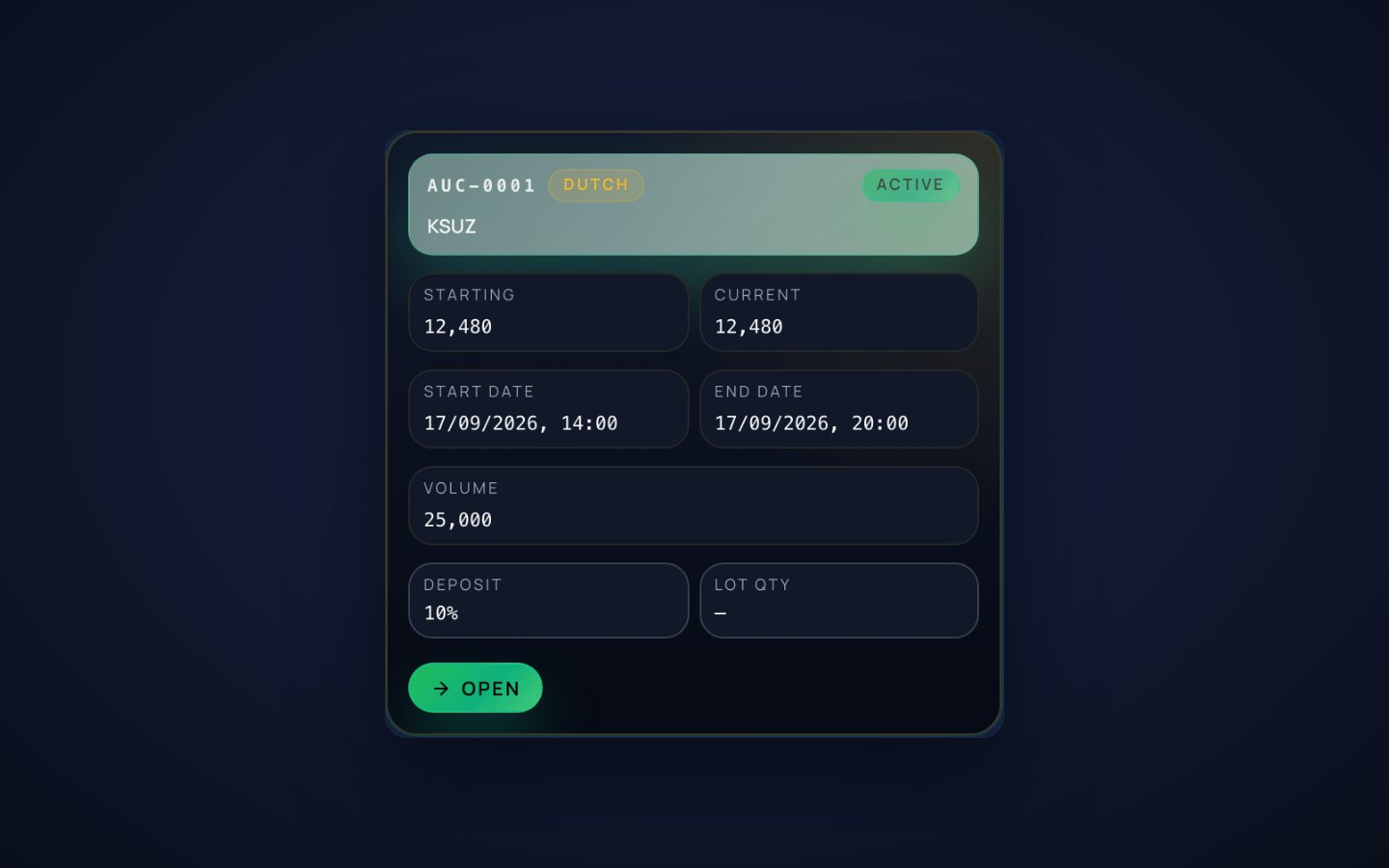
Auction card with lot terms, deposit and the bid window
Auction card: lot terms, deposit and the bid window
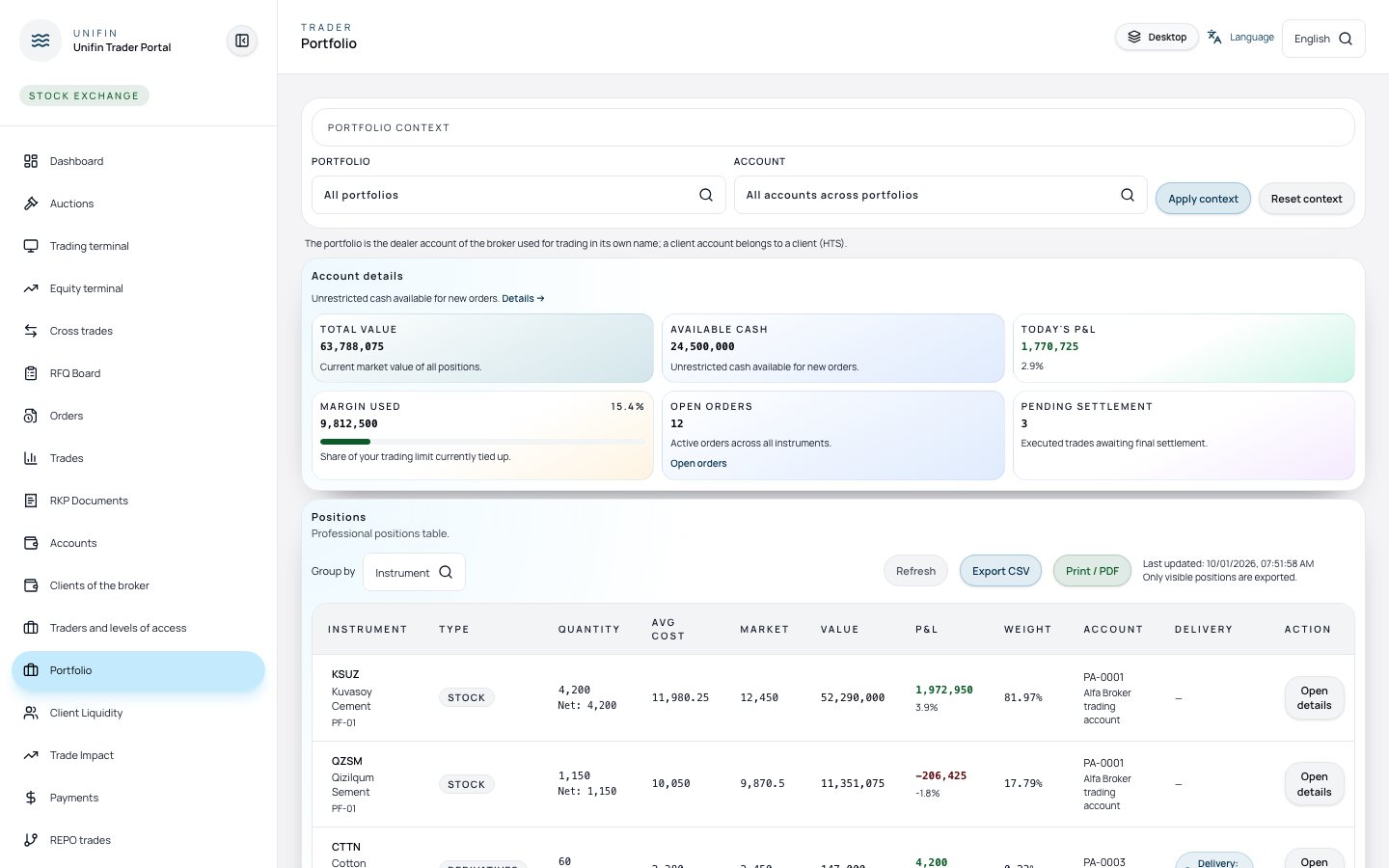
Portfolio screen with risk fields, margin usage and open positions
Portfolio: risk fields, margin usage and open positions
Trading terminal of the derivatives desk with the library chart
Trading terminal: derivatives desk with the library chart, order book and margin
Pre-trade control with limit profiles and the reject journal
Pre-trade control: limit profiles and the reject journal with codes
Risk monitor with member margin accounts and VaR scenarios
Risk monitor: member margin accounts, VaR scenarios and margin calls
Clearing session with novation and netting per member
Clearing session: novation, netting per member and the run of the session
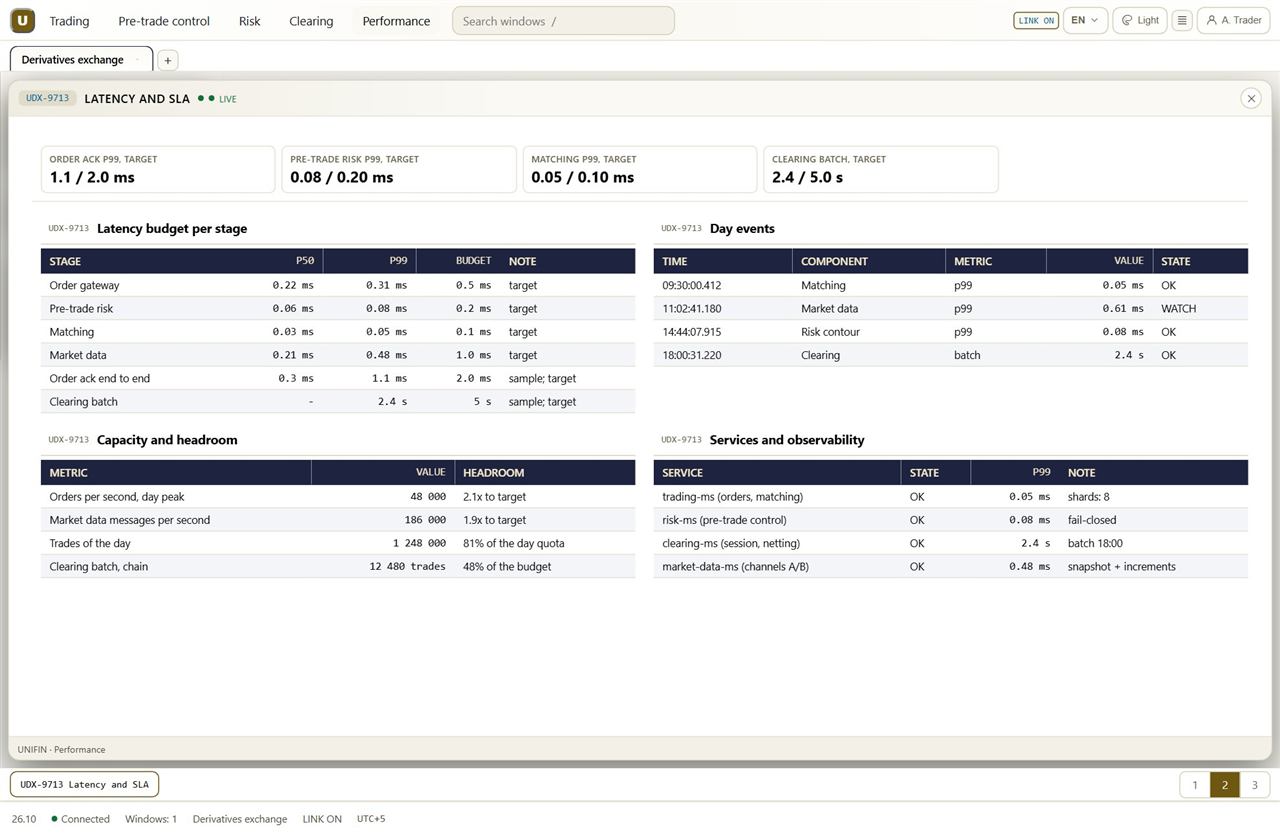
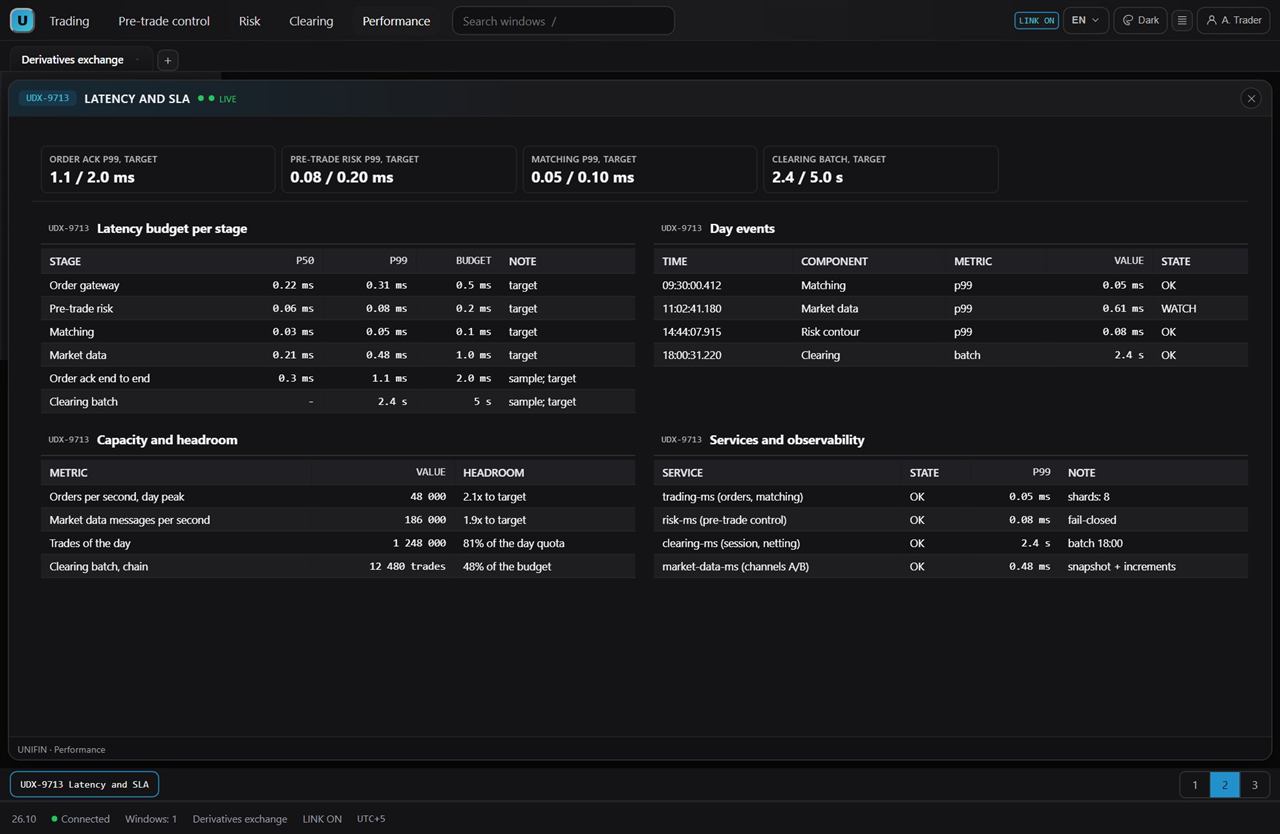
Latency and SLA with the budget per stage and day events
Latency and SLA: budget per stage, day events and capacity headroom

How it works

From the order to the delivery in five steps

The path of the order: gateway, matching, risk, clearing, delivery.

  1. 1

    The order arrives through the FIX gateway

    A member sends the order; the gateway checks the session.

  2. 2

    Pre-trade control runs

    Margin is compared with collateral and limits apply before the book.

  3. 3

    Matching in the sharded book

    Thread per shard keeps the path clean; trades hit the journal.

  4. 4

    Positions and margin recalculate

    Positions and stress scenarios move the margin; deficits start margin calls.

  5. 5

    Clearing, delivery and reports

    The clearing session nets the obligations; delivery goes to the CSD.

Industries

Industries it serves

The system works for derivative venues, their clearing organisations and the members who trade and hedge through them.

Broker / investment firm

Client access and risk control on the same rails as the venue: terminals, mobile and pre-trade limits.

Architecture

Architecture and access

The architecture is built on the services of the solution and keeps the hot path protected.

Service suite

Order gateway, matching with the sharded book, trade journal, risk service, clearing, delivery and portals.

External states stay external

The CSD keeps the assets, the bank moves the money, KYC platforms check the members.

Three zones, active-active

Stateless services run in three zones; storages are reserved active-passive (Patroni, Redis Sentinel, RabbitMQ).

Performance by structure

Revaluation runs by events, heavy calculations move to the night cycle; the shard queue is bounded.

AI layer

The AI layer drafts margin notes and explains risk changes; people approve every step.

Four control points

Pre-trade control, the risk gate, matching and clearing: the order path with a checkpoint at every step.

Control points in action

Price corridor

An order outside the price corridor is declined before the book with the code PRICE_BAND_VIOLATION.

Risk gate

No risk answer within the budget means no order: the risk gate fails closed.

Margin and netting

Coverage of 104% starts a margin call; the clearing session nets member obligations to one amount.

Architecture scheme The same architecture as a standalone page. Open the diagram separately

Performance

Performance on the money path

Microsecond matching core, millisecond order acknowledgment, minute-scale clearing - and a throughput that grows by adding shards, not by re-engineering. Figures below are split into reproducible benchmarks and target profile values for the reference configuration.

2-30 µs per operation
Matching core

benchmark (JMH), in-process

< 20 ms p95 / < 100 ms p99
Order acknowledgment

target profile, end to end

1,000-5,000 orders/s
Sustained throughput

target profile, sharded; scales with the shard count

300-500k trades in minutes (< 3 min)
Clearing batch

design target, parallel netting

Latency budget per stage (target profile)

Order ingress and authorization 1-3 ms < 10 ms single gateway, local token validation
Pre-trade control 1-5 ms < 15 ms in-memory limits, warm caches
Matching core (in-process) 10-20 µs 50-100 µs one single-thread worker per shard
Order ack, end to end 3-8 ms < 20 ms includes the durable journal and the commit
Clearing batch (300-500k trades) - < 3 min parallel netting per member
Market data - parallel path fan-out outside the acknowledgment critical path

Scale axes

Instruments Order books are sharded; shards compute in parallel. A new shard leaves neighbours unchanged; throughput scales with the shard count (reference: about 500 orders/s per shard)
Orders One single-thread worker per shard plus a bounded queue (100,000). Overflow returns an explicit error (backpressure), never a silent loss
Portals Stateless replicas over REST and WebSocket. Horizontal by the replica count
Events Broker with event-id deduplication and a transactional outbox. A replay creates no double effects

Service levels we hold

  • Availability SLO99.95%+ for the money path
  • Storage failoverPostgreSQL <= 30 s, Redis <= 15 s, RabbitMQ quorum <= 30 s (chaos-tested thresholds)
  • Durabilityorders are acknowledged only after a durable commit; events are published via a transactional outbox
  • Degradationexplicit backpressure under overload: no silent loss, no duplicates (idempotent consumers)
  • RPO / RTORPO ~0 for committed money-path data (synchronous replication); DR RTO <= 15 min (runbook; report on request)

World-class matching core (microseconds), solid enterprise-grade end-to-end profile (tens of milliseconds). Scalable to thousands of orders per second per sharded configuration - headroom designed for frontier and regional markets.

Benchmark figures are reproducible (the JMH order book benchmark). Target profile figures are engineering targets for the reference sharded configuration. They are validated in our NFR program (k6 load suites); validation reports are available on request.

Readiness

Ready today, next in line

Runs a futures and options market; the next wave extends the desk.

Ready today

  • FIX gateway and sharded matching with pre-trade control
  • SPAN-style margin and the margin call lifecycle with deadlines
  • Clearing session with novation, netting and settlement instructions
  • Delivery to the CSD and money through the bank

Next in line

  • Calendar spreads and combined instruments
  • Options pricing service for members
  • Additional shard management tooling (roadmap)

Releases

Release history

Quarterly releases from the foundation of the platform (2020); the derivatives suite grows with the venue.

2025 Q4

  • Options suite: series, strikes and expiration in the book.

2026 Q1

  • SPAN-style portfolio margin and the margin call lifecycle.

2026 Q2

  • Clearing session with novation, netting and settlement instructions.

2026 Q3

  • Multi-chart workspace and option widgets for the trading desk.

2026 Q4

  • Pre-trade control journal with reject codes.
  • Latency budgets per stage and scale axes for the matching core.

Detailed description

Detailed description

The module map, the metrics and the delivery frame.

How the suite is assembled

Channels and clients
FIX 4.2 / 4.4 / 5.0, REST with mTLS, SFTP files, web portals
Edge and access
API gateway with 126 routes, Keycloak single sign-on, WAF and CSP
Platform core services
derivatives-ms risk-ms clearing-ms settlement-ms AI agentic layer Services of the suite on the shared platform core
Data and events
PostgreSQL 17 per service, Redis 7, RabbitMQ 3.13 quorum queues, transactional outbox
Results and reporting
Portals, reports, regulator and partner channels

Technology stack

Runtime and backend: Java 21 (LTS), Spring Boot 3.5.16, Spring Cloud 2025.0.3, Gradle, Flyway 10.15.

Data: PostgreSQL 17 per service, Redis 7 with Sentinel, RabbitMQ 3.13 quorum queues, transactional outbox and DLQ replay.

Portals: Next.js 16.3.3, React 19, TypeScript 5; OpenTelemetry 1.31 to Jaeger.

Delivery: Kubernetes and Helm, Vault secrets, Prometheus and Grafana, Docker Compose for pilots.

Visualisation: Apache Superset 4 and ECharts 5 for dashboards and charts, Grafana for operations panels, Mermaid for documentation schemes and the portal diagrams.

Contract lifecycle

  • Futures and options with specifications: underlying, multiplier, tick, expiry, settlement type.
  • Exercise and assignment runs with automatic checks and notifications.
  • Expiry and roll rules: calendar processing without manual runs.
  • Delivery against expiring contracts: the link to the commodity or cash settlement suite.

Risk and margin

  • Pre-trade checks: price bands, position and notional limits, short option floors.
  • Portfolio margin with scenario sets and parameters under committee control.
  • Margin calls with deadlines, partial fulfilments and close-out escalation.
  • Stress scenarios on the clearing house book with member concentration views.

Clearing links

  • Trade registration and netting hand-off to the clearing suite.
  • Funds and default waterfalls: contributions, use and return.
  • Settlement prices formation and publication rules.
  • Member reporting: positions, margin, calls and deliveries on one sheet.

Architecture

  • Built from the platform core: derivatives-ms, risk-ms with portfolio margin, clearing-ms and settlement-ms.
  • The suite works through platform contracts: one register of record, no shadow copies of the data.
  • Scaling adds nodes, not rewrites: stateful services grow with Patroni, RabbitMQ and Redis clusters.

Integrations and access

  • OpenAPI for every service: 978 documented endpoints behind 126 gateway routes, plus webhooks and SFTP where partners need files.
  • Single sign-on: Keycloak 26.1, OIDC and JWT, roles, MFA and API keys with quotas.
  • Evidence by default: the audit journal, idempotency keys on writes and a record for every disclosure.
Detailed description

Leave your contacts to open the detailed description and download the PDF with architecture, cases and delivery details.

Trade a contract on the platform

Pick one contract. We set it up by configuration and show the path from the order to the delivery on a pilot stand.