UNIFINplatform

Solution

Unifin Bank Core

A bank core that opens the books by configuration, not by project.
The general ledger, accounting and treasury run on one governed base.
New services plug in as bricks and the money path keeps its guards.

  • Bank general ledger
  • Dual books
  • Treasury in two modes
All solutions

Live screens from the product terminals

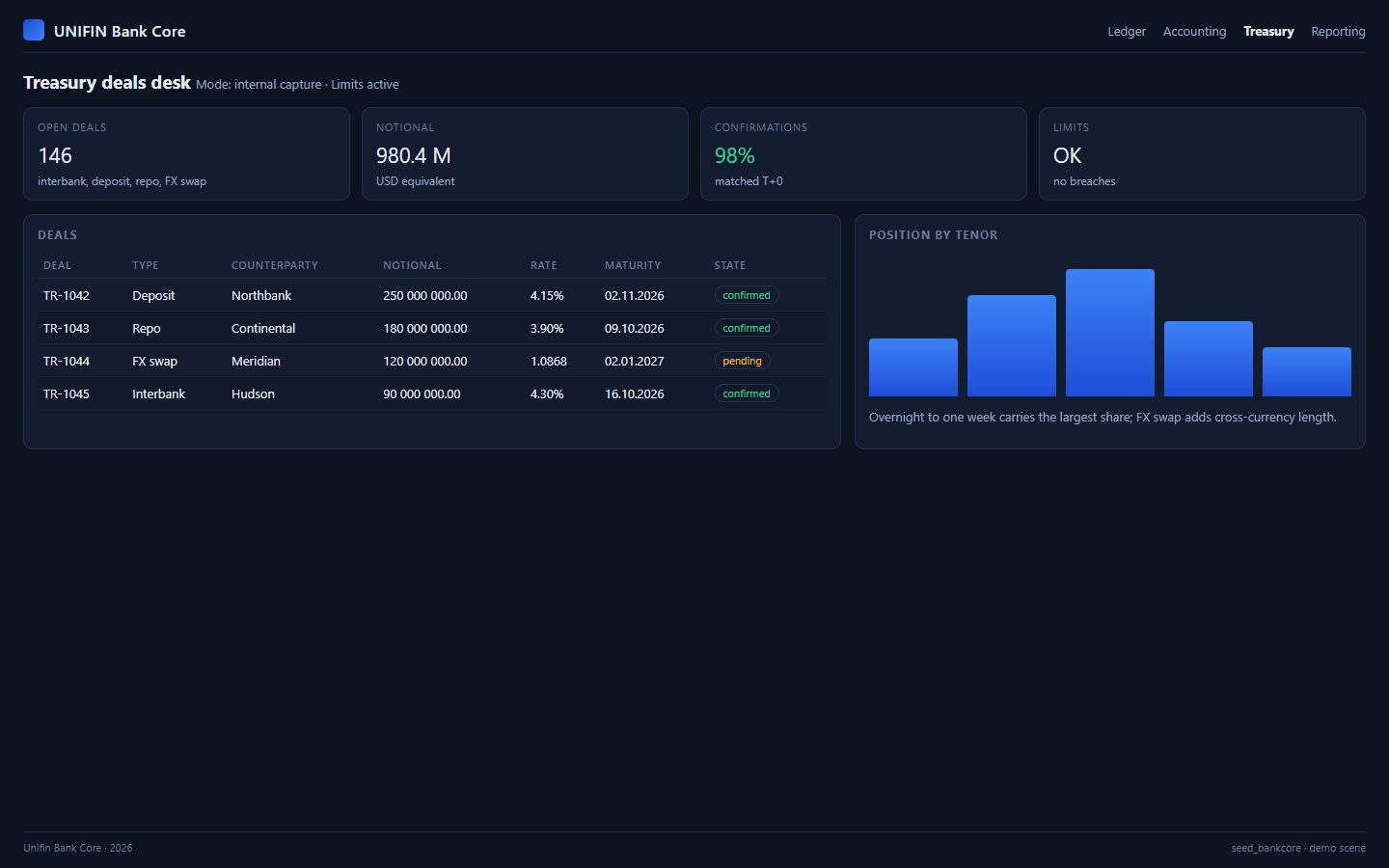
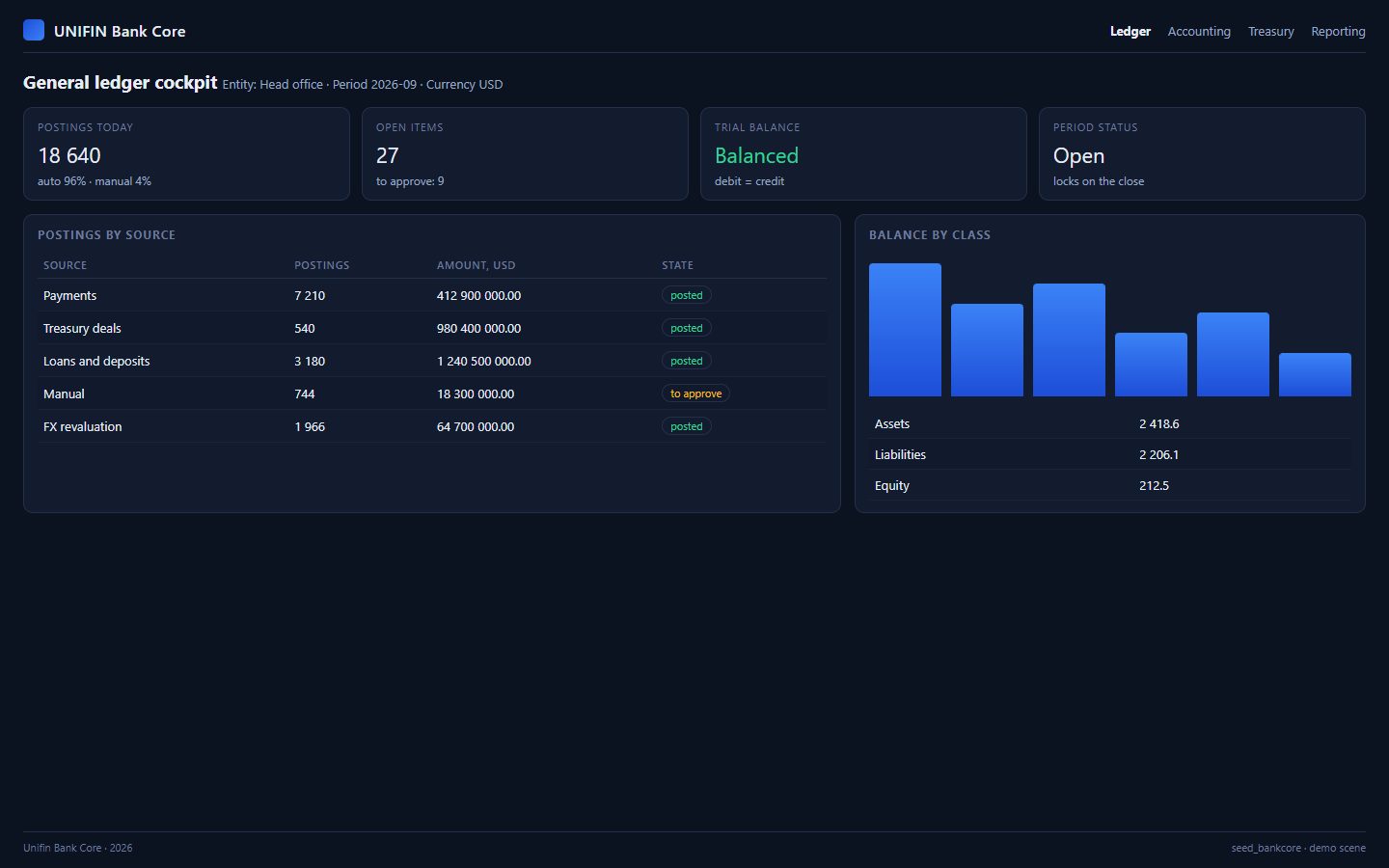
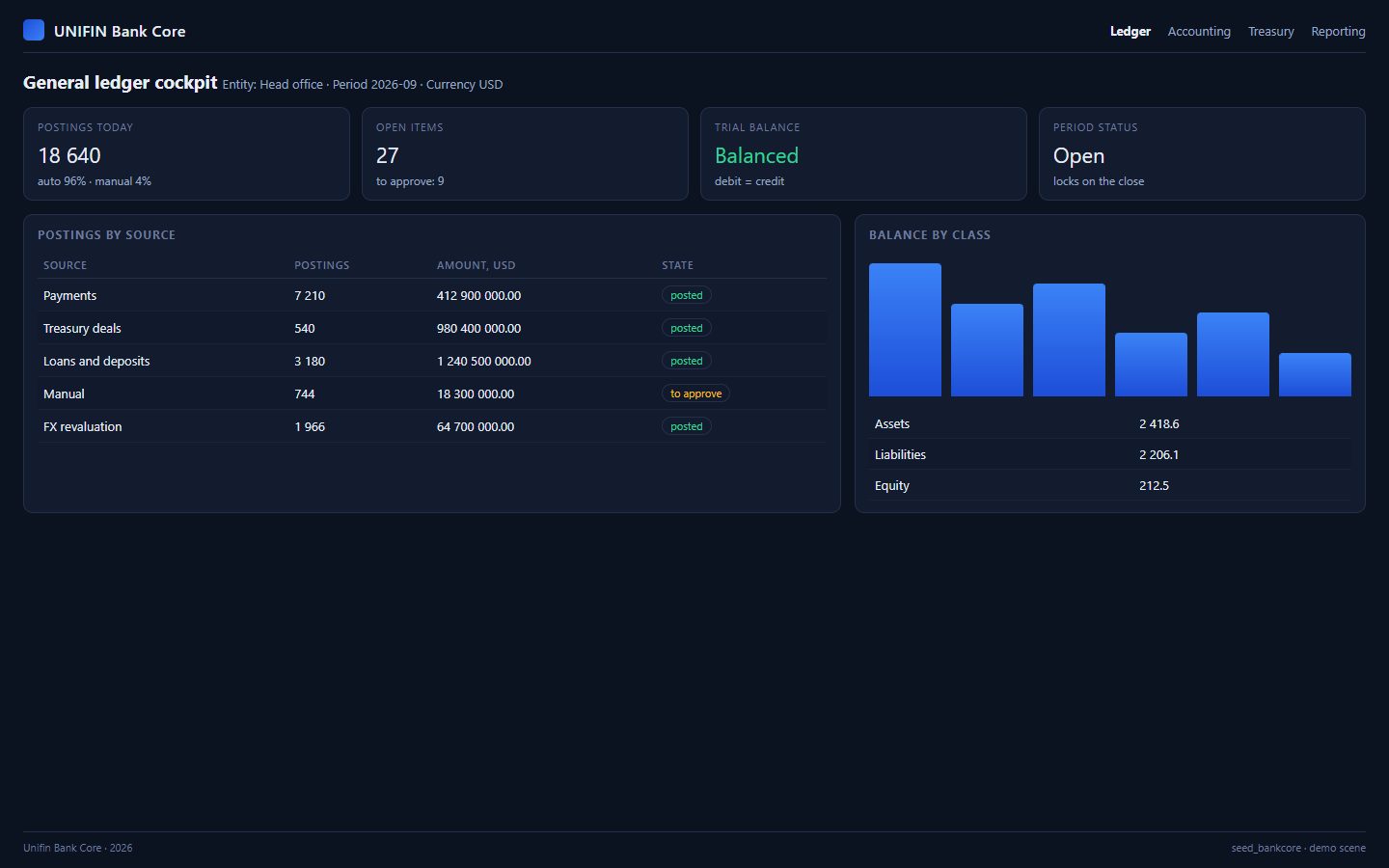
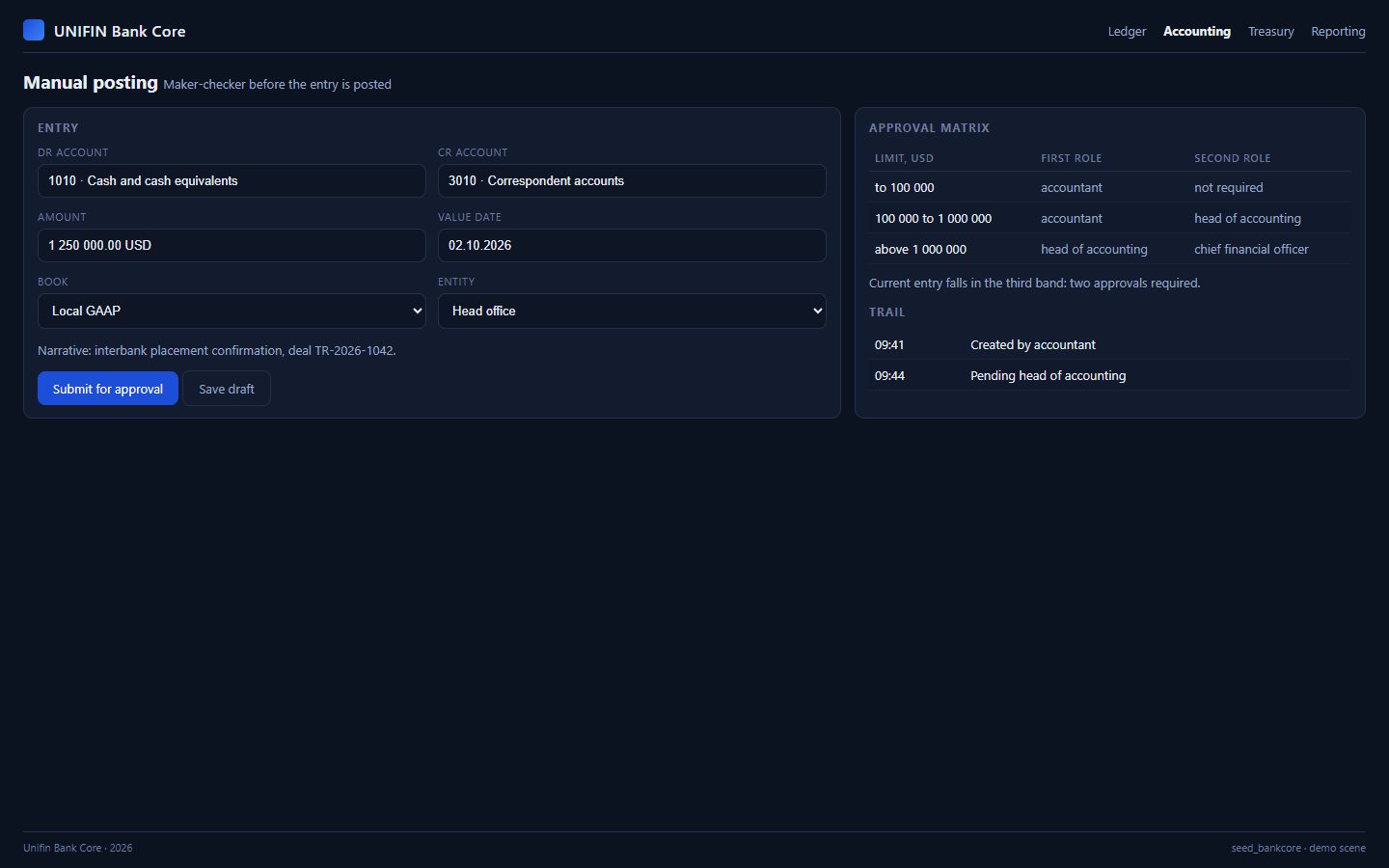
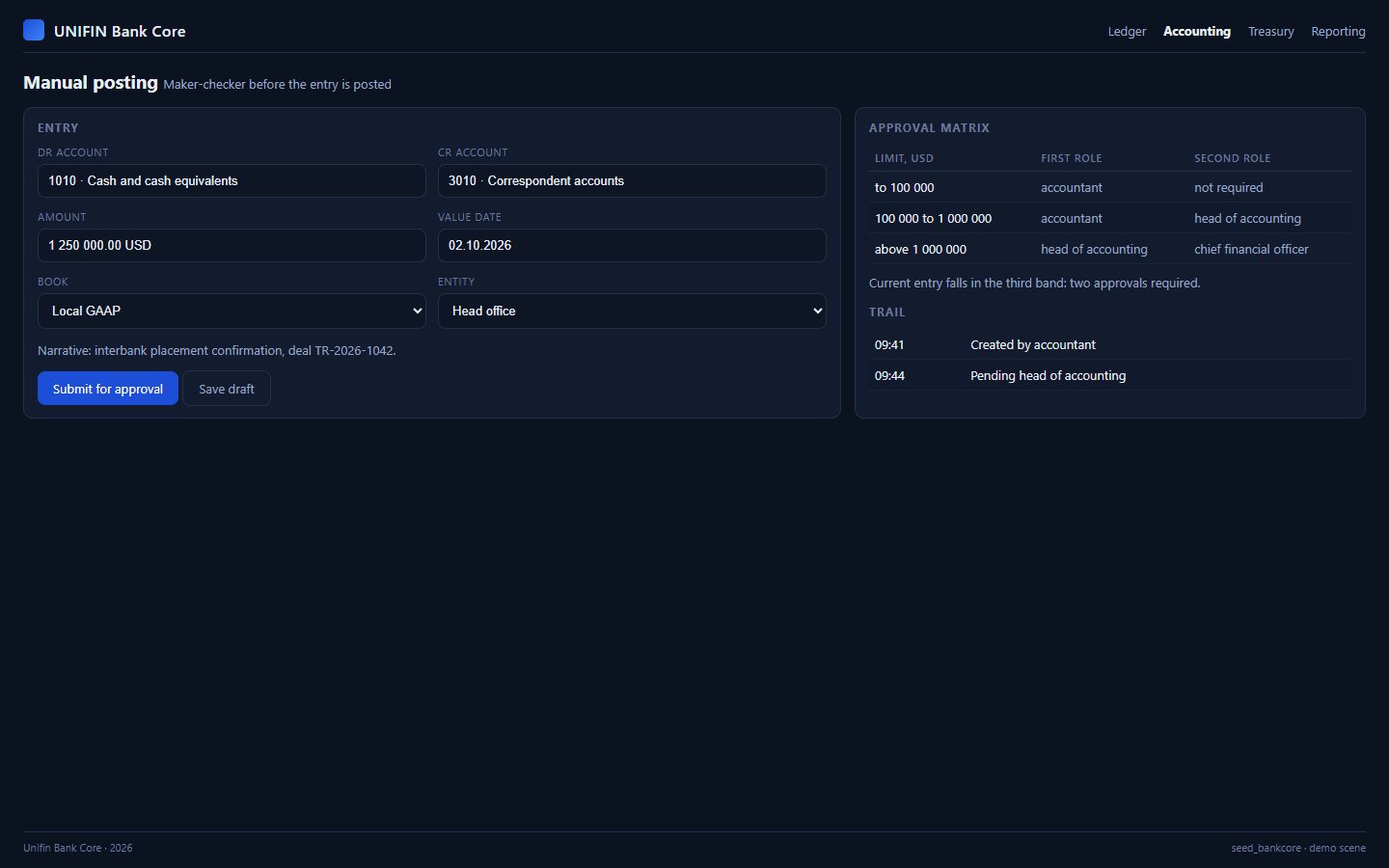
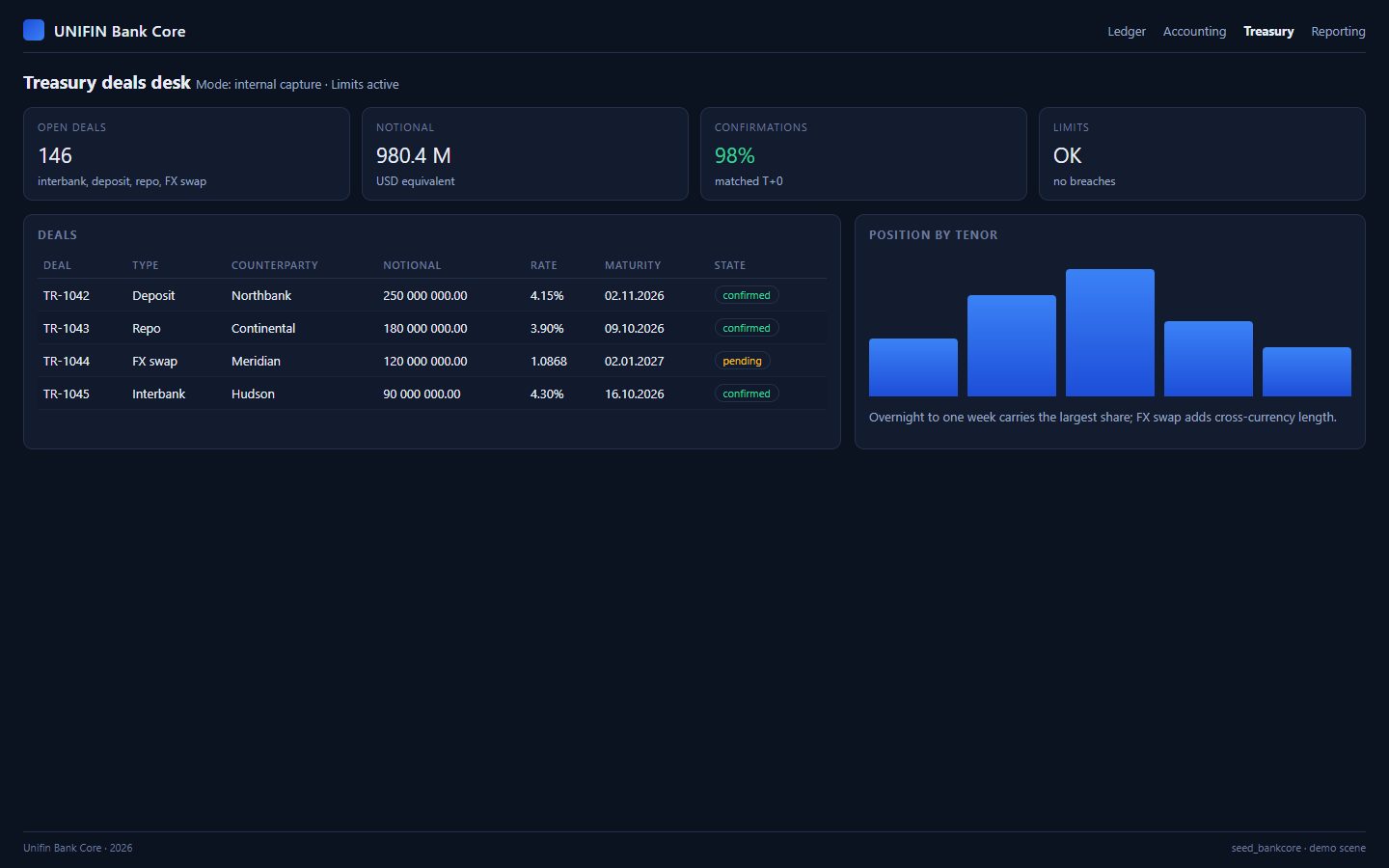
Treasury deals desk Treasury deals desk Ledger cockpit dashboard Ledger cockpit dashboard Manual posting form with the approval matrix
Demo Unifin Bank Core
Ledger cockpit
Ledger cockpit: positions, periods and the posting trail
Ledger cockpit
Ledger cockpit: positions, periods and the posting trail

This is an interface demonstration: the real solution will differ in colours and content for a specific project.

Functions at a glance

Business functions at a glance

From the chart of accounts to the regulator report.

General ledger
Posts double entry with periods and an immutable trail
The books close on time and audit holds
Account registry
Holds the chart of accounts, branches and nostro accounts
One account map for every contour
Dual books
Keeps local GAAP and IFRS in one posting engine
Two statements from one transaction
Product accounting
Values bonds and swaps with EIR and mark to market
Instrument classes plug in as modules
Treasury deals
Captures or imports interbank, deposits, repo and FX swap
One lifecycle whatever feeds the deal
Maker-checker
Applies approval matrices by entity and limit
Every manual posting is approved
Month close
Runs the end-of-day catalogue and period locking
Close is a schedule, not a fire drill
Regulator reporting
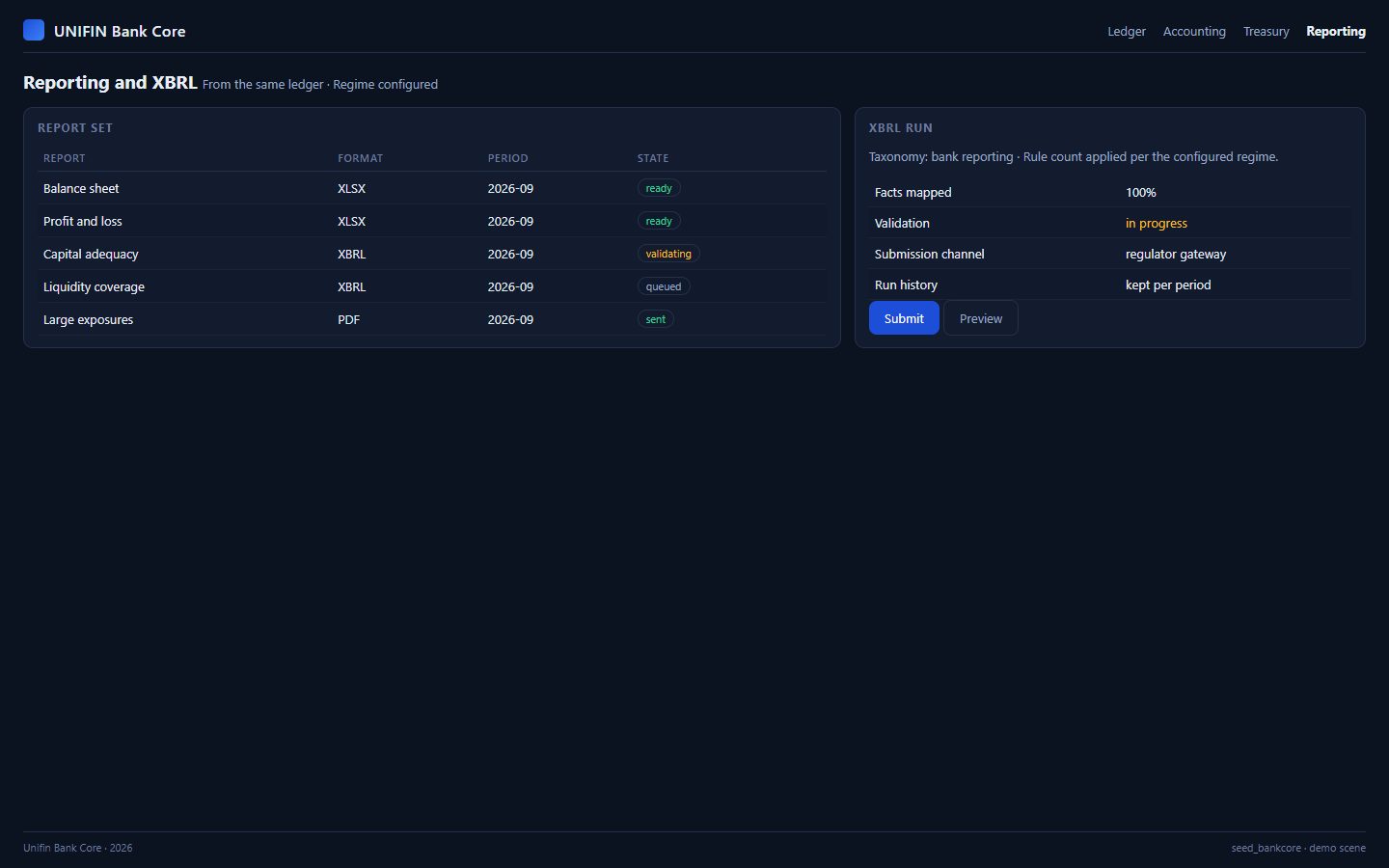
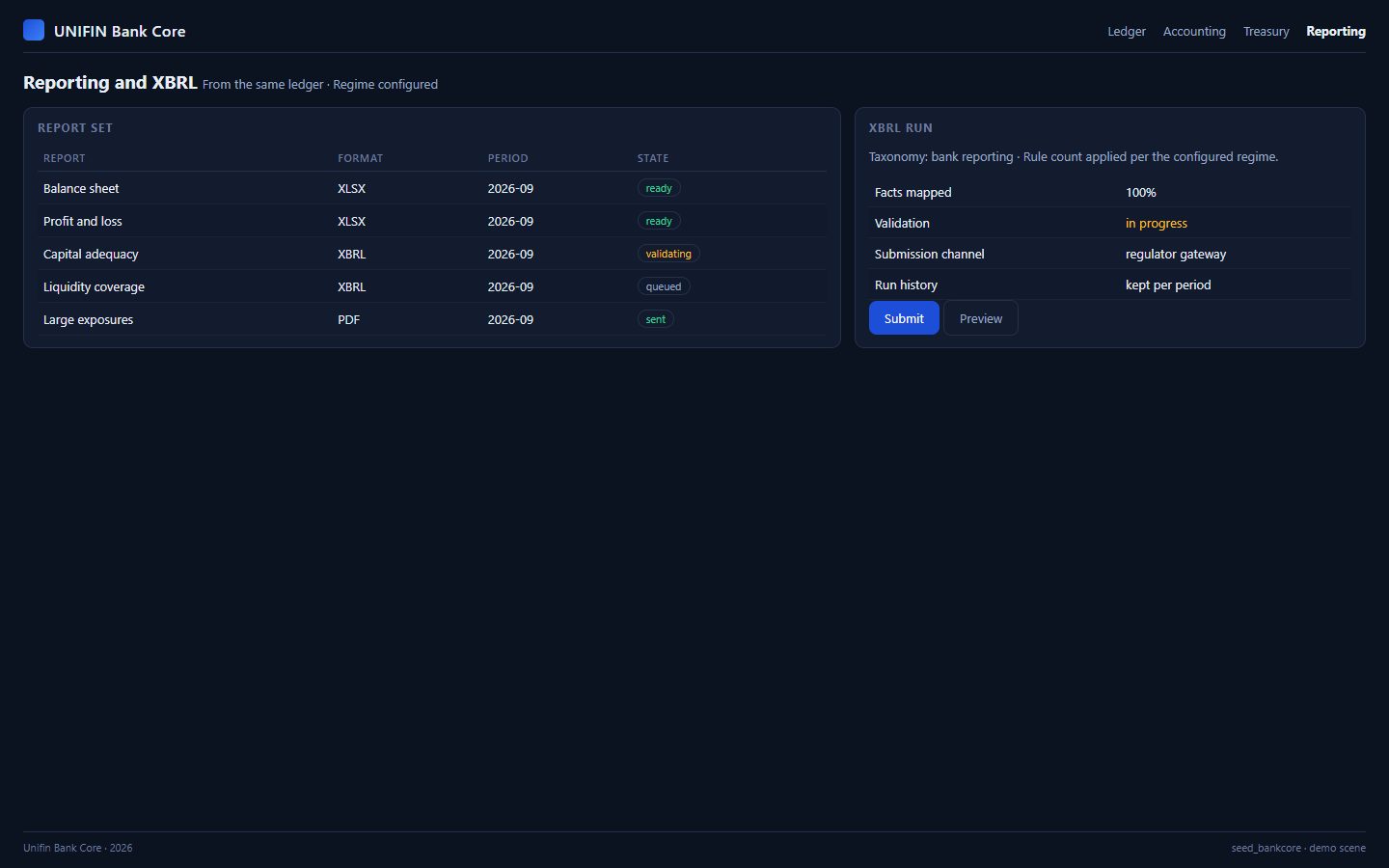
Builds statements and XBRL for the supervisor
Regulator output from the same ledger

What runs today

A bank core that opens by configuration

A bank core that opens by configuration.

Ledger

Double-entry postings, periods and an immutable trail.

Accounting

Policy, dual books, IFRS 9 and product accounting.

Treasury

Interbank, deposits, repo and FX swap in two modes.

Controls

Maker-checker, four eyes and limit approvals.

Reporting

Statements and XBRL from the same ledger.

Platform base

Identity, audit, approval and the event backbone.

Solution description

Capabilities and overview

Key features

  • General ledger with periods and an immutable trail
  • Chart of accounts, branches and correspondent accounts
  • Accounting policy with local GAAP and IFRS books
  • IFRS 9 expected credit loss and IFRS 13 fair value
  • Product accounting for bonds (EIR) and swaps (mark to market)
  • Treasury in capture and import modes
  • Maker-checker approval matrices by entity and limit
  • End-of-day catalogue and period locking
  • Internal sub-ledger reconciliation
  • Regulator statements and XBRL validation
  • Platform services: identity, audit, approval and events
  • New bank services built from the template

Product overview

Unifin Bank Core is the accounting core for banks that need one governed ledger under their own rules.

It joins a general ledger, an accounting policy with dual books and a treasury contour on one platform base.

The three new bank services, the ledger, accounting and treasury, are built fresh from the service template.

Platform capabilities such as identity, audit, approval and events are reused, so the bank does not rebuild its base.

The result is a bank core that opens by configuration and grows service by service.

What it delivers

What the bank core delivers

One ledger for postings, policy and treasury.

General ledger

Banks often keep the general ledger in a system that cannot change without a project. The core posts double entry with periods, batch and an immutable trail. With the solution the books close on time and audit holds end to end. In setup the chart of accounts and the posting rules are visible, and the account map comes as reference data.

Dual books

Local GAAP and IFRS are usually reconciled by hand at close. The core keeps both books in one posting engine with transformation. With the solution two statements come from one transaction. In setup the policy, the mappings and the transformation rules are visible, and the books are configured per entity.

Product accounting

Bonds and swaps are usually valued in separate spreadsheets. The core values them with effective interest and mark to market. With the solution an instrument class plugs in as a module on the same ledger. In setup the valuation rules and the schedules are visible, and the curves come from the platform.

Treasury deals

Treasury often runs on a front office the bank cannot replace. The core captures deals itself or imports them from an external front office. With the solution the lifecycle, confirmations and positions are the same in both modes. In setup the mode, the deal types and the limits are visible, and the counterparties come as reference data.

Maker-checker

Manual postings usually pass with no second pair of eyes. The core applies approval matrices by entity and limit. With the solution every manual posting is approved and traced. In setup the matrices, the roles and the four-eyes thresholds are visible, and the roles follow the platform canon.

Month close

Closing the month usually becomes a fire drill across teams. The core runs the end-of-day catalogue and locks the period. With the solution the close follows a schedule and a checklist. In setup the close tasks, the owners and the deadlines are visible, and the calendar comes from the day schedule.

Regulator reporting

Regulator reports are usually assembled from extracts that disagree. The core builds the statements and XBRL from the same ledger. With the solution the regulator output comes from one source of truth. In setup the report set, the templates and the validation rules are visible, and the taxonomy is configured per regime.

Coverage

What it covers

Three new bank services on the platform base.

General ledger

Chart of accounts, postings, batch, periods and the immutable trail.

Accounting

Policy, dual books, IFRS 9 and IFRS 13, product accounting and reconciliation.

Treasury

Interbank, deposits, repo and FX swap in capture and import modes.

Controls

Maker-checker, limit approvals and the action audit.

Reporting

Statements, regulatory forms and XBRL validation and submission.

Platform base

Identity, audit, approval, day schedule and the event backbone.

Stand

Screens of the solution

The ledger cockpit, the period close and the treasury deals desk.

Ledger cockpit dashboard
Ledger cockpit: positions, periods and the posting trail
Manual posting form with the approval matrix
Manual posting: maker-checker and the approval matrix
Treasury deals desk
Treasury deals desk: interbank, deposits, repo and FX swap
Reporting workspace with XBRL submission
Reporting: statements and XBRL submission to the regulator

How it works

From a posting to the regulator report in five steps

From a posting to the regulator report.

  1. 1

    The posting is made

    Automatic or manual double entry with a source.

  2. 2

    Approval is applied

    Maker-checker runs by entity and limit.

  3. 3

    Both books are kept

    Local GAAP and IFRS transform from one entry.

  4. 4

    The period is closed

    The end-of-day catalogue runs and locks the period.

  5. 5

    Reporting is built

    Statements and XBRL come from the same ledger.

Industries

Industries it serves

The bank core serves commercial banks, central banks and financial institutions that need one governed ledger and their own reporting.

Bank / payments

Settlement, payments and custody services for the market around the trading core.

CSD / depository

Custody, corporate actions and settlement discipline for classic and digital assets.

Architecture

Architecture and access

The bank core stands on the common platform base and keeps new services pluggable from the template.

On the platform base

Shared identity, audit, approval, day schedule and events.

Three new services

The ledger, accounting and treasury are built from the template.

Reuse by reference

Platform services are rebuilt fresh from contracts, not forked.

Fail-closed money path

Postings run under guards and the money invariants.

AI layer

The assistant explains breaks and drafts report notes under review.

Architecture scheme The same architecture as a standalone page. Open the diagram separately

Readiness

Ready today, next in line

The core design is fixed; build runs in waves.

Ready today

  • The service inventory and the service template base
  • General ledger, accounting and treasury service design
  • Dual books, product accounting and the close catalogue
  • Maker-checker, limit approvals and the action audit

Next in line

  • Service scaffolding by waves (plan)
  • XBRL validation oracle on the test contour (plan)
  • Client onboarding and KYC as a separate process (plan)

Releases

Release history

Quarterly releases from the foundation of the platform (2020); the bank core line starts in 2026.

2026 Q4

  • The decision records, the service inventory and the general ledger specification.

2027 Q1

  • The general ledger and accounting services on the template (plan).

2027 Q2

  • The treasury service and the reporting contour with XBRL (plan).

Detailed description

Detailed description

The service map, the accounting model and the delivery waves.

How the suite is assembled

Channels and clients
FIX 4.2 / 4.4 / 5.0, REST with mTLS, SFTP files, web portals
Edge and access
API gateway with 126 routes, Keycloak single sign-on, WAF and CSP
Platform core services
gl-ms accounting-ms treasury-ms reporting-ms AI agentic layer Services of the suite on the shared platform core
Data and events
PostgreSQL 17 per service, Redis 7, RabbitMQ 3.13 quorum queues, transactional outbox
Results and reporting
Portals, reports, regulator and partner channels

Technology stack

Runtime and backend: Java 21 (LTS), Spring Boot 3.5.16, Gradle, Flyway; per-service PostgreSQL 17.

Kernel and test support are consumed as versioned artifacts (ms-common, ms-test-support, ms-template), never copied.

Messaging: RabbitMQ 3.13 quorum queues, transactional outbox, DLQ with replay; identity on Keycloak with a bank realm.

General ledger

  • gl-ms holds the bank chart of accounts, multi-entity and branches, postings, batch, periods and maker-checker.
  • An immutable trail records every posting with its source, so audit and the regulator see the full history.
  • The account registry and correspondent accounts (LORO and NOSTRO) live in the ledger; posting rules are decision tables.

Accounting

  • accounting-ms keeps the accounting policy, dual books (local GAAP plus IFRS) and the transformation between them.
  • IFRS 9 expected credit loss and IFRS 13 fair value are modules; product accounting values bonds (EIR) and swaps (mark to market).
  • Internal sub-ledger reconciliation keeps the books agreed with the source systems.

Treasury

  • treasury-ms works in two deal source modes: internal capture of interbank, deposits, repo and FX swap, or import from an external front office.
  • Middle office keeps limits; back office keeps confirmations; the lifecycle, positions and P&L are the same in both modes.
  • Deals post straight into the ledger, so the treasury position and the books stay in step.

Reporting

  • reporting-ms builds statements and regulatory forms from the same ledger, without separate extracts that disagree.
  • XBRL validation and submission sit behind a port, so the taxonomy and the regime are configured, not coded.
  • Distribution by e-mail, SFTP and object storage, with a run history and reprocessing on demand.

Architecture

  • Three new bank services (gl-ms, accounting-ms, treasury-ms) are built from the service template, not forked from the platform.
  • Platform capabilities are re-implemented fresh from the template using the current services as a contract reference.
  • The money path is fail-closed: postings hold under guards and money invariants, and the ledger keeps one register of record.

Integrations and access

  • Payment systems, SWIFT and the central bank channel come through integration and gateway services.
  • Reference data covers the chart of accounts, correspondent banks, branches and currencies.
  • The day schedule drives the end-of-day action catalogue, so the close follows a calendar, not a manual chase.
Detailed description

Leave your contacts to open the detailed description and download the PDF with architecture, cases and delivery details.

Open the books on one core

Tell us the regime and the books: we will bring the ledger, the accounting model and the reporting set for a pilot.