UNIFINplatform

Solution

Unifin Stock Exchange

A modern exchange is judged by how the front, middle and back offices hold together.
The suite covers terminal, matching, clearing, settlement and supervision on one core.
Participants work through an open API, and new segments switch on as modules.

  • Front office
  • Middle office
  • Back office
  • Surveillance and brokers
All solutions

Live screens from the product terminals

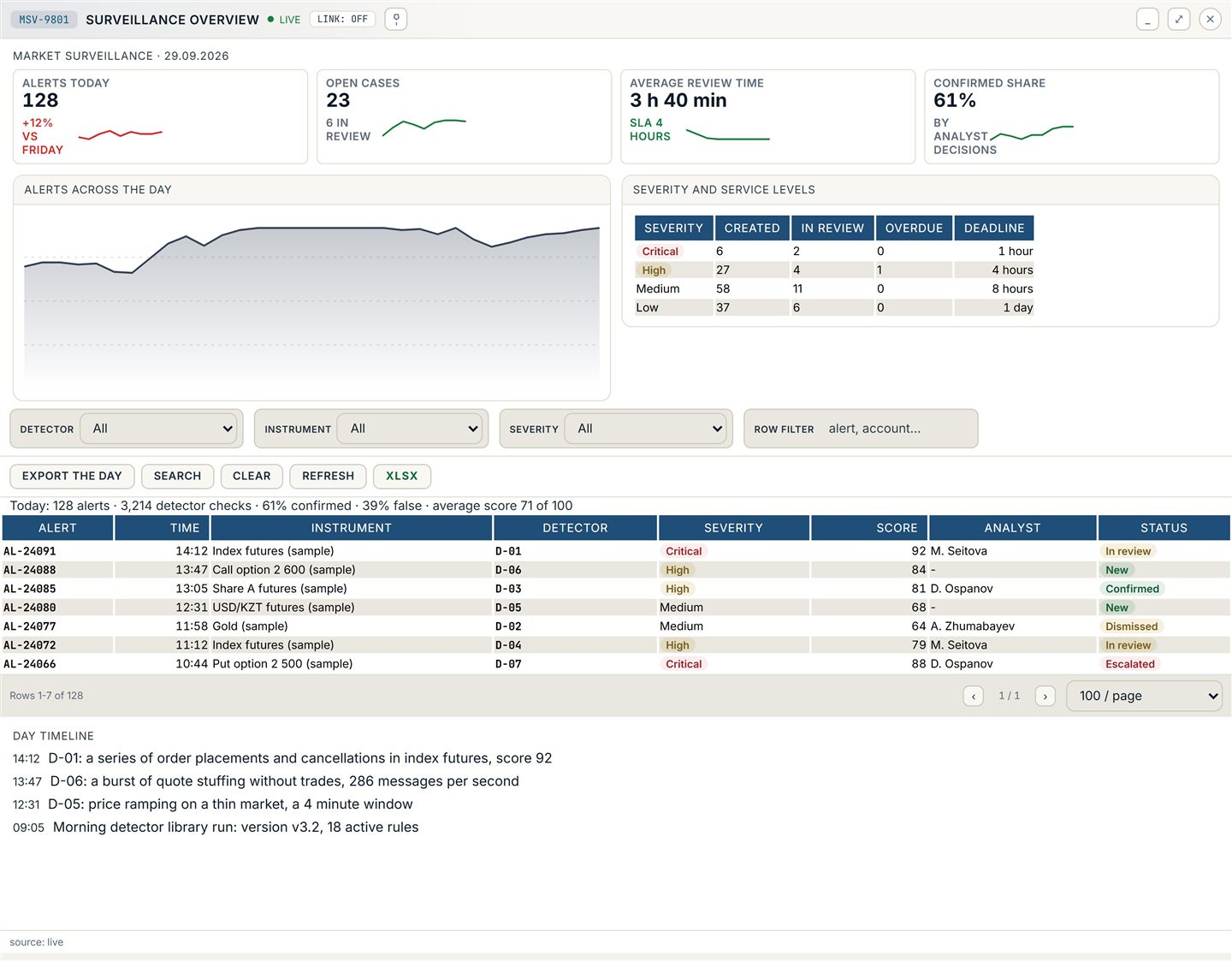
Surveillance screen with signals and cases Trader terminal with the quote board and the order ticket Smart order routing with venue scores and the split Smart order routing with venue scores and the split Market overview screen with trades and turnover
Demo Unifin Stock Exchange Theme Open separately
Trading terminal
Trading terminal

This is an interface demonstration: the real solution will differ in colours and content for a specific project.

Functions at a glance

Business functions at a glance

From the trading terminal to the broker cabinet.

Trading terminal
Runs quotes, orders and the trade tape for every instrument
The trader works in one terminal
Order routing
Splits volume across venues with an explainable decision
An explainable route and price against the worst case
Matching and risk
Matches orders in the core, holds limits and the risk monitor
Trades pass the rules, risk visible before clearing
Clearing and settlement
Nets positions and runs delivery versus payment
Settlement closes inside the day rules
Reporting
Builds regulatory reports and BI views
Reports go out on schedule without manual assembly
Surveillance
Builds signals, cases and evidence from venue data
The regulator sees the live market picture
Broker cabinet
Gives clients their portfolio, orders and reports
The broker serves clients without extra systems

What runs today

The exchange core, already running

Trading, clearing and supervision on one core: the live parts.

Order types

LIMIT, MARKET, IOC, FOK, STOP_LIMIT and ICEBERG run on the matching core.

Short sales

Short selling runs under the borrow flag and self-trade controls.

Auctions

Call auctions and auction modes run beside continuous trading.

FIX and API

FIX gateways and the open REST API serve participants and robots.

Pre-trade control

Pre-trade risk checks fail closed before an order reaches the book.

Roadmap

Algorithms (VWAP, TWAP) and new segments are next in line.

Solution description

Capabilities and overview

Key features

  • Trading terminal: quotes, orders and the tape across instruments
  • Order routing with an explainable venue decision
  • Matching and the risk monitor in one core
  • Clearing with net positions and delivery versus payment
  • Regulatory reporting and BI views from a single source
  • Surveillance: signals, cases and evidence from venue data
  • Broker cabinet: portfolio, orders and reports for clients
  • Open platform API for participants and partners
  • Front, middle and back office in one suite
  • New segments switch on as modules, without a restart
  • Journal and audit across all exchange operations
  • Deployment: by configuration, on the UniFin platform

Product overview

Unifin Stock Exchange is the UniFin platform exchange suite for venues that need trading, clearing, supervision and participant services on one core.

The suite covers the terminal and orders, routing, matching and risk, clearing and settlement, reporting, surveillance and the broker cabinet.

Participants work through the open API, while internal teams share one picture of orders, trades and positions.

New segments and instruments switch on as modules and configuration, without rewriting the core.

The solution runs within the UniFin platform and connects to external CSDs, clearing and banks through standard channels.

What it delivers

What the solution delivers

Trading terminal

A trader usually keeps several windows and spreadsheets: quotes in one place, orders in another. The solution brings the terminal, the watchlist, the ticket and the trade tape into one workspace. With the solution the trading seat is reshaped with widgets for every role. In setup workspaces are assembled from widgets and layouts without code changes.

Order routing

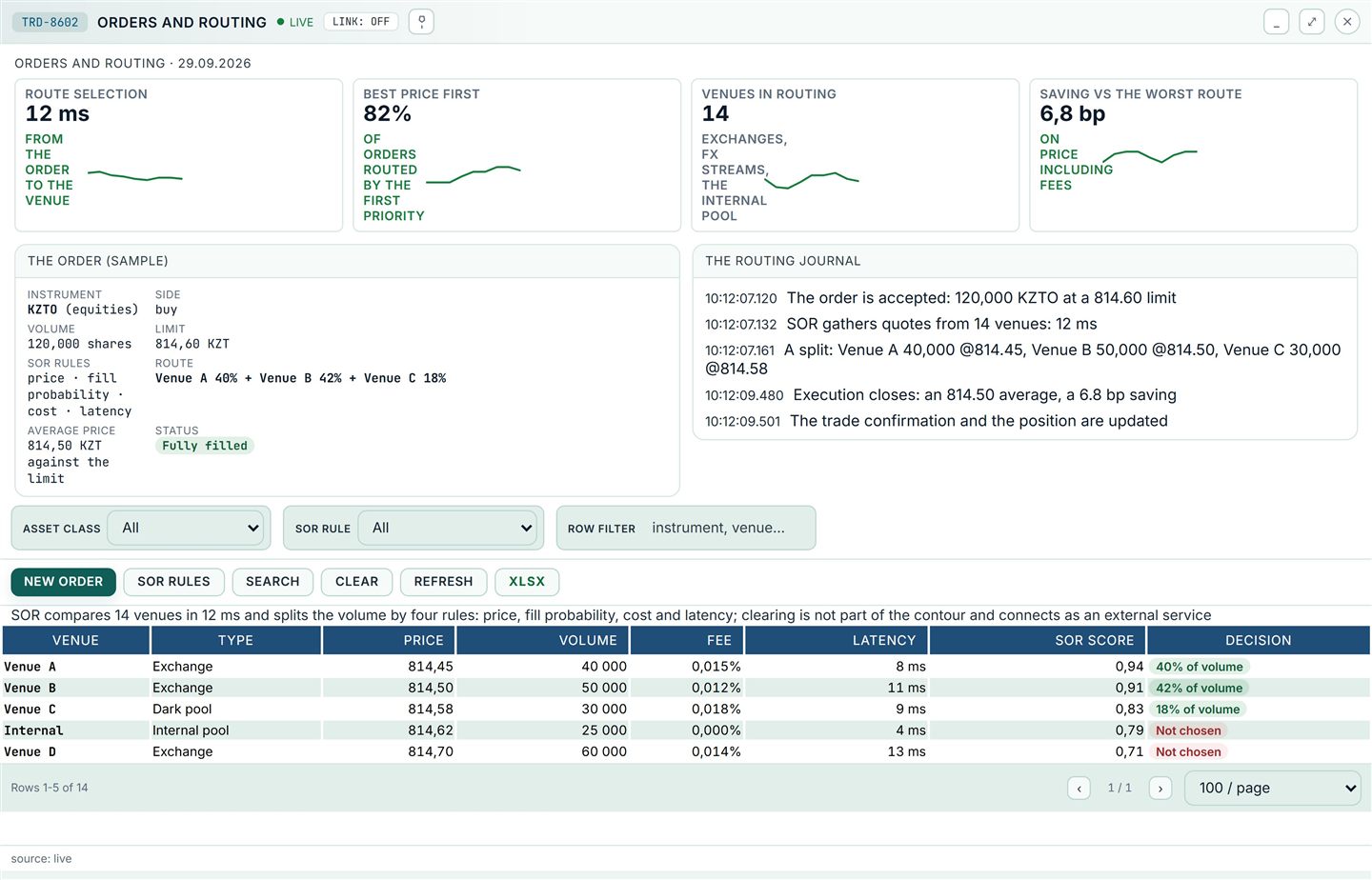
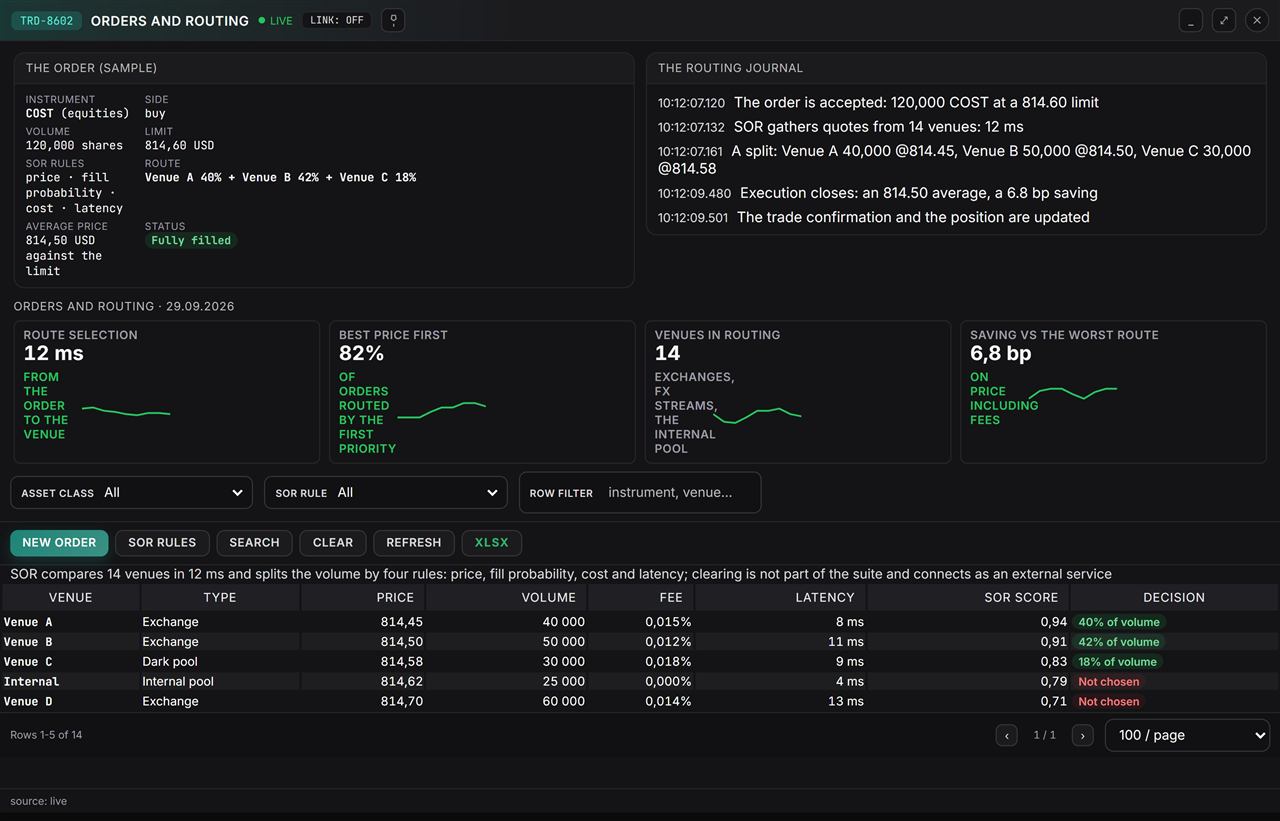
The venue choice usually stays with the trader, and explaining the route after the trade is hard. The solution compares venues by price, fill probability, cost and latency and splits the volume by rules. With the solution routing is explainable, and the price against the worst case is visible. In setup venue scores are visible on every order, and the rule weights come as reference data.

Matching and risk

Matching and risk usually live in different systems, and limits are checked after the cut-off. The solution runs orders through the matching core under pre-trade limits and price corridors. With the solution the risk monitor with margin calls is visible before positions reach clearing. In setup the matching and check journal is visible, and limits and corridors are set in configuration.

Clearing and settlement

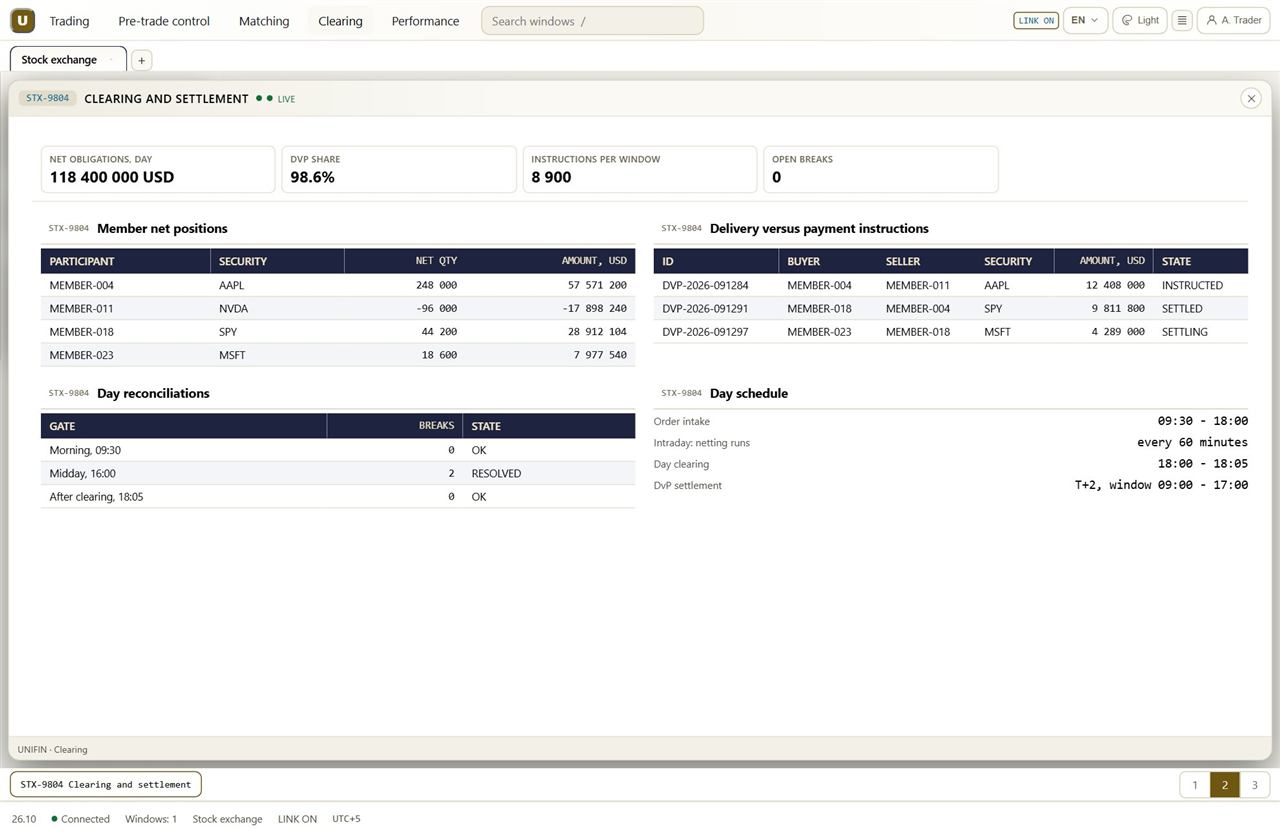
Clearing and settlement are usually computed the next day, and a divergence surfaces by the evening. The solution nets positions and runs delivery versus payment inside the day rules. With the solution settlement closes without rollovers or after-the-fact checks. In setup net positions, instructions and reconciliations are visible for every participant, and the settlement rules are configured per segment.

Reporting

Regulatory reports are usually assembled from extracts by hand, and every form sits with its own officer. The solution builds the regulatory reports from one data picture and runs schedules and distribution. With the solution the regulator gets an answer on time, and the board sees slices from ready views. In setup the template catalogue and the dispatch control are visible, and schedules come from the setup.

Surveillance

Surveillance usually receives data late and collects evidence by hand. The solution builds signals from the live venue data and runs cases with evidence in one journal. With the solution the regulator sees a controlled market, not promises. In setup the case queue and the full trail behind every signal are visible, and detector rules are part of the configuration.

Broker cabinet

Clients usually get a cabinet on a separate system, and reports go out by hand. The solution opens the portfolio, orders, reports and notifications to clients on the same rails as the exchange. With the solution the client base grows without one more platform. In setup accesses and notification channels are visible, and the cabinet scope comes as reference data.

Scope

What the suite covers

Layers switch on by configuration; the journal records the links.

Front office

Trader terminal, watchlist, order ticket, tape and market depth; desks assembled from widgets.

Middle office

Order matching, pre-trade limits, price corridors, the risk monitor and margin calls.

Back office

Clearing, net positions, delivery versus payment, depository operations and reconciliations.

Surveillance

Signals, cases and evidence from the venue's own data; exports for the regulator.

Broker solution

The client cabinet, portfolios and orders, reports and notifications; mobile access.

Reporting

The template catalogue, schedules and send control, ad-hoc queries and BI dashboards.

API and integrations

The full API: REST and WebSocket, FIX, ISO 20022; OpenAPI per domain.

Journal and audit

Every order, trade, decline, report and API call stays in the event journal.

Stand

Screens of the solution

The terminal, routing, the market overview, the auction card, the portfolio. Surveillance, reporting, the widget desk, the options chain, price slices and the risk monitor.

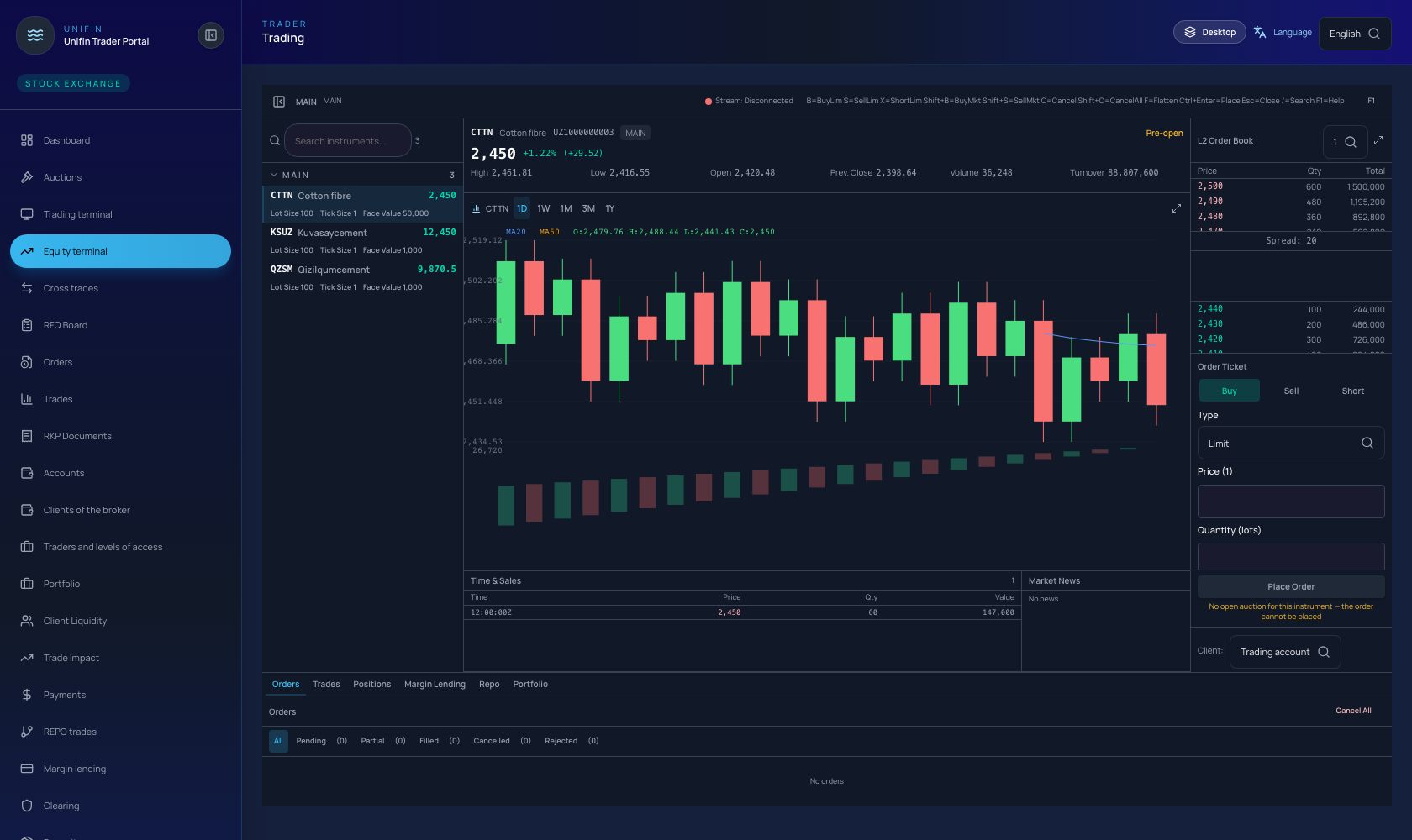
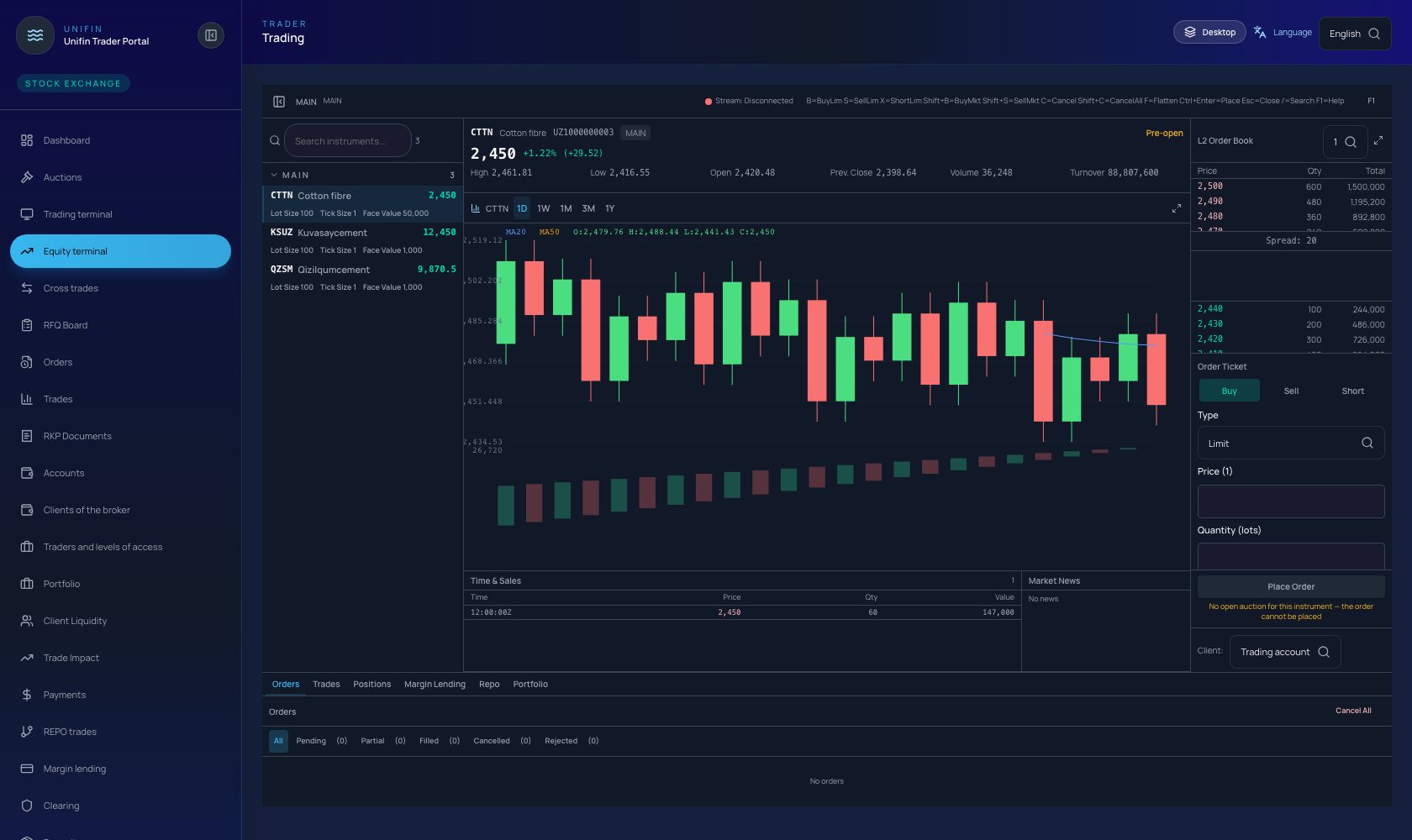
Trader terminal with the quote board and the order ticket
Trader terminal: quote board, order entry and the time and sales tape
Smart order routing with venue scores and the split
Smart order routing: venue scores and the volume split
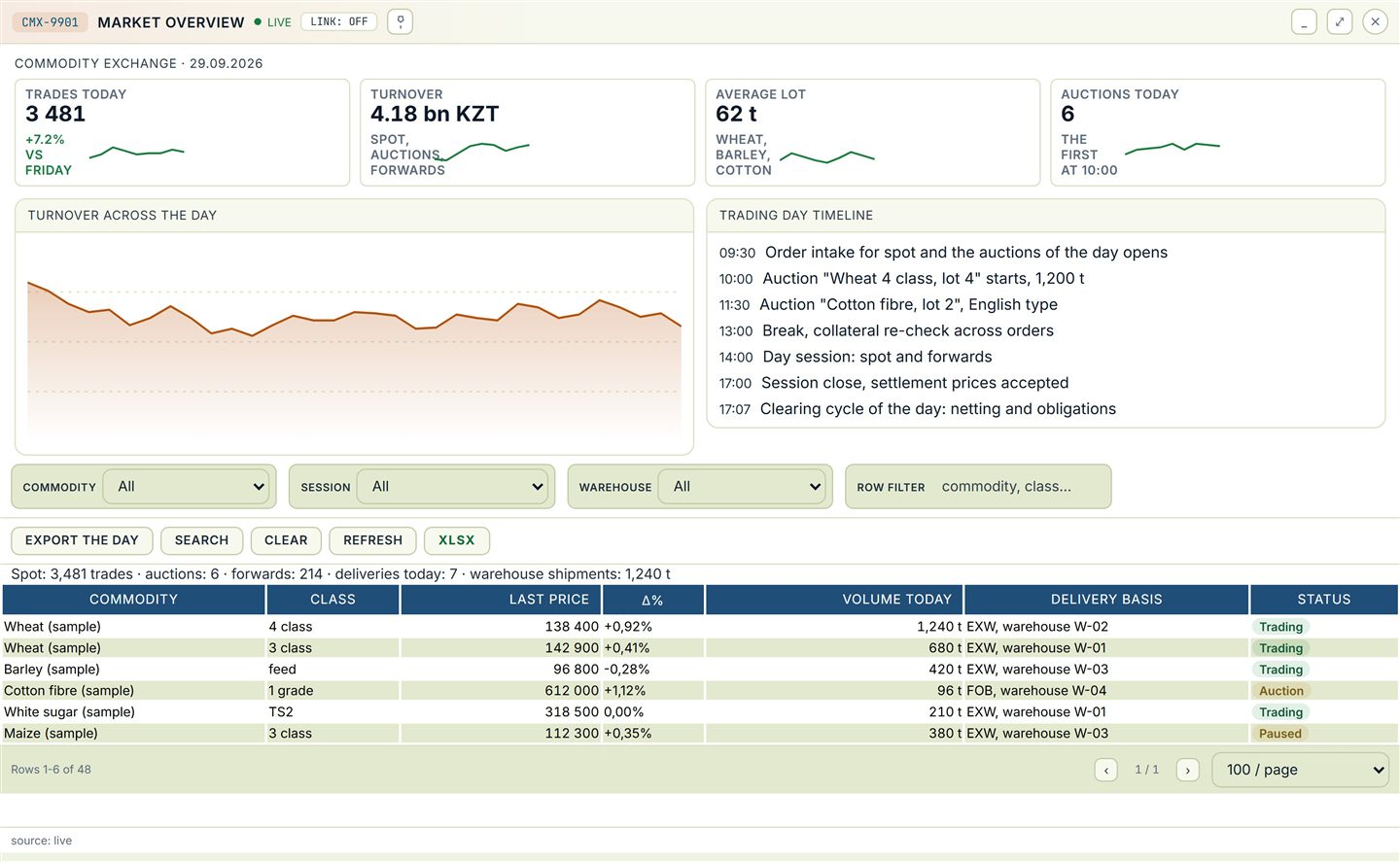
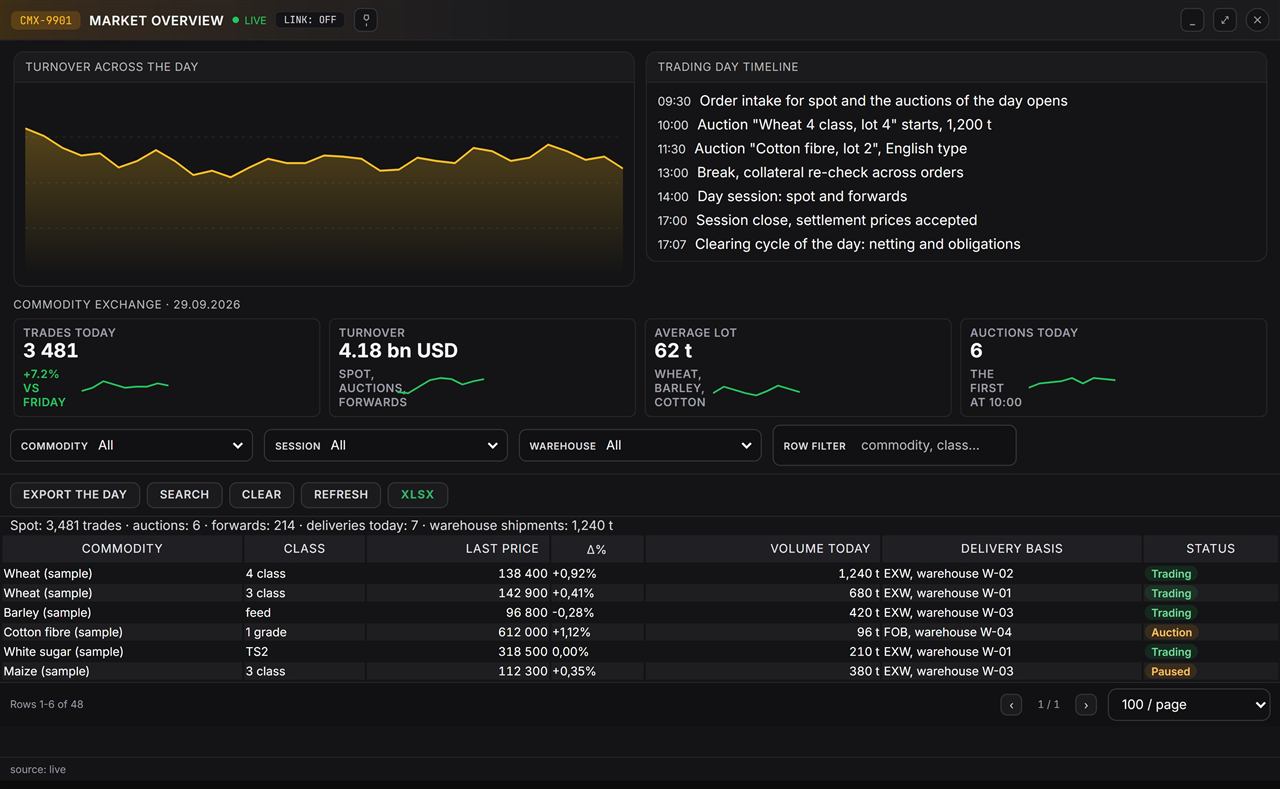
Market overview screen with trades and turnover
Market overview: trades, turnover and the course of the trading day
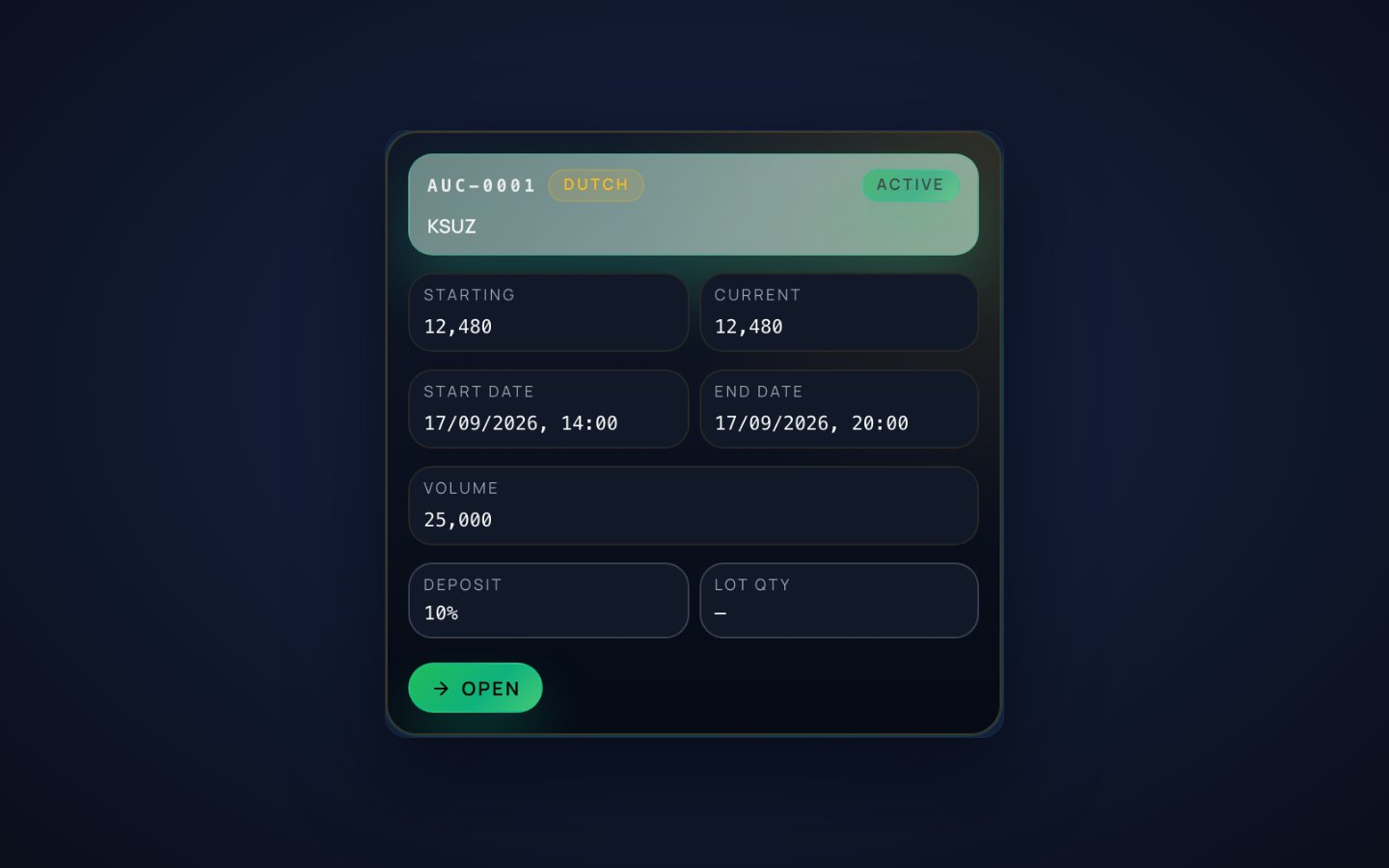
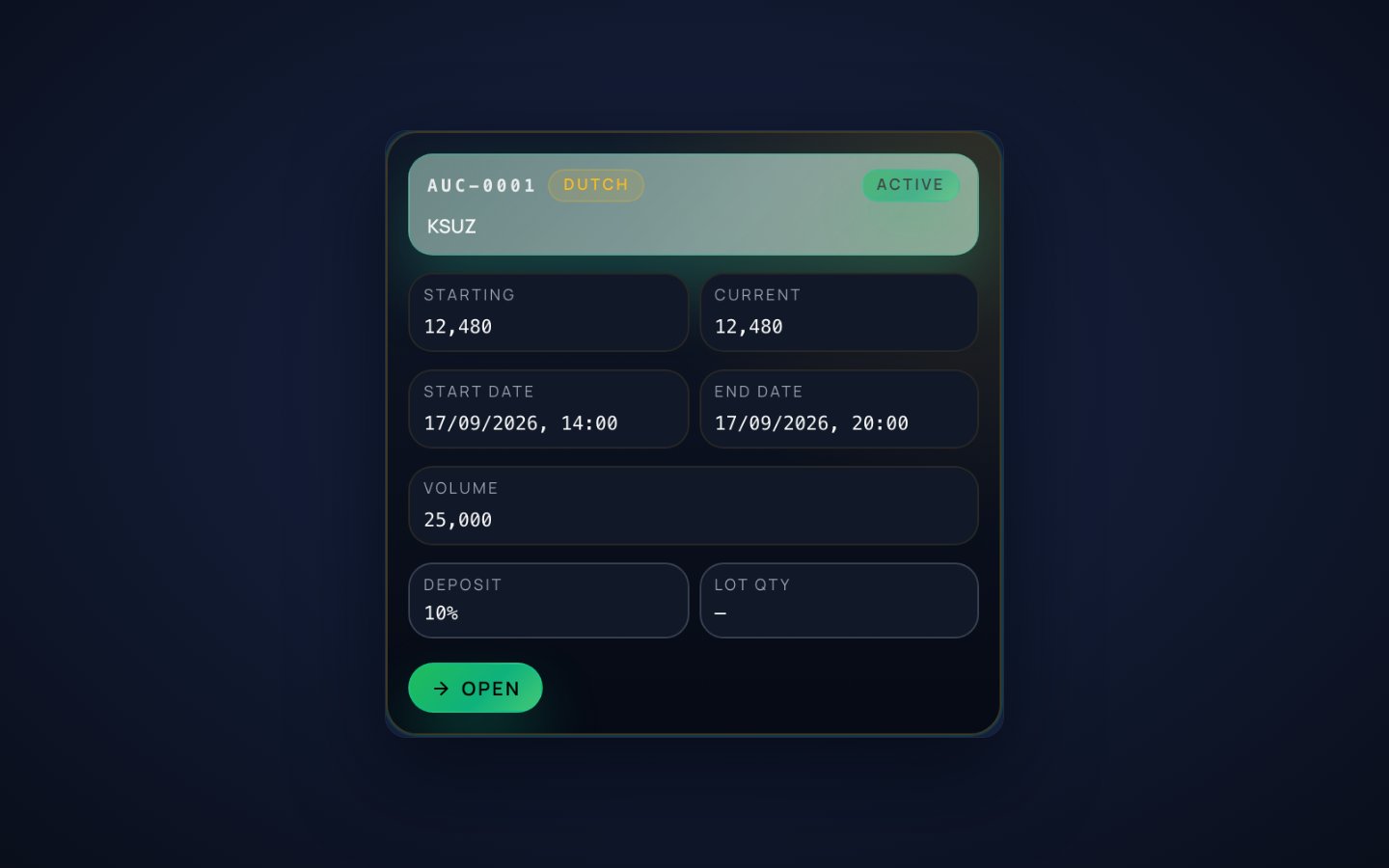
Auction card with the starting price, volume, deposit and the bid window
Auction card: starting price, volume, deposit and the bid window
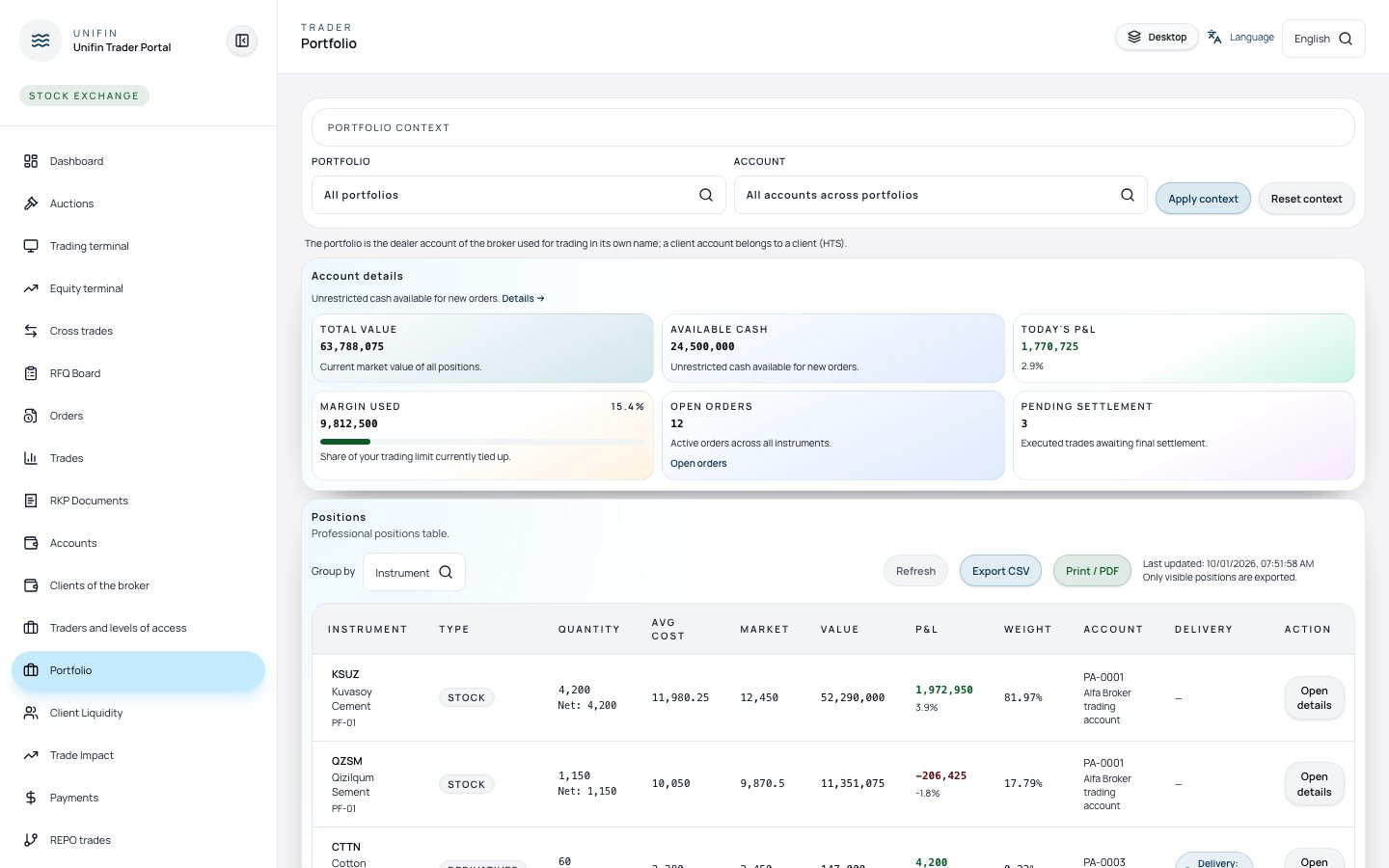
Portfolio screen with margin usage and the positions table
Portfolio: total value, margin usage and the positions table
Surveillance screen with signals and cases
Surveillance: signals, cases and evidence from live trading data
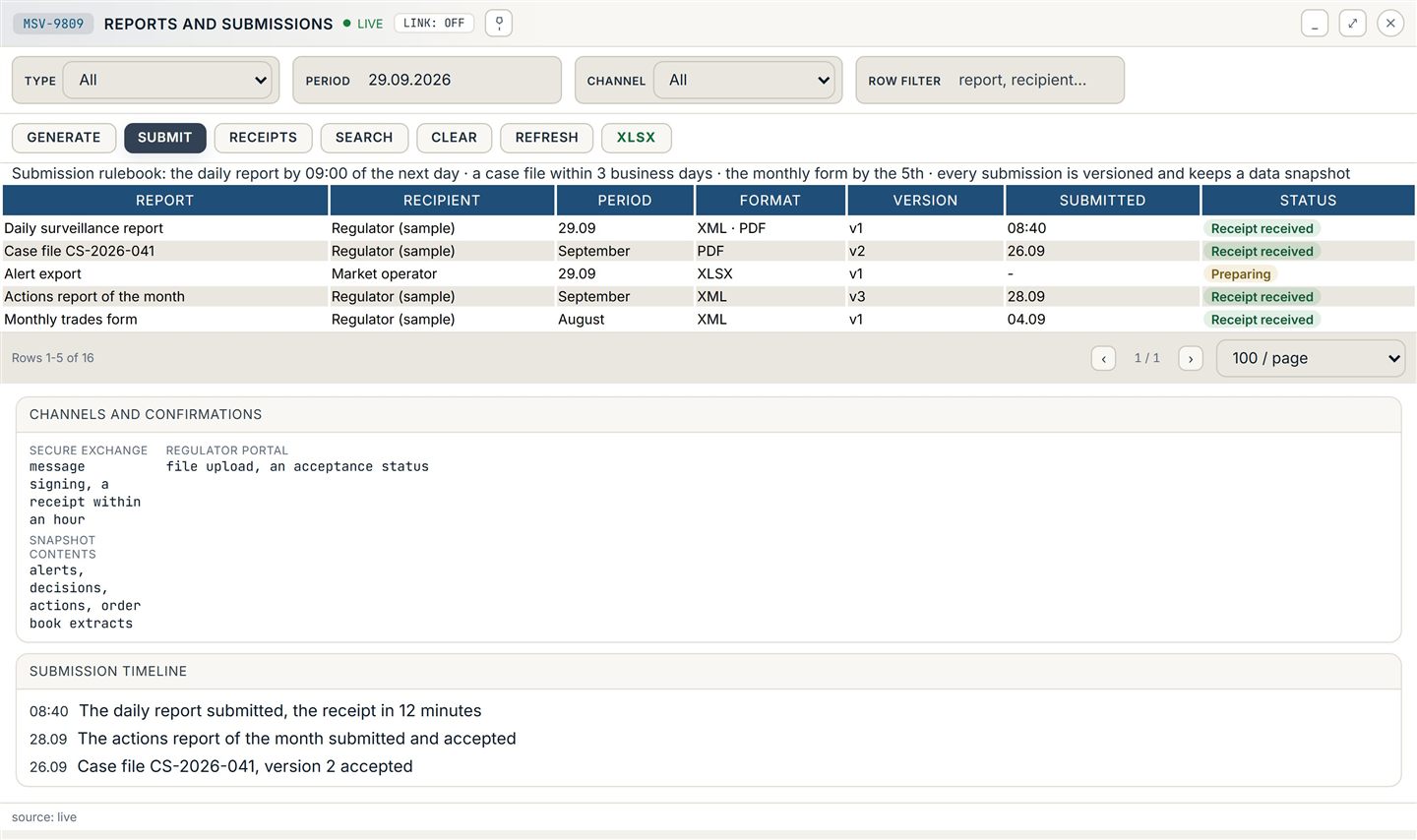
Reporting screen with templates and schedules
Reports: templates, schedules and the summary of the operating day
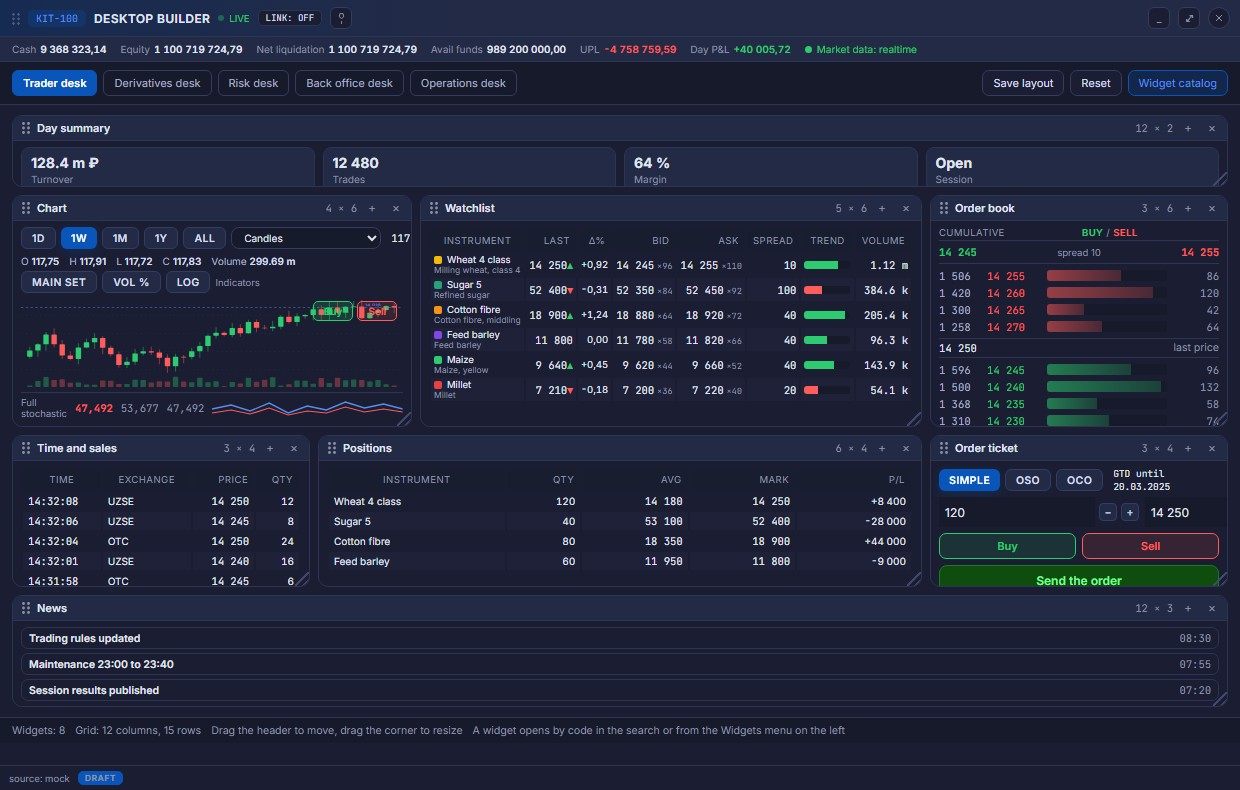
Trader desk assembled from widgets
Trader desk assembled from widgets: day totals, chart, order book and positions
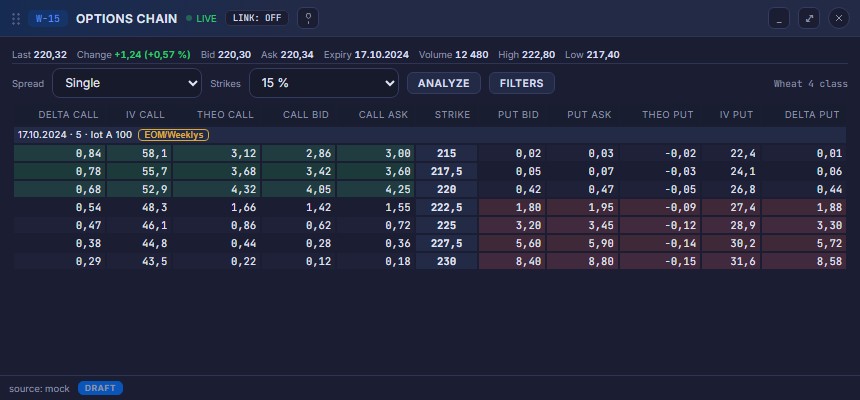
Options chain with strikes, quotes and greeks
Options chain: strikes, bid and ask, implied volatility and greeks
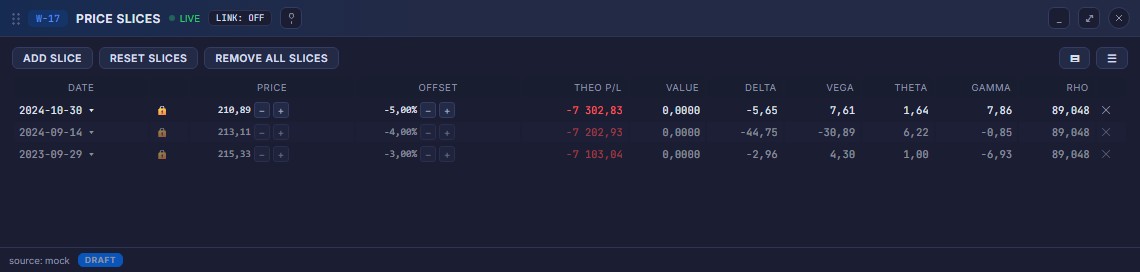
Price slices with scenario dates and greeks
Price slices: scenario dates, offsets and the greeks of each slice
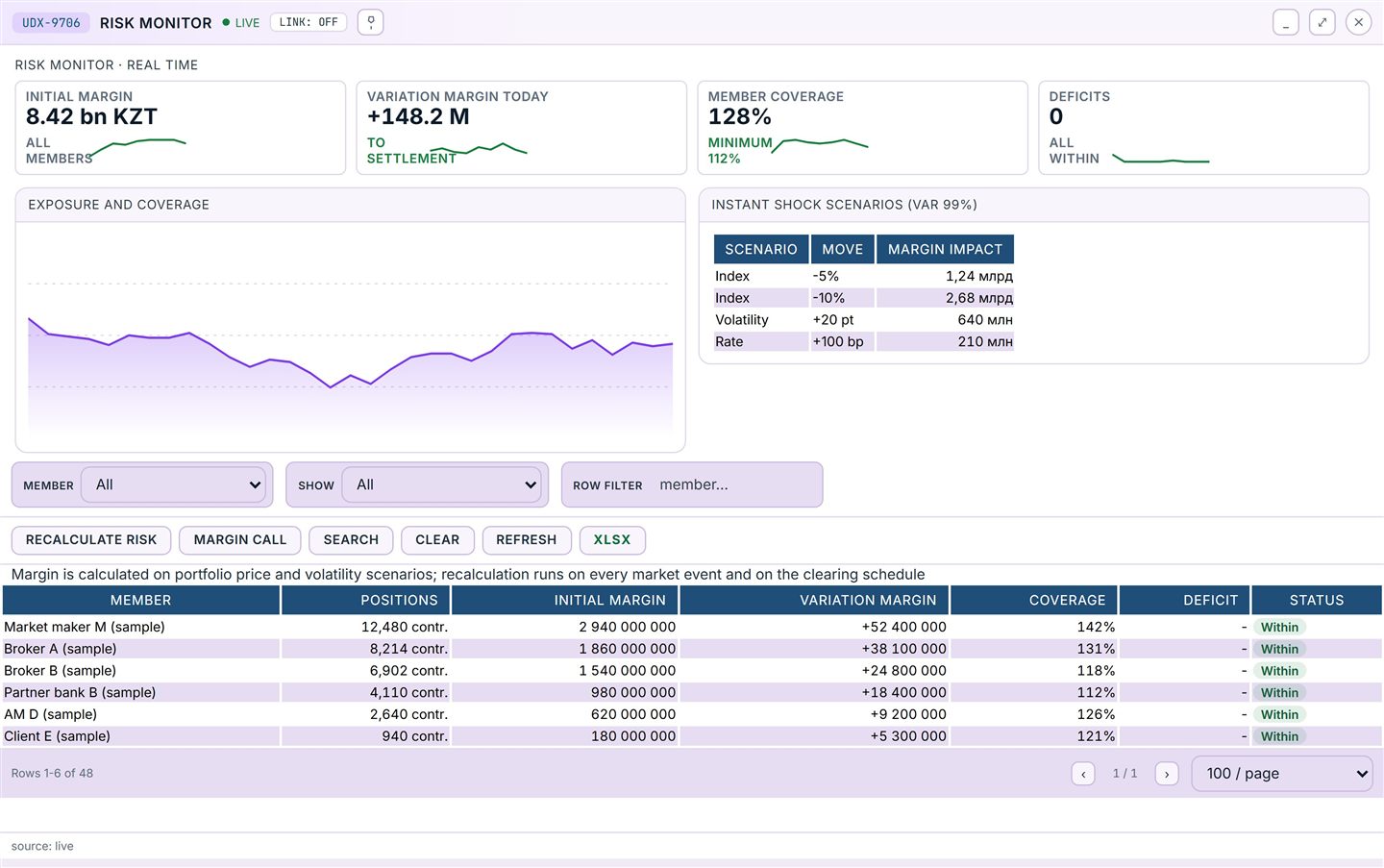
Risk monitor with portfolio margin and the margin call
Risk monitor: portfolio margin, limits and the margin call
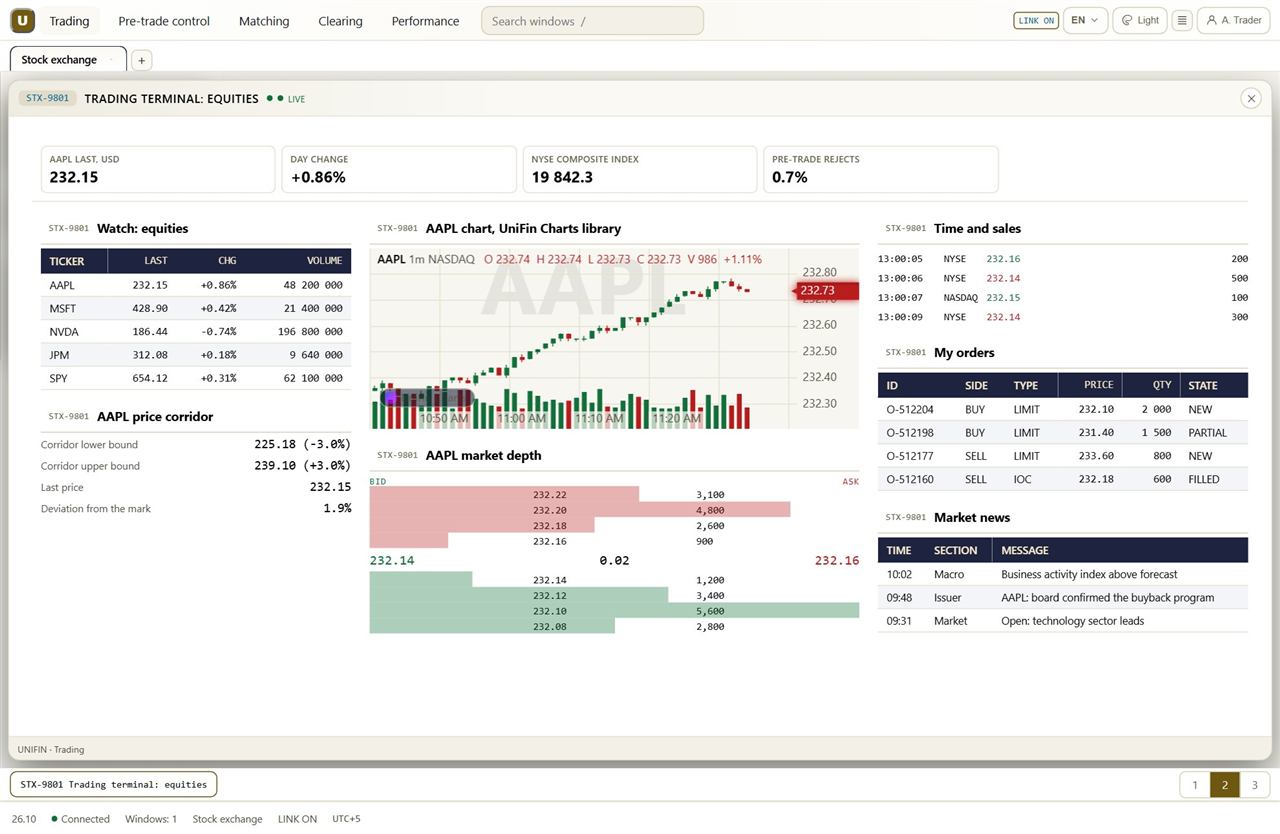
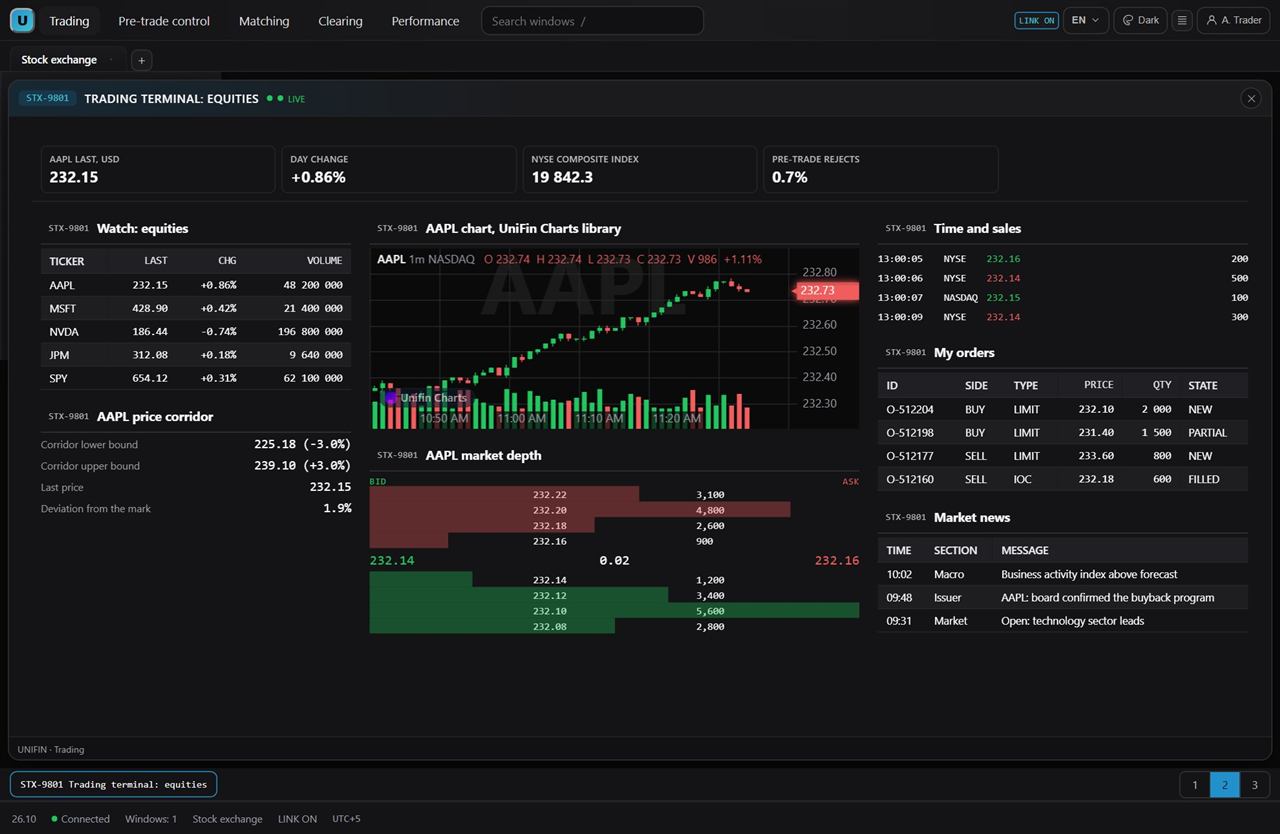
Trading terminal of the equities desk with the library chart
Trading terminal: equities desk with the library chart, market depth and news
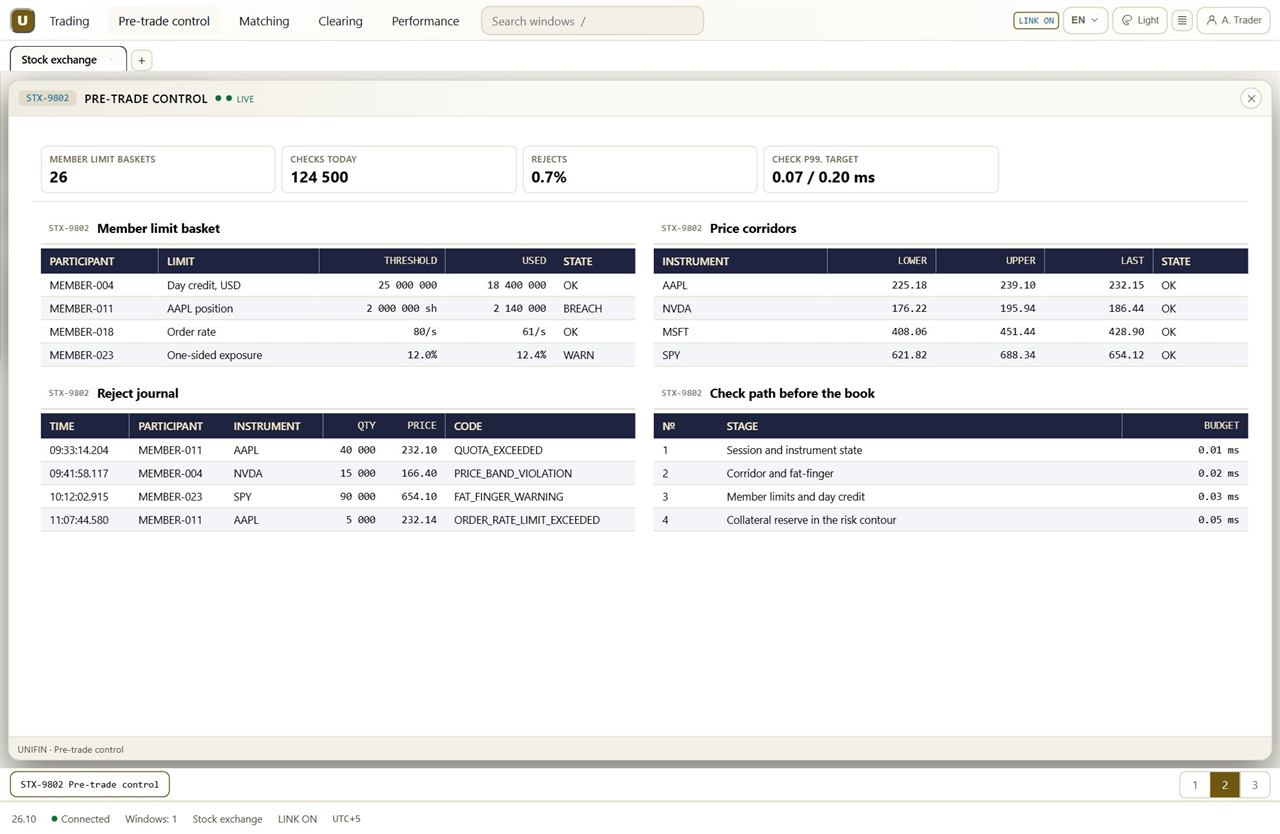
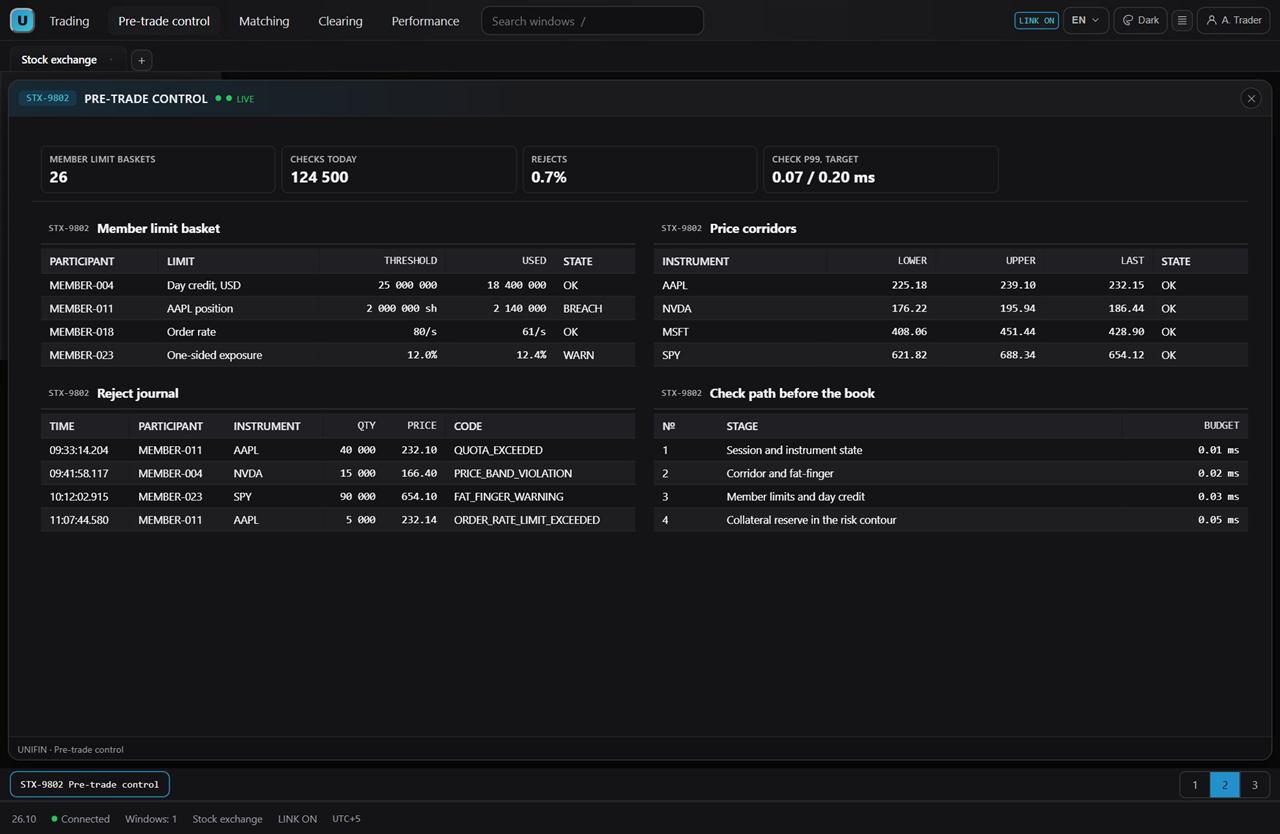
Pre-trade control with the member limit basket and price corridors
Pre-trade control: member limit basket, price corridors and the reject journal
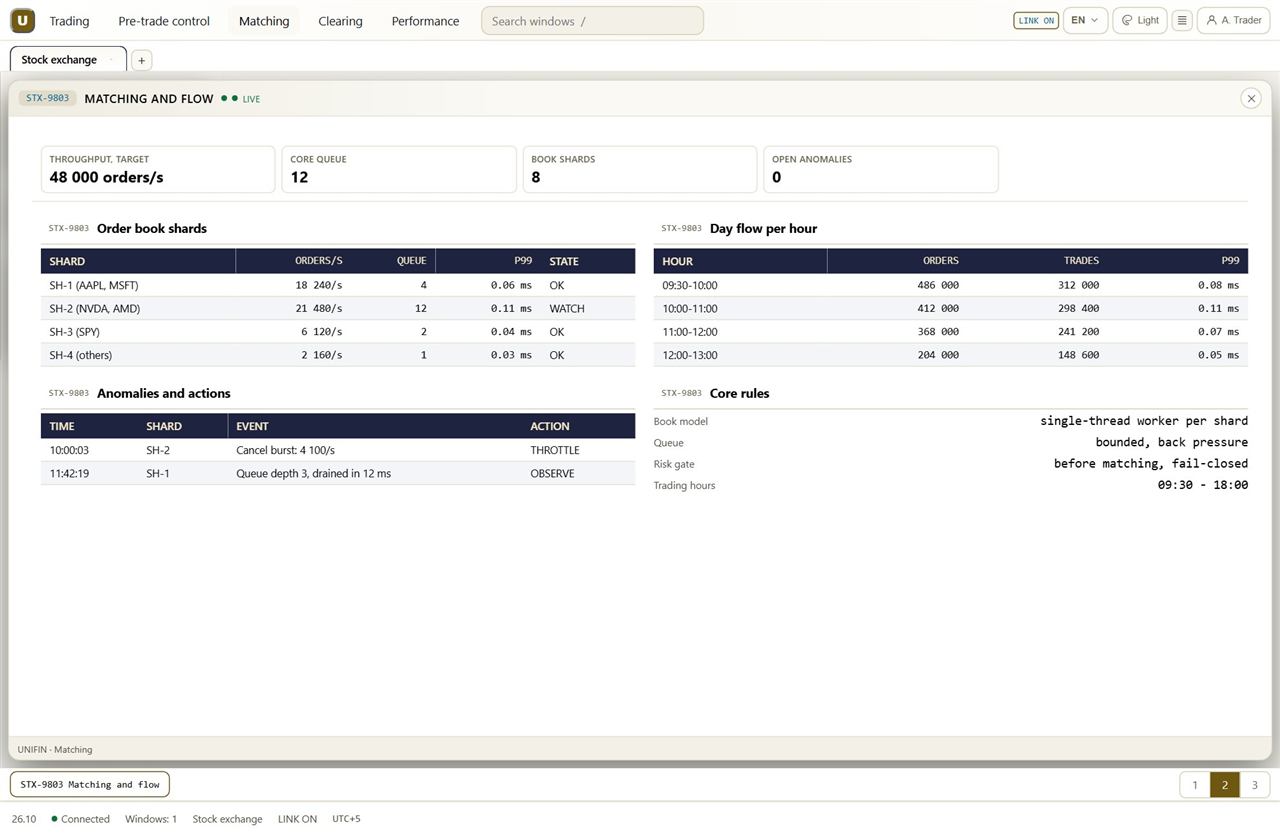
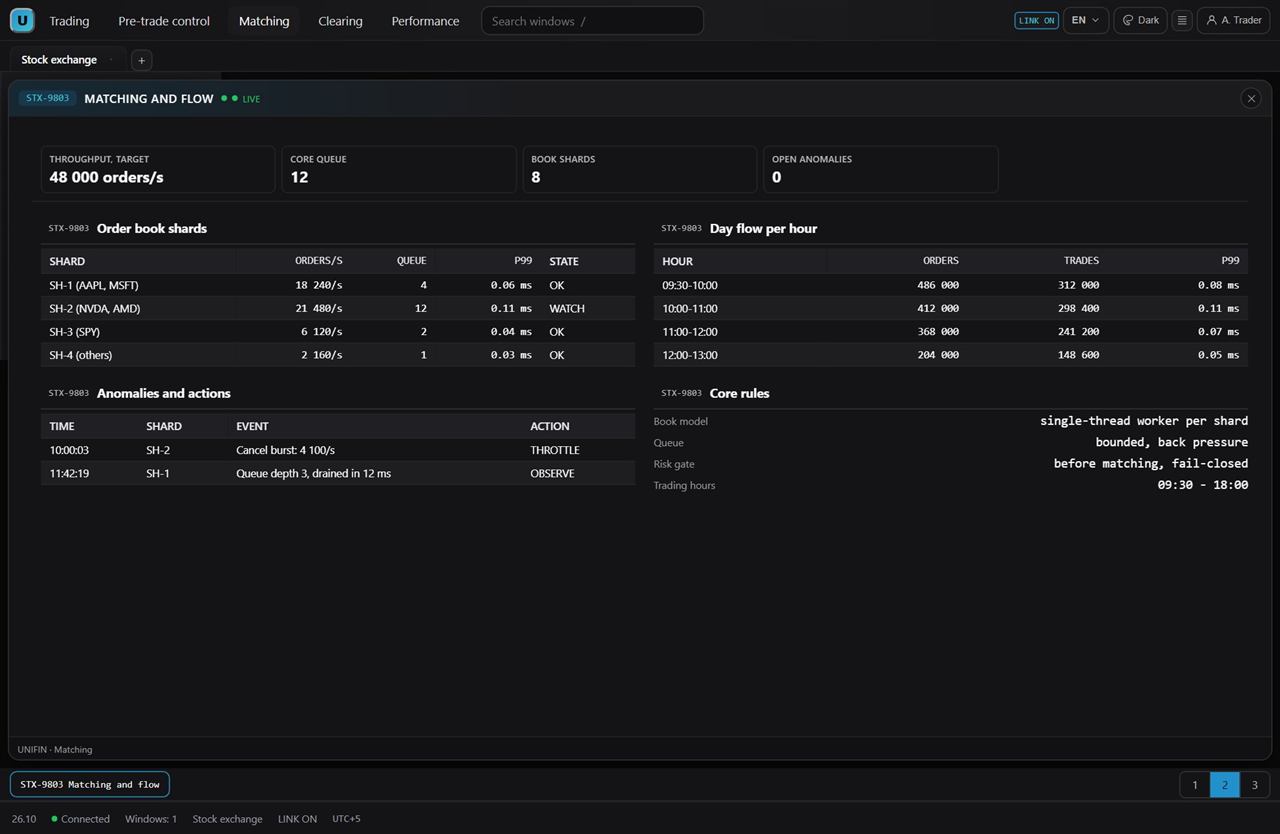
Matching and flow with book shards and the hourly throughput
Matching and flow: book shards, queue depth and the hourly throughput
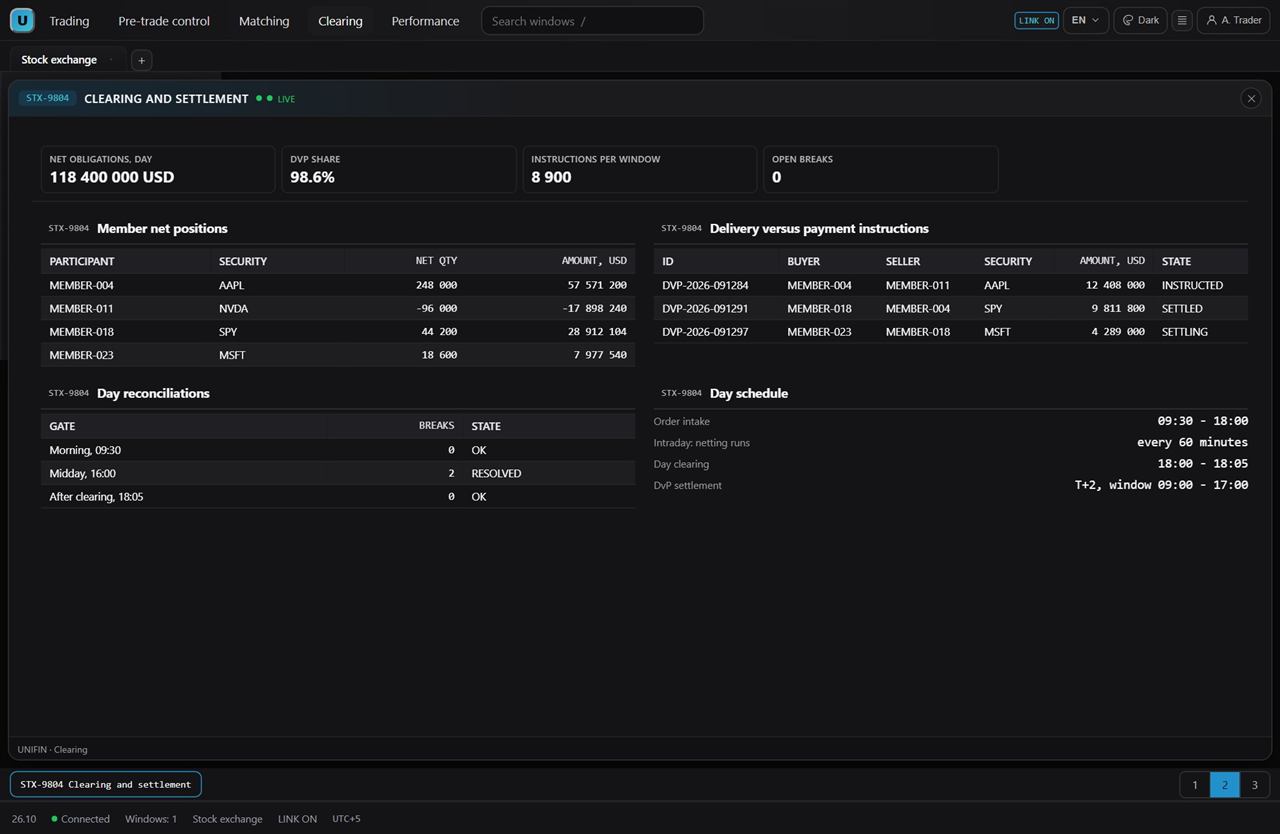
Clearing and settlement with net positions and DvP instructions
Clearing and settlement: net positions, DvP instructions and day reconciliations
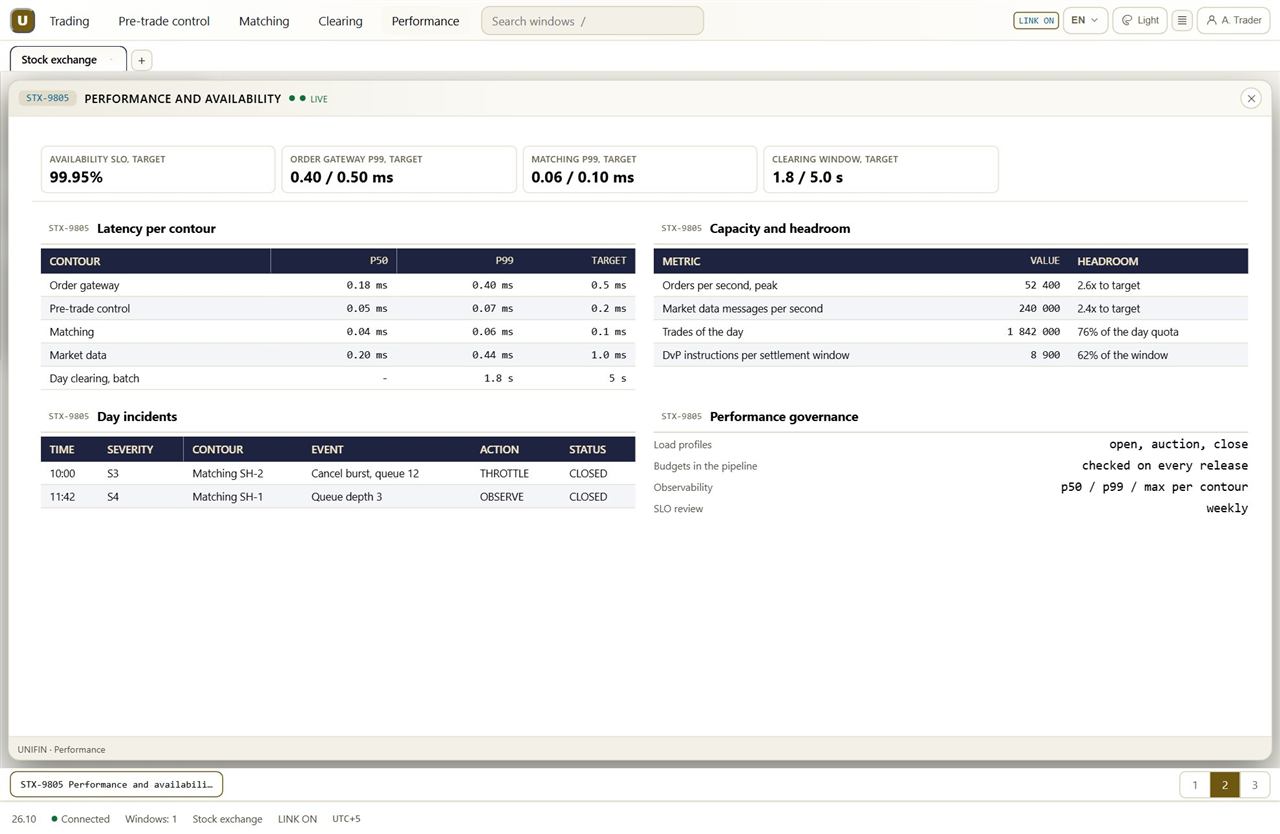
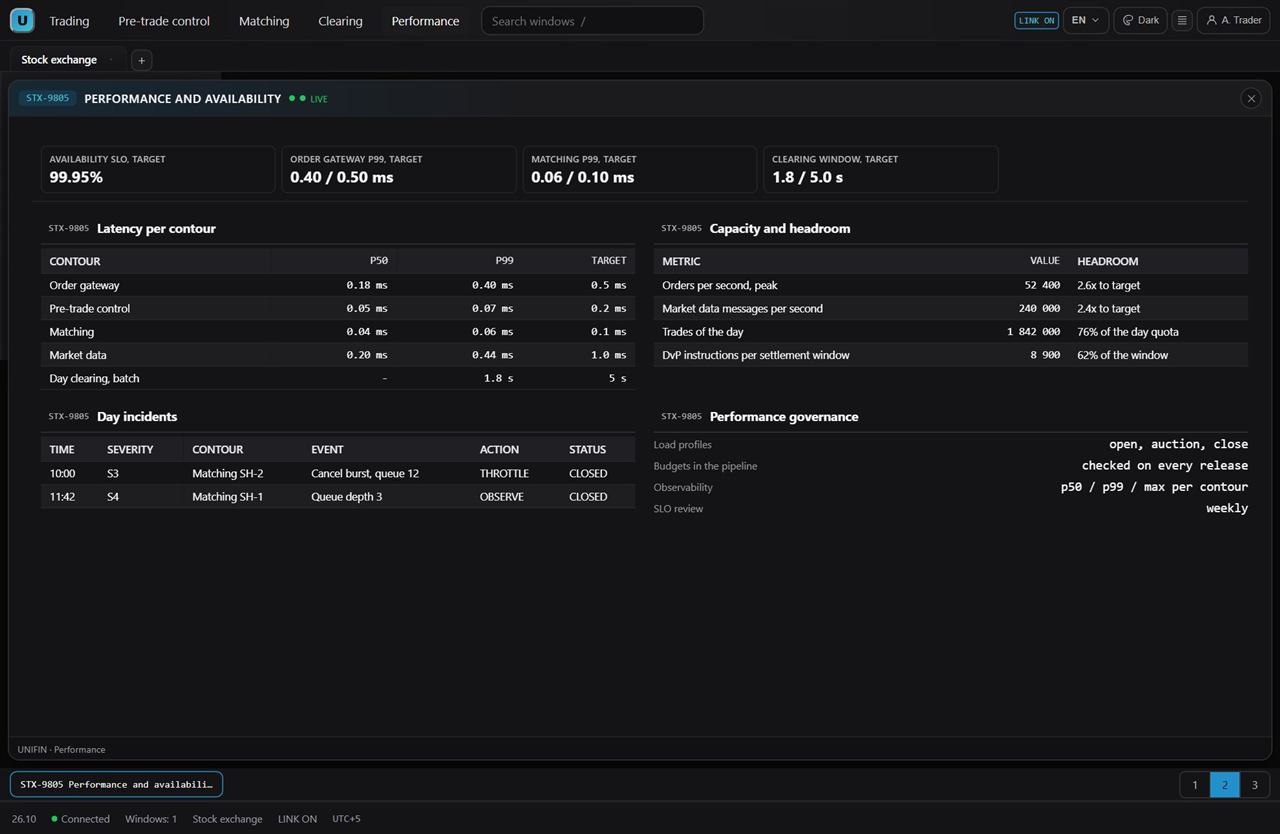
Performance and availability with latency per contour and day incidents
Performance and availability: latency per contour, capacity and day incidents

How it works

One exchange day

The path of the day: opening, orders, matching, settlement, supervision.

  1. 1

    The day opens

    The venue opens; instruments and participants come from reference data.

  2. 2

    Orders and checks

    Orders arrive from terminals and API; pre-trade checks run before matching.

  3. 3

    Matching and quotes

    The core matches orders; quotes and the tape update over WebSocket.

  4. 4

    Settlement and delivery

    Clearing computes net positions; instructions flow to settlement and the depository.

  5. 5

    Reports and surveillance

    Day reports run on schedule; surveillance signals sit in one journal.

Industries

Which industries it serves

The suite serves exchanges and venues, brokers and banks, asset managers, issuers and market regulators.

Exchange / venue

Trading, supervision, market data and post-trade on one governed core, launched by configuration.

Broker / investment firm

Client access and risk control on the same rails as the venue: terminals, mobile and pre-trade limits.

Asset manager / fund

Analytics, indices and hedging instruments for portfolio and research teams.

Regulator / supervisor

Surveillance evidence, market analytics and reporting built from live transaction data.

Architecture

Architecture and access

The suite is assembled from platform core services behind the portals. Front, middle and back office, surveillance and reporting connect over the event bus.

Service suite

Terminal, matching and risk, clearing and settlement, surveillance and the broker cabinet; every layer behind one BFF.

Full API

Full API open to participants: REST and WebSocket, FIX, ISO 20022; OpenAPI with call audit.

External suites

The depository, the bank, custodians, reference data and regulator channels connect as connectors.

Multi-region and DR

Active-active reads and a DR region for Tier-0; cluster and database replication are supported.

Growth without core changes

A new instrument, limit or report is added by configuration: the matching core stays in place.

AI layer

The AI layer builds the trading-day summary and highlights unusual moves; a human confirms every action.

Four control points

Pre-trade control, the risk gate, matching and clearing: the daily path with a checkpoint at every step.

Control points in action

Corridor and reject

An order outside the price corridor is declined before the book and listed in the reject journal.

Fat-finger and limits

Fat-finger raises a warning; day credit and the position limit are checked before matching.

Settlement inside the day

Clearing nets positions per member; delivery versus payment instructions close inside the day.

Architecture scheme The same architecture as a standalone page. Open the diagram separately

Performance

Performance on the money path

Microsecond matching core, millisecond order acknowledgment, minute-scale clearing - and a throughput that grows by adding shards, not by re-engineering. Figures below are split into reproducible benchmarks and target profile values for the reference configuration.

2-30 µs per operation
Matching core

benchmark (JMH), in-process

< 20 ms p95 / < 100 ms p99
Order acknowledgment

target profile, end to end

1,000-5,000 orders/s
Sustained throughput

target profile, sharded; scales with the shard count

300-500k trades in minutes (< 3 min)
Clearing batch

design target, parallel netting

Latency budget per stage (target profile)

Order ingress and authorization 1-3 ms < 10 ms single gateway, local token validation
Pre-trade control 1-5 ms < 15 ms in-memory limits, warm caches
Matching core (in-process) 10-20 µs 50-100 µs one single-thread worker per shard
Order ack, end to end 3-8 ms < 20 ms includes the durable journal and the commit
Clearing batch (300-500k trades) - < 3 min parallel netting per member
Market data - parallel path fan-out outside the acknowledgment critical path

Scale axes

Instruments Order books are sharded; shards compute in parallel. A new shard leaves neighbours unchanged; throughput scales with the shard count (reference: about 500 orders/s per shard)
Orders One single-thread worker per shard plus a bounded queue (100,000). Overflow returns an explicit error (backpressure), never a silent loss
Portals Stateless replicas over REST and WebSocket. Horizontal by the replica count
Events Broker with event-id deduplication and a transactional outbox. A replay creates no double effects

Service levels we hold

  • Availability SLO99.95%+ for the money path
  • Storage failoverPostgreSQL <= 30 s, Redis <= 15 s, RabbitMQ quorum <= 30 s (chaos-tested thresholds)
  • Durabilityorders are acknowledged only after a durable commit; events are published via a transactional outbox
  • Degradationexplicit backpressure under overload: no silent loss, no duplicates (idempotent consumers)
  • RPO / RTORPO ~0 for committed money-path data (synchronous replication); DR RTO <= 15 min (runbook; report on request)

World-class matching core (microseconds), solid enterprise-grade end-to-end profile (tens of milliseconds). Scalable to thousands of orders per second per sharded configuration - headroom designed for frontier and regional markets.

Benchmark figures are reproducible (the JMH order book benchmark). Target profile figures are engineering targets for the reference sharded configuration. They are validated in our NFR program (k6 load suites); validation reports are available on request.

Readiness

What is ready, what is next

Built from platform services; the next wave widens algorithmic trading and surveillance.

Ready today

  • Front office: the terminal, orders, the tape and widget desks
  • Middle office: matching, pre-trade limits and the risk monitor with margin calls
  • Back office: clearing, delivery versus payment and depository links
  • Surveillance and reporting: live-data signals, the report catalogue and BI dashboards

Next in line

  • Algorithmic trading and a cross-venue smart split (plan)
  • Extended surveillance scenarios and AI hints for the inspector (plan)
  • More connectors for venues, banks and depositories (plan)

Releases

Release history

Quarterly releases since the platform was founded (2020); the exchange suite shipped in 2026.

2026 Q1

  • Trader terminal, orders and the tape.

2026 Q2

  • Venue routing and pre-trade limits.

2026 Q3

  • The risk monitor, clearing and operating-day reporting.

2026 Q4

  • Live-data surveillance and the broker cabinet (plan).
  • Latency budgets per contour and scale axes for the exchange core.

Detailed description

Detailed description

The layer map, the API catalogue by domain, the rulebook and the delivery frame.

How the suite is assembled

Channels and clients
FIX 4.2 / 4.4 / 5.0, REST with mTLS, SFTP files, web portals
Edge and access
API gateway with 126 routes, Keycloak single sign-on, WAF and CSP
Platform core services
trading-ms market-data-ms risk-ms clearing-ms settlement-ms reporting-ms AI agentic layer Services of the suite on the shared platform core
Data and events
PostgreSQL 17 per service, Redis 7, RabbitMQ 3.13 quorum queues, transactional outbox
Results and reporting
Portals, reports, regulator and partner channels

Technology stack

Runtime and backend: Java 21 (LTS), Spring Boot 3.5.16, Spring Cloud 2025.0.3, Gradle, Flyway 10.15.

Data: PostgreSQL 17, Redis 7 with Sentinel, RabbitMQ 3.13 with the transactional outbox.

Market connectivity: FIX 4.4/5.0 for venues, WebSocket streams for quotes and trades, ISO 20022 for settlement.

Portals: Next.js 16.3.3, React 19, TypeScript 5; Onest typography and two themes; Keycloak 26.1 for OIDC sign-in.

Delivery: Kubernetes and Helm, Vault secrets, Prometheus and Grafana, Docker Compose for pilots.

Evidence by default: orders, trades, routing decisions, declines, reports and API calls are journaled for five years.

Front office and orders

  • The terminal keeps the quote board, the watchlist, the order ticket and the tape on one screen across asset classes.
  • Desks are assembled from widgets: day totals, charts, the order book, positions and news in one layout.
  • Amend and cancel keep a version journal; a manual volume or price change takes a second approval.
  • Declines return a reason to the trader and go to the day report for compliance review.

Routing and matching

  • Smart order routing compares venues by price, fill probability, cost and latency, and splits the volume across them.
  • The order card keeps venue scores, the split and the outcome: the decision is explainable to compliance.
  • The matching core works over the event bus; quotes and the tape reach subscribers over WebSocket.
  • Auction types stay available for placements and special sessions alongside continuous trading.

Risk, margin and clearing

  • Pre-trade limits cover position, concentration, cash, venue and the price corridor before the order leaves the desk.
  • The risk monitor shows portfolio margin, limits and margin calls with stress scenarios and the liquidation plan.
  • Clearing computes net positions and hands settlement instructions to the settlement suite.
  • Delivery versus payment, depository links and reconciliations run on the same event journal as trading.

Surveillance and reporting

  • Surveillance runs on the venue's own live data: signals open cases, and every case keeps its evidence.
  • The report catalogue keeps templates, schedules and send control; ad-hoc queries run on the same data.
  • BI dashboards slice the day by desk, instrument and participant for the exchange and its members.
  • The broker cabinet gives clients portfolios, orders, reports and notifications on the same rails.

Architecture and the full API

  • The suite is assembled from the platform core: trading-ms, market-data-ms, risk-ms, clearing-ms, settlement-ms and reporting-ms behind a portal BFF.
  • The full API is open: REST and WebSocket for terminals and partners, FIX for venues and market streams, ISO 20022 for settlement, OpenAPI per domain.
  • Roles, routing and call audit live in the BFF; a window knows only its own /api/v1 calls.
  • Externals connect as connectors: the CSD, the settlement bank, custodians, reference data systems and regulator channels.
Detailed description

Leave your contacts to open the detailed description and download the PDF with architecture, cases and delivery details.

Ask about the exchange suite

Bring one trading day or your integration list. We will show the path from an order to settlement and the API surface for your systems.