UNIFINplatform

Solution

Unifin Open Market Operations

Bank money moves on the schedule of the central bank.
Auctions, tenders, repos, FX swaps and the portfolio follow the windows of the day.
Results, collateral and settlements meet in the protocol and the journal.

  • Auctions and tenders
  • FX swaps and collateral
  • Bond portfolio
All solutions

Live screens from the product terminals

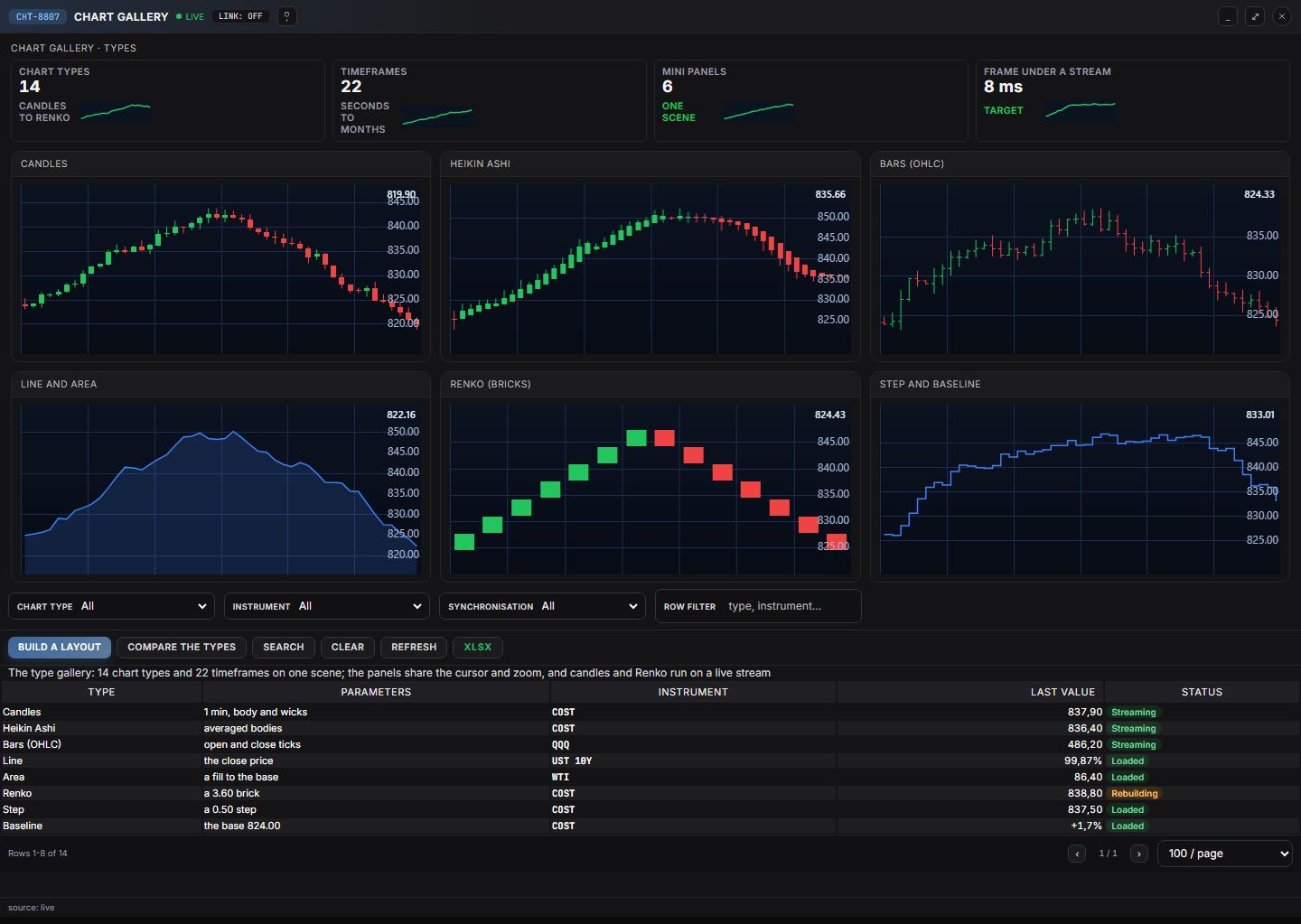
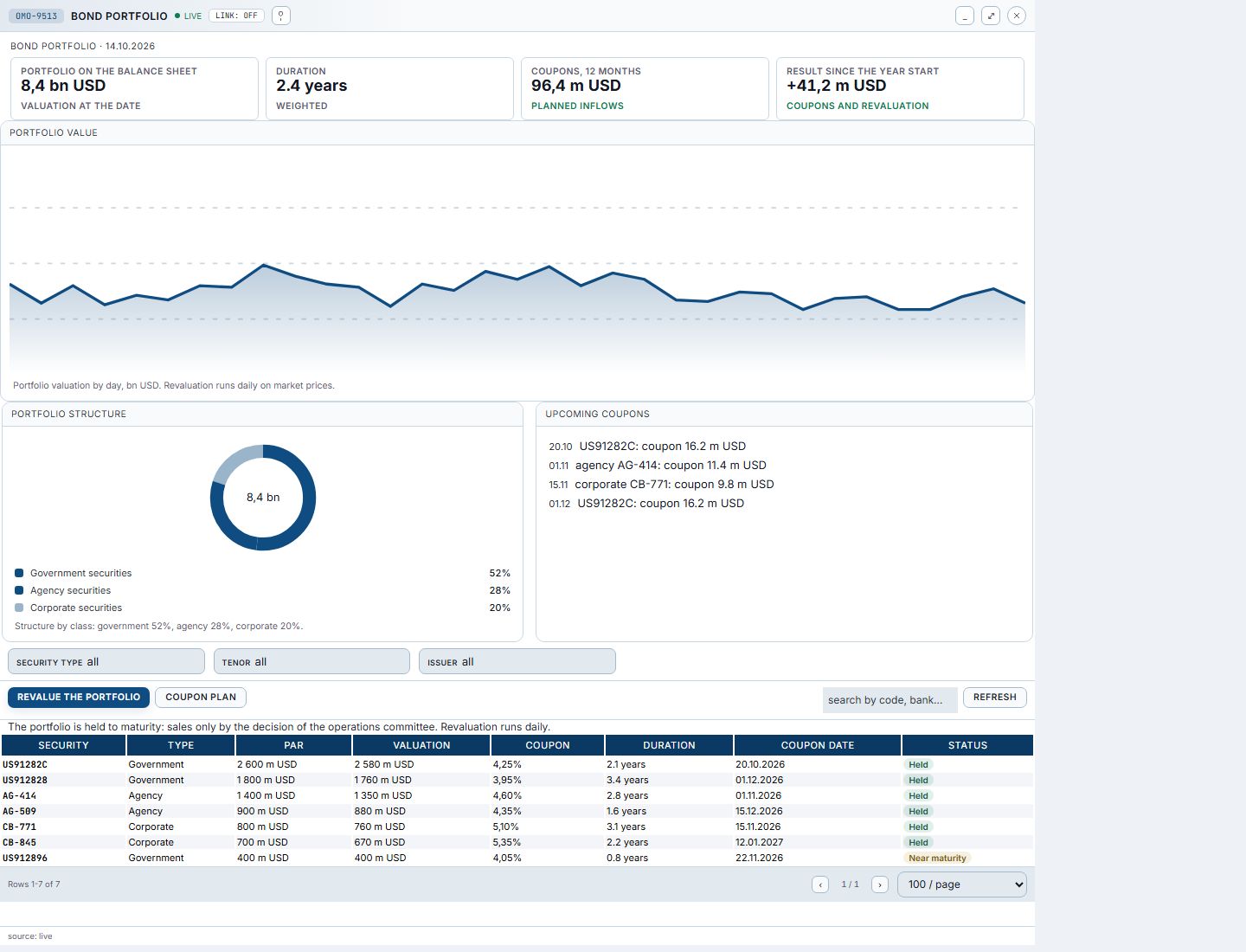
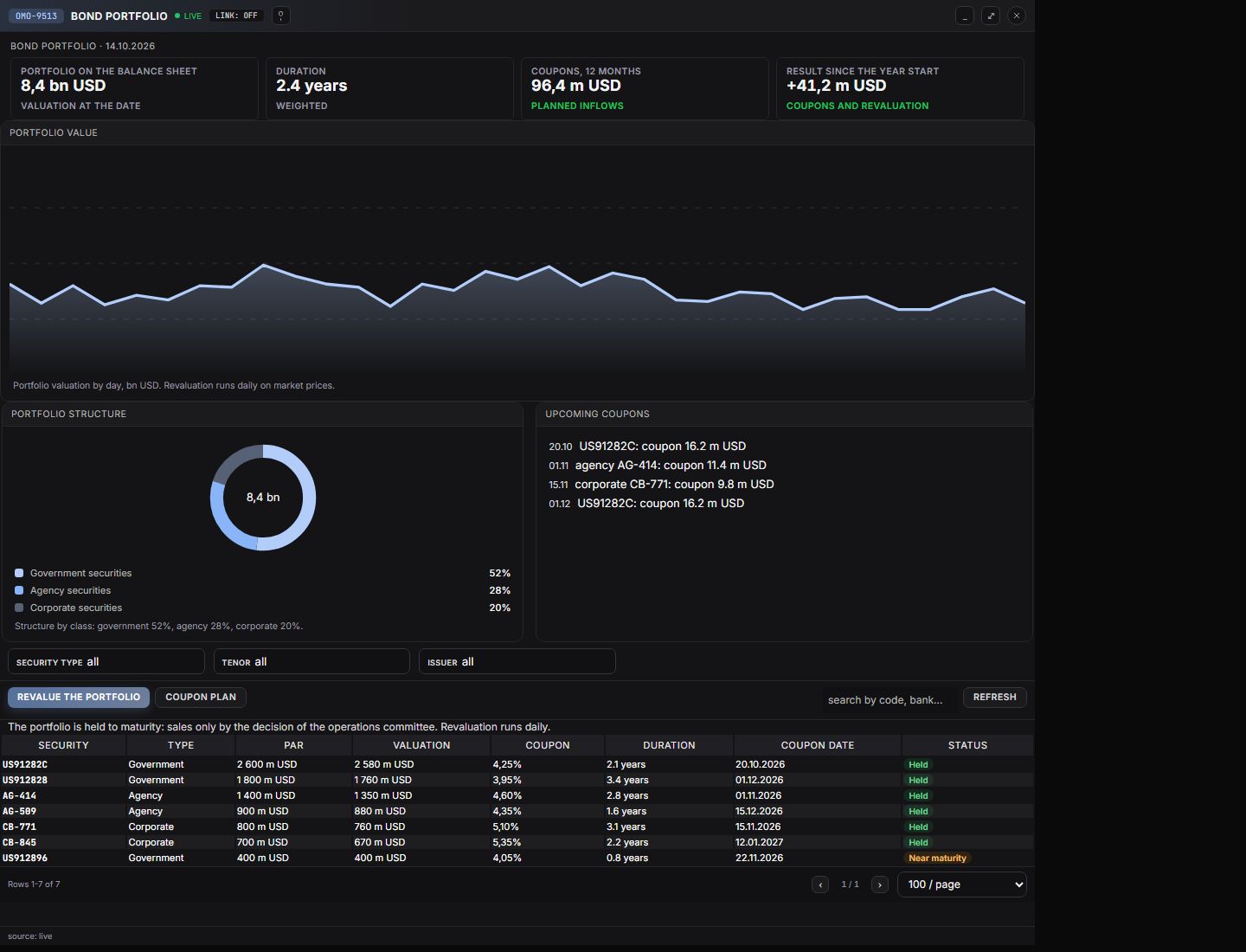
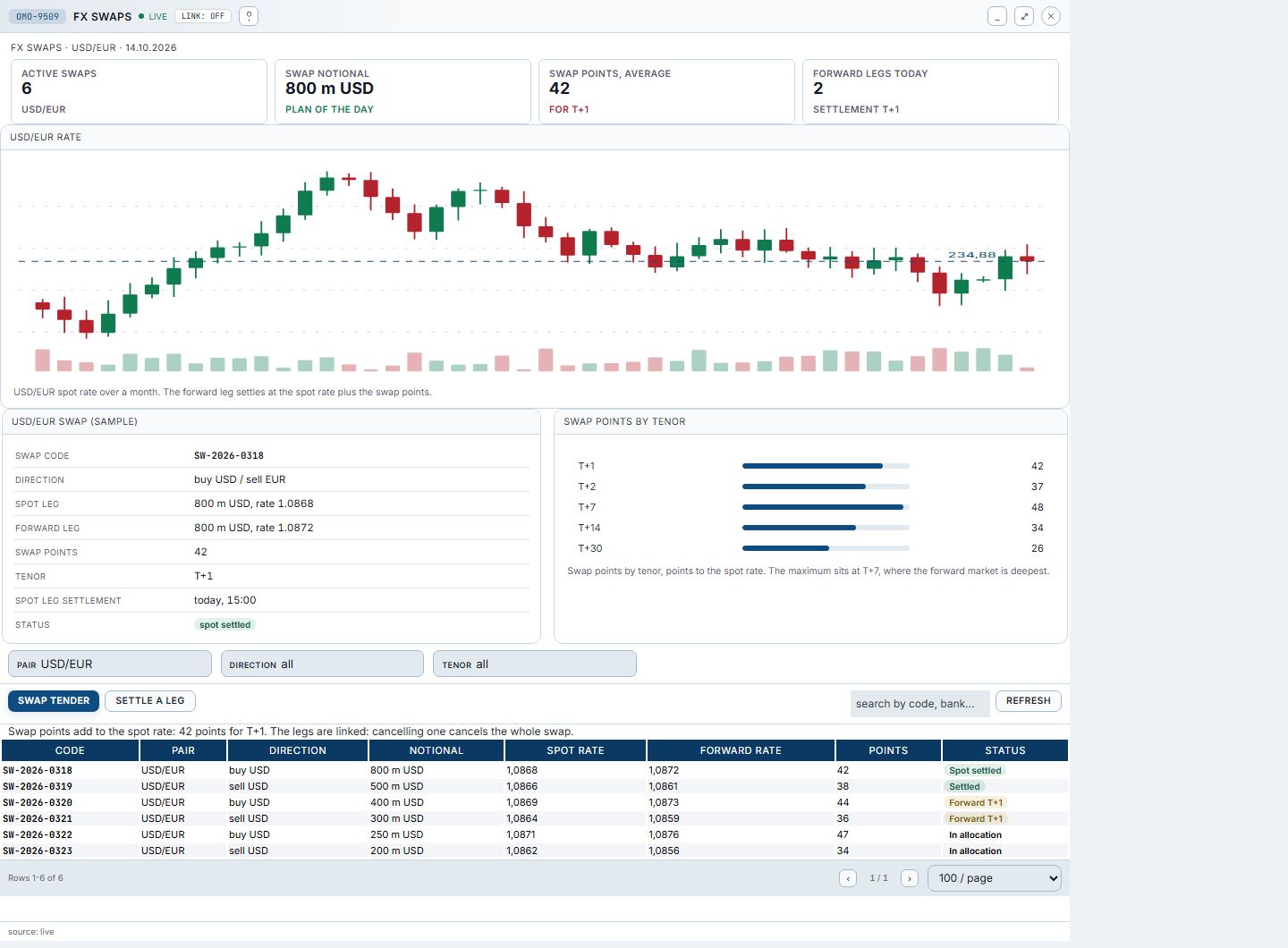
Chart gallery screen with the catalogue of chart types of the library Chart gallery screen with the catalogue of chart types of the library Bond portfolio screen with the valuation chart, the structure donut and the coupons Bond portfolio screen with the valuation chart, the structure donut and the coupons FX swaps screen with the USD/EUR candles and the swap points by tenor
Demo Unifin Open Market Operations Theme Open separately
Operation plan
Operation plan

This is an interface demonstration: the real solution will differ in colours and content for a specific project.

Functions at a glance

Business functions at a glance

From the plan to the second leg.

Operation plan
Keeps the schedule, the windows of the day and the cut-off commands
The desk sees the day by windows and deadlines
Tenders and auctions
Opens the bidding window for every instrument and computes the allocation
The result follows the rules, with no manual sheets
Operations
Runs repo, deposits, ILF, swaps and bilateral deals to closure
Every deal carries its legs and statuses
Bond portfolio
Holds the portfolio with daily valuation and coupon dates
The book and the coupons stay visible
Collateral
Values the pool, computes coverage and raises margin calls
Coverage stays above the threshold
Limits
Checks simple limits before every deal on the money path
A deal above the limit does not pass
Settlement
Runs DvP legs with the central bank system and the CSD
Securities and money move on one atomic rail
Reporting
Builds protocols, publications and statements from live operations
The board and the banks see the result on time

What runs today

The operations cycle, already designed

The plan, the tenders and the post-trade legs.

Plan of the day

The schedule, the windows and the cut-off commands in one place.

Auctions by instrument

One calendar and one result sheet across repo, deposits, ILF and swaps.

Tenders and allocation

An announcement, a bidding window, a stop-out and an allocation.

Repo and deposits

Two legs, interest schedules and payouts on the maturity date.

ILF

Intraday liquidity with repayment by the cut-off and penalties.

FX swaps

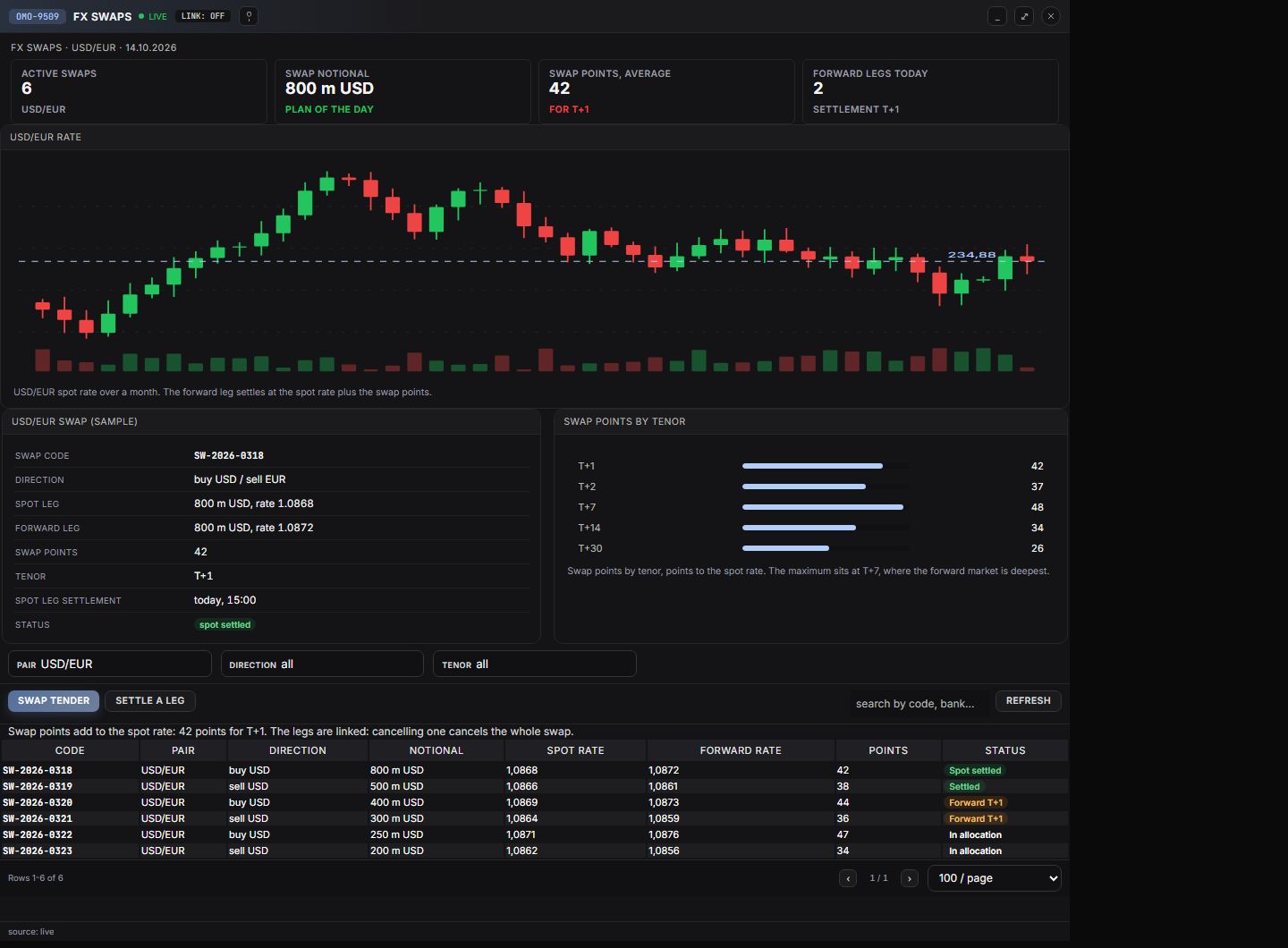
Simple swaps with spot and forward legs and swap points.

Collateral

The pool, haircuts, coverage, margin calls and substitutions.

Bond portfolio

Holdings, daily valuation, duration and coupon dates in one view.

Solution description

Capabilities and overview

Key features

  • The operation plan with windows, schedules and cut-off commands
  • Tender campaigns and auctions by instrument with rate modes and allocation
  • The stop-out and the allocation with the rounding step and caps
  • Repo, reverse repo, deposits, ILF, FX swaps and bilateral deals
  • Collateral: eligibility, haircuts, coverage and margin calls
  • Simple limits by counterparty, instrument and tenor before the deal
  • Interest schedules and payouts by the day count of the instrument
  • The ILF monitor with deadlines, penalties and the overnight flag
  • DvP settlement as sagas with the central bank system and the CSD
  • Reconciliation of balances and positions with both external systems
  • Tender protocols, publications and personal notifications
  • The bond portfolio: holdings, valuation, duration and coupon dates
  • The desk, the counterparty web cabinet and the API in one suite
  • Four-eyes approval for allocations, deals and publications

Product overview

Unifin Open Market Operations is the central bank operations suite of the UniFin platform. It serves central banks and monetary authorities that manage the liquidity of the banking system with their own counterparty banks.

The suite runs the whole cycle. The desk keeps the plan and announces auctions by instrument. Banks submit bids from the web cabinet or the API. Limits and coverage are checked on every bid, and the engine computes the allocation at the close.

Settlement follows the tender. The first leg of a repo is a DvP saga: securities move against money on one atomic rail. The second leg reverses the deal with interest. ILF draws live within the day and return by the cut-off.

The central bank system stays the source of truth for money and the external CSD for securities. The suite keeps a mirror for blocking and reconciles with both on a schedule. When an external system is not available, the money path blocks: fail-closed by design.

The suite reuses the auction engine, collateral, settlement sagas, the depository mirror, the payment adapter and the calendar of the platform. The new service omo-ms owns the plan, auctions, facilities, deals, interest, limits, positions, the bond portfolio and publications.

What it delivers

What the solution delivers

From the announcement to the second leg.

Operation plan

A day without a plan turns into a queue of urgent calls. The suite keeps quarterly and weekly templates, generates the operations and publishes the schedule of windows and cut-offs. With the solution the desk sees the day by windows and deadlines, and every operation has an owner. In setup the templates, calendars and cut-off times stay under configuration.

Tenders

An allocation computed on a spreadsheet is disputed at the first oversight request. The suite opens the bidding window for every instrument and checks limits and coverage on every bid. Then it computes the stop-out and the allocation with the rounding step and the caps. With the solution the result follows published rules and passes four-eyes approval. In setup the rate modes, rounding and caps are configuration per instrument.

Repo and the legs

A repo is judged by its second leg. The suite runs the first leg as a DvP saga and holds the collateral until maturity. On the date it returns the securities and debits the money with interest. With the solution both legs move on one atomic rail, and a failed leg holds the operation with a clear status. In setup the settlement offsets and retry rules come per instrument.

ILF and deposits

Intraday money that is not returned on time becomes an overnight exposure nobody planned. The suite checks the ILF limit and the collateral, disburses the money, monitors the balance and warns before the cut-off. With the solution overdue items open a penalty and an escalation, and deposits accrue interest by the instrument. In setup the cut-off, the penalty scale and the overnight flag are policy.

Collateral and limits

A shortfall discovered at the close is a shortfall too late. The suite revalues the pool, computes coverage and raises a margin call early in the day. Simple limits check every deal before it reaches the money path. With the solution coverage stays above the threshold and a bid above the limit does not pass. In setup eligibility, haircuts and thresholds are reference data.

Settlement and reconciliation

Money and securities that move without a reconciliation leave an open question. The suite drives the central bank system and the external CSD. It keeps a mirror for blocking and reconciles balances and positions on schedule. With the solution a break opens a case with an owner before the day closes. In setup the schedules, formats and tolerances are configuration.

Reporting and the journal

The protocol and the journal answer the questions of the board and the audit. The suite builds the tender protocol, publications, statements and reports from the live operations. With the solution every action, approval and publication stays in the immutable journal with the actor, the time and the basis. In setup the report scope and the dispatch schedule stay visible.

Coverage

What it covers

The suite from the plan to the protocol.

Plan and schedule

The plan, templates, announcements and the windows of the day.

Instruments

The catalogue with rate modes, tenors, day count and settlement modes.

Auctions by instrument

One calendar and one result sheet across instruments.

Tenders and auctions

A campaign with bids, the stop-out, the allocation and the protocol.

Facilities

ILF and deposits with interest, penalties and auto-renewal.

Deals

Bilateral offers, acceptance, confirmation and the four-eyes route.

Limits and counterparties

Simple limits, channels, instruments and statuses per bank.

Positions

Exposure by counterparty and instrument from the live operations.

Bond portfolio

Holdings, daily valuation, duration and coupon dates.

Publications

Results, protocols and exports for internal and external channels.

Stand

Screens of the solution

The plan and the auctions, the tender card, operations, FX swaps, the bond portfolio, the counterparty bid and the charts library.

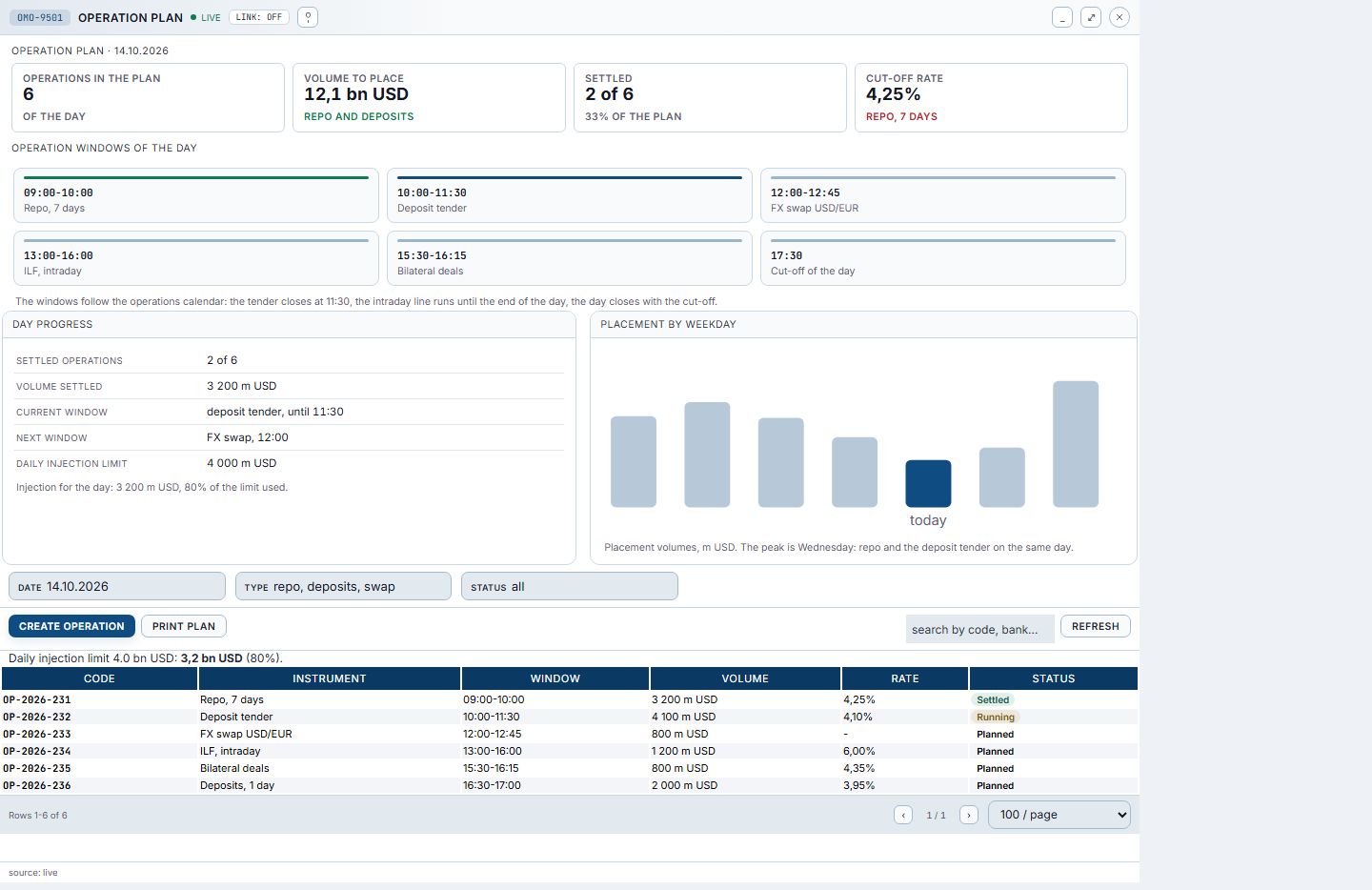
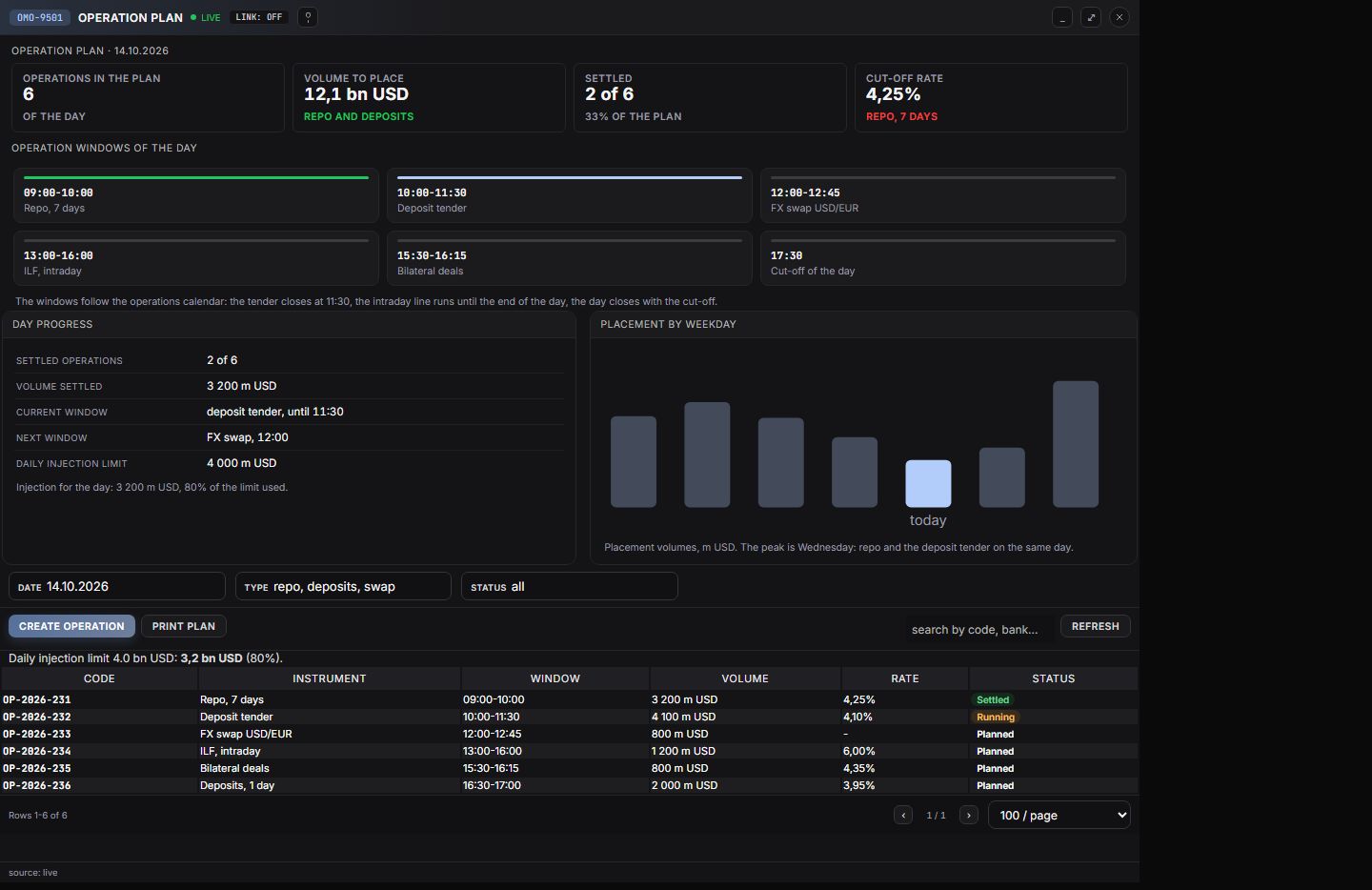
Operation plan screen with the windows of the day and the weekly placement
The operation plan: the windows of the day, the week and the statuses
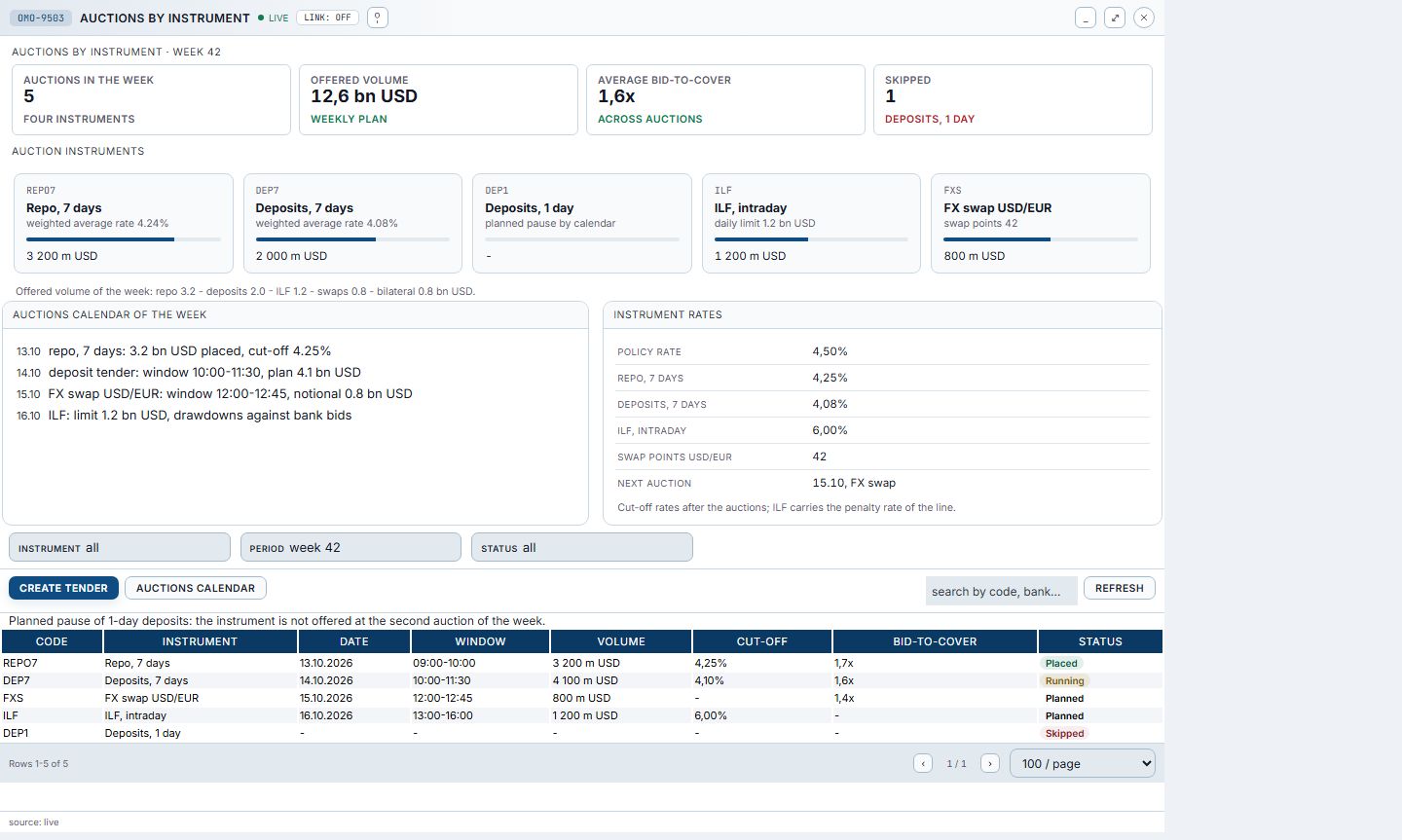
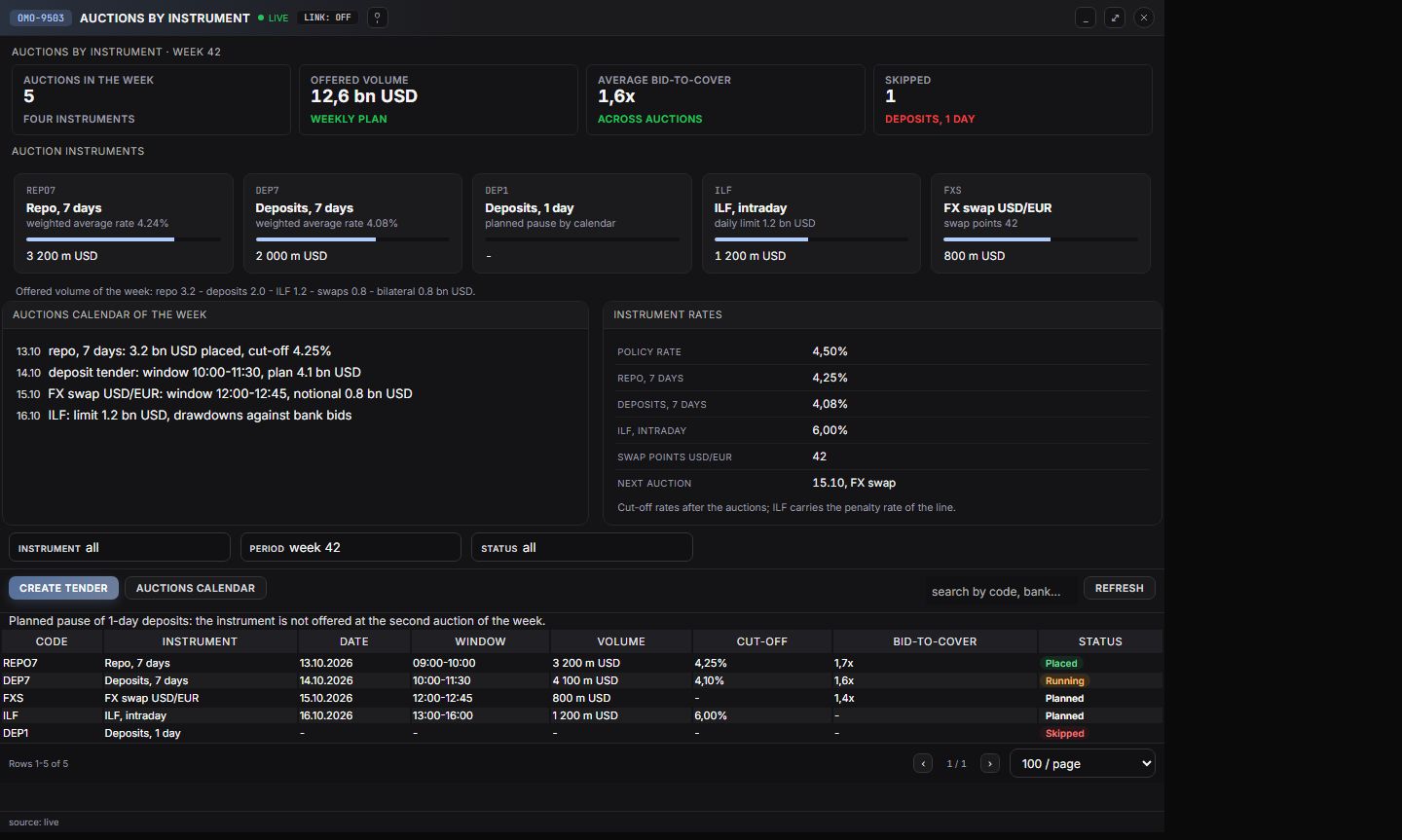
Auctions by instrument screen with the instrument cards and the week calendar
Auctions by instrument: one calendar and one result sheet across repo, ILF and swaps
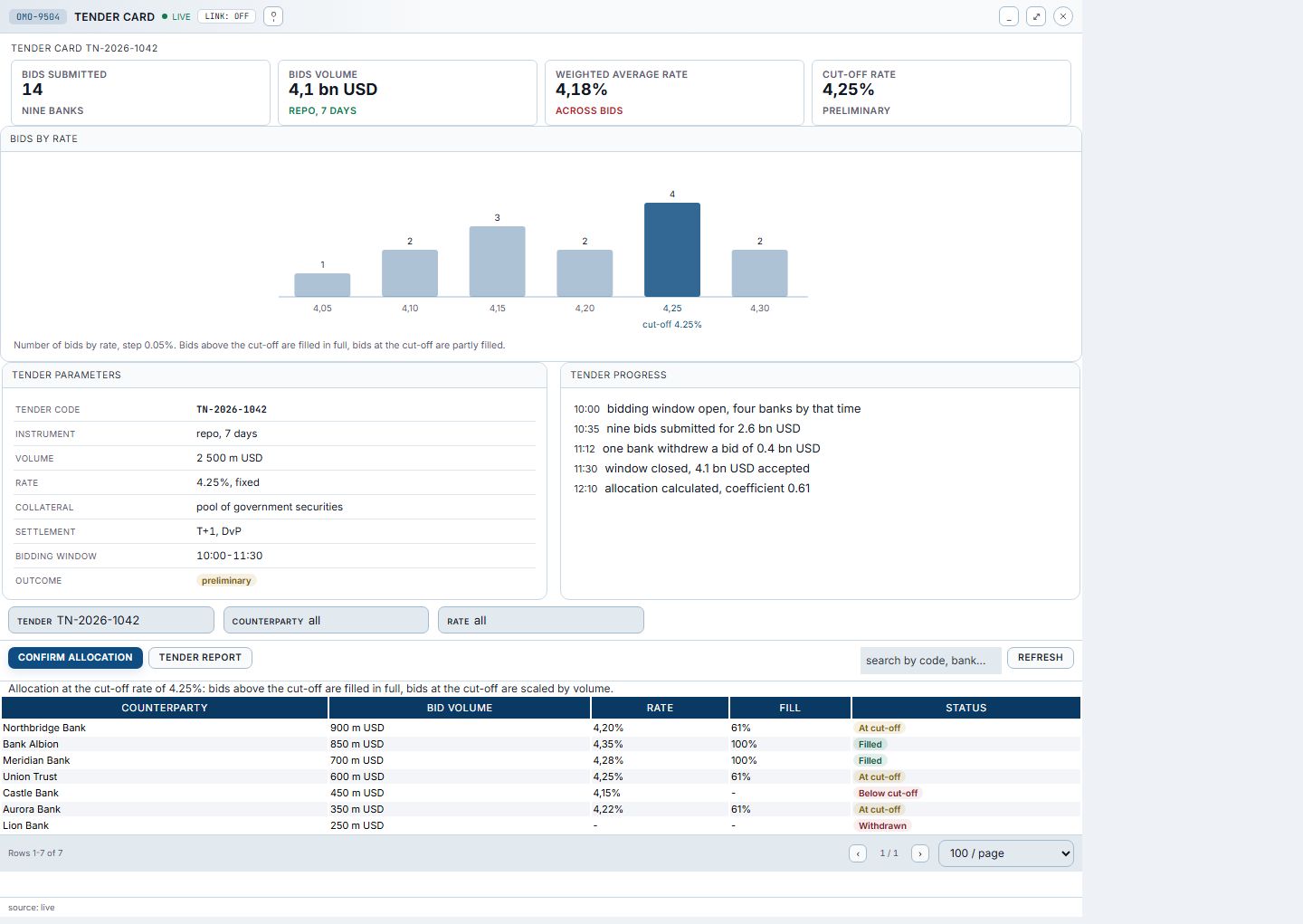
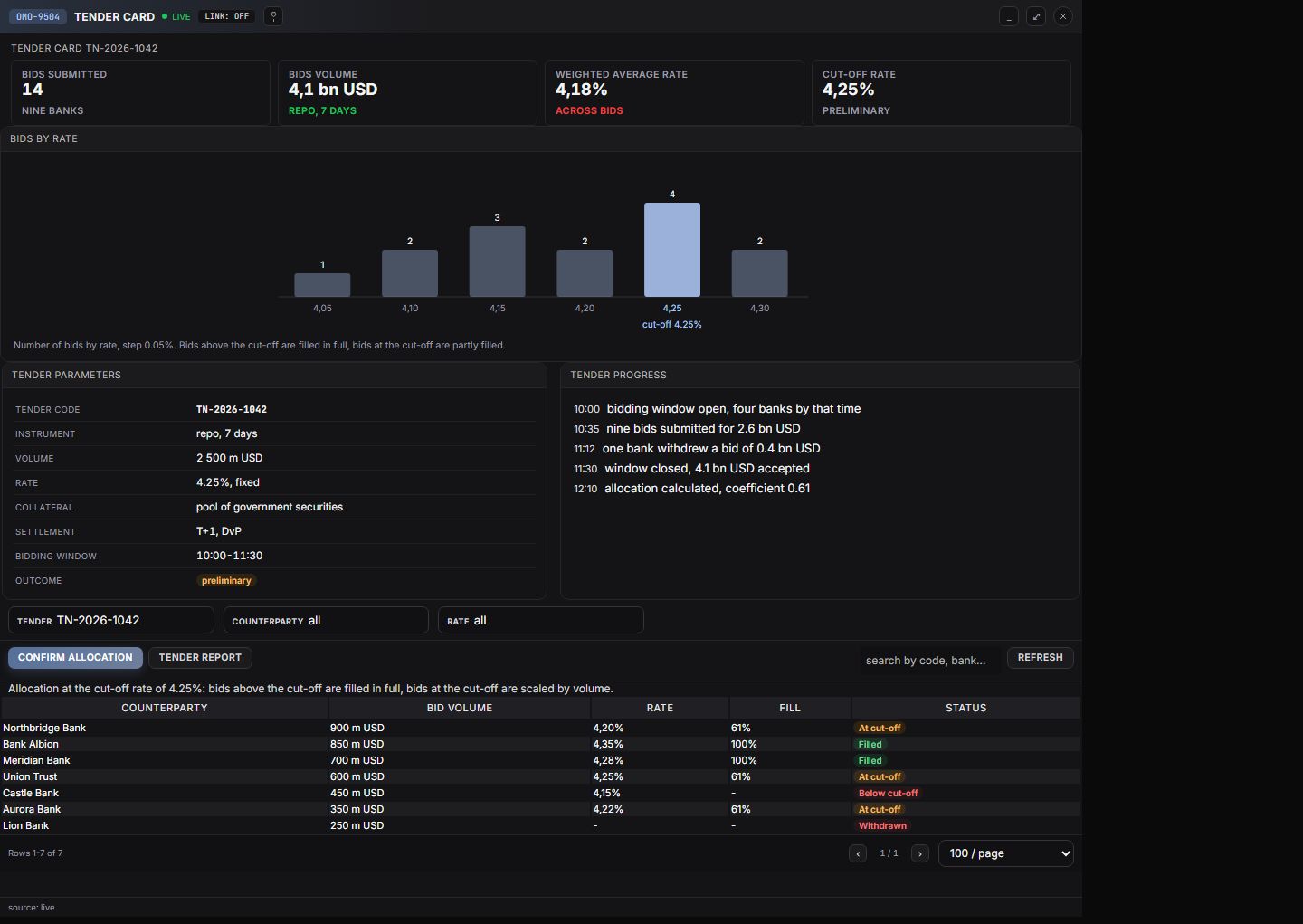
Tender card screen with the bid histogram and the allocation route
The tender card: bids by rate, the cut-off, the allocation and the approval
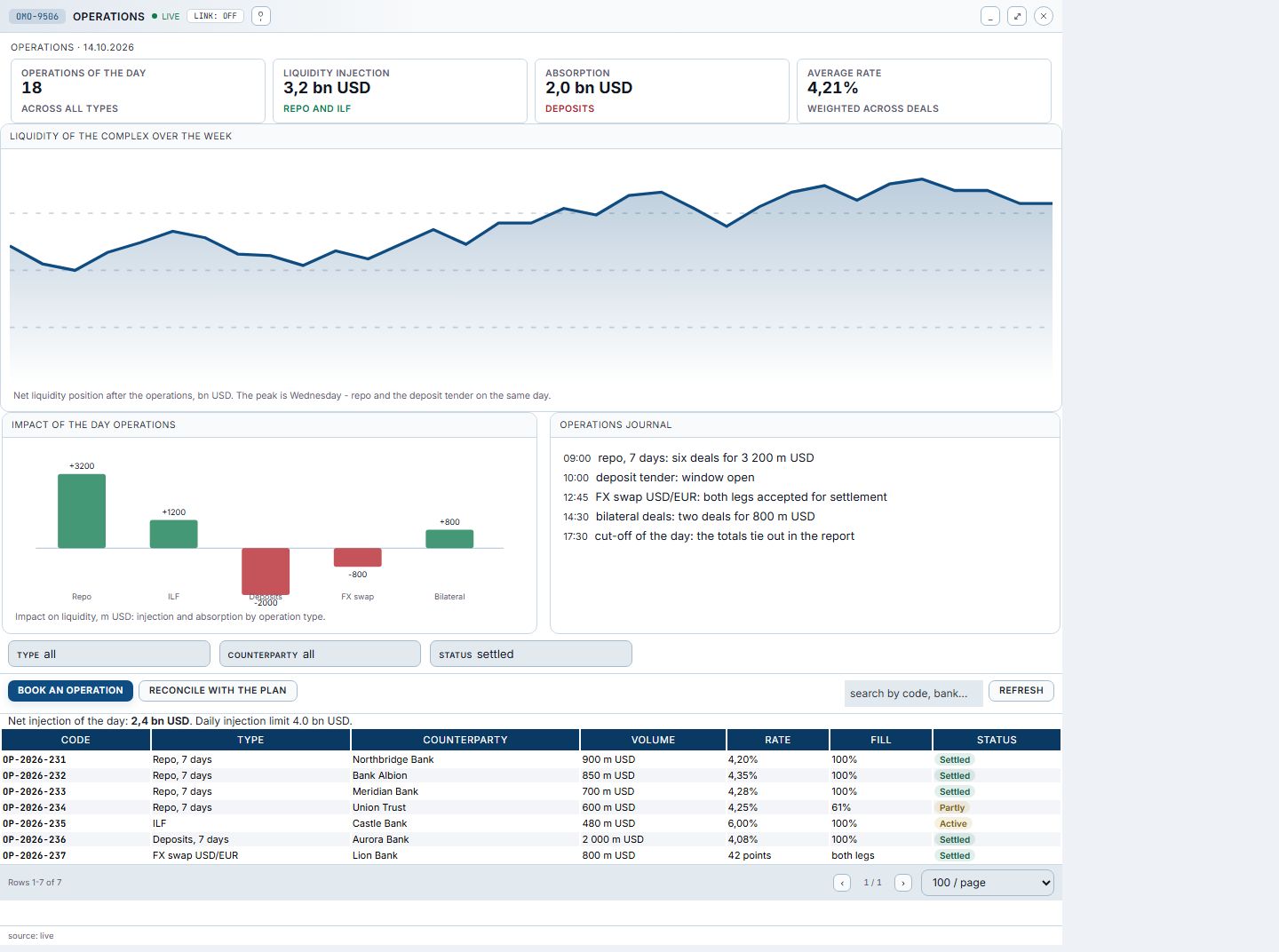
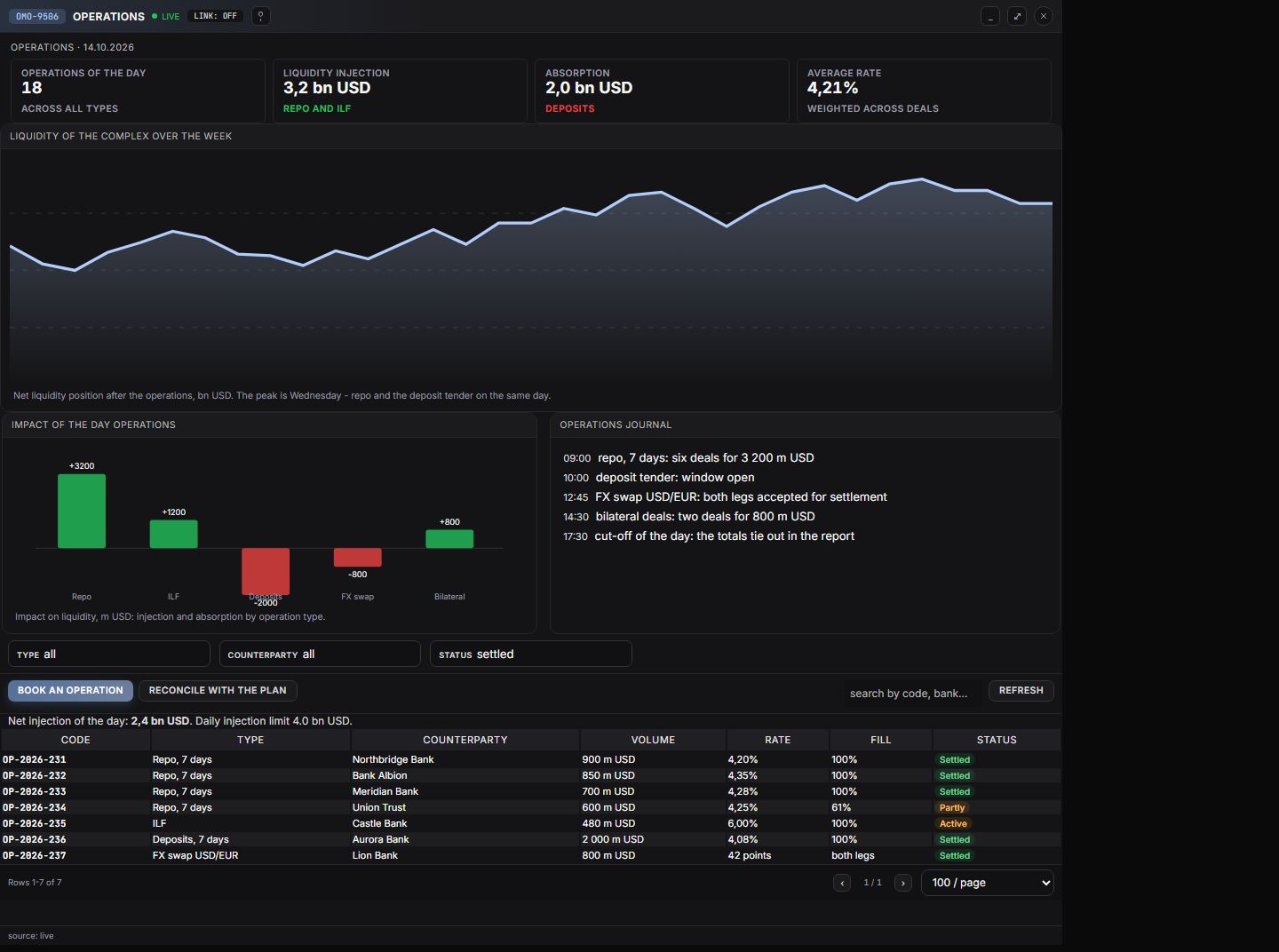
Operations screen with the liquidity area chart and the impact waterfall
Operations: the liquidity curve, the impact of the day and the deals
FX swaps screen with the USD/EUR candles and the swap points by tenor
FX swaps: the USD/EUR rate, the swap points and the linked legs
Bond portfolio screen with the valuation chart, the structure donut and the coupons
The bond portfolio: the valuation, the structure and the coupon calendar
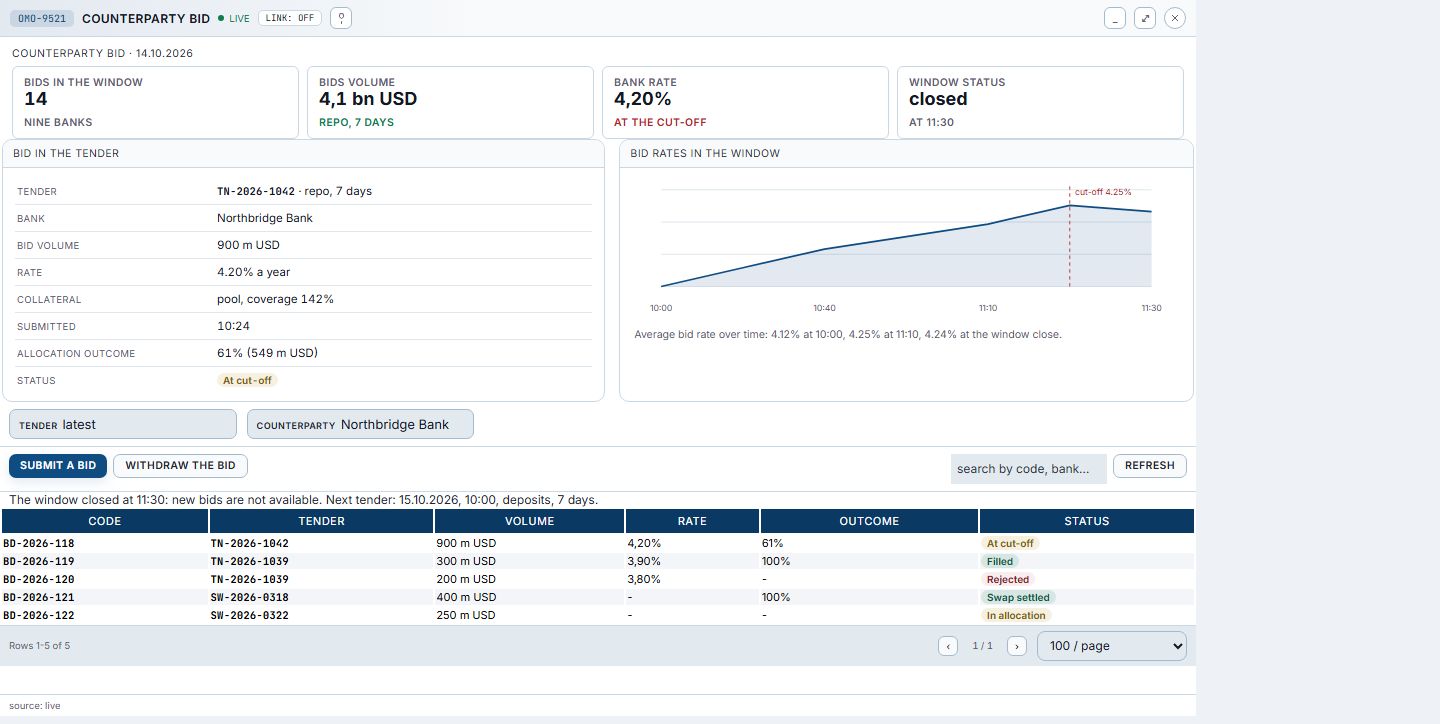
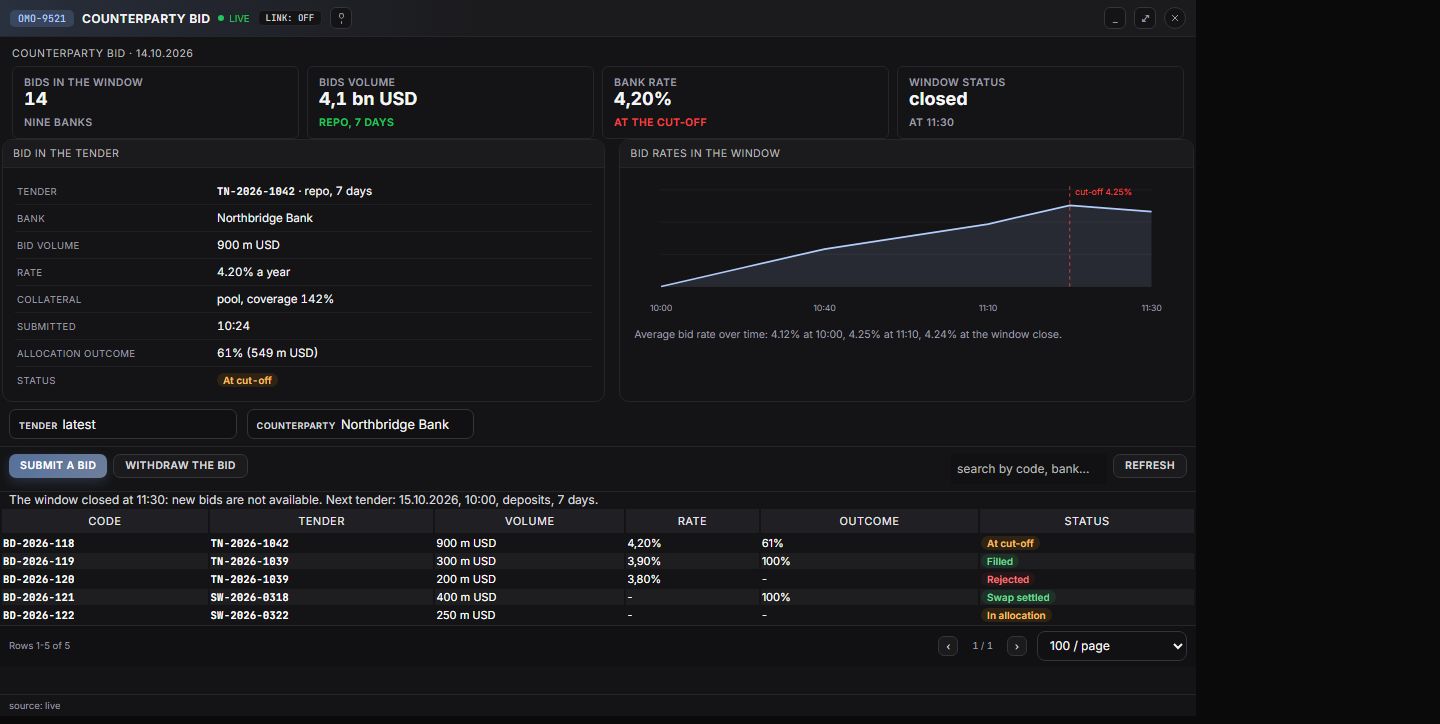
Counterparty bid screen with the bid card and the bid rates over the window
The counterparty bid: the closed window, the bid card and the rate line
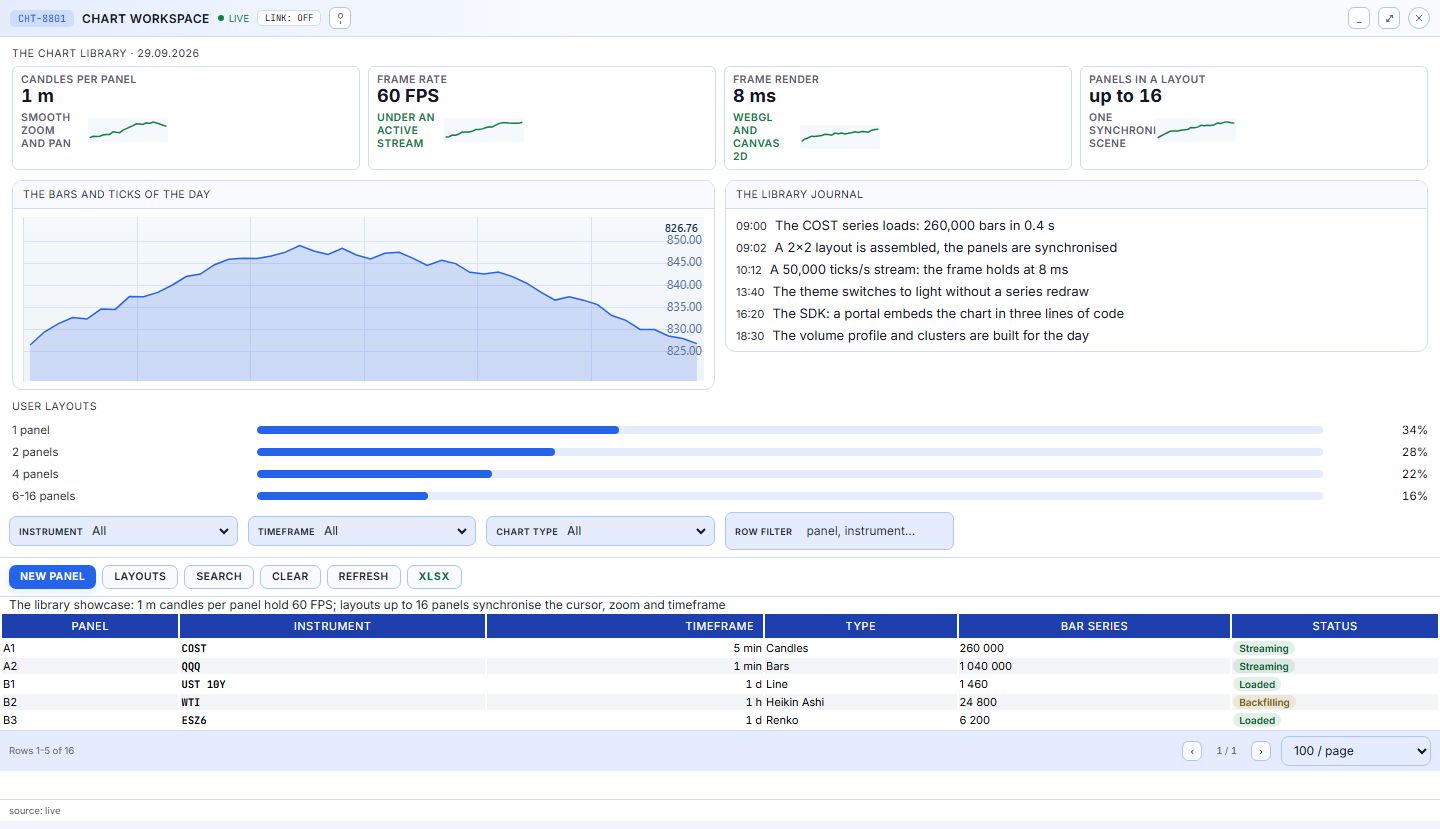
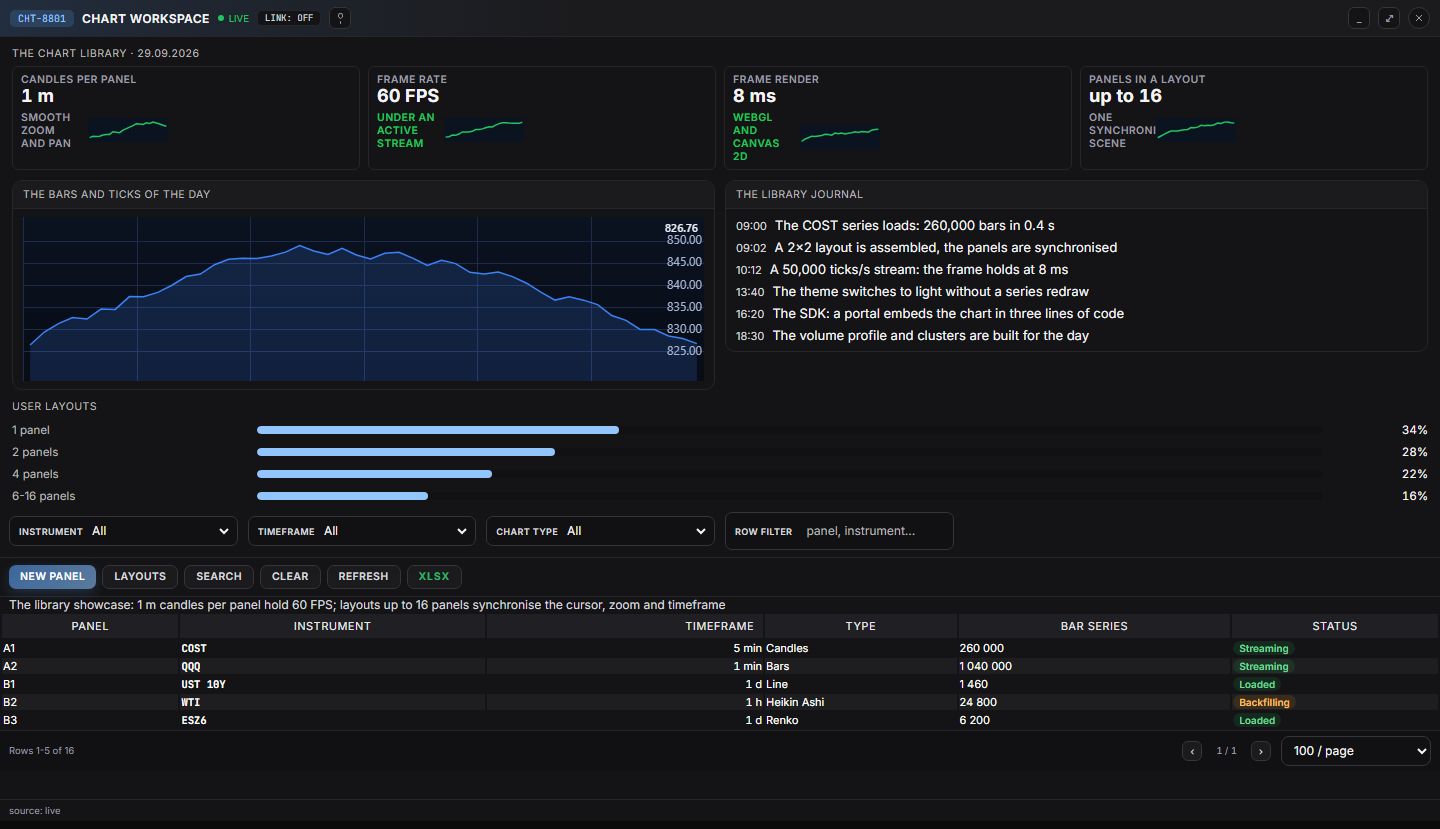
Chart workspace screen used for rate and liquidity monitoring
Rate and liquidity monitoring on the chart workspace of the library
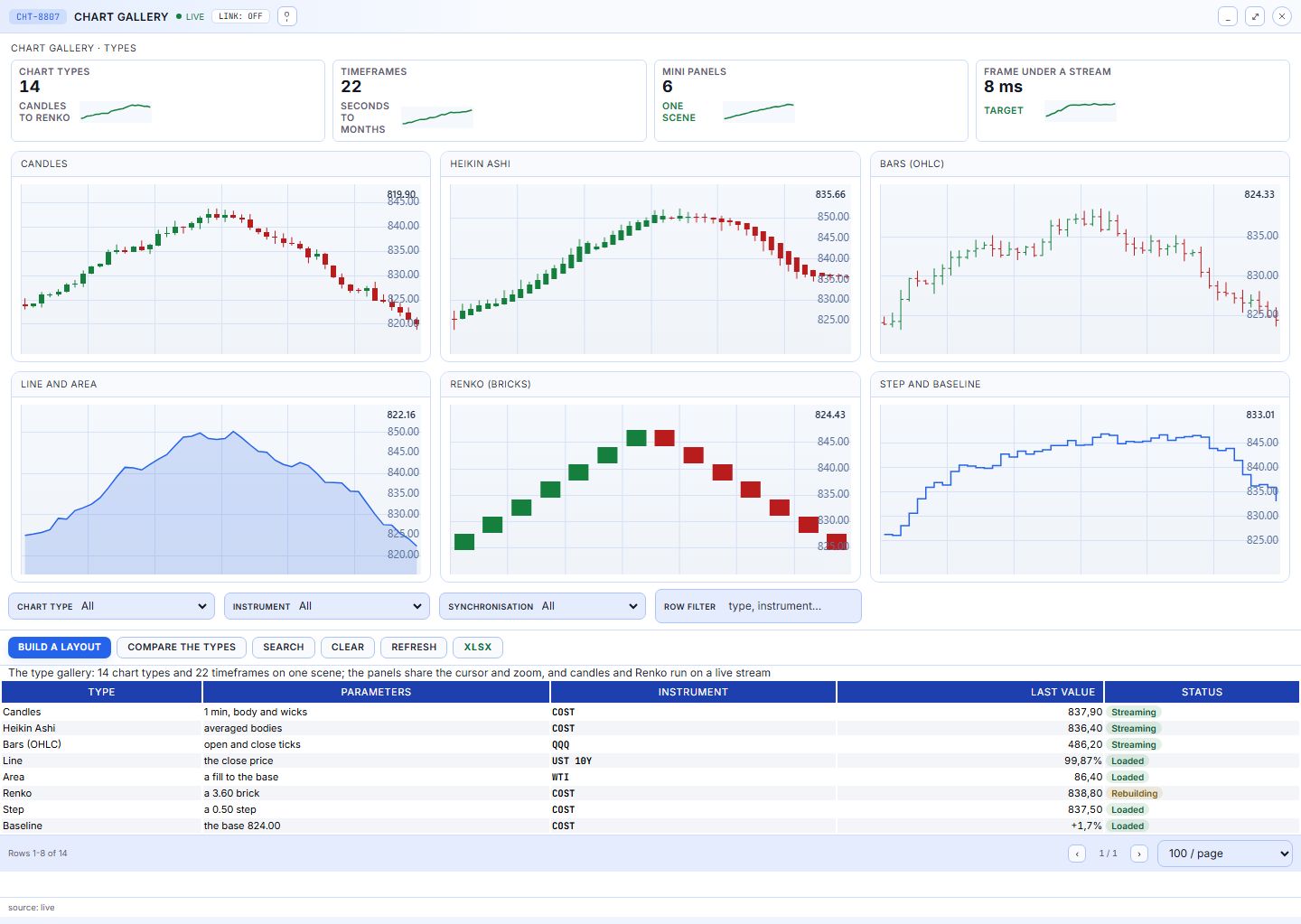
Chart gallery screen with the catalogue of chart types of the library
The chart gallery of the library: signal and comparison chart types

How it works

A tender from the plan to the second leg

A tender from the plan to the second leg.

  1. 1

    The plan and the announcement

    A weekly template forms the tender; the desk publishes it.

  2. 2

    The bidding window

    Banks submit bids; limits and coverage are checked on every one.

  3. 3

    The stop-out and approval

    The engine computes the stop-out and the allocation; risk approves.

  4. 4

    The settlement of the legs

    The first leg moves securities against money through the CB system.

  5. 5

    The maturity and closure

    The second leg closes the repo; the operation goes to reports.

Industries

Industries it serves

The suite serves central banks and their counterparty banks, settlement systems and the market infrastructure around them.

Architecture

Architecture and access

The architecture rests on the operations core and the settlement rail. The plan, tenders, facilities, collateral and the journal.

Service core

The plan, tenders, facilities, deals, interest, limits and publications in one service.

Reuse

Bids, collateral, settlement, the depository mirror, money and swaps come from platform services.

Money and securities

The CB system is the source of money and the external CSD of securities.

Reliability

Fail-closed on the money path, idempotent commands and the transactional outbox.

Observability

Metrics on tender windows and settlements, alerts on overdue items and breaks.

AI layer

The layer drafts the day summary and answers questions on operations; people decide.

Architecture scheme The same architecture as a standalone page. Open the diagram separately

Readiness

Ready today, next in line

The base is in place; next: outright and margin.

Ready today

  • The operation plan and the windows of the day
  • Auctions by instrument with one result sheet
  • Tenders with the stop-out, the allocation and four-eyes approval
  • Repo and deposits with two legs and interest payouts
  • ILF with the cut-off repayment and penalties
  • Collateral: the pool, haircuts and coverage
  • FX swaps and bilateral deals
  • The bond portfolio with valuation and coupon dates

Next in line

  • Outright purchases and sales (plan)
  • FX swap margin and revaluation (plan)
  • A limit hierarchy and VaR from the risk suite (plan)
  • An external publication channel through the service bus (plan)

Releases

Release history

Quarterly releases from the foundation of the platform (2020); the operations suite arrives in waves.

2026 Q4

  • The operation plan and the schedule templates.
  • The instrument catalogue, counterparties and simple limits (plan).

2027 Q1

  • Tenders with fixed and variable rate, the stop-out and the allocation.
  • Auctions by instrument with one result sheet (plan).
  • Four-eyes approval and the publication of results (plan).

2027 Q2

  • Repo and deposit legs with DvP settlement and interest.
  • The bond portfolio with valuation and coupon dates (plan).
  • ILF, FX swaps and bilateral deals (plan).

Detailed description

Detailed description

The plan, auctions, tenders, settlement, collateral and the journal.

How the suite is assembled

Channels and clients
FIX 4.2 / 4.4 / 5.0, REST with mTLS, SFTP files, web portals
Edge and access
API gateway with 126 routes, Keycloak single sign-on, WAF and CSP
Platform core services
omo-ms auction-ms collateral-ms settlement-ms AI agentic layer Services of the suite on the shared platform core
Data and events
PostgreSQL 17 per service, Redis 7, RabbitMQ 3.13 quorum queues, transactional outbox
Results and reporting
Portals, reports, regulator and partner channels

Plan, windows and the day

  • The desk keeps quarterly and weekly templates and confirms the parameters of each operation.
  • Windows of bidding, settlement, ILF and deposits open and close by the central bank calendar.
  • Cut-off commands close the windows on schedule; a late request carries a status and an escalation.
  • Every change of the plan is journaled with the actor, the time and the basis.

Tenders and allocation

  • Auctions by instrument share one calendar and one result sheet across repo, deposits, ILF and swaps.
  • A tender carries the instrument, volume, rate mode, window, settlement dates and collateral mode.
  • Bids arrive from the web cabinet and the API; limits and coverage are checked at entry.
  • The engine runs fixed-rate pro-rata or variable-rate multiple-price and uniform-price modes.
  • The stop-out, the rounding step and the caps produce the allocation; risk approves with four eyes.

Post-trade: legs, ILF, deposits and swaps

  • The first leg of a repo is a DvP saga: securities against money on one atomic rail.
  • The second leg returns the securities and debits the money with interest on the maturity date.
  • ILF draws live within the day and return by the cut-off; a delay opens a penalty and a roll flag.
  • Deposits accrue interest per the day count of the instrument and auto-renew on a flag.

Collateral and limits

  • The pool is revalued daily and on events; coverage is computed against the outstanding operations.
  • A margin call carries a deadline; a substitution keeps the coverage and releases the replaced paper.
  • Simple limits check the amount by counterparty, instrument and tenor before every deal.
  • A shortfall blocks new bids of the bank until the deficit closes: fail-closed by design.

Settlement, reconciliations and the journal

  • Money moves through the central bank system; securities at the external CSD over ISO 20022 and files.
  • Balances are reconciled with the central bank system and positions with the CSD on schedule.
  • Every command is idempotent: a repeated request returns the same result.
  • The journal is immutable: the actor, the time and the basis of every action.

The bond portfolio

  • The central bank portfolio keeps holdings by issue with daily valuation and duration.
  • The coupon calendar shows the nearest inflows; the result report combines coupons and revaluation.
  • A sale runs only by the committee decision and leaves a record in the journal.

AI layer

  • The AI layer drafts the day summary and the draft protocol from the live operations.
  • Questions on the plan, tenders and balances are answered from the register and the journal.
  • Alerts flag upcoming deadlines and breaks before they become incidents.
  • People approve: the agent prepares, the officer decides.
Detailed description

Leave your contacts to open the detailed description and download the PDF with architecture, cases and delivery details.

Ask about open market operations

Bring one tender type or one settlement date. We will show the path from the announcement to the allocation and the second leg.