UNIFINplatform

Solution

Unifin Clearing Lense

Clearing houses sell certainty, and certainty starts with control over trades and fees.
The suite takes the flow from every mechanism, runs pre-clearing checks and calculates fees.
One snapshot and one rule version give one amount; a dispute closes with an explanation.

  • Deterministic fees
  • Full traceability
  • Checks before settlement
All solutions

Live screens from the product terminals

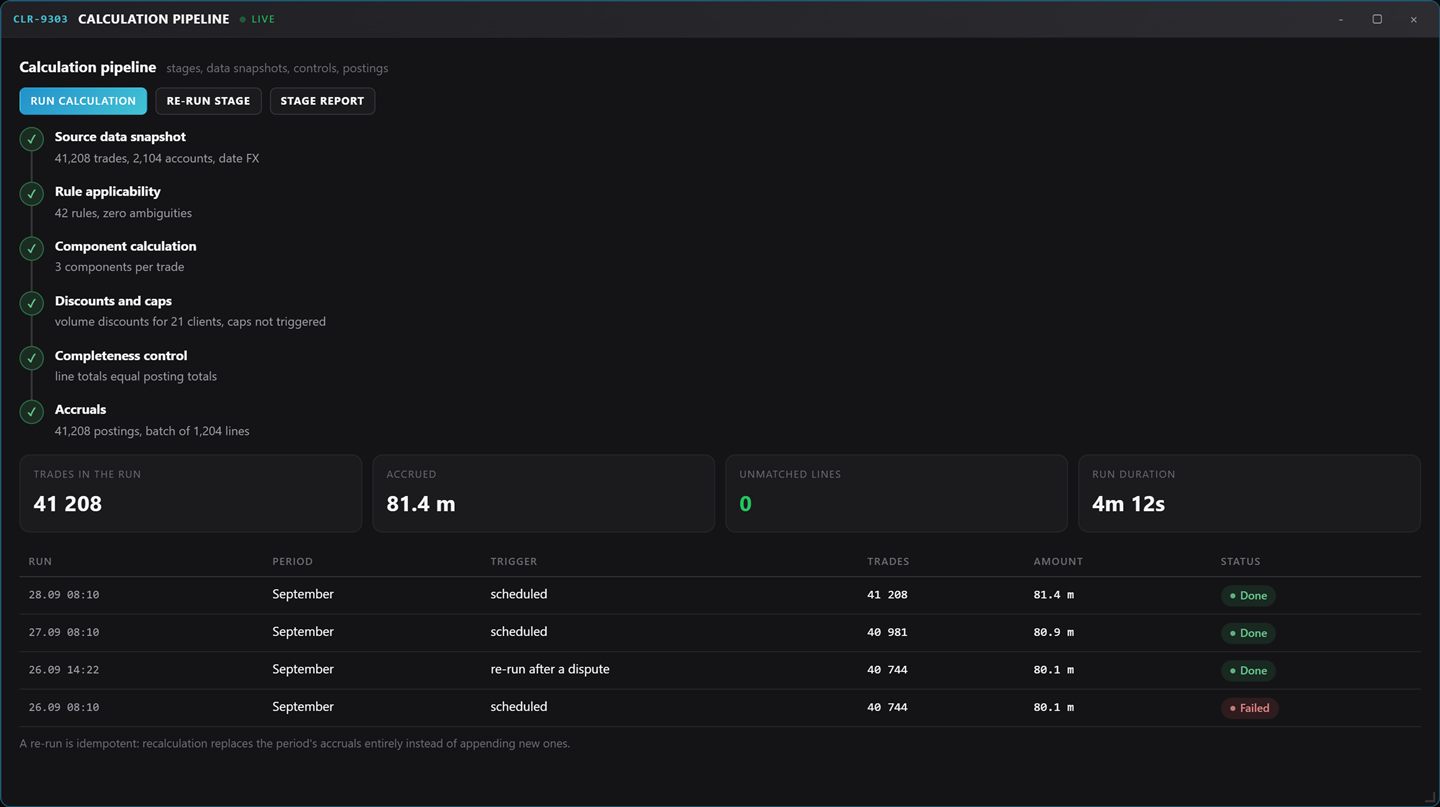
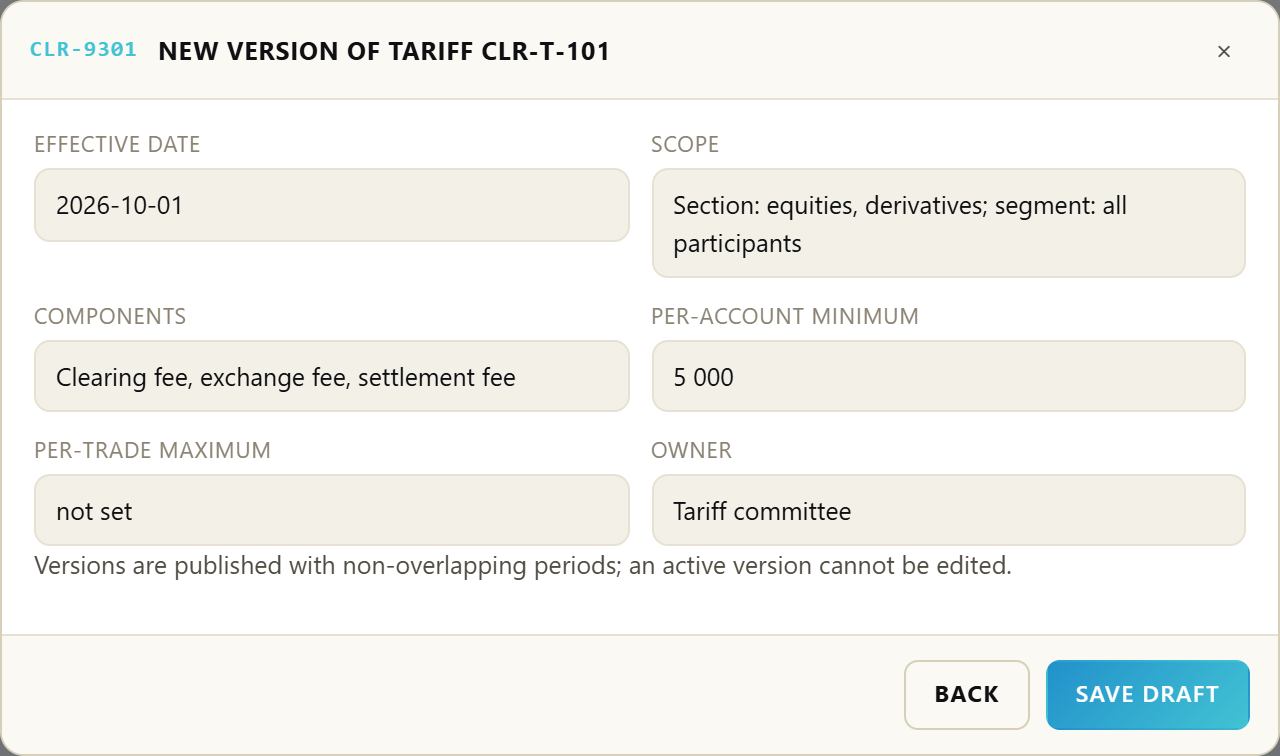
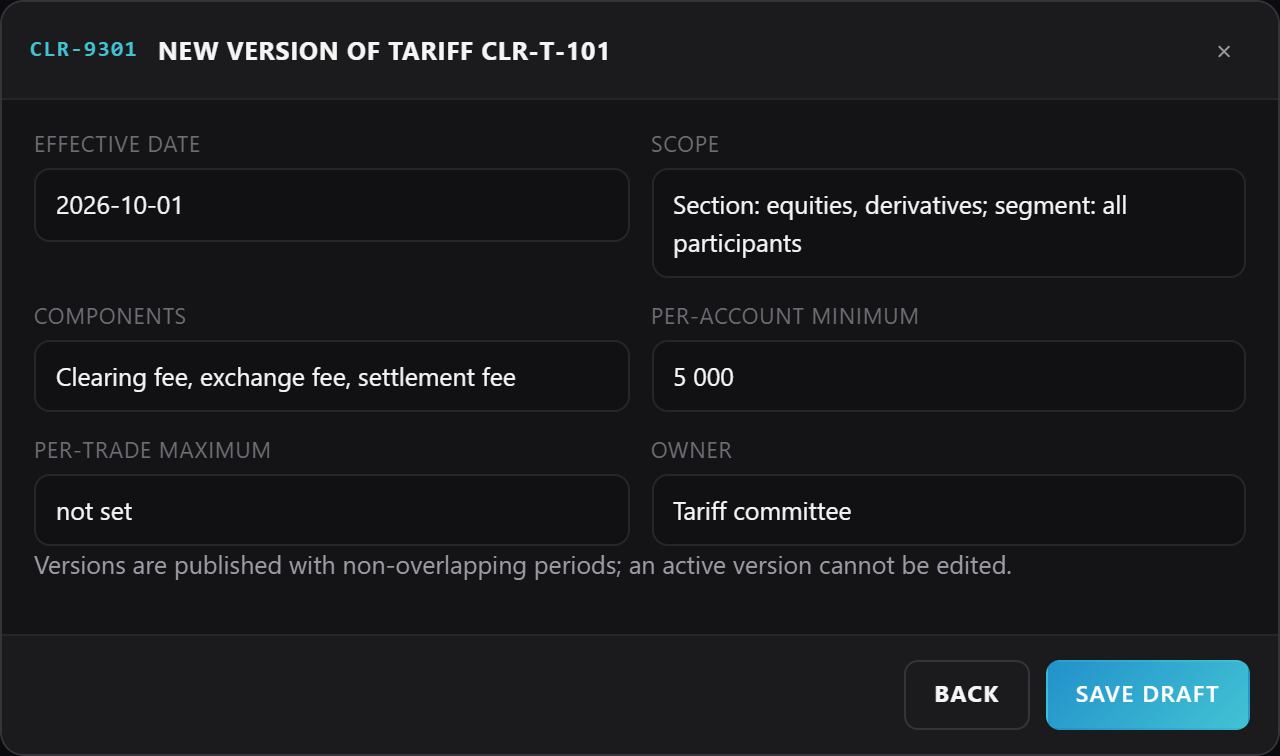
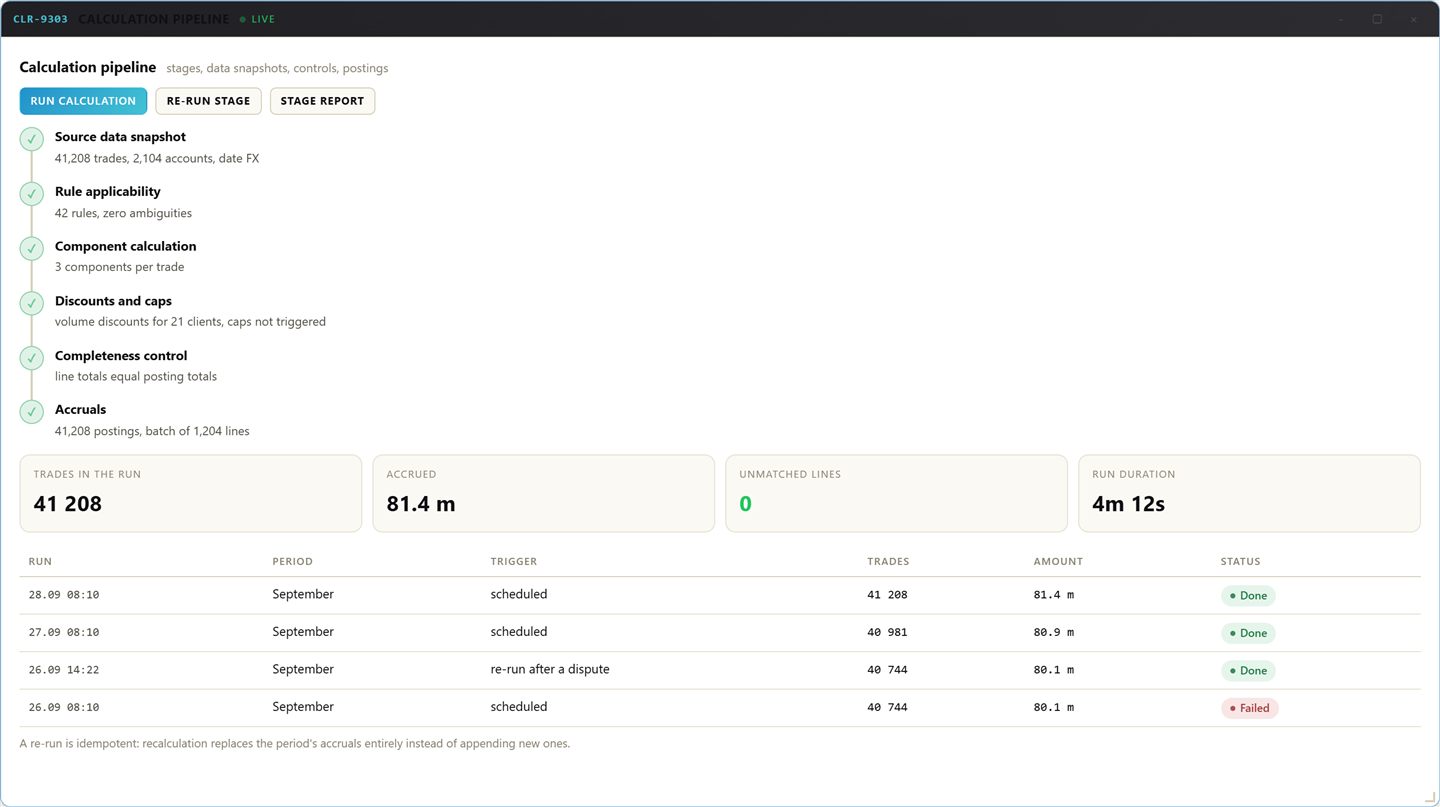
Calculation pipeline screen Calculation pipeline screen New tariff version: scheme, components and effective dates New tariff version: scheme, components and effective dates Tariff studio screen
Demo Unifin Clearing Lense
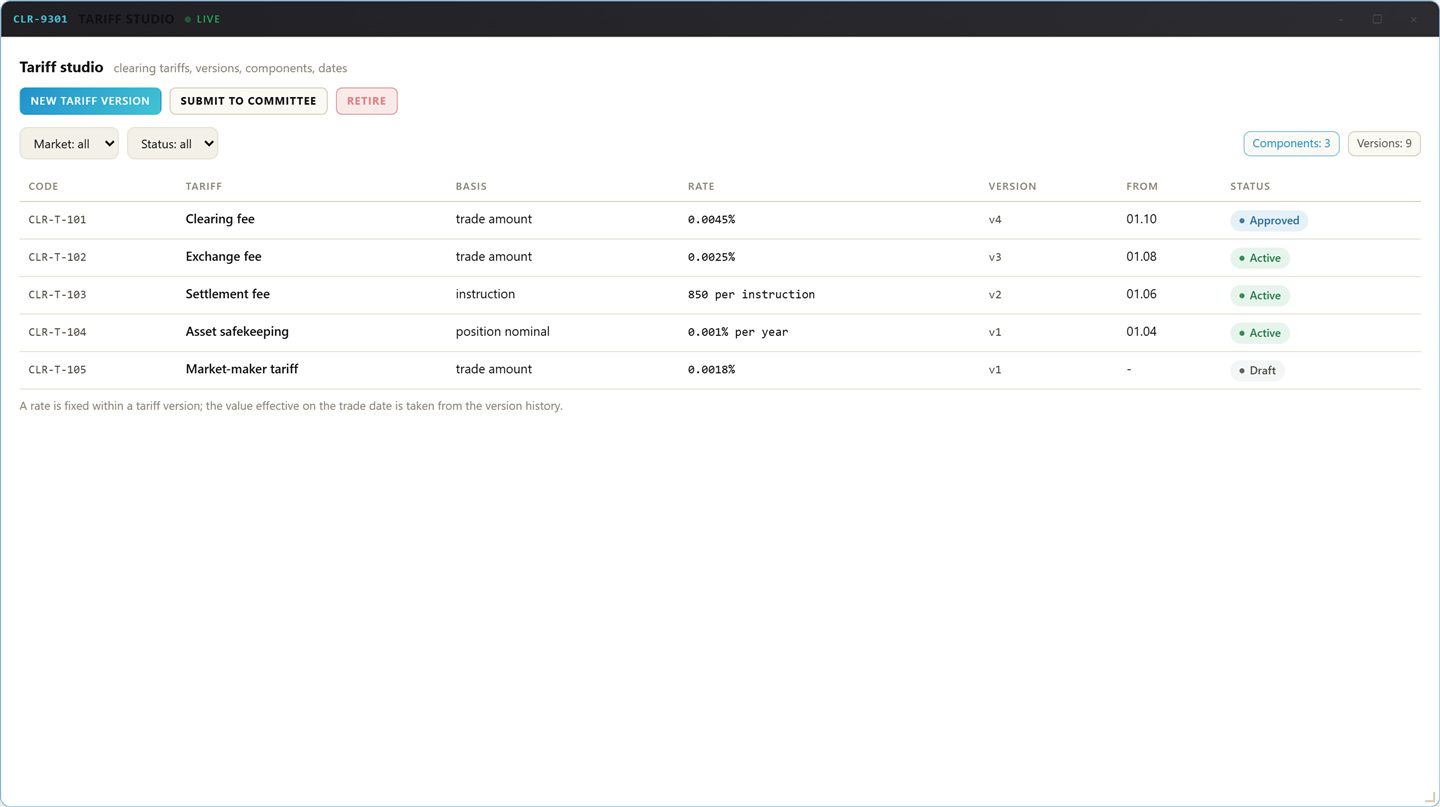
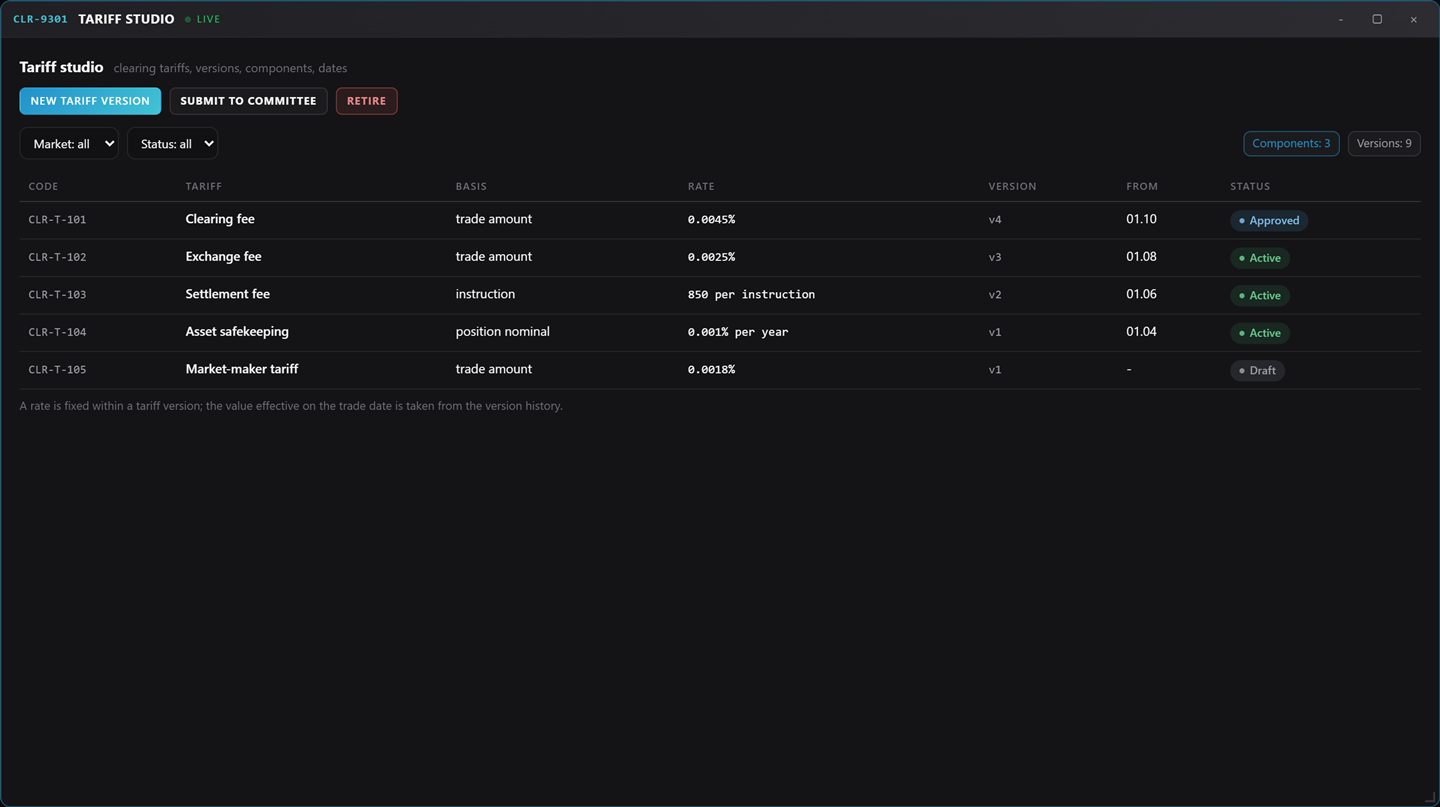
Tariff studio
Tariff studio: schemes, versions, components and effective dates
Tariff studio
Tariff studio: schemes, versions, components and effective dates

This is an interface demonstration: the real solution will differ in colours and content for a specific project.

Functions at a glance

Business functions at a glance

From trade intake to invoices and reconciliation.

Trade intake
Takes the flow from every venue mechanism
No trade is lost on the way
Pre-clearing checks
Passes trades through a checklist before settlement
Expensive surprises stay behind
Obligations and netting
Builds positions and obligations of participants
Netting runs from the accepted flow
Deterministic engine
Computes fees with tiers, caps and taxes
One amount for the same inputs
Explainable amounts
Keeps a snapshot and rule behind every accrual
A dispute closes with an explanation
Tariff simulator
Runs a draft tariff on history
The committee decides on the delta
Invoices and reconciliation
Issues invoices and reconciles fees with the venue
The period closes without breaks

What runs today

Fees and the CCP core, already running

Fees and the CCP core: the live parts.

Tariff studio

Tariffs and calculation rules live in the studio.

Pipeline

The calculation pipeline is deterministic and traceable.

Invoices

Fee invoices run with VAT, collection and disputes.

CCP core

Novation, netting, sessions and margin calls run in the CCP core.

Default fund

The default fund runs hash-chain waterfall and default auction.

Roadmap

Give-up and allocations are next in line.

Solution description

Capabilities and overview

Key features

  • Trade intake from every mechanism of the venue
  • Pre-clearing checks against a checklist before settlement
  • Participant obligations and net positions
  • Deterministic fee engine: tiers, caps and taxes
  • Explainable amounts: a snapshot and rule per accrual
  • Tariff simulator on the historical data of the venue
  • Accounts, accruals and collection by periods
  • Fee reconciliation with the venue and break handling
  • Disputes closed with an explanation of the calculation
  • Rule versioning and audit of tariff periods
  • Journal of every accrual and rule change
  • Deployment: by configuration, within the UniFin platform

Product overview

Unifin Clearing Lense is the UniFin platform clearing fee and settlement suite for clearing houses and market operators.

The suite takes the flow from every mechanism, runs pre-clearing checks and calculates fees with a deterministic engine.

One snapshot and one rule version give one amount: a dispute closes with an explanation from the journal.

The simulator runs a draft tariff on history, while invoices and reconciliation confirm every accrual.

The solution runs standalone or as part of the UniFin platform and is configured to the tariff policy.

What it delivers

What the solution delivers

Trade intake

Trades are usually taken from several mechanisms by hand, and the completeness of the day is in question. The solution takes continuous trading, auctions and OTC registration in real time and in batches. With the solution no trade is lost. In setup completeness against the venue stream and the intake queue are visible, and the mechanisms come as reference data.

Pre-clearing checks

Problems usually surface at settlement, when fixing them is expensive. The solution passes every trade through a checklist before settlement. With the solution deviations are caught before money and time are spent. In setup rejects are visible with a code, an owner and a queue, and the checklist comes as reference data.

Obligations and netting

Positions are usually assembled from exports and checked before the netting cycle. The solution builds positions and obligations of participants from the accepted flow. With the solution netting is prepared without manual assembly. In setup the composition of positions and their movement are visible, and the netting rules are set in configuration.

Deterministic engine

Fee calculation usually lives in spreadsheets and depends on who runs it. The solution computes fees with tiers, caps, taxes and rounding rules. With the solution the same inputs give one amount. In setup the tariff versions and the calculation rules are visible, and the schemes are configured per segment.

Explainable amounts

An accrual usually can be explained only in general words. The solution keeps the snapshot, rule, version, author and time behind every amount. With the solution a dispute closes with an explanation, not a negotiation. In setup the explanation for every calculation line is visible, and the snapshot composition comes as reference data.

Tariff simulator

The effect of a new tariff scheme is usually checked on last year reports and intuition. The solution runs the draft tariff on the trade history and shows the delta. With the solution decisions rest on reproducible numbers. In setup the simulation parameters and its result are visible, and the scenarios come from the setup.

Invoices and reconciliation

Invoices are usually issued by hand, and breaks are caught once a month. The solution issues invoices on schedule, tracks payments and reconciles fees with the venue daily. With the solution the arrears are visible, and the period closes without surprises. In setup break cases and customer disputes are visible, and the schedule comes as reference data.

Coverage

What it covers

The suite serves finance and operations; the venue stream is the truth.

Tariff studio

Tariffs as versioned schemes: components, effective dates, scope, committee approval.

Calculation rules

Priorities, conditions, discounts, caps and conflict checks with tests on history.

Calculation pipeline

Snapshots, stages, control totals and fixing the result: received, calculated, explained.

Simulator

Run a draft tariff on history, compare and present the delta.

Accounts and accruals

Per-client summaries, postings and explanations behind every amount.

Invoices and collection

Billing packages, payments, reminders and overdue tracking.

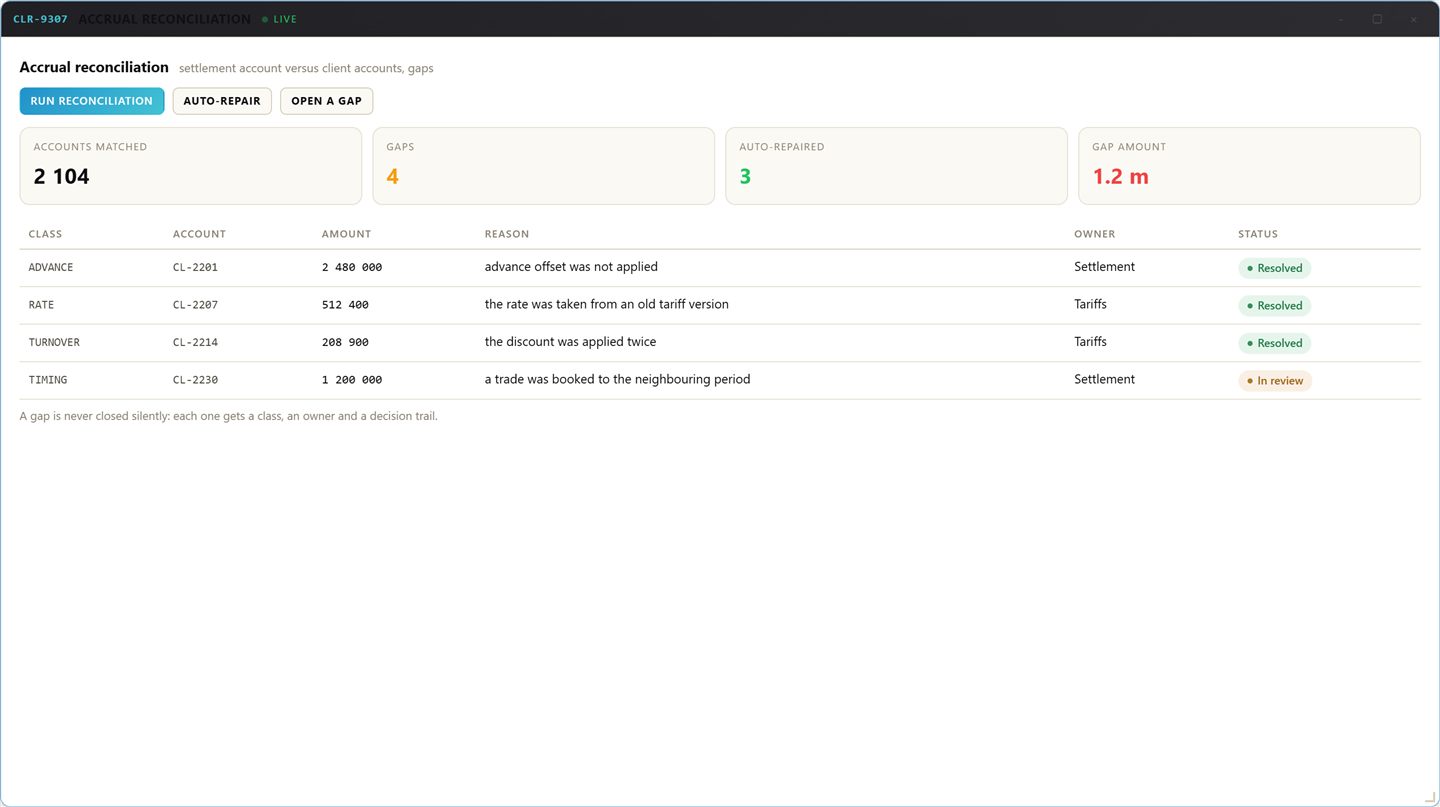
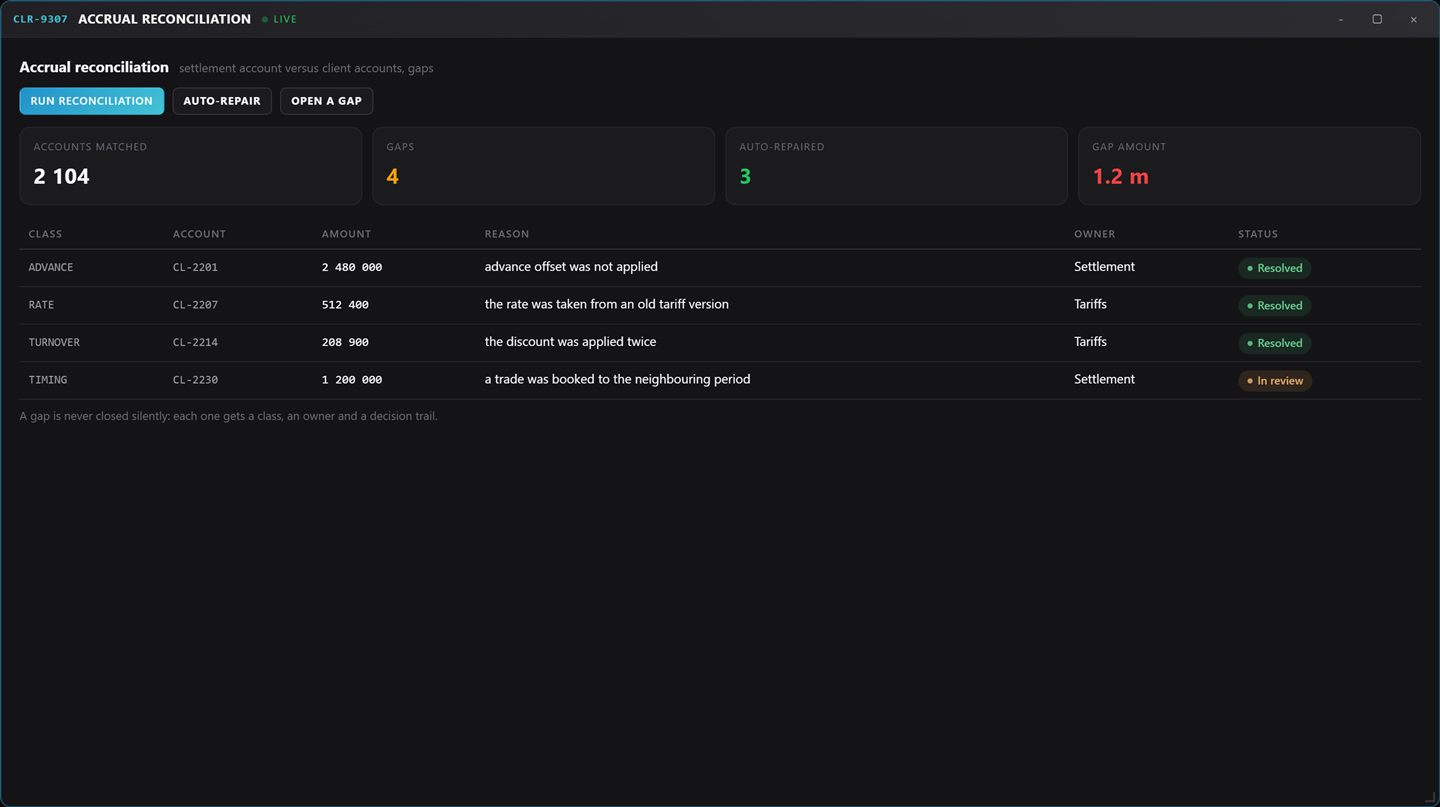
Reconciliation and disputes

Daily reconciliation with the venue and customer dispute cases with deadlines.

Periods and audit

Period close with change freeze, registers, extracts and the audit trail.

Stand

Screens of the solution

The tariff studio, the calculation pipeline and reconciliation.

Tariff studio screen
Tariff studio: schemes, versions, components and effective dates
Calculation pipeline screen
Calculation pipeline: stages, snapshots and control totals
Fee reconciliation screen
Reconciliation: venue stream against client accounts with breaks

How it works

From a tariff decision to the collected invoice in five steps

The path of the money: design, simulation, calculation, billing and reconciliation.

  1. 1

    The tariff is designed

    The draft is built from components; conflicts are checked early.

  2. 2

    The simulation runs

    The draft runs on trade history; the delta reaches the committee.

  3. 3

    The calculation closes

    The engine accrues fees with snapshots; every line is explained.

  4. 4

    Invoices are collected

    Billing packages go out, payments reconcile and reminders follow the schedule.

  5. 5

    Disputes close with evidence

    A dispute opens a case; the snapshot and rules explain it.

Industries

Industries it serves

The suite works for clearing organisations and market operators, and for brokers and banks that receive clearing invoices.

Exchange / venue

Trading, supervision, market data and post-trade on one governed core, launched by configuration.

Broker / investment firm

Client access and risk control on the same rails as the venue: terminals, mobile and pre-trade limits.

Bank / payments

Settlement, payments and custody services for the market around the trading core.

Architecture

Architecture and access

The suite sits between the venue and the clearing accounts: intake, checks, the engine and the billing close.

Service suite

Trade intake, pre-clearing checks, obligations, the tariff registry, the calculation engine, billing and the reconciliation service.

Determinism by design

Snapshot and rule version pin the result; repeat runs give identical amounts.

External sources

The venue stream, bank statements and the general ledger connect as adapters with daily reconciliation.

Roles and audit

Tariff changes, overrides and period closes carry four-eyes approval and the full audit trail.

AI layer

The AI layer explains calculation differences and flags unusual volumes; people approve.

Architecture scheme The same architecture as a standalone page. Open the diagram separately

Readiness

Ready today, next in line

The concept and the prototype are complete; build waves start after approval.

Ready today

  • Product frame: modules and business cases
  • Screen prototype: operation forms and end-to-end scenarios
  • Estimates for four implementation waves

Next in line

  • Wave W1: trade intake and pre-clearing checks
  • Wave W2: tariff studio and the deterministic engine
  • Wave W3: billing, disputes and reconciliation

Releases

Release history

The suite is designed in 2026 and joins the platform release waves with the first pilot.

2026 Q3

  • Concept, business cases and the screen prototype; estimates for four waves.

2026 Q4

  • Planned: wave W1 with trade intake and checks (plan).

Detailed description

Detailed description

The rule model, control totals and the delivery frame.

How the suite is assembled

Channels and clients
FIX 4.2 / 4.4 / 5.0, REST with mTLS, SFTP files, web portals
Edge and access
API gateway with 126 routes, Keycloak single sign-on, WAF and CSP
Platform core services
clearing-ms tariff services payment-ms reporting-ms AI agentic layer Services of the suite on the shared platform core
Data and events
PostgreSQL 17 per service, Redis 7, RabbitMQ 3.13 quorum queues, transactional outbox
Results and reporting
Portals, reports, regulator and partner channels

Technology stack

Runtime and backend: Java 21 (LTS), Spring Boot 3.5.16, Spring Cloud 2025.0.3, Gradle, Flyway 10.15.

Data: PostgreSQL 17 per service, Redis 7 with Sentinel, RabbitMQ 3.13 quorum queues, transactional outbox and DLQ replay.

Portals: Next.js 16.3.3, React 19, TypeScript 5; OpenTelemetry 1.31 to Jaeger.

Delivery: Kubernetes and Helm, Vault secrets, Prometheus and Grafana, Docker Compose for pilots.

Visualisation: Apache Superset 4 and ECharts 5 for dashboards and charts, Grafana for operations panels, Mermaid for documentation schemes and the portal diagrams.

Rule model

  • Fee components: transaction, clearing, exchange, settlement, caps and floors as configurable parts.
  • Priorities and conflict checks: which rule wins when two apply to one trade.
  • Draft tariffs run on history with a delta report before the committee decides.
  • Effective dating and version pinning: a recalculation reproduces historical amounts.

Control totals

  • Every pipeline stage records control totals: trades in, trades out, amounts in, amounts out.
  • Discrepancies against the venue stream open automated cases, not silent adjustments.
  • Snapshot plus rule version make any amount reproducible on demand.
  • Period close freezes the past: corrections go through an adjustment ledger.

Disputes and evidence

  • A client dispute opens a case linked to the exact trades, accruals and rules.
  • The explanation screen reconstructs the accrual step by step for the client.
  • Statistics: disputes by cause, by client and by rule version.
  • SLA credits and manual adjustments require four-eyes and leave a full trail.

Architecture

  • Built from the platform core: clearing-ms, the tariff services, payment-ms and reporting-ms.
  • The suite works through platform contracts: one register of record, no shadow copies of the data.
  • Scaling adds nodes, not rewrites: stateful services grow with Patroni, RabbitMQ and Redis clusters.

Integrations and access

  • OpenAPI for every service: 978 documented endpoints behind 126 gateway routes, plus webhooks and SFTP where partners need files.
  • Single sign-on: Keycloak 26.1, OIDC and JWT, roles, MFA and API keys with quotas.
  • Evidence by default: the audit journal, idempotency keys on writes and a record for every disclosure.
Detailed description

Leave your contacts to open the detailed description and download the PDF with architecture, cases and delivery details.

Recalculate your clearing fees with evidence

Bring one tariff and one month of trades. We will run the engine on your data and show an explained amount for every line.