UNIFINplatform

Solution

Unifin Collateral

Collateral lives in spreadsheets and coverage is counted by end of day.
The suite keeps pools, haircuts, coverage, calls and default procedures in one circuit.
Coverage stays inside the limits, and every call closes with a receipt.

  • Pools and coverage
  • Haircuts and eligibility
  • Default fund Cover-2
All solutions

Live screens from the product terminals

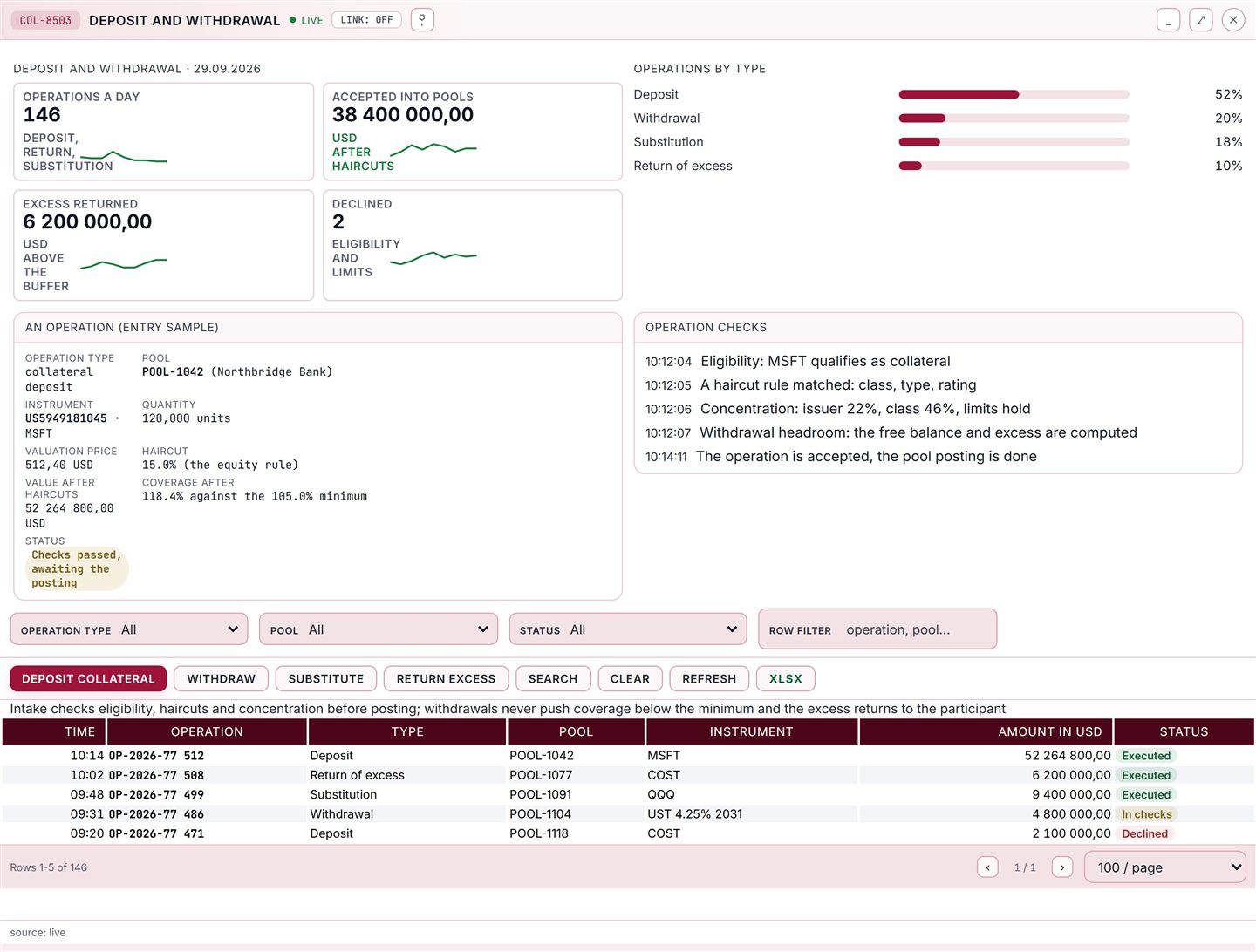
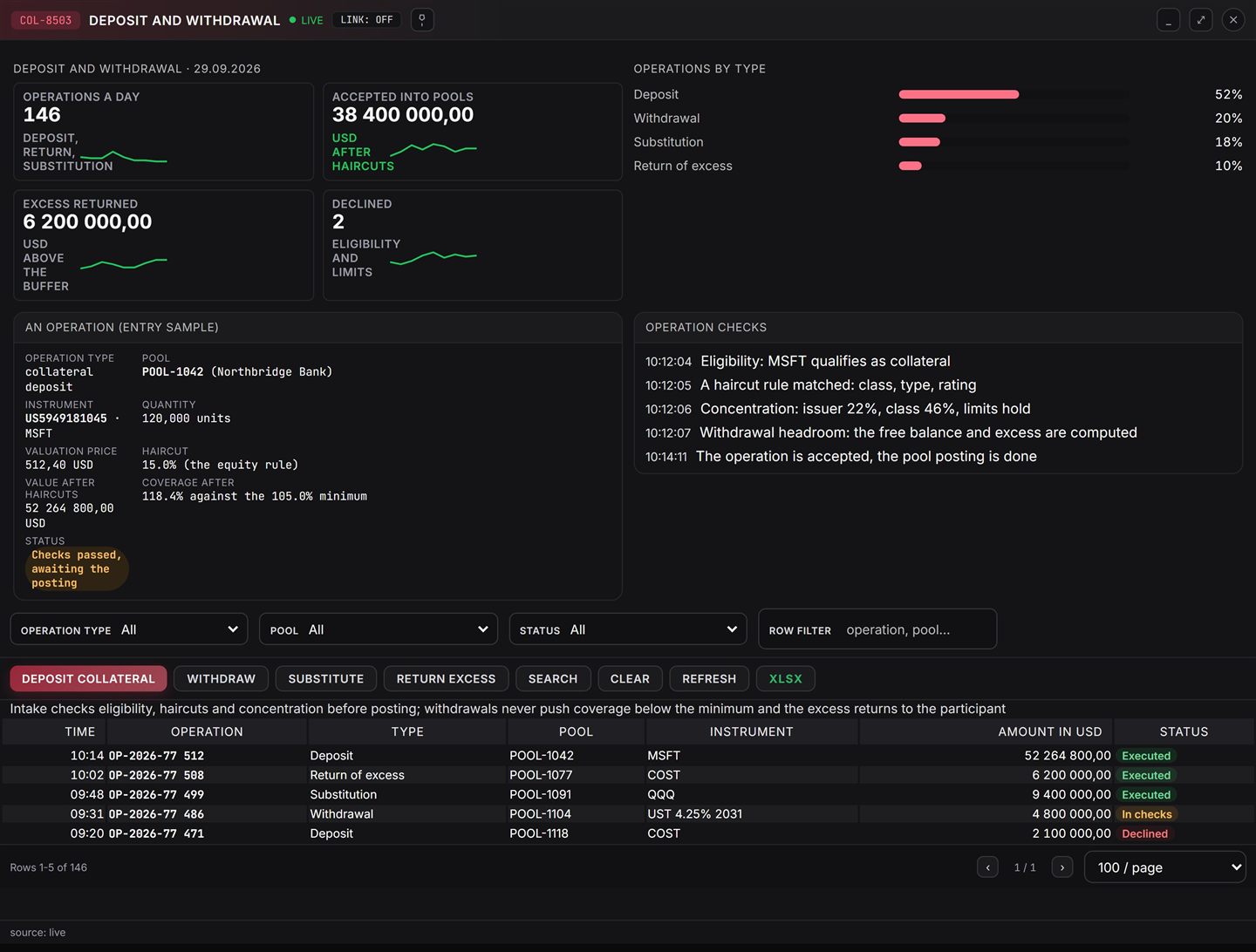
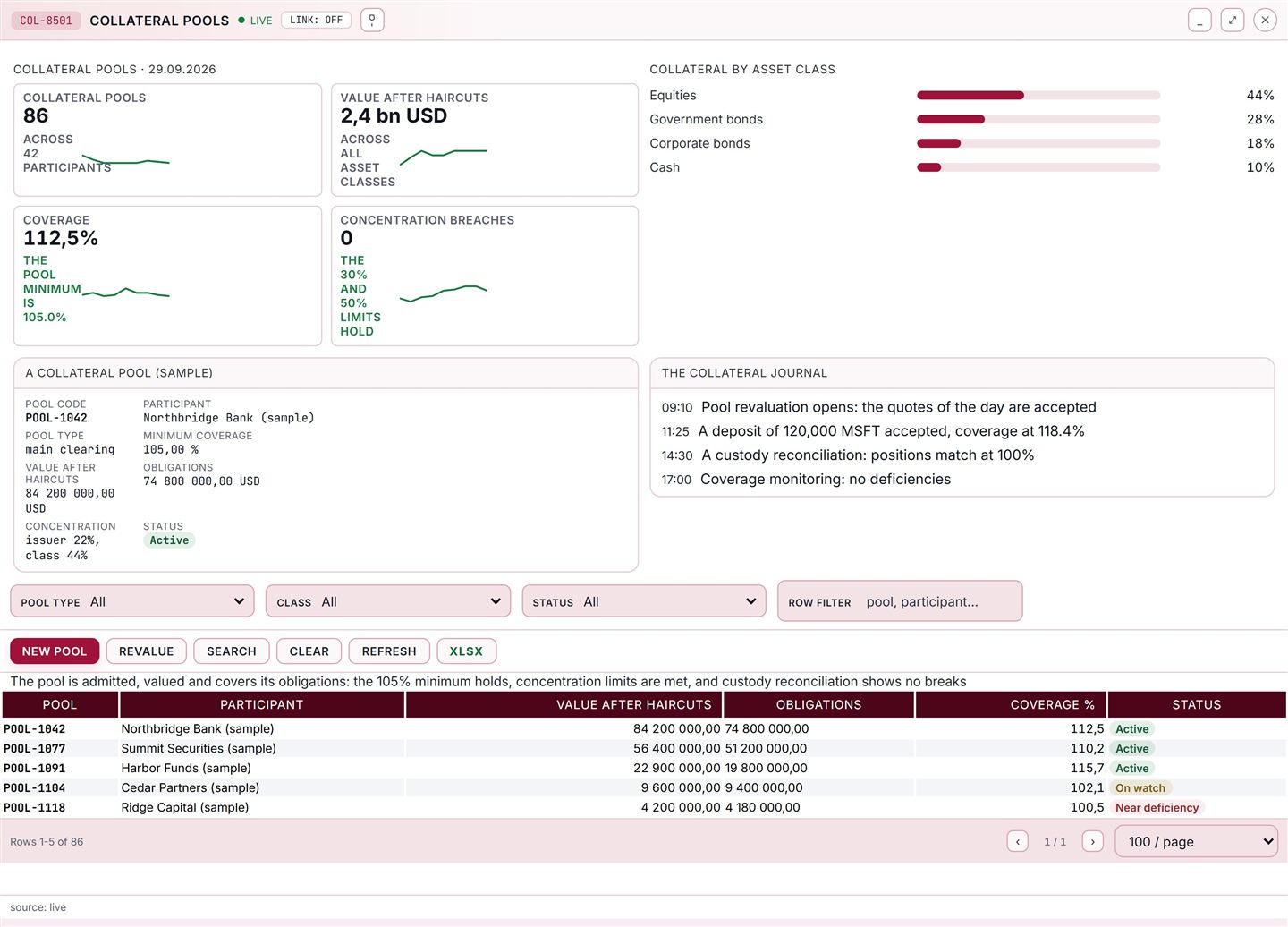
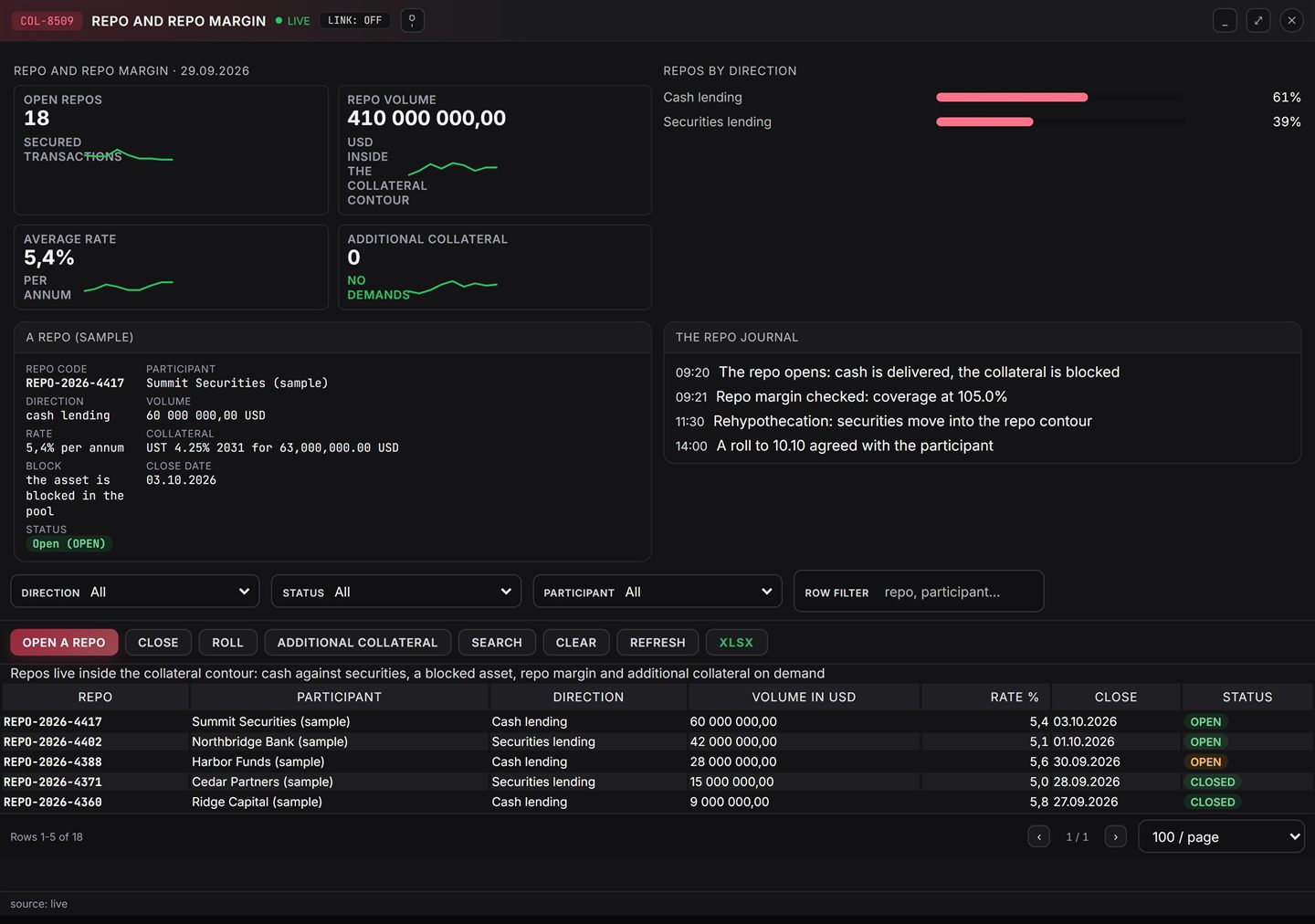
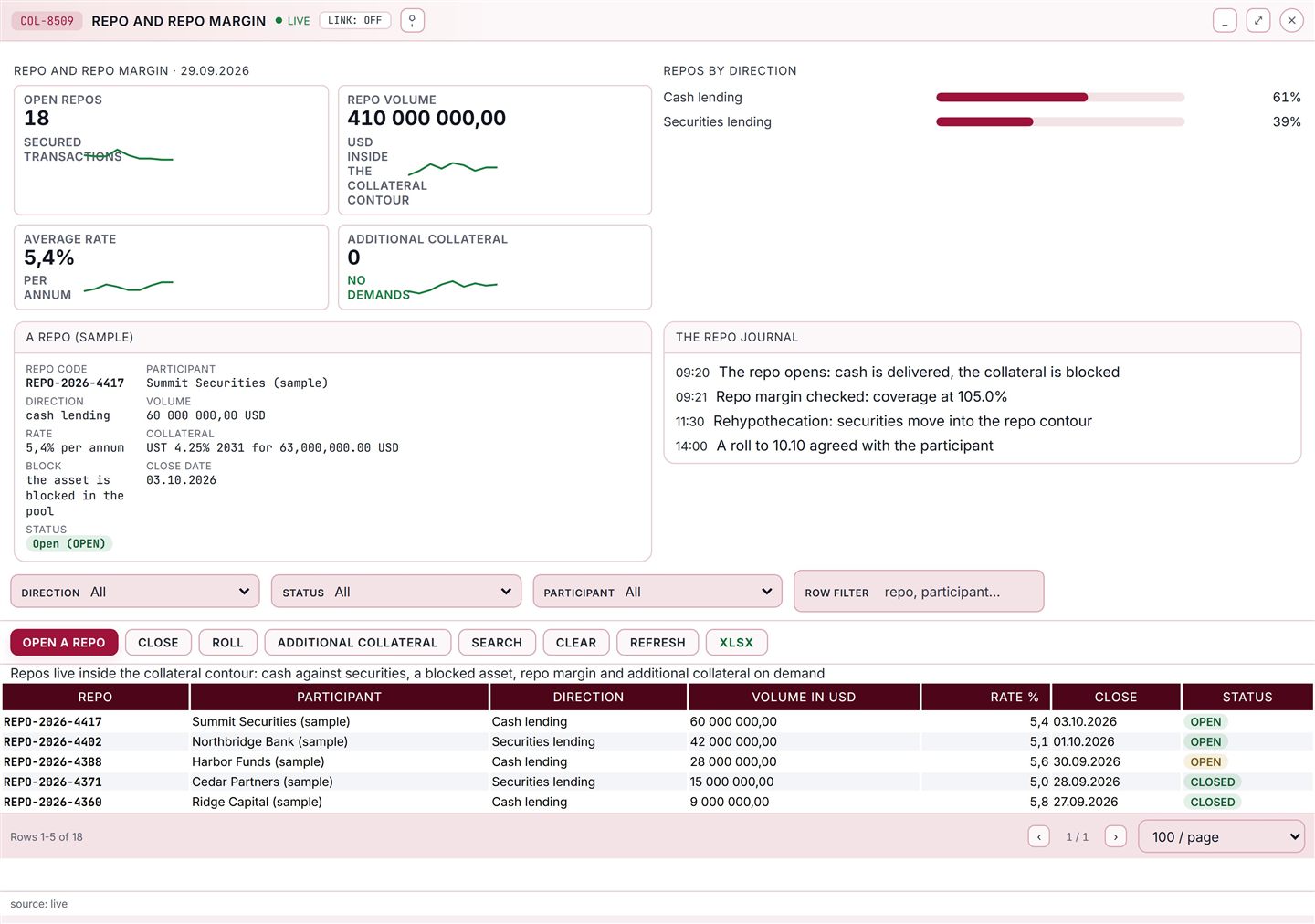
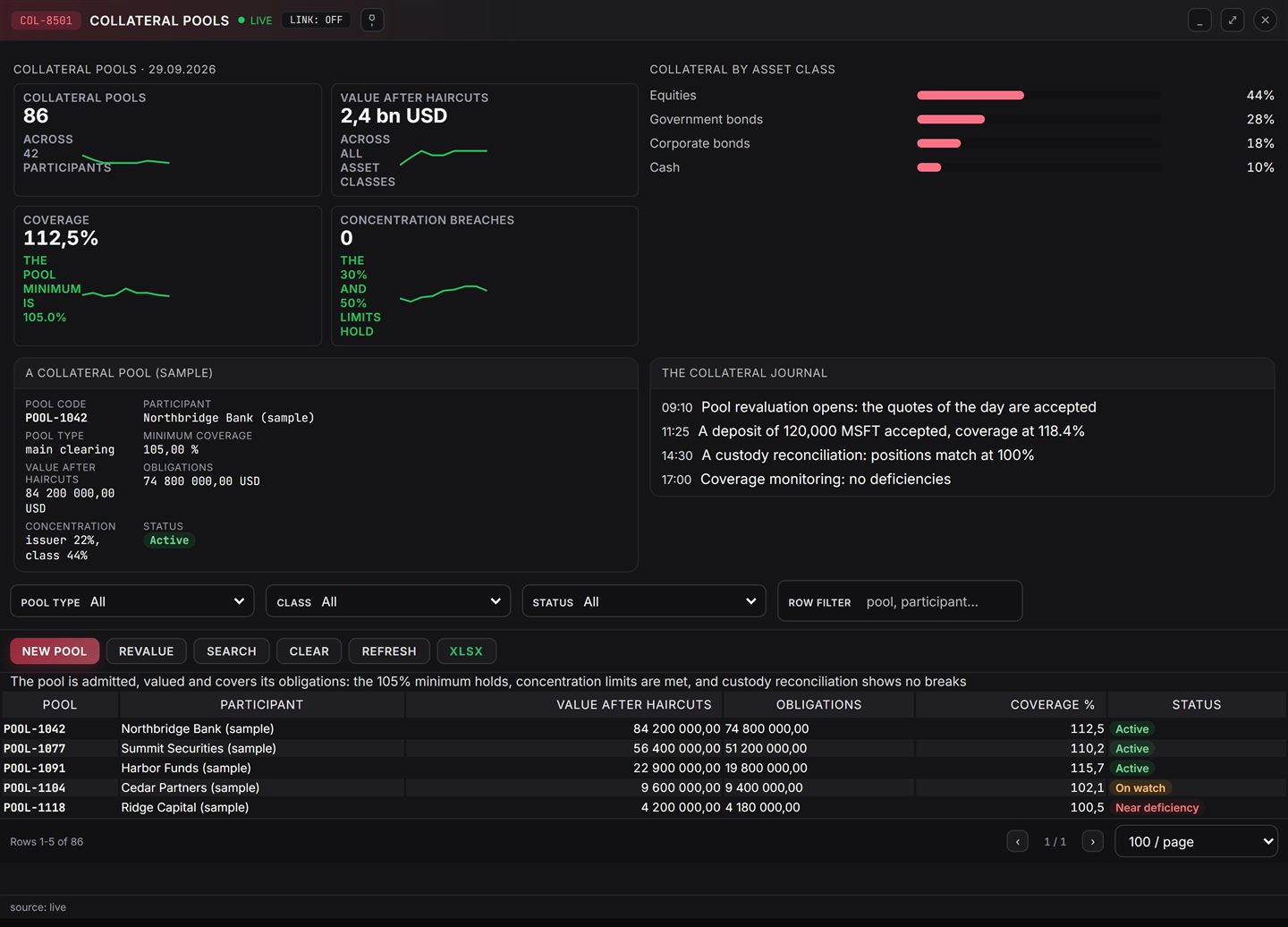
The deposit entry form with checks and the journal The deposit entry form with checks and the journal The collateral pool overview with KPIs and the pool table The repo list with margin and blocking controls The repo list with margin and blocking controls
Demo Unifin Collateral
Collateral pools
Collateral pools: coverage, haircuts and the pool table
Collateral pools
Collateral pools: coverage, haircuts and the pool table

This is an interface demonstration: the real solution will differ in colours and content for a specific project.

Functions at a glance

Business functions at a glance

From an asset deposit to a closed default procedure.

Pools and valuation
Accepts assets, values them and counts value with a haircut
Collateral is visible at the moment of the operation
Haircuts and rules
Picks a haircut by class, type and rating
Rules apply uniformly
Coverage and deficiency
Compares clearing obligations with available collateral
Deficiency is seen ahead of time
Margin calls
Creates calls on the deficiency and tracks fulfilment
Calls close on time
Default management
Runs the declaration, the auction, the waterfall and the close-out
The procedure is transparent to the regulator
Default fund and stress
Counts Cover-1 and Cover-2, runs scenarios
The safety margin is evidenced
Repo and reconciliation
Keeps repo in the collateral circuit and checks positions
Breaks are resolved with evidence

Solution description

Capabilities and overview

Key capabilities

  • Pools: intake, valuation, haircut and obligation coverage
  • Operations: deposit, withdrawal, substitution, return of surplus
  • Haircuts: rules by class, type and minimum rating
  • Coverage: pool minimum 105.00%, reconciliation threshold 100.00%
  • Margin calls: notices, fulfilment, disputes and audit
  • Default management: declaration, auction and the waterfall
  • Default fund: Cover-1 and Cover-2, what-if and recalculation
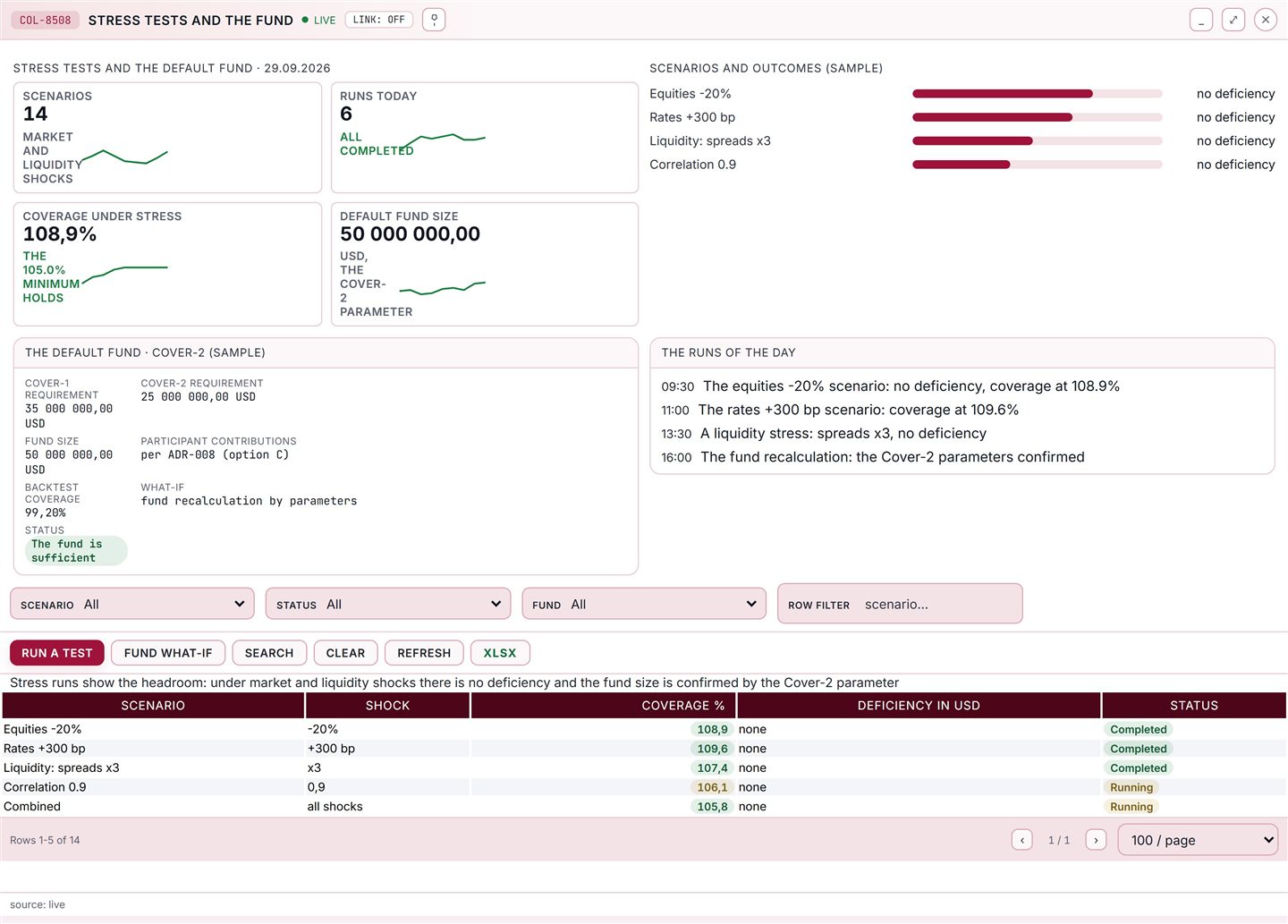
  • Stress tests: market and liquidity scenarios
  • Repo: blocking, repo margin and additional collateral
  • Reconciliation: custodians and the depository, breaks and review
  • Reporting: reports of the day and regulatory forms
  • Deployment: by configuration, inside the UniFin platform

Solution overview

Unifin Collateral runs market participants collateral: pools, valuation, haircuts, coverage and default procedures in one circuit.

Every operation passes eligibility, haircut and concentration checks before posting; coverage is recalculated straight away.

A deficiency raises a margin call with a buffer; fulfilment is recorded in the journal with audit.

Default follows the rulebook: declaration, a Dutch auction, the waterfall and close-out of the deficiency.

Stress tests and default fund parameters evidence the safety margin; custody reconciliation keeps positions in agreement.

What it gives

What the solution gives

Pools and valuation

Collateral today lives in spreadsheets and is checked by hand. With the solution a pool accepts assets, values them and counts value with a haircut, and coverage is visible straight away. In setup haircut rules, the coverage minimum and pool composition come from one configuration.

Participant operations

Deposits and withdrawals today need letters and checks. With the solution deposit, withdrawal, substitution and return of surplus pass checks and posting. A withdrawal never takes coverage below the minimum. In setup limits and thresholds are set per participant and pool type.

Coverage and deficiency

Deficiency today is found by end of day. With the solution monitoring compares clearing obligations with available collateral and shows surplus or deficiency at the moment of the operation. In setup buffers and thresholds come as pool rules.

Margin calls

Calls today are collected from statements by hand. With the solution a deficiency creates a call with a buffer, a notice goes to the participant. Partial and full fulfilment land in one journal. In setup deadlines, notice channels and escalation are set by the rulebook.

Default management

The default procedure today lives in the rulebook and spreadsheets. With the solution the declaration starts a Dutch auction, the waterfall runs step by step. Close-out of the deficiency stays a separate record with audit. In setup waterfall steps and auction rules are set by policy.

Default fund and stress

The fund size today is revisited rarely. With the solution stress scenarios evidence the safety margin, and Cover-1 and Cover-2 are recalculated in a what-if mode with snapshots. In setup scenarios, horizons and fund parameters come from a register.

Repo and reconciliation

Repo and reconciliation today live apart from collateral. With the solution repo runs in the common circuit with blocking and margin, and custody reconciliation records breaks and their review. In setup reconciliation routes and repo rules are set by participant and custodian.

Scope

What it covers

The collateral circuit: from asset intake to reporting of the day.

Pools: intake and valuation

Asset intake, valuation, haircut, obligation coverage.

Pool operations

Deposit, withdrawal, substitution, return of surplus, rehypothecation.

Haircuts and eligibility

Rules by class, type, rating; asset eligibility.

Coverage and deficiency

Calculation against obligations, buffers, thresholds, monitoring.

Margin calls

Creation, notice, fulfilment, disputes.

Default management

Declaration, auction, waterfall, close-out.

Default fund and stress

Cover-1, Cover-2, what-if, scenarios, snapshots.

Repo, reconciliation, reports

Repo and margin, custody reconciliation, reports of the day.

Demonstration

Screens of the solution

Pools, the pool card, a deposit operation, haircuts, coverage, calls, default, stress, repo and reconciliation.

The collateral pool overview with KPIs and the pool table
Collateral pools: coverage, haircuts and the pool table
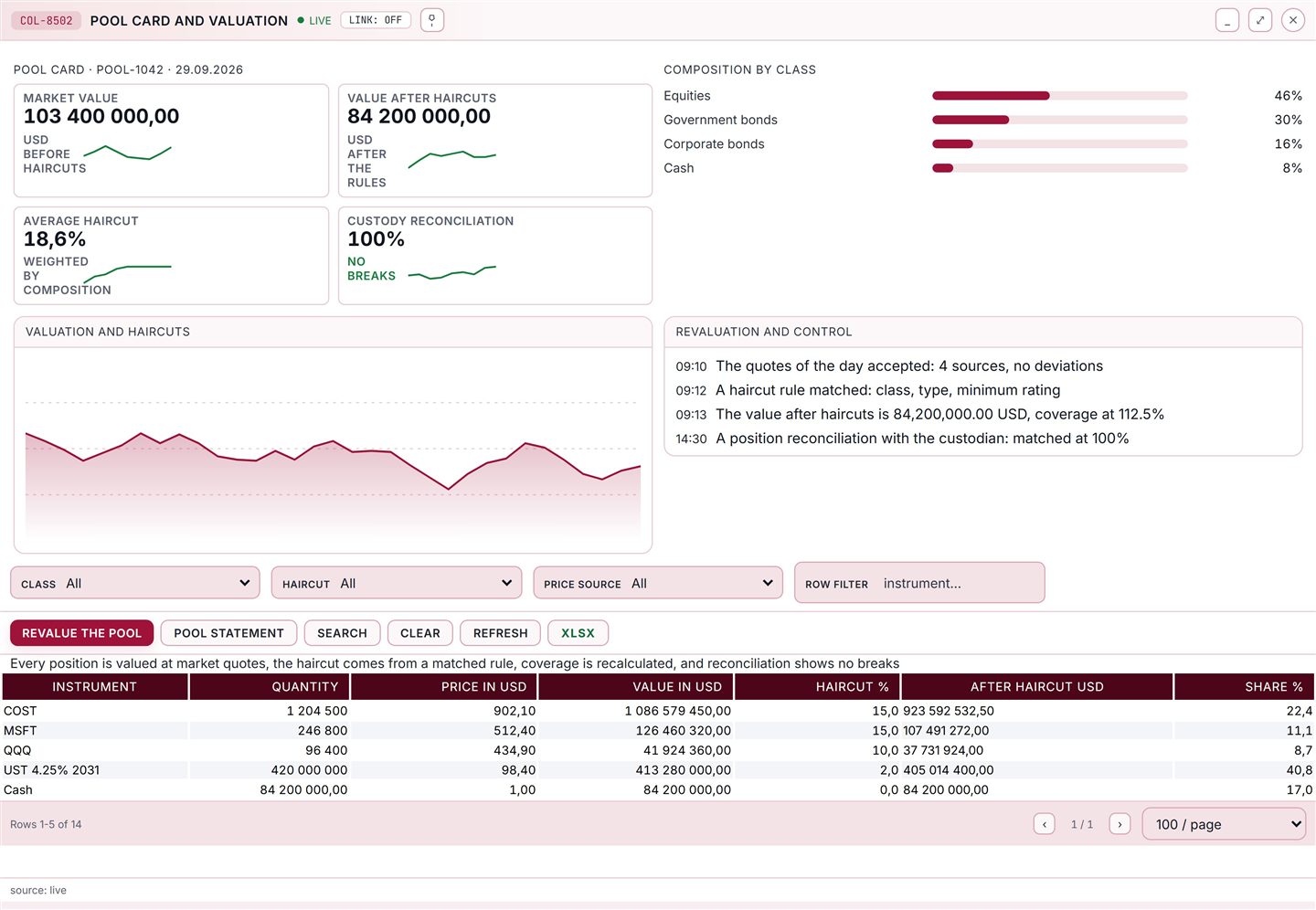
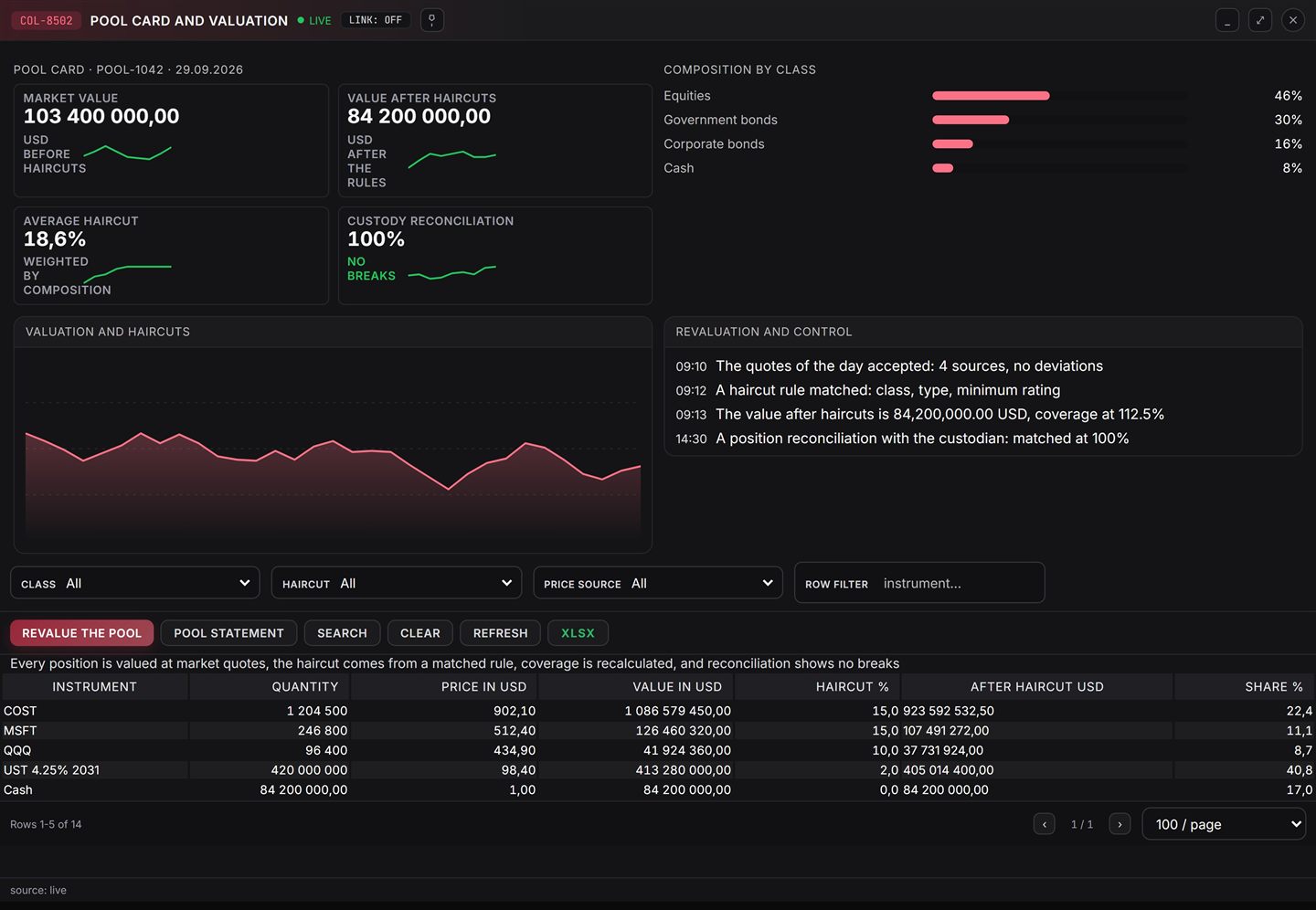
The pool card with composition and valuation panes
Pool card: composition, revaluation and the custody check
The deposit entry form with checks and the journal
A deposit operation: checks, haircut and coverage after posting
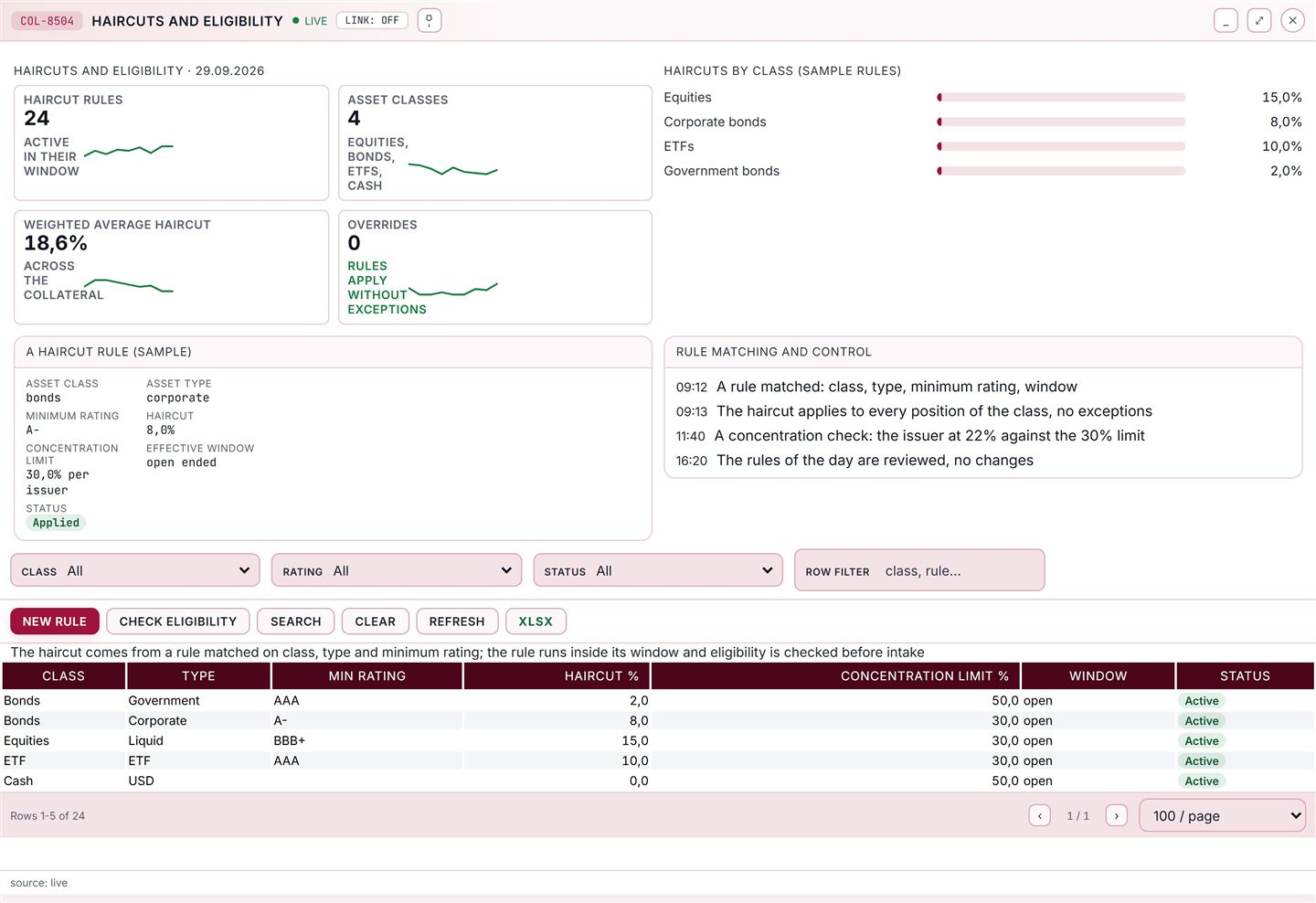
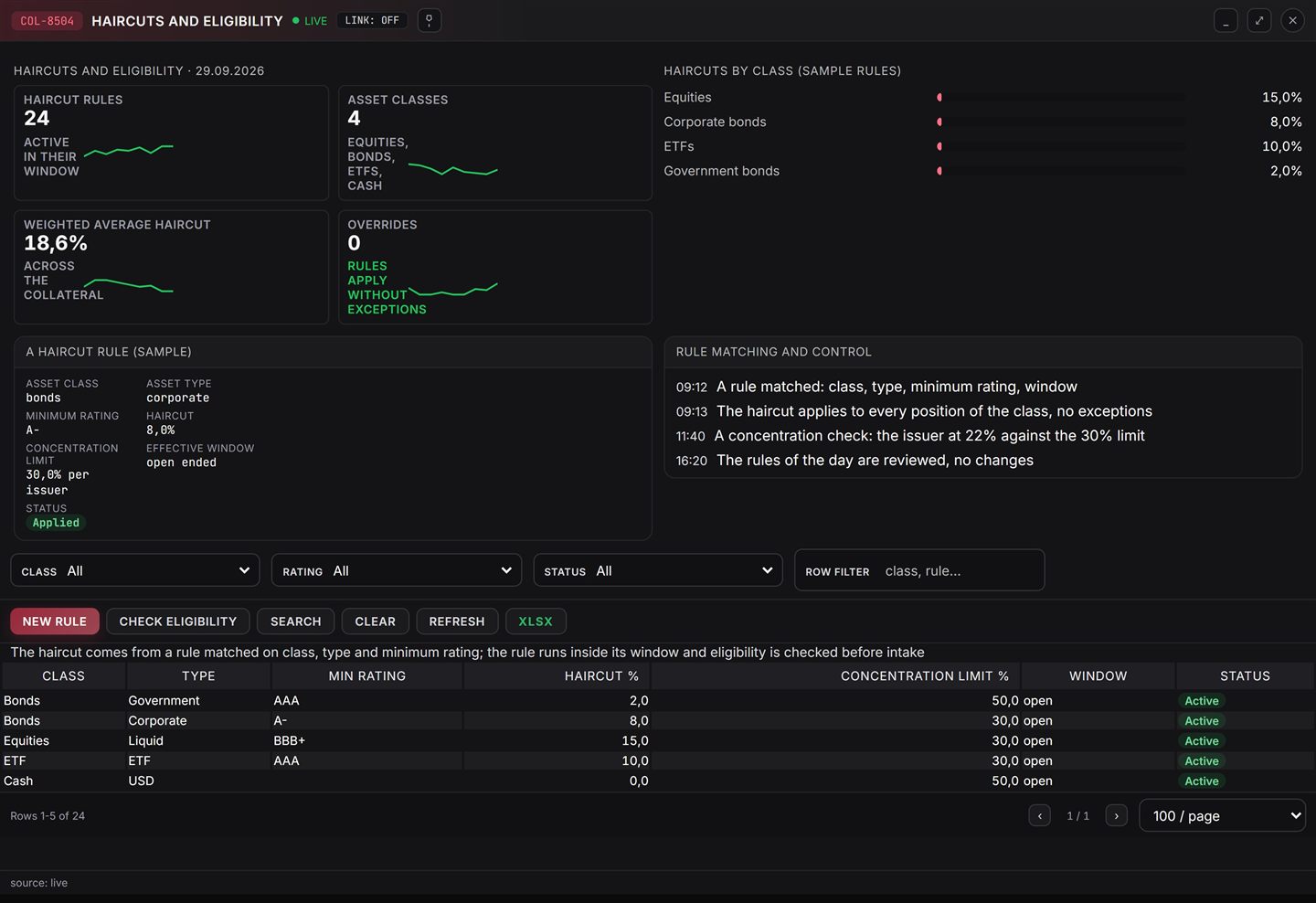
The haircut rules list with effective windows
Haircut rules by class, type and minimum rating
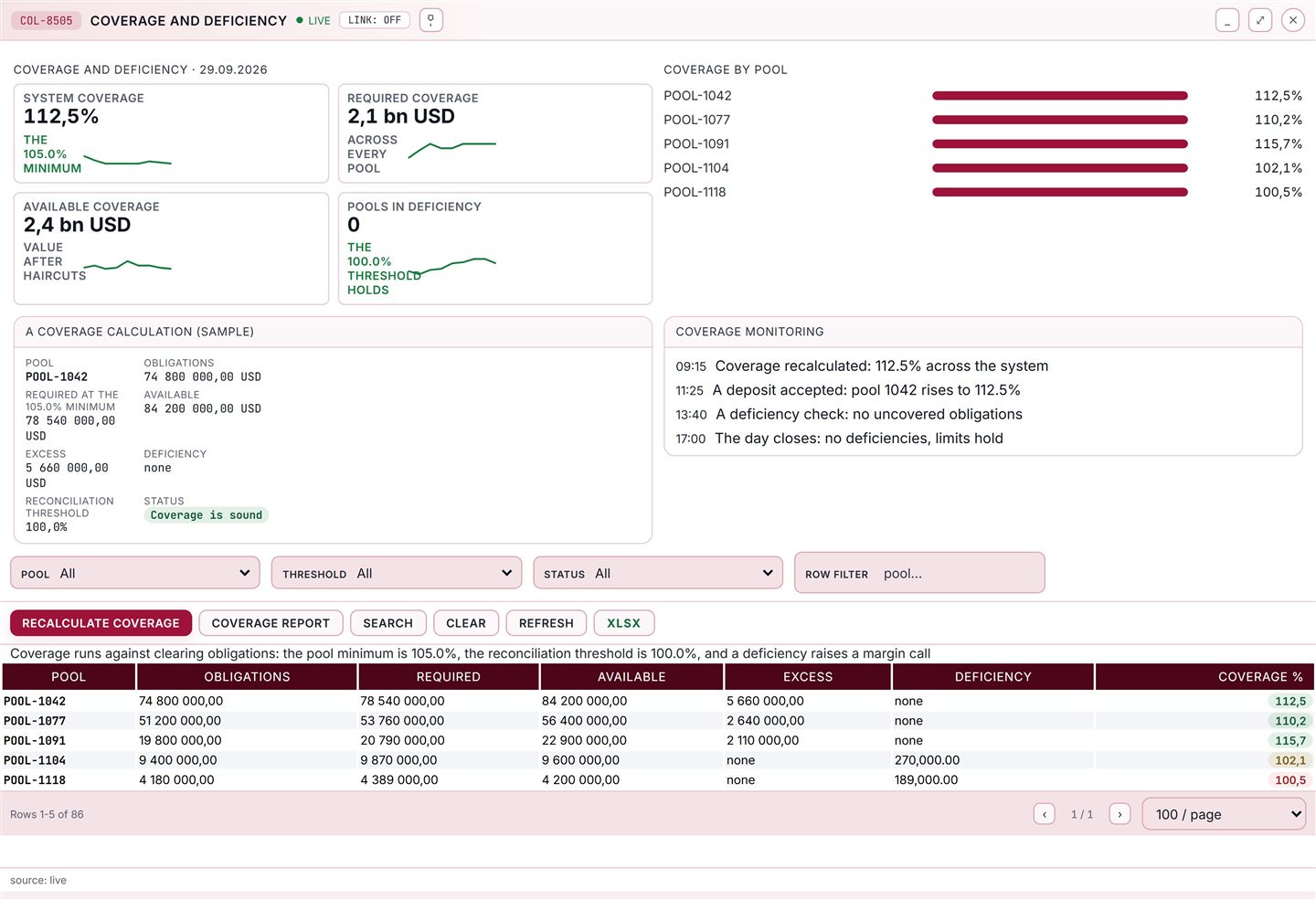
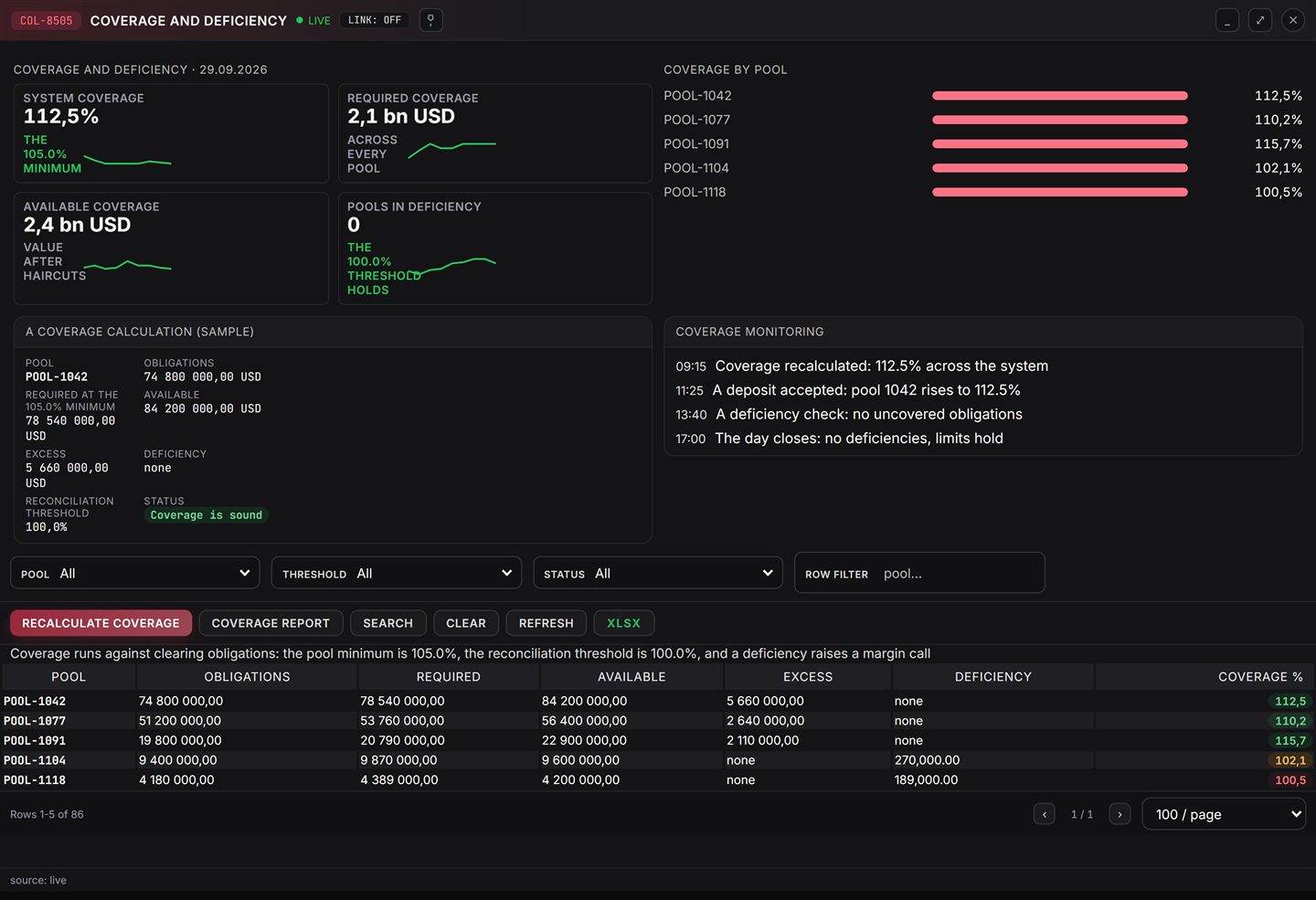
The coverage dashboard with thresholds and per-pool rows
Coverage and deficiency against clearing obligations
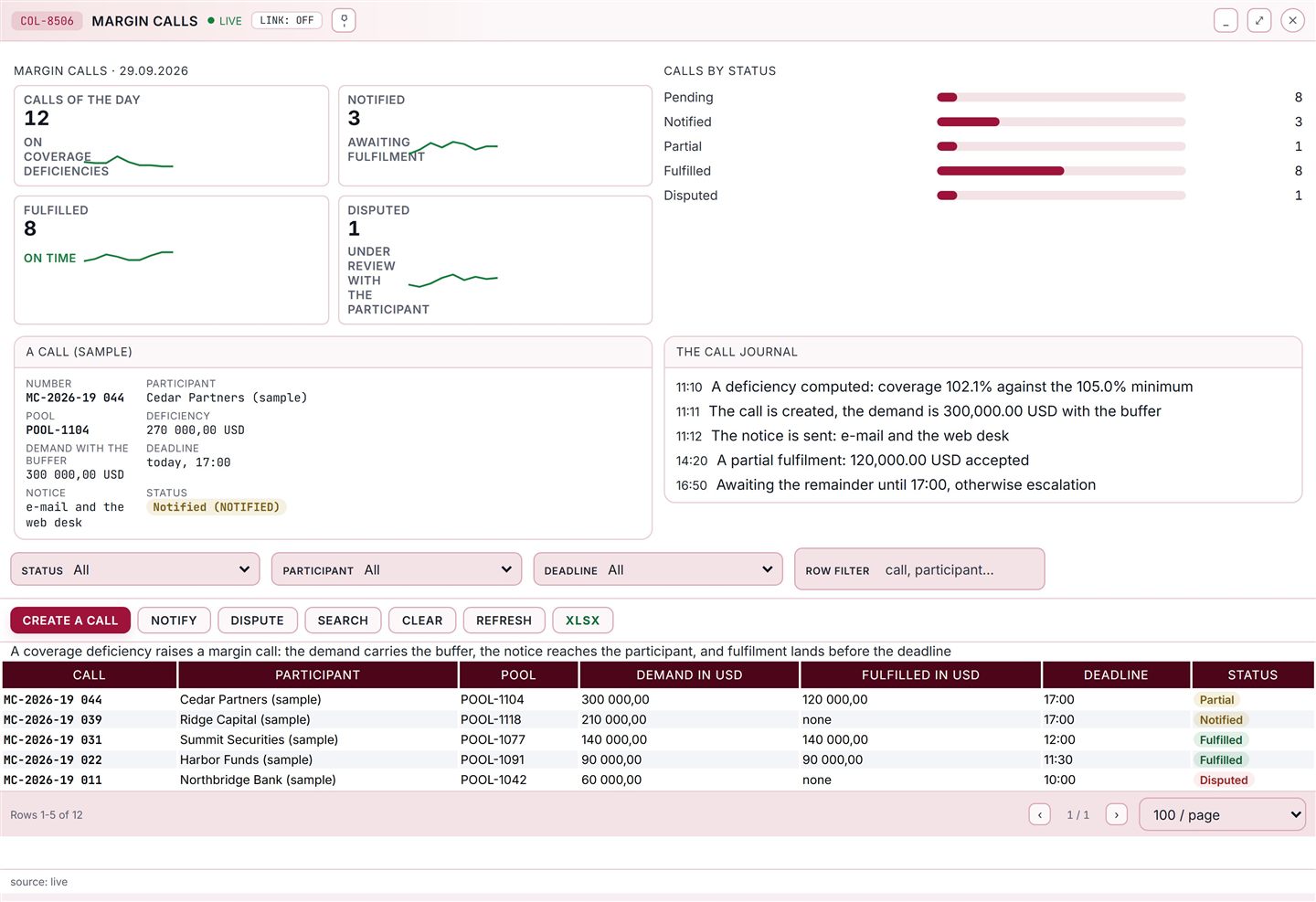
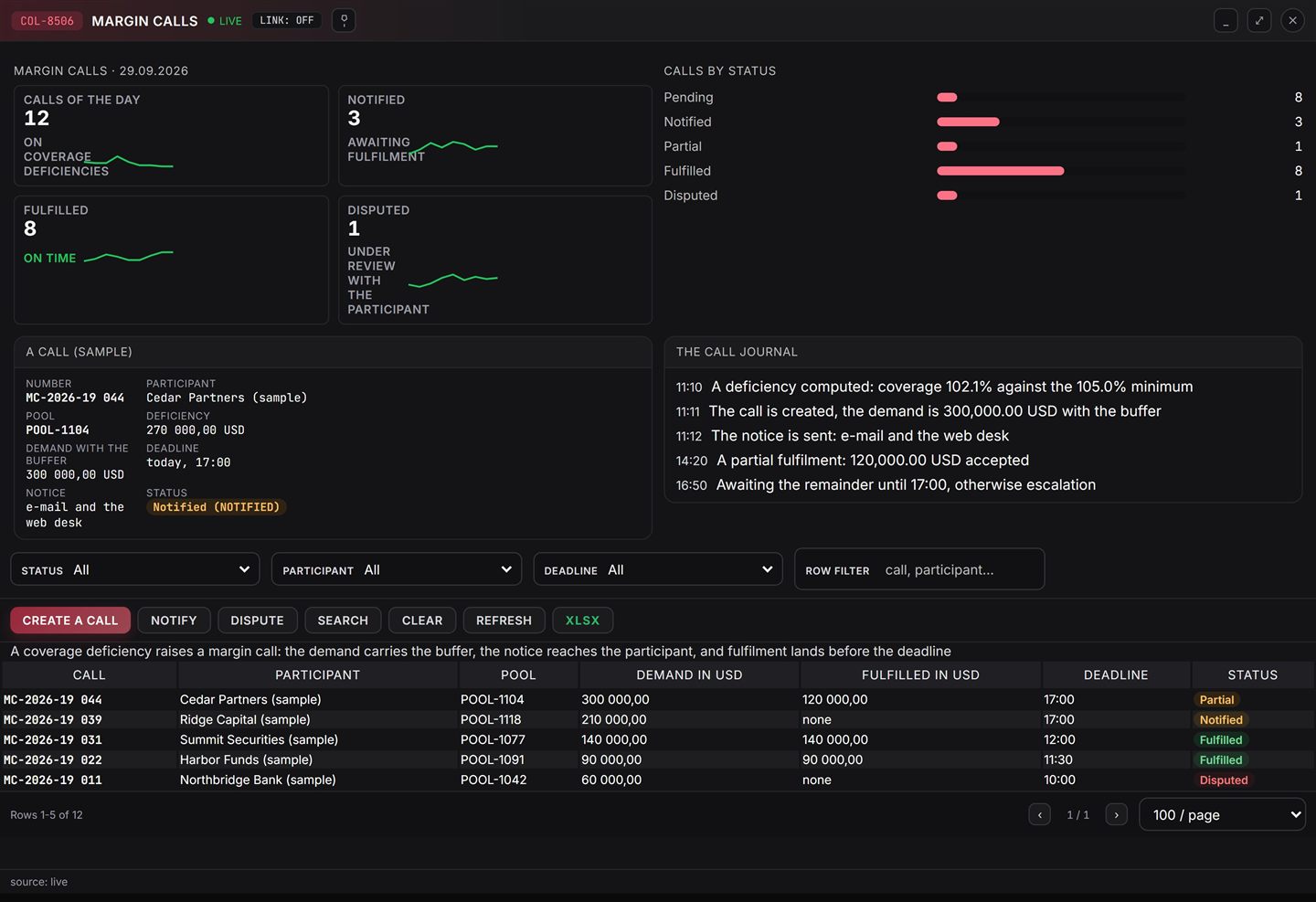
The margin call list with statuses and the call card
Margin calls: notices, partial and full fulfilment
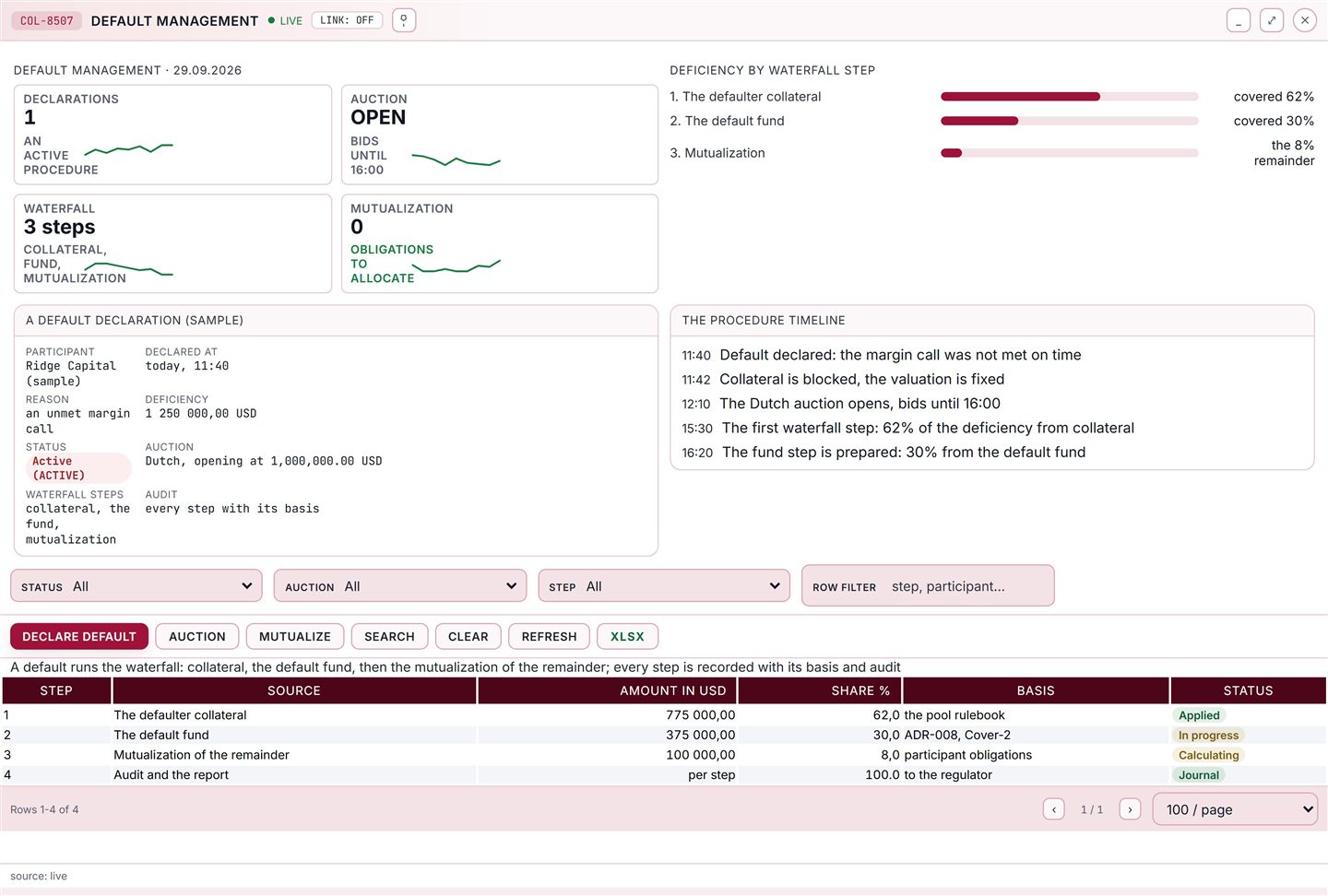
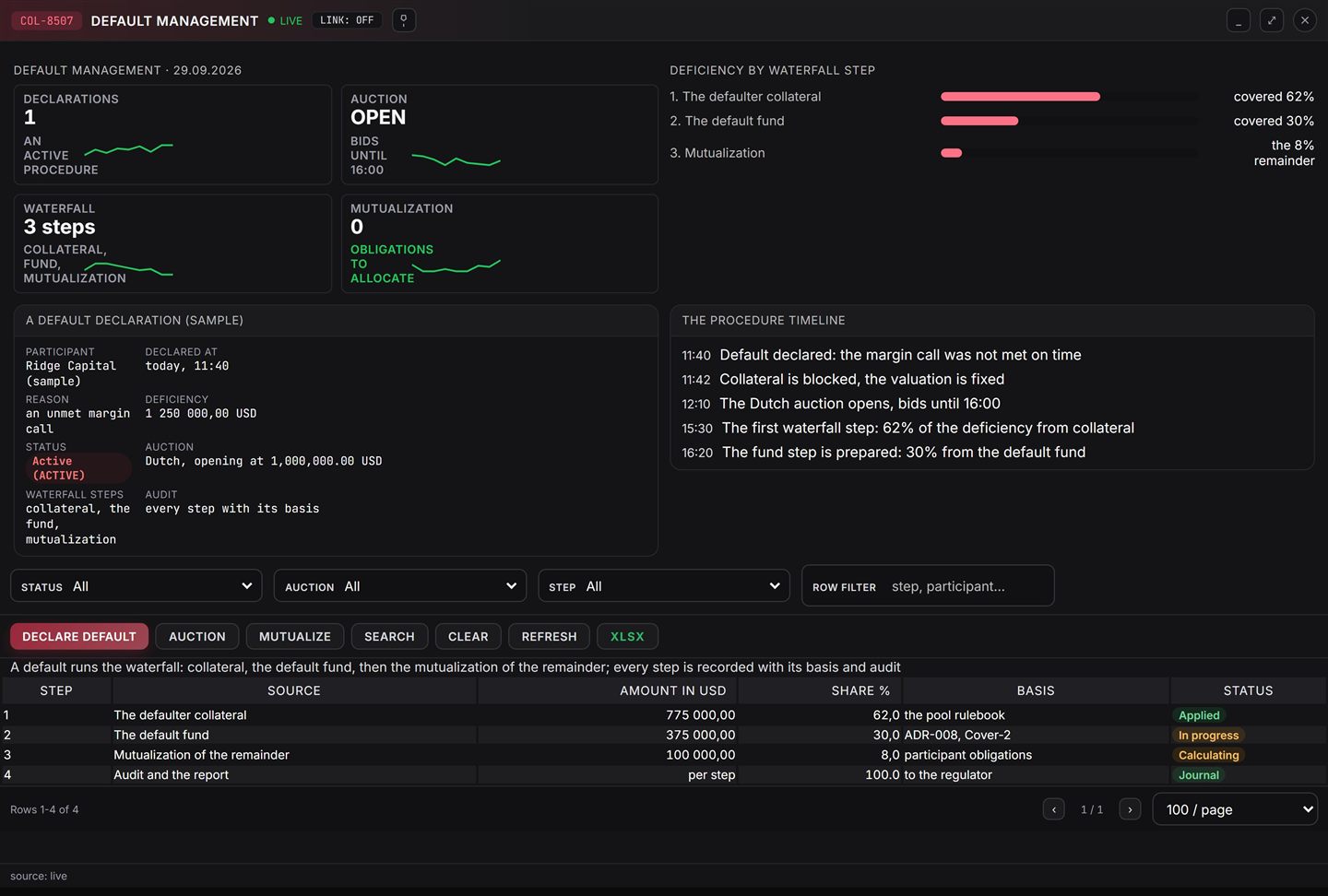
The default dashboard with waterfall steps and the auction
Default management: declaration, auction and the waterfall
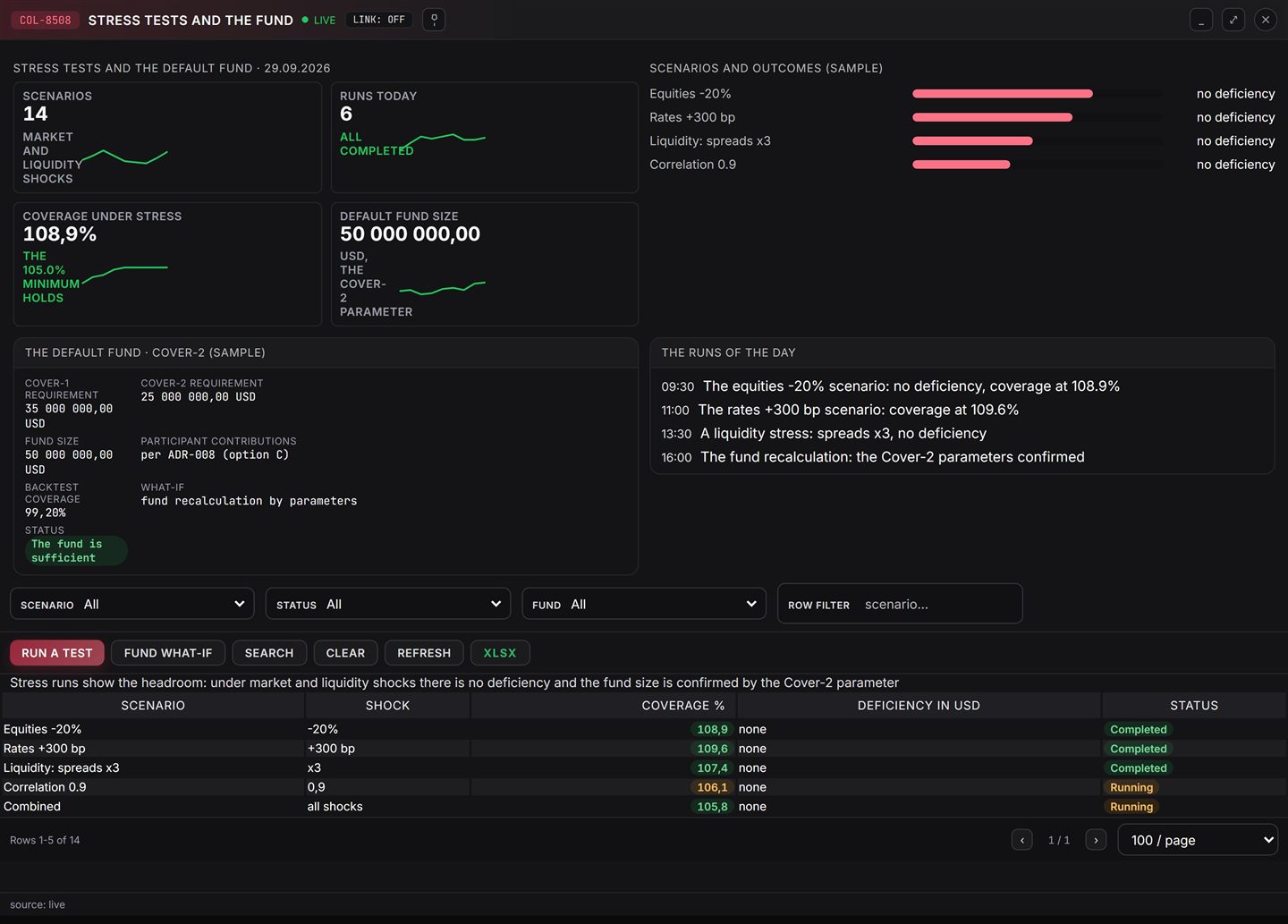
The stress dashboard with scenarios and fund parameters
Stress tests and the default fund: Cover-1 and Cover-2
The repo list with margin and blocking controls
Repo and repo margin: blocking, roll and additional collateral
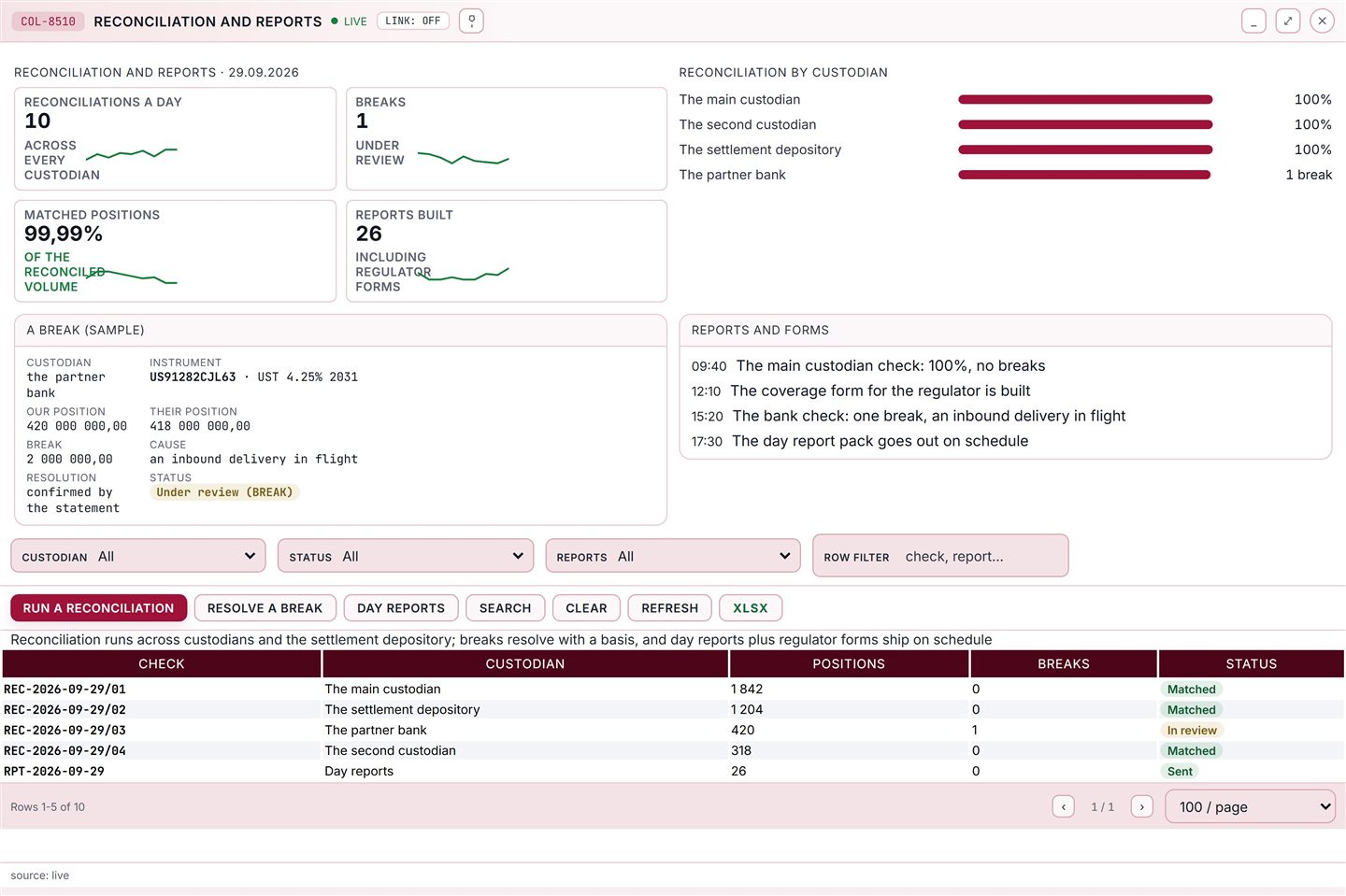
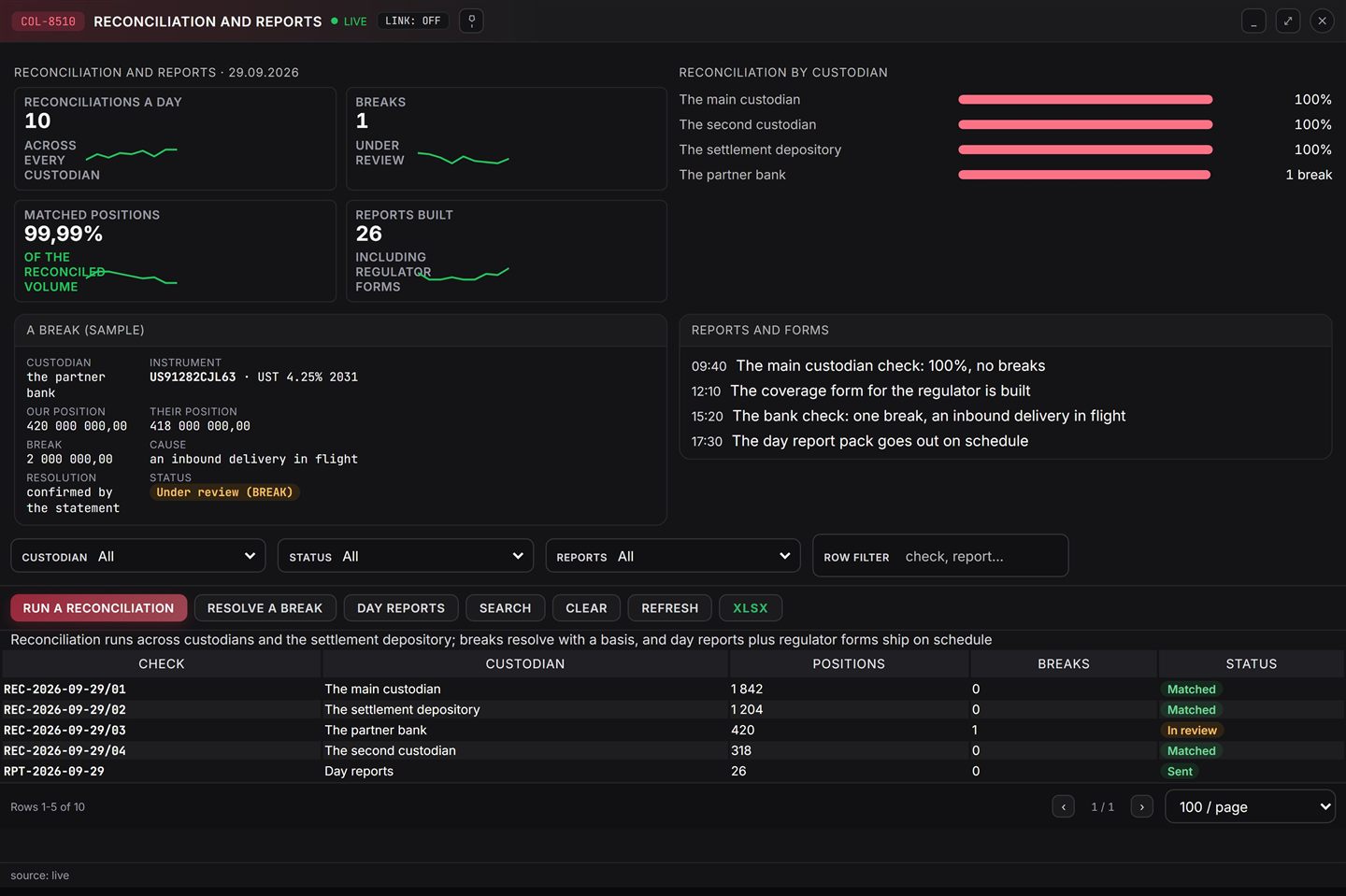
The reconciliation dashboard with breaks and reports
Reconciliation with custodians and the reports of the day

How it works

From an asset deposit to a closed procedure in five steps

The path of collateral: intake, coverage, a call, a default, reconciliation.

  1. 1

    Collateral deposited

    Assets pass checks and are valued with a haircut.

  2. 2

    Coverage counted

    Obligations are compared with available, no deficiency.

  3. 3

    A call was raised

    A call with a buffer went out, fulfilled on time.

  4. 4

    Default ran its steps

    Declaration, auction, the fund, close-out and audit.

  5. 5

    Reconciliation closed the day

    Custodians agree, reports went out on schedule.

Industries

Who it serves

The solution serves clearing organisations and exchanges, banks and brokers, custodians and depositories, asset managers.

Exchange / venue

Trading, supervision, market data and post-trade on one governed core, launched by configuration.

Bank / payments

Settlement, payments and custody services for the market around the trading core.

CSD / depository

Custody, corporate actions and settlement discipline for classic and digital assets.

Architecture

Architecture and access

The architecture rests on the collateral-ms core and participant channels; external suites connect by connectors and reconciliation.

Channels and participants

Participants, risk operators and the default desk work via the portal and API.

The collateral core

collateral-ms runs pools, valuation, coverage, calls and default procedures.

External suites stay external

Custodians, the depository, the bank and the regulator connect by channels.

Growth without core edits

New haircut rules and scenarios come by configuration.

AI layer

The AI layer suggests fund parameters and flags unusual collateral movements.

Architecture scheme The same architecture as a standalone page. Open the diagram separately

Readiness

Ready today, next in line

The base is in place; next: collateral portfolio optimisation and liquidity hints.

Ready today

  • Pools, valuation, haircuts and obligation coverage
  • Operations: deposit, withdrawal, substitution, return of surplus
  • Margin calls with notices and fulfilment
  • Default management with the waterfall and close-out

Next in line

  • Collateral optimisation by cost and liquidity
  • Concentration what-if per participant (plan)
  • Extended regulatory reporting snapshots (plan)

Releases

Release history

Quarterly releases since the platform was founded (2020); the collateral circuit arrived in 2026.

2025 Q4

  • Collateral pools, haircuts and coverage of obligations.

2026 Q1

  • Operations: deposit, withdrawal, substitution and return of surplus.

2026 Q2

  • Margin calls, notices and fulfilment.

2026 Q3

  • Default management, the default fund and stress tests; repo and reconciliation.

2026 Q4

  • Collateral optimisation and reporting snapshots (plan).

Detailed description

Detailed description

Operations, rules, default procedures and the delivery frame.

How the suite is assembled

Channels and clients
FIX 4.2 / 4.4 / 5.0, REST with mTLS, SFTP files, web portals
Edge and access
API gateway with 126 routes, Keycloak single sign-on, WAF and CSP
Platform core services
collateral-ms clearing-ms · obligations market-data-ms · valuation risk-ms bank-ms · cash AI agentic layer Services of the suite on the shared platform core
Data and events
PostgreSQL 17 per service, Redis 7, RabbitMQ 3.13 quorum queues, transactional outbox
Results and reporting
Portals, reports, regulator and partner channels

The collateral core and pools

  • The core is collateral-ms with its own collateral_ms schema: pools, valuations, haircut rules, coverage, calls and default cases live in one circuit.
  • A pool belongs to a participant and carries an owner, a policy, the currency and the composition: cash and securities side by side.
  • Pool composition shows every line with its class, type, rating and market value; revaluation is event-driven and on schedule.
  • Operations: a deposit, a withdrawal, a substitution, a return of surplus and rehypothecation; every one passes eligibility, haircut and concentration checks before posting.

Valuation and haircuts

  • A haircut rule binds a class, a type and a minimum rating to a haircut and an effective window; the change is versioned.
  • The applied haircut explains itself: which rule, which window, which source; the log keeps the calculation for audit.
  • Valuation uses market data quotes with a fallback: a missing price over the limit puts the line on hold instead of guessing.
  • Concentration checks cap one issuer and one instrument class by default at 30 per cent and 50 per cent; the numbers are configurable.

Coverage, deficiency and margin calls

  • Coverage compares the clearing obligations of a participant with the available collateral; the pool minimum is 105.00 per cent and the reconciliation threshold is 100.00 per cent.
  • A deficiency opens a margin call with a buffer and a deadline; the notice routes to the participant and repeats on escalation.
  • Call statuses run from created through notice sent, partially fulfilled and fulfilled to overdue and disputed; every step is in the journal.
  • A withdrawal never takes coverage below the minimum; the check answers before posting, not after.

Default management and the default fund

  • A default declaration freezes the pools of the participant and opens a case with a log of every decision.
  • The waterfall runs by policy: in the demo case the tiers split 62 / 30 / 8 between the defaulter collateral, the default fund and the mutualised layer.
  • The Dutch auction of the portfolio is a session with bids, allocations and a settlement record; the auction result feeds the close-out.
  • The fund is sized by stress: Cover-1 and Cover-2 hold 35,000,000.00 and 25,000,000.00 in the demo, 50,000,000.00 in total; a what-if recalculates without posting.

Repo, reconciliation and reporting

  • A repo blocks the pledged securities in the pool and carries its own margin; a roll, a top-up of the repo margin or an early close moves the block.
  • Reconciliation against custodians uses position and valuation files; a break opens with a reason and closes with evidence.
  • The check number of the day is the coverage ratio: the demo reconciliation of 29.09.2026 closed against a floor of 100.00 per cent.
  • Reports of the day: pools, coverage, calls, defaults, the fund and reconciliation; regulatory forms leave on schedule.

Security, audit and supervision

  • Every operation carries the actor, the four-eyes approval where the policy demands it and the source document.
  • Money movements stay on bank-ms rails with idempotency per operation and reconciliation of unknown outcomes.
  • Rights are split: the desk posts operations, risk sets the rules, the default desk and the supervisor read the case.
  • The journal keeps pools, calls, defaults and auctions for five years; exports are signed for audit.

The AI layer and stack

  • The AI layer suggests fund parameters from stress backtests: the demo scenario holds a backtest confidence of 99.20 per cent.
  • Unusual collateral movements are flagged with a reason and an example, not an alarm without a case.
  • Runtime: Java 21 and Spring Boot 3.5; collateral-ms keeps pools and journals in PostgreSQL 17 with events on the bus.
  • Connectivity: the clearing core for obligations, market data for valuation, the bank for cash, custodians for reconciliation, the regulator for reports.
Detailed description

Leave your contacts to open the detailed description and download the PDF with architecture, cases and delivery details.

Ask about collateral

Bring one collateral circuit or one call procedure. We show the path from an asset deposit to the report of the day. A deficiency runs through to a closed default.