UNIFINplatform

Solution

Unifin Payment Bank

In market infrastructure the money leg is where trust is won or lost.
The suite operates participant and fund accounts, payment orders, DvP money legs and clearing settlements.
Money and securities move on one instruction. The day closes with no open items.

  • Starting solution
  • Payment microservices
  • Treasury and liquidity
All solutions

Live screens from the product terminals

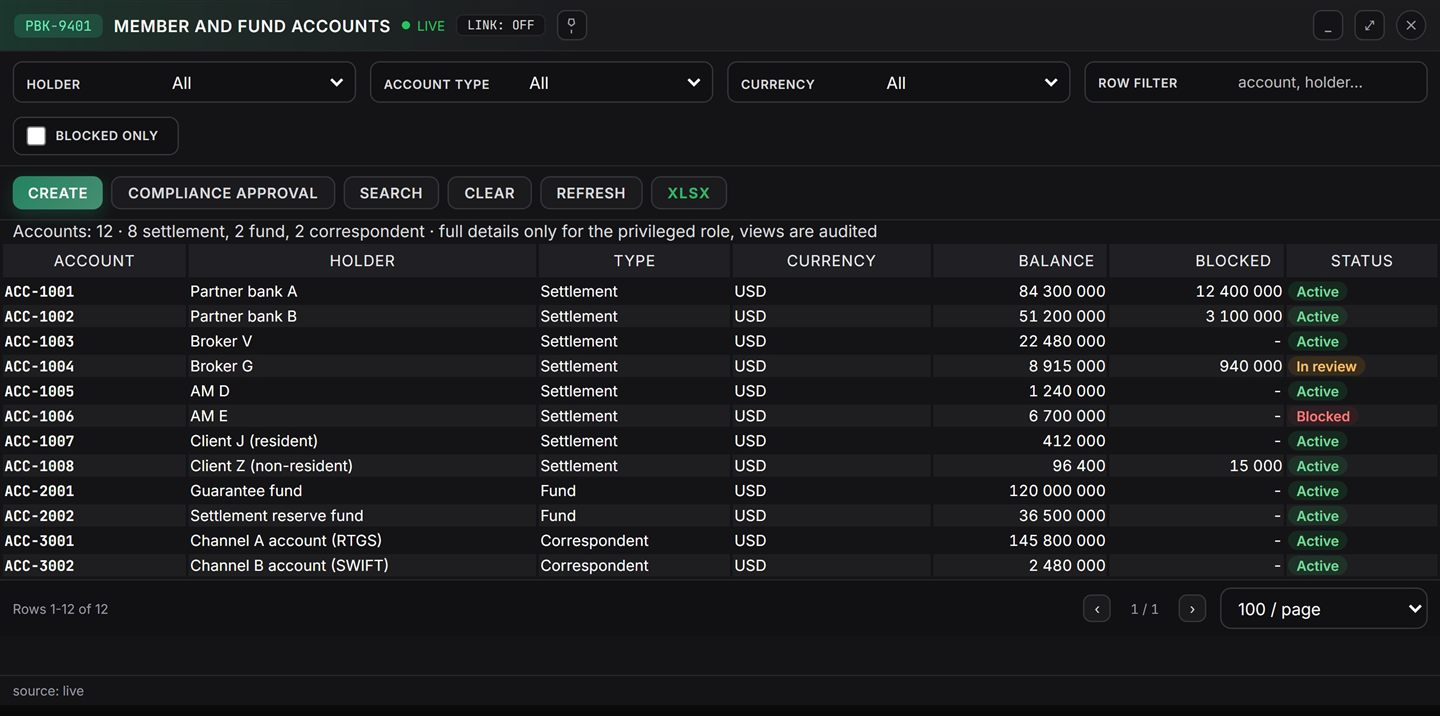
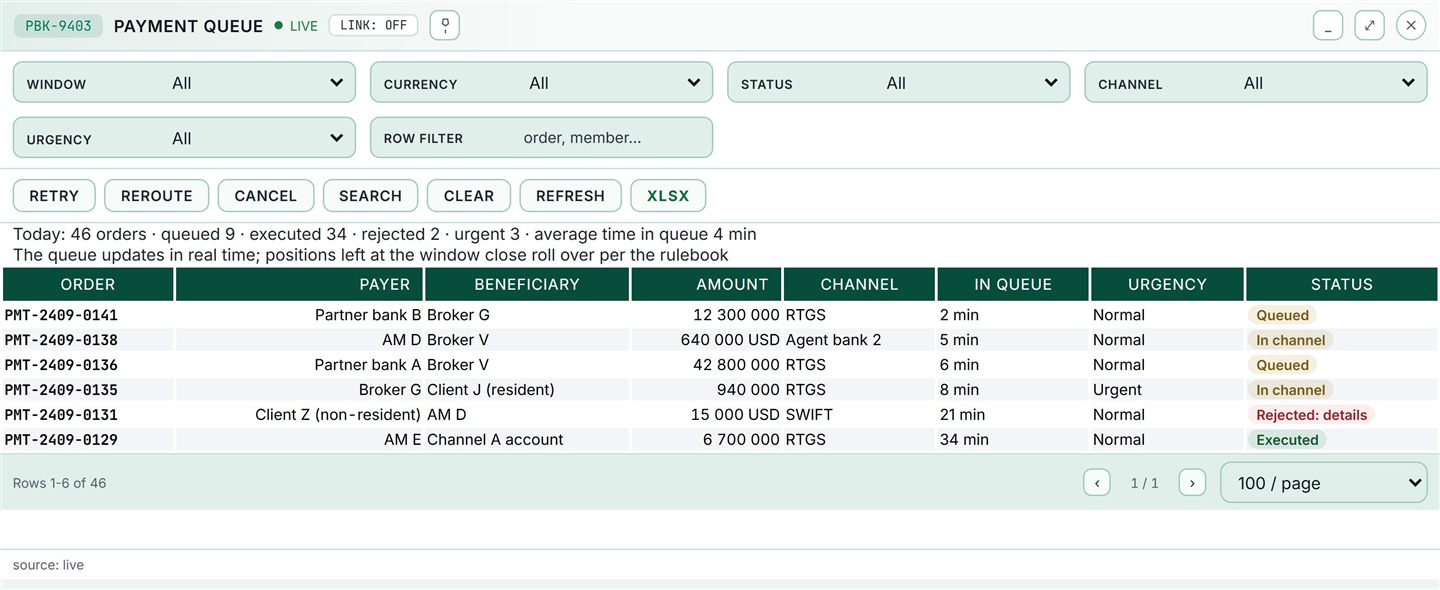
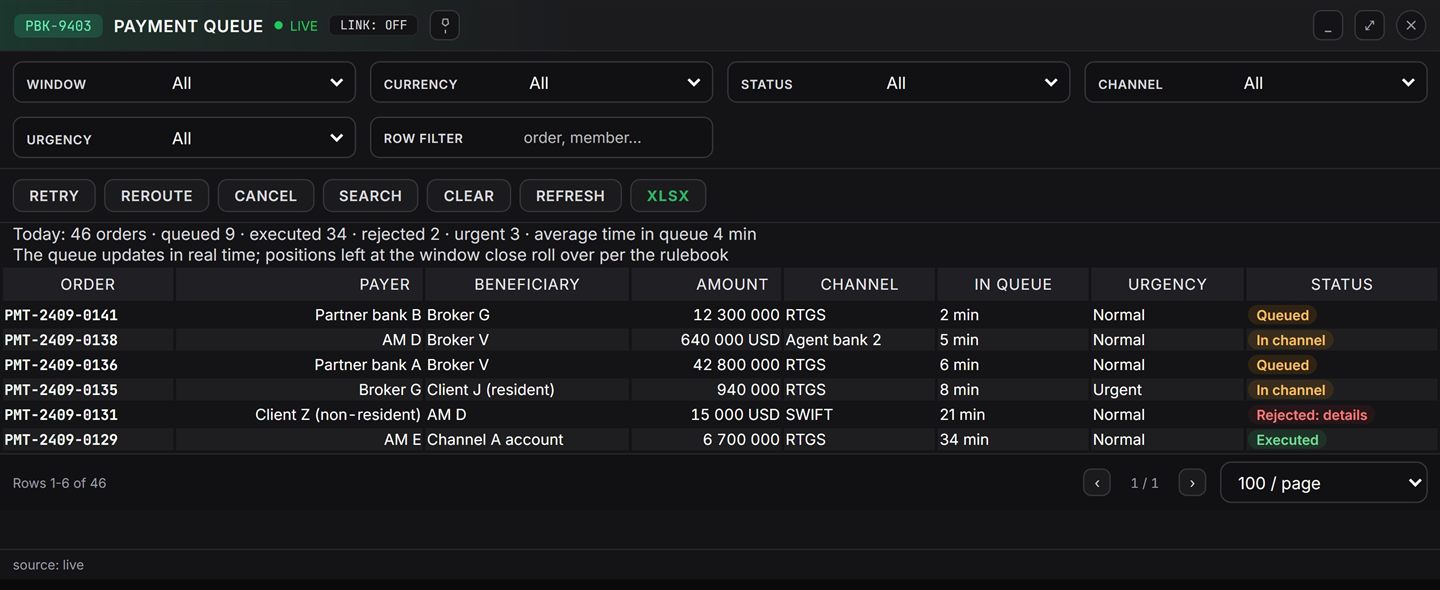
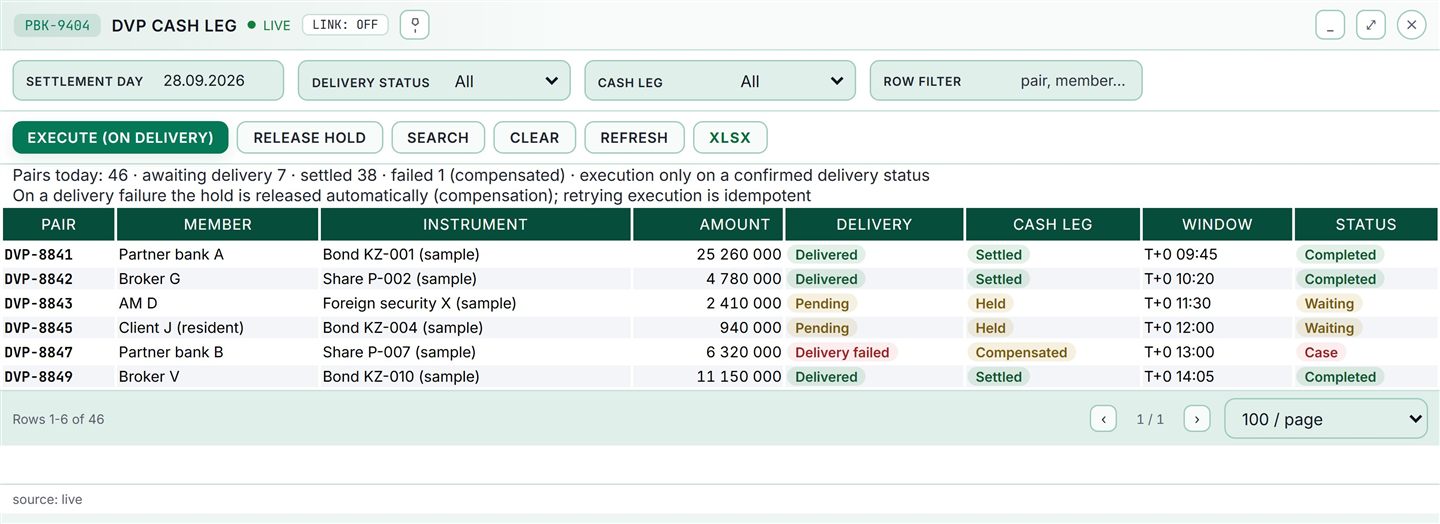
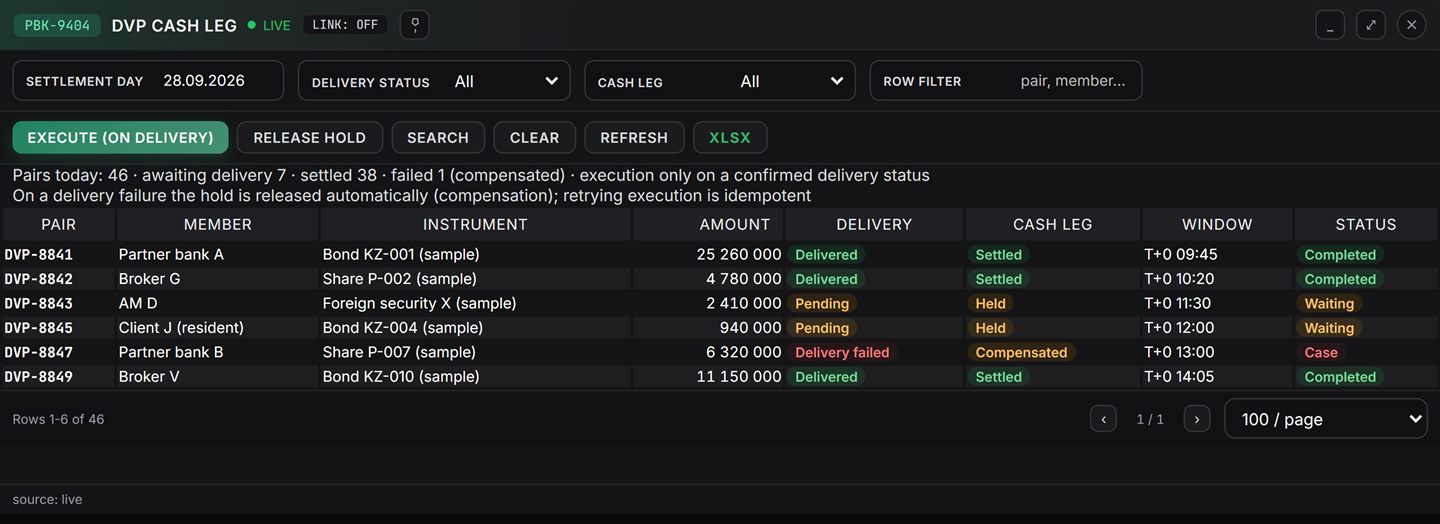
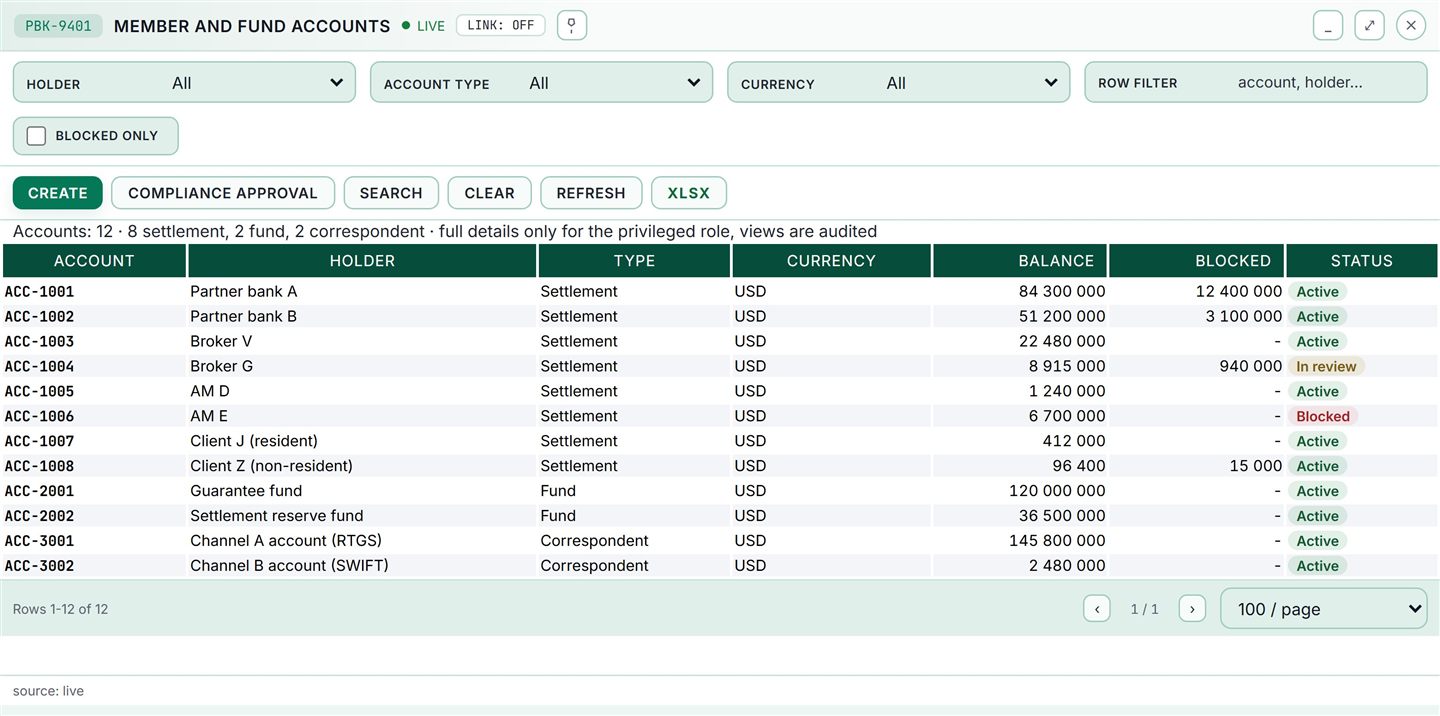
Account registry screen Account registry screen Payment queue screen Payment queue screen DvP money leg screen
Demo Unifin Payment Bank Theme Open separately
Member and fund accounts

This is an interface demonstration: the real solution will differ in colours and content for a specific project.

Functions at a glance

Business functions at a glance

From participant accounts to treasury and reporting.

Participant accounts
Runs settlement, currency and correspondent accounts
Balances and blocks in one picture
Payment orders
Takes orders with coverage and limit checks
An order is neither lost nor duplicated
Day payment queue
Runs the queue with priorities, windows and replay
Overdue items surface before a window fails
DvP money legs
Blocks funds against securities delivery
Money moves together with securities
Clearing and funds
Settles net positions and fund movements
Clearing obligations settle in windows
Fees and payouts
Computes fees and pays corporate actions
Payouts go out in date, with no manual nets
Treasury and reporting
Holds the liquidity forecast and day reports
The day closes with a proven picture

What runs today

The money leg, already running

Accounts to statements: the live money leg.

Accounts

Participant and fund accounts run with blocks.

Payment queue

Payment orders queue with priorities and cut-offs.

DvP money legs

DvP money legs close with the securities leg.

Channels

RTGS, SWIFT and ACH channels are wired.

Statements

MT940 and MT950 statements feed reconciliation.

Roadmap

Nostro management is next in line.

Solution description

Capabilities and overview

Key features

  • Participant and fund accounts: settlement, currency, correspondent
  • Payment orders with coverage and limit checks
  • The day payment queue with priorities, windows and replay
  • DvP money legs: funds blocked against securities delivery
  • Clearing settlements: net positions and fund movements
  • Venue fees and corporate action payouts
  • Treasury: the liquidity forecast and coverage management
  • Settlement reconciliation and day reporting
  • ISO 20022 channels for banks and participants
  • Roles and limits of settlement operators
  • Journal of every posting and audit of operations
  • Deployment: by configuration, within the UniFin platform

Product overview

Unifin Payment Bank is the UniFin platform settlement bank of the market for exchanges. Depositories and agent banks that need a reliable money leg.

The suite runs participant and fund accounts, payment orders, the day queue, DvP money legs and clearing settlements.

Money and securities move by one instruction: a block against delivery removes discrepancies.

Treasury holds the liquidity forecast, while fees and payouts are computed on the same suite.

The solution runs within the UniFin platform and connects to banks through standard ISO 20022 channels.

What it delivers

What the solution delivers

Participant accounts

Participant accounts are usually scattered across systems and spreadsheets, and balances are tied by hand. The solution runs settlement, currency, correspondent and fund accounts in one registry. With the solution balances and blocks are visible in one picture, and an account opens by template. In setup the operations on every account are visible with masked details, and the account structure comes as reference data.

Payment orders

A payment order usually goes through manual checks, and a duplicate on replay is found in a statement. The solution checks the account, coverage, limits and calendar at every step. With the solution payments run by the rulebook, and duplicates are not untangled after the fact. In setup the status and the route of every order are visible, and the signing rules come as reference data.

Day payment queue

The payment queue usually lives in an operator journal, and priorities are set by phone. The solution runs the day queue with priorities, windows and reprocessing. With the solution the day closes with no open payment items. In setup rejection reasons and overdue orders are visible, and the windows are set in configuration.

DvP money legs

The money leg is usually detached from delivery, and a mismatch is caught at reconciliation. The solution blocks funds against securities delivery, and execution runs only on the depository status. With the solution money and securities arrive together, and the gap is not carried. In setup the block, the execution and the compensation are visible, and the closing rules are configured per segment.

Clearing and funds

Clearing settlements are usually assembled by hand before cut-off, and funds live in a separate process. The solution settles net positions in windows automatically and runs fund contributions, use and return. With the solution clearing obligations close on time, and the risk stays under control. In setup pay and receive positions and fund movements with approvals are visible, and the tariffs come from the setup.

Fees and payouts

Fees and payouts are usually counted at month end, and every line lives with its own clerk. The solution computes fees from one registry and pays corporate actions, including withholding tax. With the solution payments run in date, and payouts are not collected by hand. In setup the fee and payout composition is visible for every issue, and the tariffs are part of the configuration.

Treasury and reporting

Liquidity is usually counted in spreadsheets in the morning, and the day is closed by reconciliation at night. The solution holds the liquidity forecast, channel limits and the daily reconciliation of money and obligations. With the solution the whole day is visible, and reporting runs without manual assembly. In setup statements, day reports and channel statuses are visible, and the schedules are set in configuration.

Coverage

What it covers

Runs on the platform base; the securities side stays with the depository.

Accounts and blocks

Opening, closing, blocks, mandates and balances with details masked by role.

Payment orders and queue

Order intake with checks, the settlement day queue, windows, rejects and reprocessing.

DvP money legs

Blocking and release against delivery, compensation and the link between the legs.

Clearing settlements

Net positions from the clearing suite settle in windows to cut-off.

Funds and margin

Contribution, top-up, use on default and return with four-eyes approval.

Fees and payouts

Fees from one registry, corporate action payouts with withholding tax.

Treasury and reconciliation

Liquidity forecast, channel limits and daily reconciliation of money and clearing.

Reporting and channels

Statements to participants, day reports, tax and regulatory reporting; channel statuses and SLA.

Stand

Screens of the solution

The account registry, the payment queue and the DvP money leg.

Account registry screen
Participant and fund accounts: balances, blocks and details by role
Payment queue screen
Payment queue of the settlement day: windows, statuses and reprocessing
DvP money leg screen
DvP money leg: blocking against delivery and release by status

How it works

The money leg of a DvP trade in five steps

The path of the money: blocking, delivery confirmation, settlement, reconciliation and statements.

  1. 1

    The trade reaches settlement

    The suite sends the instruction; the money side reserves the amount.

  2. 2

    Funds are blocked

    The participant sees the block; the queue shows the instruction state.

  3. 3

    Delivery confirms

    Execution runs on the depository status; unknown states fail closed.

  4. 4

    Settlement closes both legs

    The money and securities legs close together; the link stays visible.

  5. 5

    Day close and statements

    Daily reconciliation of money and clearing; reports go to the regulator.

Industries

Industries it serves

The suite works for market operators and their infrastructure: exchanges, central depositories, clearing organisations, agent banks and settlement participants.

Exchange / venue

Trading, supervision, market data and post-trade on one governed core, launched by configuration.

Bank / payments

Settlement, payments and custody services for the market around the trading core.

CSD / depository

Custody, corporate actions and settlement discipline for classic and digital assets.

Corporate / issuer

Market access for producers and issuers: auctions, deliveries, tokenised assets and data.

Architecture

Architecture and access

A ready platform and payment microservices, customised for the rulebooks of your market.

Ready base from day one

The platform and payment microservices work from the start; channels and limits are configured, not rebuilt.

Money safety by construction

Idempotency on every call, a duplicate is a success, fail-closed on unknown money states, maker-checker on withdrawals.

Single sign-on and audit

Identity, roles and the audit journal work as platform services; four-eyes approval covers fund operations.

Source code as an option

Code handover is optional for production; the service runs under an SLA or by your team.

AI layer

The AI layer drafts investigation notes and explains rejections; people approve every step, the journal records it.

Architecture scheme The same architecture as a standalone page. Open the diagram separately

Readiness

Ready today, next in line

Ready for a settlement-day pilot; the next wave adds your market channels.

Ready today

  • Account registry, payment orders and the settlement day queue
  • DvP money legs with blocks and fail-closed handling
  • Clearing settlements, funds and margin operations
  • Treasury picture, daily reconciliation and statements

Next in line

  • Connector presets for local RTGS and ACH schemes
  • Standing orders and recurring payments for issuers
  • Liquidity stress scenarios for the treasury desk

Releases

Release history

Quarterly releases from the foundation of the platform (2020); the Payment Bank suite develops from 2026.

2026 Q1

  • Account registry, payment orders and the queue of the settlement day.

2026 Q2

  • DvP money legs, funds and margin operations with four-eyes.

2026 Q3

  • Treasury picture, daily reconciliation and participant statements.

Detailed description

Detailed description

Message formats, the treasury drill-down and the delivery frame.

How the suite is assembled

Channels and clients
FIX 4.2 / 4.4 / 5.0, REST with mTLS, SFTP files, web portals
Edge and access
API gateway with 126 routes, Keycloak single sign-on, WAF and CSP
Platform core services
payment-ms fx-ms clearing-ms bank connectors AI agentic layer Services of the suite on the shared platform core
Data and events
PostgreSQL 17 per service, Redis 7, RabbitMQ 3.13 quorum queues, transactional outbox
Results and reporting
Portals, reports, regulator and partner channels

Technology stack

Runtime and backend: Java 21 (LTS), Spring Boot 3.5.16, Spring Cloud 2025.0.3, Gradle, Flyway 10.15.

Data: PostgreSQL 17 per service, Redis 7 with Sentinel, RabbitMQ 3.13 quorum queues, transactional outbox and DLQ replay.

Portals: Next.js 16.3.3, React 19, TypeScript 5; OpenTelemetry 1.31 to Jaeger.

Delivery: Kubernetes and Helm, Vault secrets, Prometheus and Grafana, Docker Compose for pilots.

Visualisation: Apache Superset 4 and ECharts 5 for dashboards and charts, Grafana for operations panels, Mermaid for documentation schemes and the portal diagrams.

Message formats

  • Payment orders in the local and international message families with mapping rules per channel.
  • Statement formats to participants and the schedule of day reports.
  • Reconciliation files for the settlement bank and the clearing organisation.
  • Configurable statuses and reason codes translated to the language of each channel.

Treasury drill-down

  • Liquidity by currency and by correspondent bank with intraday updates.
  • Tomorrow and day-after views: what is expected from deliveries, settlements and payouts.
  • Limits to channels and counterparties with warnings before breach.
  • Fee accruals and the money result of the day in one view.

Delivery frame

  • The pilot runs one settlement scenario on the customer stand, from order to day close.
  • Ready microservices: accounts, orders, queue, DvP legs, funds, treasury, reporting.
  • RTGS and ACH connectors are presets configured for the local scheme.
  • Source code handover as an option with a separate fee, with the payment rulebook documented as configuration.

Architecture

  • Built from the platform core: payment-ms, fx-ms, clearing-ms and the bank connectors.
  • The suite works through platform contracts: one register of record, no shadow copies of the data.
  • Scaling adds nodes, not rewrites: stateful services grow with Patroni, RabbitMQ and Redis clusters.

Integrations and access

  • OpenAPI for every service: 978 documented endpoints behind 126 gateway routes, plus webhooks and SFTP where partners need files.
  • Single sign-on: Keycloak 26.1, OIDC and JWT, roles, MFA and API keys with quotas.
  • Evidence by default: the audit journal, idempotency keys on writes and a record for every disclosure.
Detailed description

Leave your contacts to open the detailed description and download the PDF with architecture, cases and delivery details.

Run a settlement day on the platform

Bring one settlement scenario: we will run the pilot from the payment order to the day close on your stand.