UNIFINplatform

Solution

Unifin Beholder Eye

The suite runs compliance as a process: checks, risk, investigations and reporting.
KYC and KYB, list screening, risk profiles, red flags and the regulator channel.
Every decision carries its evidence and audit trail; personal data is masked by default.

  • Evidence for every decision
  • Data masked by default
  • Reports to the FIU
All solutions

Live screens from the product terminals

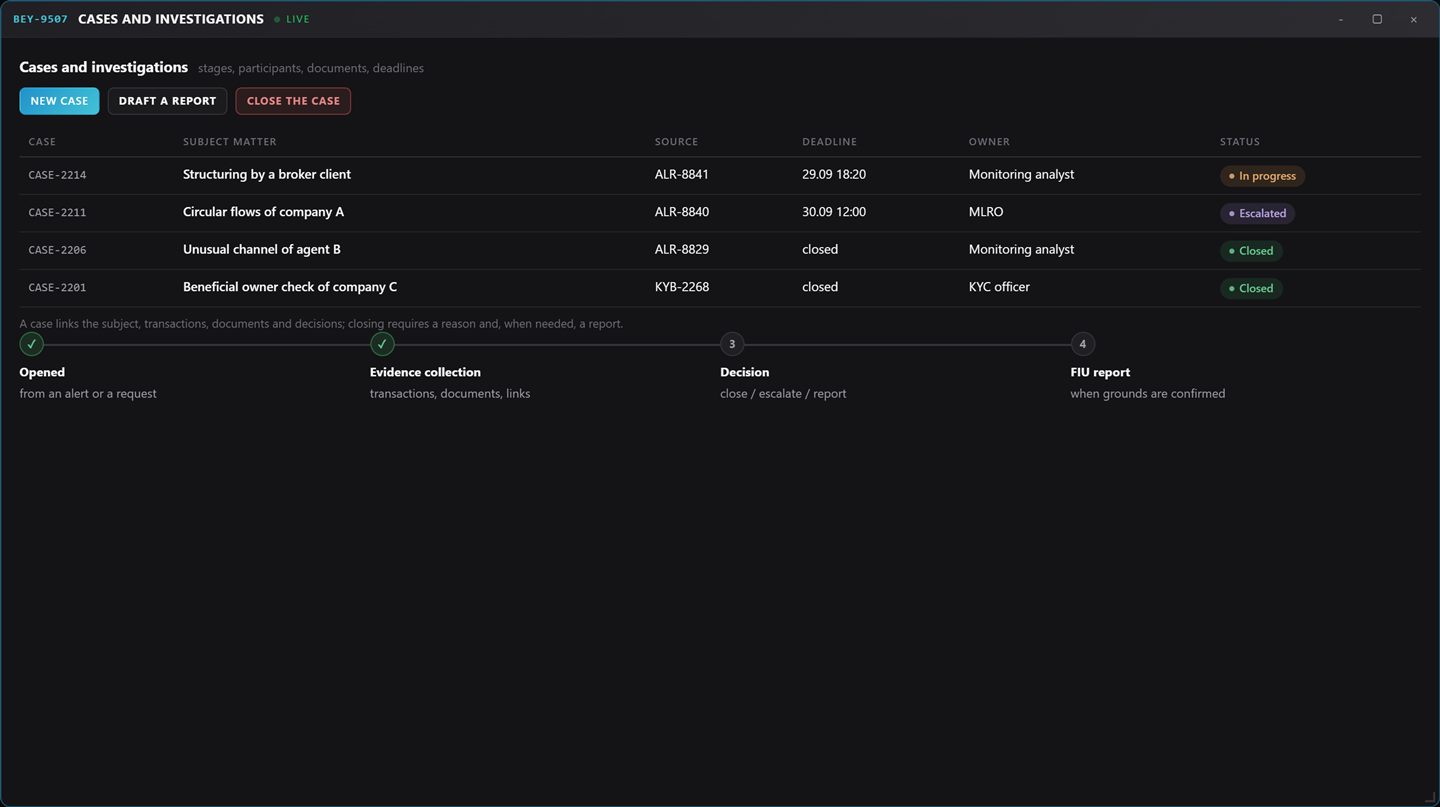
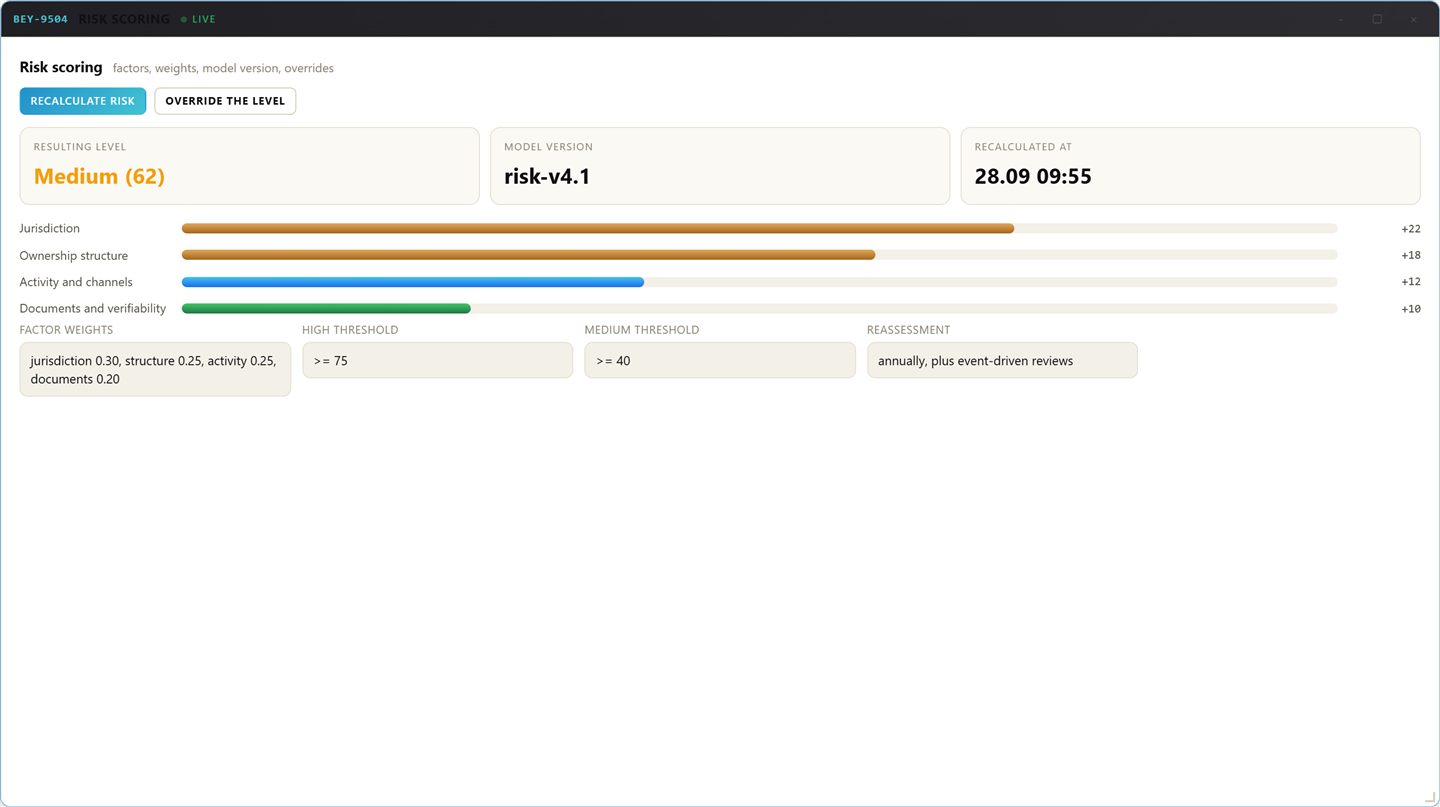
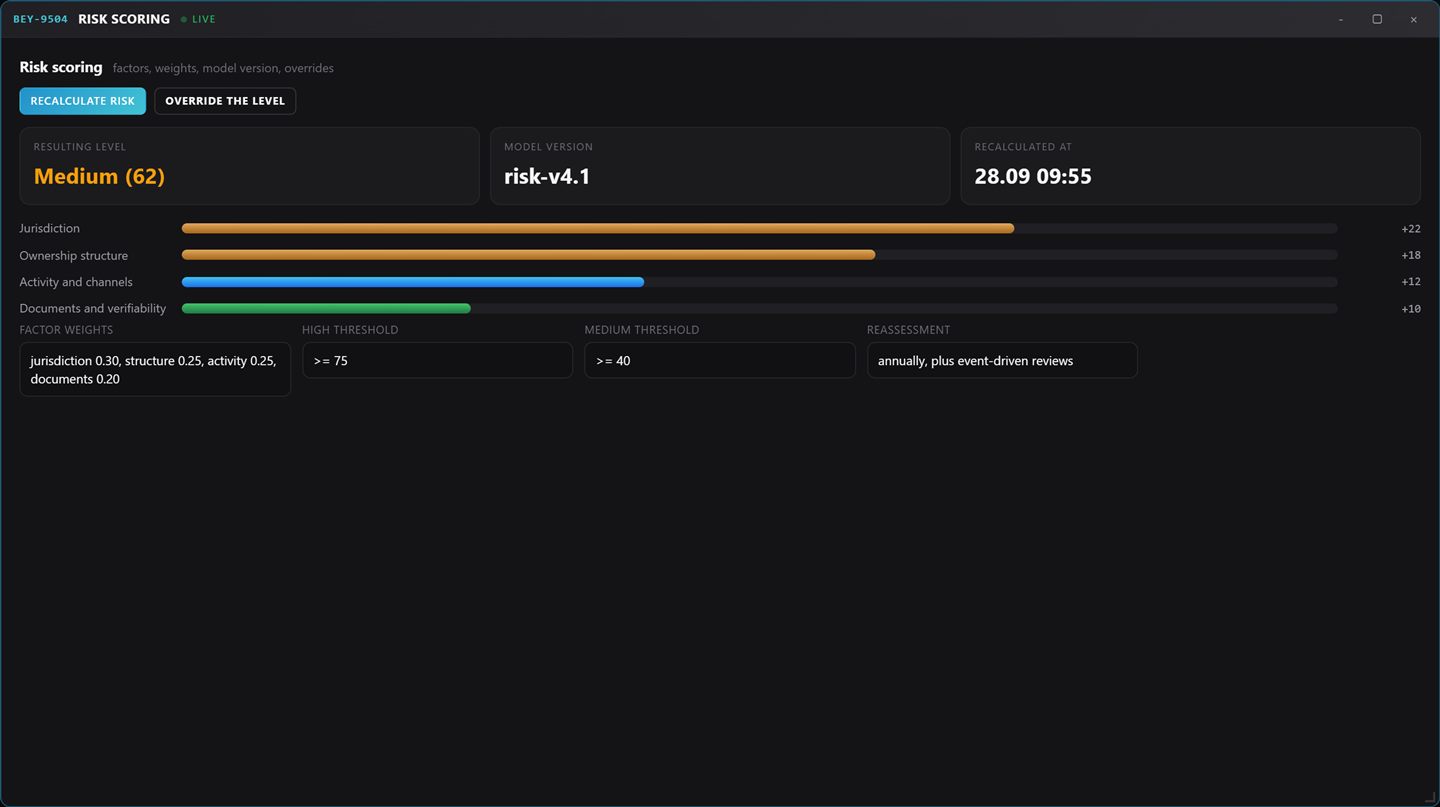
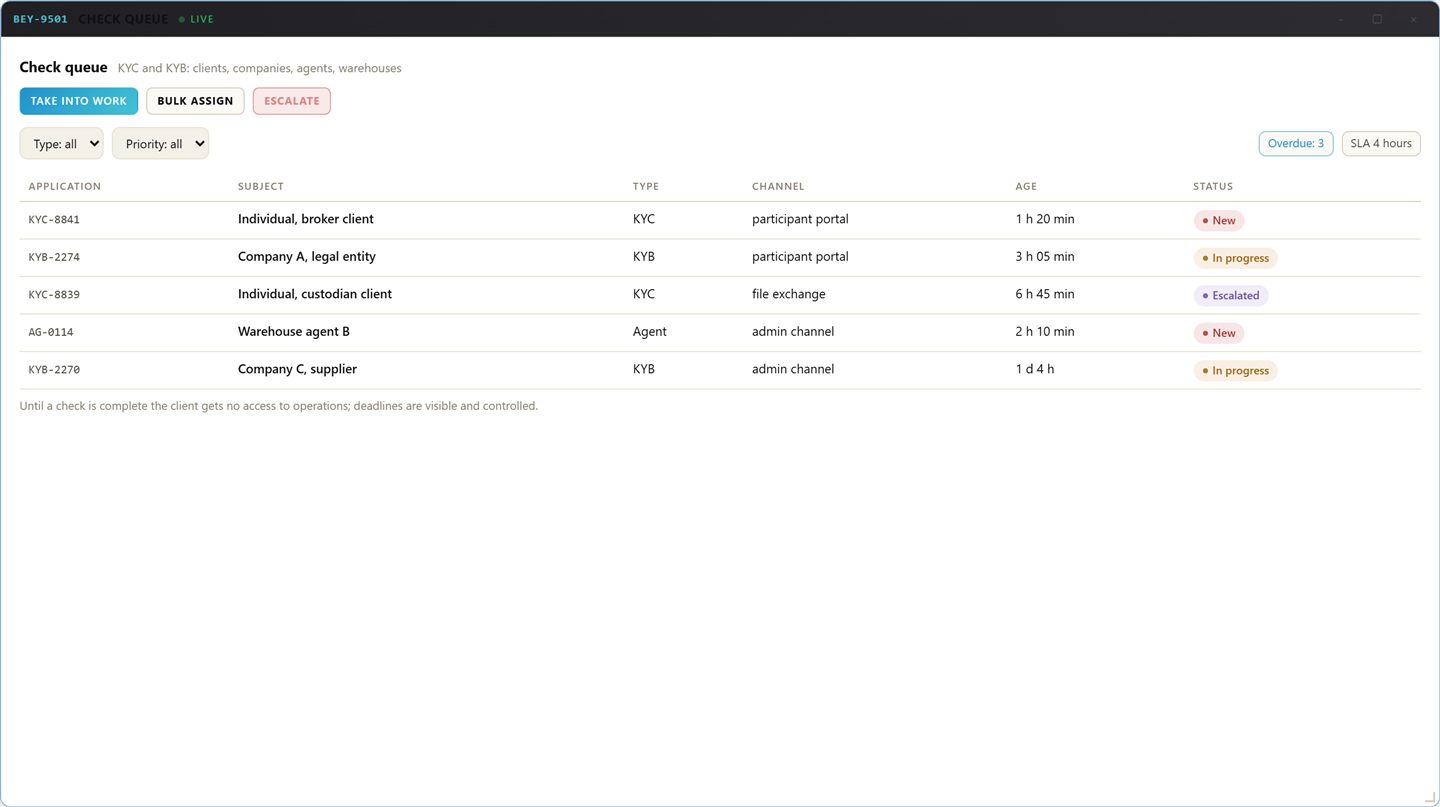
Case workspace screen Case workspace screen Risk scoring screen Risk scoring screen KYC verification queue screen
Demo Unifin Beholder Eye
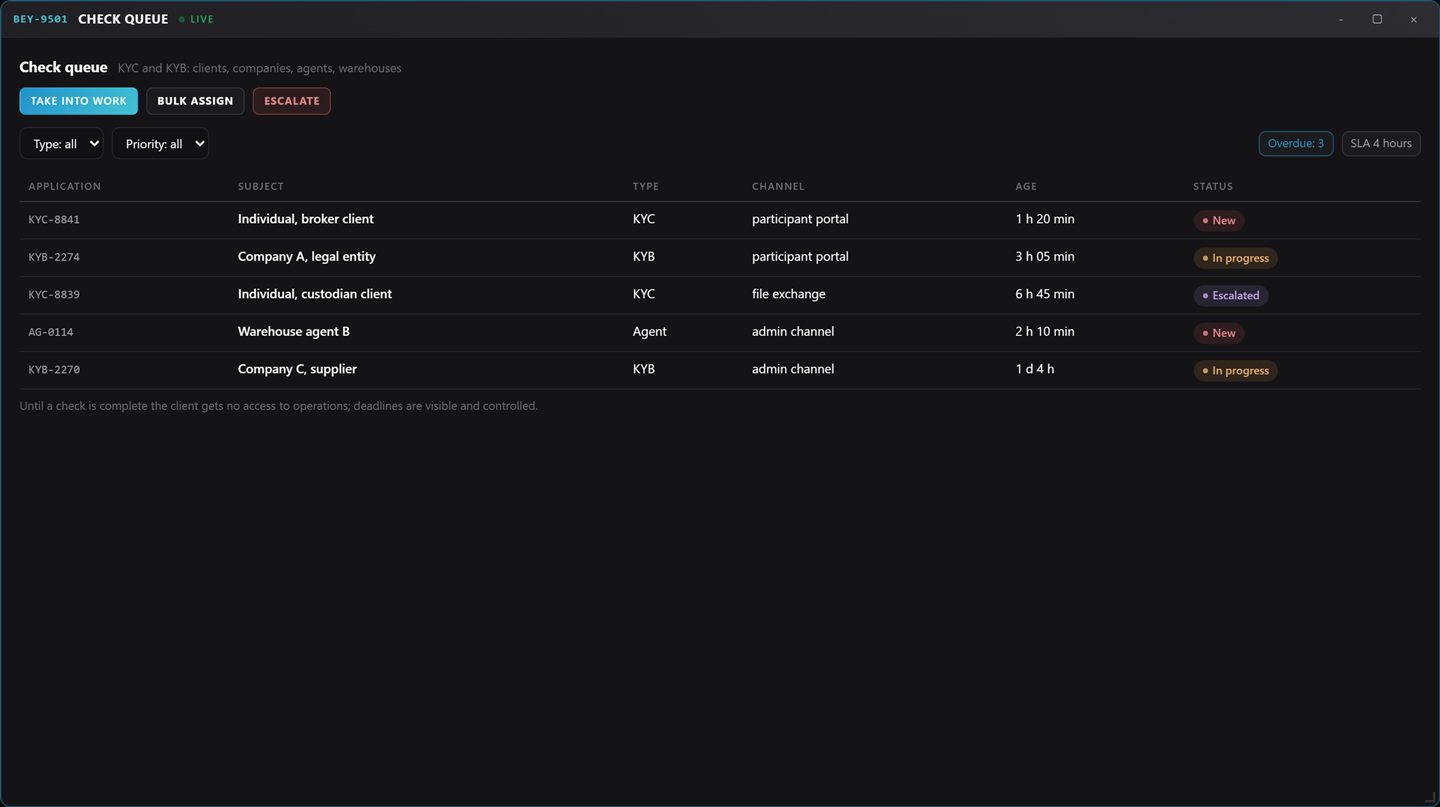
Verification queue
Verification queue: clients, companies, agents and warehouses by SLA
Verification queue
Verification queue: clients, companies, agents and warehouses by SLA

This is an interface demonstration: the real solution will differ in colours and content for a specific project.

Functions at a glance

Business functions at a glance

From the subject registry to reports to the FIU.

Subject registry
Runs the subject card with documents and links
One card instead of folders and sheets
KYC and KYB
Checks identity, business and ownership structure
Onboarding runs by the requirements
Screening
Resolves matches from lists and media
False positives become a statistic
Risk scoring
Scores the risk level with factors and weights
An override is always justified
Transaction monitoring
Catches red flags across trades and operations
Alerts are resolved with deadlines
Investigations
Runs cases with stages and evidence
Every decision rests on evidence
Reports to the FIU
Sends reports and keeps the receipts
A supervisory question finds an answer in minutes

What runs today

Compliance as a process, already running

Compliance as a process: the live parts.

Onboarding

Onboarding and review run as a process.

Screening

KYC, KYB and list screening run on every party.

Scoring

Risk scoring and red flags drive decisions.

Investigations

Investigations keep the evidence trail.

Reporting

Reports go to the FIU; personal data stays masked.

Roadmap

More list sources come next.

Solution description

Capabilities and overview

Key features

  • Subject registry: a card with documents and links
  • KYC and KYB: identity, business and ownership structure
  • List and media screening with match resolution
  • Risk scoring with factors and decision weights
  • Transaction monitoring: red flags across trades and transfers
  • Investigations: cases with stages and evidence
  • Reports to the financial intelligence unit with receipts
  • Personal data is masked by default
  • Client review by schedule and events
  • Monitoring rules are configured by compliance itself
  • Audit journal for every decision and disclosure
  • Deployment: by configuration, within the UniFin platform

Product overview

Unifin Beholder Eye is the UniFin platform compliance suite for market operators, banks and brokers that need provable checks.

The suite runs compliance as a process: client onboarding and review, screening, risk profiles, monitoring and investigations.

Every decision carries its indicators, its basis and an audit trail, while personal data is masked by default.

Reports go to the financial intelligence unit with receipts, and monitoring rules are configured by compliance itself.

The solution runs within the UniFin platform and is configured to the procedures of the organisation.

What it delivers

What the solution delivers

Subject registry

Client records usually live across systems, and one check needs exports. The solution runs the subject card with documents, links, risk and the decision history. With the solution the client is visible as a whole before every decision. In setup the documents and history per subject are visible, and the participant links come as reference data.

KYC and KYB

Checks are usually done by hand over folders, and the ownership structure gets lost in scans. The solution checks identity, business and ownership against documents and registries. With the solution clients onboard by the requirements, with no surprises at inspection. In setup the questions and deadlines per finding are visible, and the check rules are set in configuration.

Screening

Matches are usually resolved in the evening and closed without a basis. The solution screens lists, PEP and adverse media, resolving matches with a recorded decision. With the solution the quality of screening is known, and false positives do not drown it. In setup the false-positive statistics and the resolution history are visible, and the lists are configured per segment.

Risk scoring

A risk level is usually set by eye and cannot be explained. The solution scores risk with factors and weights, versioning the model. With the solution every score is explainable and defended with confidence. In setup the factors and override bases are visible, and the model comes as reference data.

Transaction monitoring

Suspicious operations are usually hunted before an inspection. The solution catches red flags across trades and operations and resolves them with deadlines. With the solution the suspicious is visible in the moment, not at a year-end review. In setup the evidence and links per alert are visible, and the scenarios come from the setup.

Investigations

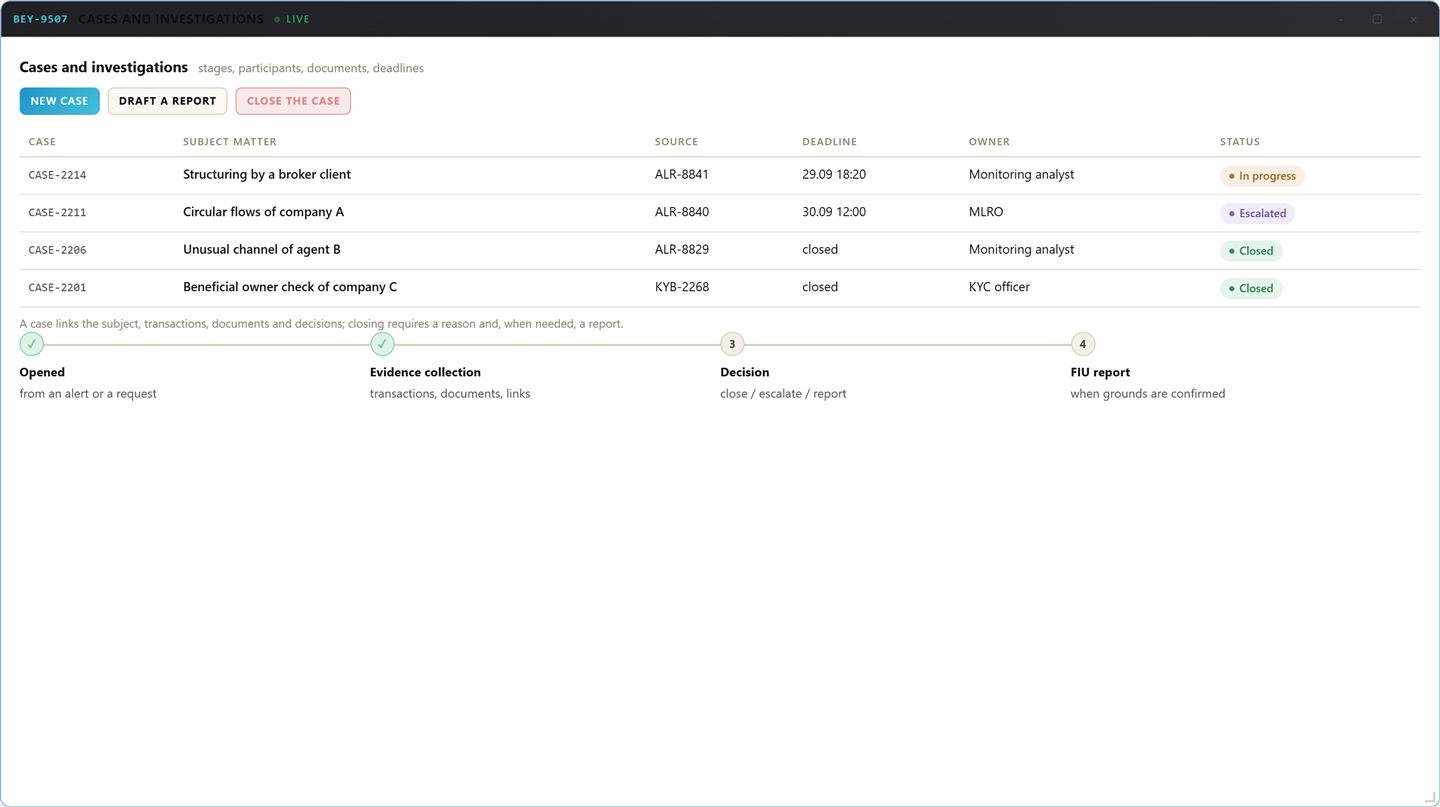
Cases usually live in folders, and evidence is reassembled. The solution runs cases with stages, tasks, evidence and RFIs. With the solution the state of every case is visible, and deadlines are not missed. In setup the evidence and the case participants are visible, and the task templates are part of the configuration.

Reports to the FIU

Reports are usually sent by letter without an acknowledgement. The solution sends suspicious operation and threshold reports with acceptance receipts. With the solution it is known that the report arrived: inspection is calm. In setup the sending statuses and the data disclosures are visible, and the templates are set in configuration.

Coverage

What it covers

The suite is designed around proof: features, decisions and the audit record.

Onboarding and review

Application, documents, checks and the decision with conditions and the next review date.

Screening

List screening with match resolution, false-positive analytics and scheduled re-screening.

Risk scoring

Factors and weights, model versions, recalculation and controlled overrides.

Monitoring rules

Scenario library with versions, thresholds, tests on history and activation by four eyes.

Investigations

Cases with tasks, evidence, RFI to other organisations and deadlines.

Regulatory reporting

Suspicious operation reports, threshold and statistical reports with acceptance receipts.

Data protection

Masking by default, disclosure with a basis and TTL, the access audit.

Stand

Screens of the solution

The verification queue, risk scoring and the case workspace.

KYC verification queue screen
Verification queue: clients, companies, agents and warehouses by SLA
Risk scoring screen
Risk scoring: factors, weights, model version and overrides
Case workspace screen
Cases and investigations: stages, participants, documents and deadlines

How it works

From the application to the decision in five steps

The path of a client: application, checks, screening, scoring and the decision.

  1. 1

    The application arrives

    The card opens; the verification queue takes it by SLA.

  2. 2

    KYC and KYB run

    Checks run against documents and registries; findings become questions with deadlines.

  3. 3

    Screening resolves matches

    Lists and media are screened; matches close with a recorded basis.

  4. 4

    Risk is scored

    The model scores with factors; an override needs a basis.

  5. 5

    The decision is recorded

    Decision, monitoring level and review date go to the journal.

Industries

Industries it serves

The suite serves the market operator and its depository, banks and brokers in their KYC duties. The supervisor for the evidence base.

Bank / payments

Settlement, payments and custody services for the market around the trading core.

Regulator / supervisor

Surveillance evidence, market analytics and reporting built from live transaction data.

Architecture

Architecture and access

The suite sits on the platform and connects the external registries and lists that compliance depends on.

Platform services

Identity, audit and documents come from the platform; the suite adds registry, screening, scoring and cases.

External sources

Sanctions and PEP lists, registries, media and the FIU channel connect as adapters with schedules and reconciliation.

Data protection

Personal data is masked by default; unlocking needs a basis and leaves an audit record.

AI layer

The AI layer builds link graphs and drafts case summaries with sources; people approve every step.

Architecture scheme The same architecture as a standalone page. Open the diagram separately

Readiness

Ready today, next in line

The concept and the prototype are complete; build waves start after approval.

Ready today

  • Product frame: modules and business cases
  • Screen prototype: operation forms and end-to-end scenarios
  • Interface specification and estimates for the build waves

Next in line

  • Wave W1: subject registry, KYC and screening
  • Wave W2: scoring, monitoring rules and alerts
  • Wave W3: cases, regulatory reporting and the AI layer

Releases

Release history

The compliance suite is designed in 2026 and joins the platform release waves with the first pilot.

2026 Q3

  • Concept, business cases and the screen prototype; estimates for four waves.

2026 Q4

  • Planned: wave W1 with the subject registry and screening (plan).

Detailed description

Detailed description

The module map, the metrics of the suite and the delivery frame.

How the suite is assembled

Channels and clients
FIX 4.2 / 4.4 / 5.0, REST with mTLS, SFTP files, web portals
Edge and access
API gateway with 126 routes, Keycloak single sign-on, WAF and CSP
Platform core services
sanctions-ms risk-ms docflow-ms case services AI agentic layer Services of the suite on the shared platform core
Data and events
PostgreSQL 17 per service, Redis 7, RabbitMQ 3.13 quorum queues, transactional outbox
Results and reporting
Portals, reports, regulator and partner channels

Technology stack

Runtime and backend: Java 21 (LTS), Spring Boot 3.5.16, Spring Cloud 2025.0.3, Gradle, Flyway 10.15.

Data: PostgreSQL 17 per service, Redis 7 with Sentinel, RabbitMQ 3.13 quorum queues, transactional outbox and DLQ replay.

Portals: Next.js 16.3.3, React 19, TypeScript 5; OpenTelemetry 1.31 to Jaeger.

Delivery: Kubernetes and Helm, Vault secrets, Prometheus and Grafana, Docker Compose for pilots.

Visualisation: Apache Superset 4 and ECharts 5 for dashboards and charts, Grafana for operations panels, Mermaid for documentation schemes and the portal diagrams.

Screening quality

  • Match quality metrics: false positive rate, time to resolution, backlog by list.
  • List update pipeline: versioning, diff reports and impact re-screening of the portfolio.
  • Name matching tuned per script and language of the local market.
  • Every resolution carries the basis and the analyst; second review where policy demands it.

Model governance

  • Scoring models are versioned: factors, weights and performance history are visible.
  • Monitoring scenarios pass test runs on historical data before activation.
  • Rule and model changes require four-eyes approval and land in the audit journal.
  • Quality review of the alert stream: what fired, what was worth it, what to tune.

Case metrics

  • Time to detect, time to resolve and the ageing of open cases by type.
  • Repeat subjects and connected parties surfaced from the registry graph.
  • Reports to the financial intelligence unit with acceptance receipts and statistics.
  • Deletion and retention rules for personal data, enforced by the platform.

Architecture

  • Built from the platform core: sanctions-ms, risk-ms, docflow-ms and the case services.
  • The suite works through platform contracts: one register of record, no shadow copies of the data.
  • Scaling adds nodes, not rewrites: stateful services grow with Patroni, RabbitMQ and Redis clusters.

Integrations and access

  • OpenAPI for every service: 978 documented endpoints behind 126 gateway routes, plus webhooks and SFTP where partners need files.
  • Single sign-on: Keycloak 26.1, OIDC and JWT, roles, MFA and API keys with quotas.
  • Evidence by default: the audit journal, idempotency keys on writes and a record for every disclosure.
Detailed description

Leave your contacts to open the detailed description and download the PDF with architecture, cases and delivery details.

Put the compliance suite on your data

Bring a KYC case and a screening scenario. We will run them through the suite and show the evidence chain end to end.