UNIFINplatform

Solution

Unifin Commodity Exchange MSA

An organised commodity market stands on specifications and execution discipline.
The MSA suite admits the lot, trades it, clears and delivers by warrant.
A lot is traced from admission to delivery without letters and manual reconciliations.

  • Auctions: four types
  • Warrants and CSD accounts
  • Money path SLO Tier 1
All solutions

Live screens from the product terminals

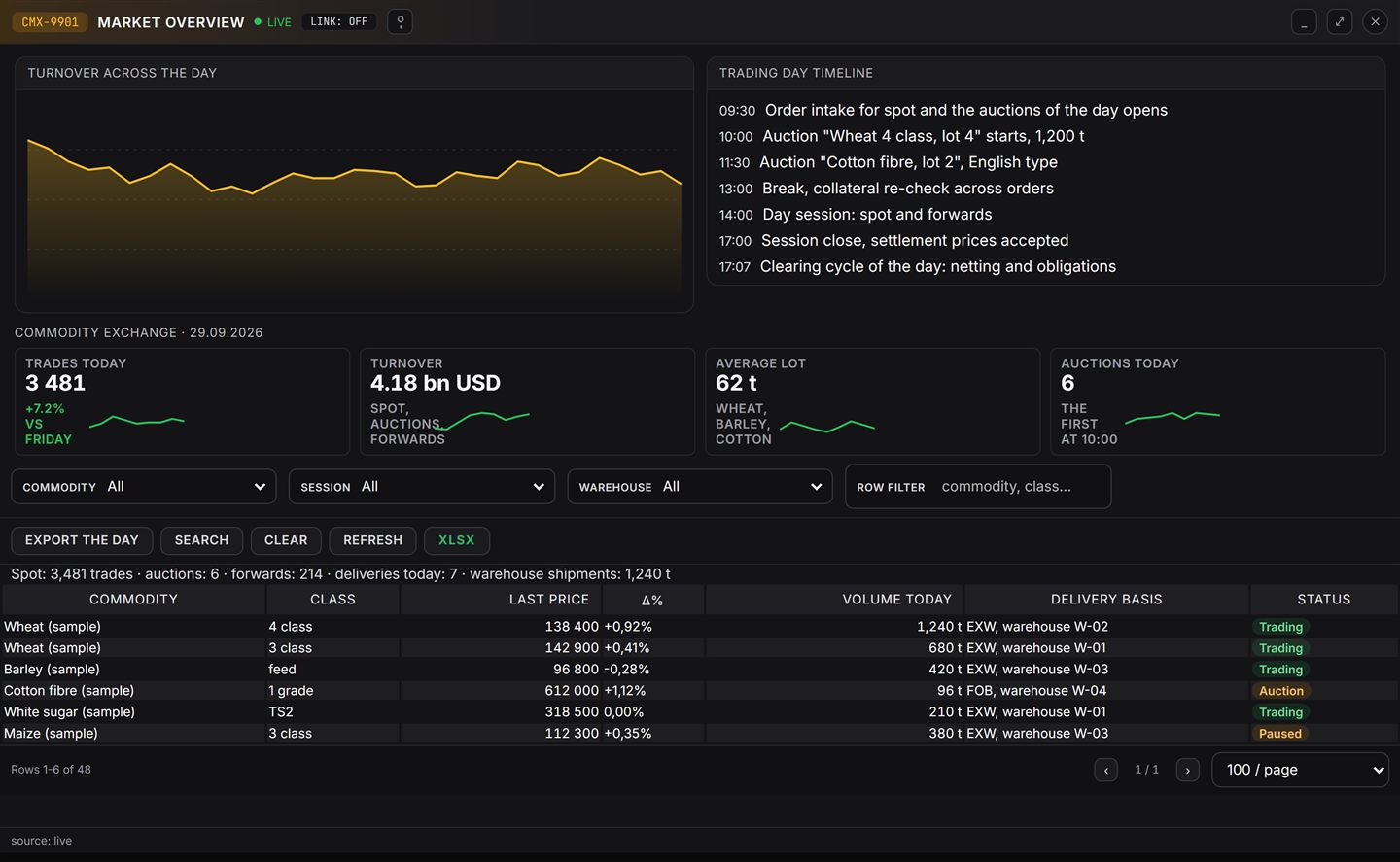
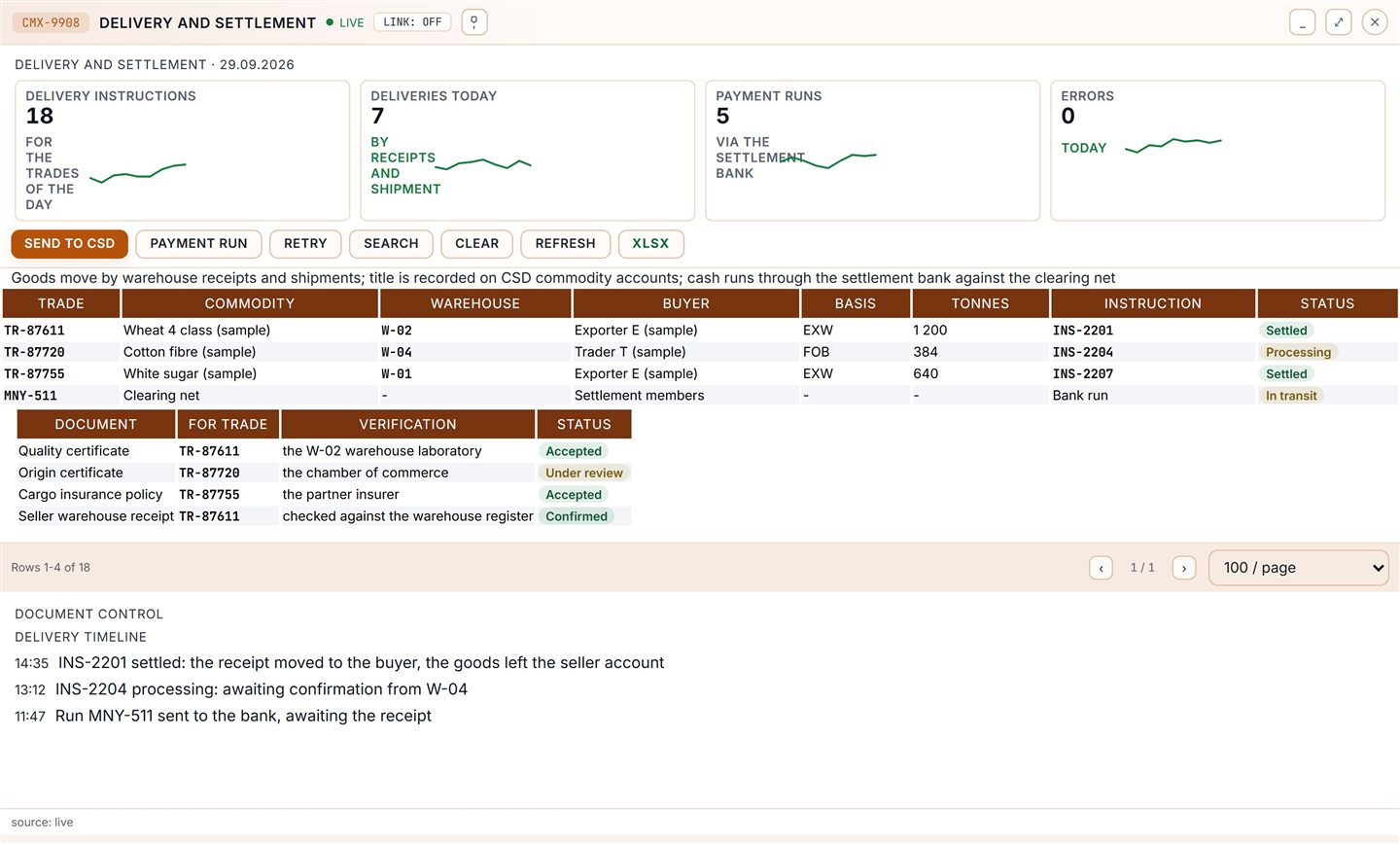
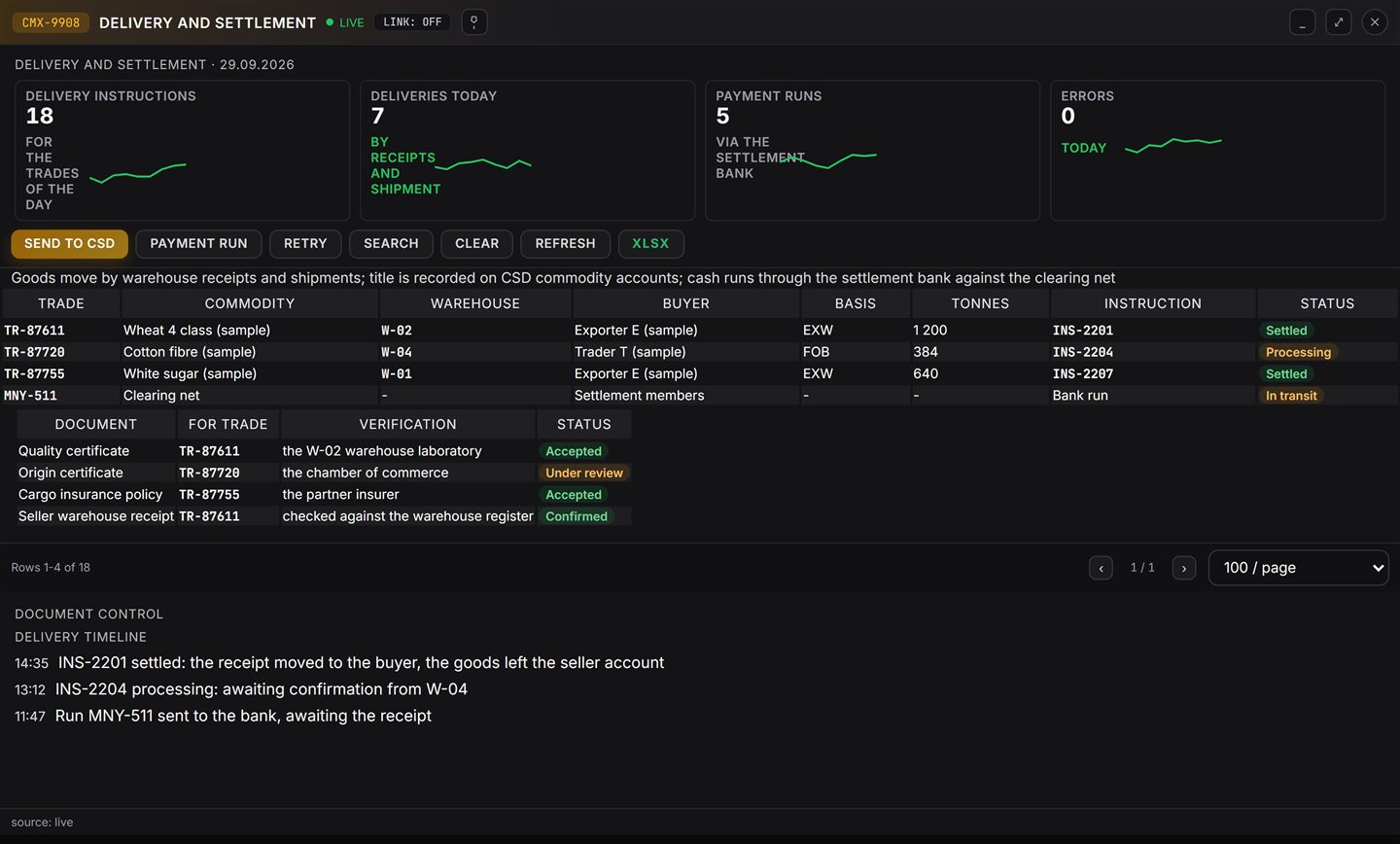
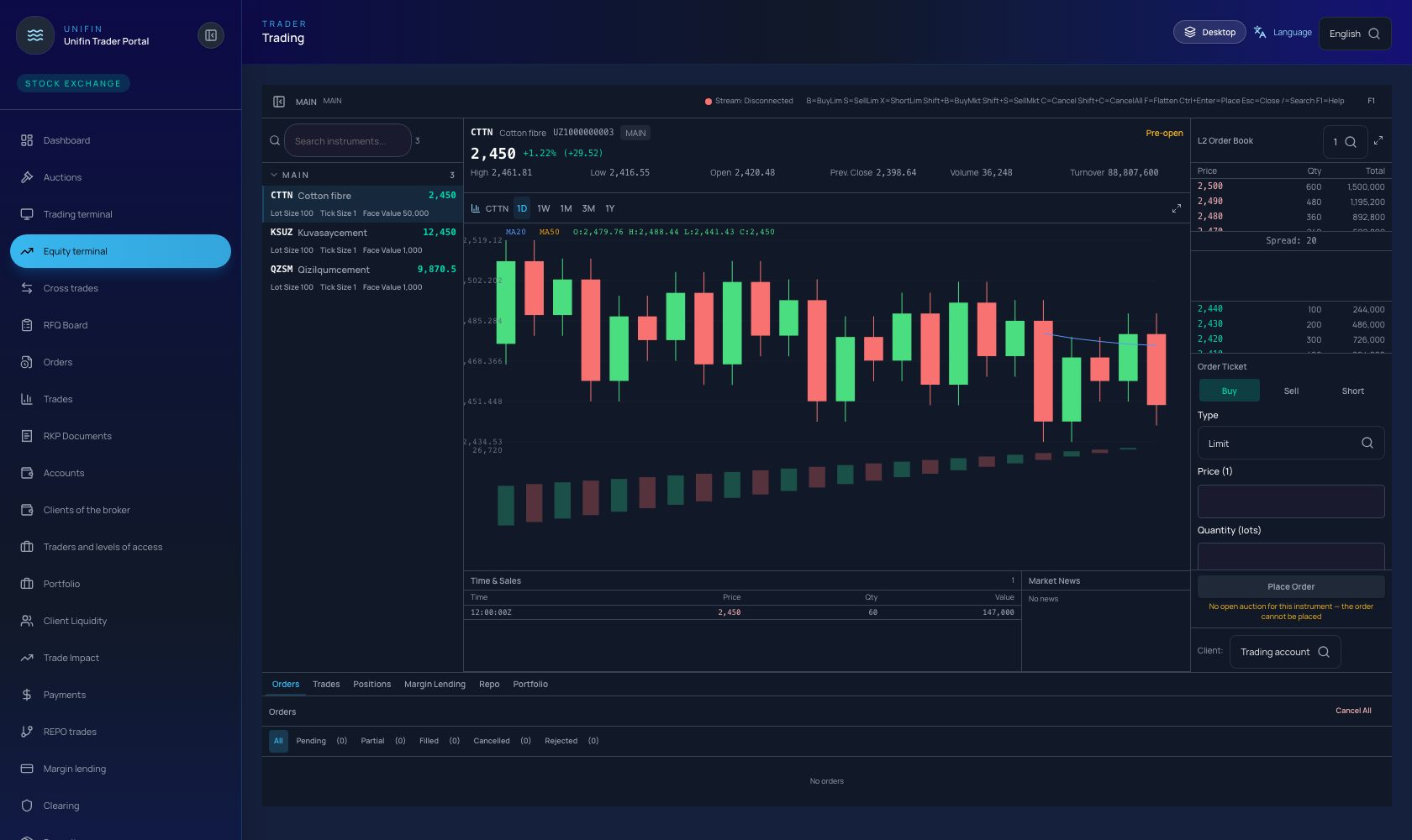
Market overview screen with trades and turnover Market overview screen with trades and turnover Warehouses and warrants screen Warehouses and warrants screen Trader terminal screen with quotes and the order ticket
Demo Unifin Commodity Exchange MSA Theme Open separately
Market overview
Market overview

This is an interface demonstration: the real solution will differ in colours and content for a specific project.

Functions at a glance

Business functions at a glance

From auctions to reports to the regulator.

Auctions
Runs four auction types with rounds and timers
The lot sells by the specification rules
Order book
Brings limit orders together and leaves a trail
Spot and forwards trade in one book
Specifications
Defines what and how the venue trades, with versions
A new commodity or rule is configuration, not code
Warehouses and warrants
Runs receipts, warrant transfer and rights on accounts
Goods stay at an accredited warehouse
Delivery
Runs delivery windows, shipment and documents
The buyer gets the goods on time
Clearing with novation
Turns trades into obligations and net positions
Money legs run through the bank in runs
Reports and regulator
Builds extracts from live transaction data
The regulator sees the exchange day in full

What runs today

From lot to warrant, already running

From lot admission to warrant delivery: the live flow.

Auctions

Four auction types admit and price the lot.

Matching

The book matches orders under market rules.

Warrants

Warehouse warrants carry quality, storage and logistics.

Delivery

Delivery runs by warrant with DvP settlement.

Specifications

Specifications and admission rules gate every lot.

Roadmap

New commodity classes come next; ETRM stays out of scope.

Solution description

Capabilities and overview

Key features

  • Auctions of four types with rounds and timers
  • Order book with a trail for every trade
  • Specifications with versions: what and how the venue trades
  • Warehouses and warrants: receipts, transfer, rights on accounts
  • Delivery: windows, shipment and documents to the close
  • Clearing with novation: obligations and net positions
  • CSD instruments: depo accounts and operations on lots
  • Reports and extracts for the regulator from live trade data
  • Lot admission through the specification and checks
  • Roles of the exchange, clearing, warehouses and participants
  • Journal and audit across lots, warrants and deliveries
  • Deployment: by configuration, within the UniFin platform

Product overview

Unifin Commodity Exchange MSA is the UniFin platform trading system of the organised commodity market for exchanges with clearing and delivery.

The suite admits a lot by specification, trades it through auctions and the book, and runs warrants, delivery and clearing with novation.

Every trade leaves a trail: from lot admission to delivery it is visible who declared what and when.

CSD instruments tie warehouse receipts to rights on accounts, and settlement runs together with the bank leg.

The solution runs within the UniFin platform and is configured without core changes.

What it delivers

What the solution delivers

Auctions

Commodity auctions are usually run by hand: rounds and price steps are counted on a calculator. The extension is watched on a clock. The solution runs all four auction types with rounds, timers and the extension rule from one window. With the solution the lot sells by the specification rules, with no dependence on a careful scorekeeper. In setup rounds, steps and timers come as reference data without code changes.

Order book

Spot orders and forwards usually live in different spreadsheets, and the trade trail gets lost. The solution brings limit orders into one book and leaves a line in the tape and a delivery instruction. With the solution spot and forward run in one place, and the depth of demand is visible. In setup the order and trade journal is visible, and the collateral checks are set in configuration.

Specifications

A specification usually lives in documents, and every change turns into a letter to the participants. The solution keeps specifications with versions: classes, basises, tariffs and admission rules. With the solution the trading terms change as reference data, and participants see the current version. In setup the version history and the differences are visible without code changes.

Warehouses and warrants

Receipts and warrants are usually passed on paper, and only the warehouse sees the title to the goods. The solution runs receipts, warrant transfer and rights on CSD commodity accounts. With the solution the reliance is on accredited warehouses, and the buyer gets a confirmed title. In setup the movement of every warrant is visible, and the warehouses and accreditation windows are configured per segment.

Delivery

Delivery is usually assembled over the phone: windows, shipment and documents stay outside the system. The solution runs delivery windows, shipment and the documents around them. With the solution the delivery date is visible in advance, and failures are not unpicked after the fact. In setup the status of every delivery is visible, and the window rules come from the setup.

Clearing with novation

Clearing is usually computed after trading in a separate circuit, and net positions appear by the morning. The solution turns trades into obligations and a multilateral net, and runs the money legs through the bank. With the solution obligations are known on the trade day, and settlement is not rolled over. In setup net positions and instructions are visible for every participant, and the clearing rules are part of the configuration.

Reports and regulator

Regulator extracts are usually assembled from spreadsheets by hand, and the data diverges from trading. The solution builds the reports from live transaction data and keeps the trail of every day. With the solution the regulator gets trading figures, and reviews pass along a ready journal. In setup the extract scope and the dispatch history are visible, and the schedule comes as reference data.

Coverage

What it covers

Trading core: auctions with rounds, the spot and forward book, the journal.

Auctions

The auction desk: four types, rounds, timers, start and completion.

Book and matching

The spot and forward book with pre-trade collateral checks and the trade journal.

Specifications

The catalog of specifications that defines what the venue trades.

Warehouses and warrants

Accredited warehouses, receipts, warrant transfer and rights on CSD commodity accounts.

Delivery

Delivery windows, shipment and the documents around them.

Clearing

Novation, multilateral netting and settlement instructions.

Participants and admission

Admission of participants, deposits and the role model of the venue.

Reports and regulator

Regulatory extracts built from live transaction data, not from manual assembly.

Stand

Screens of the solution

The market overview, the auction desk, the trader terminal, the auction card and the portfolio.

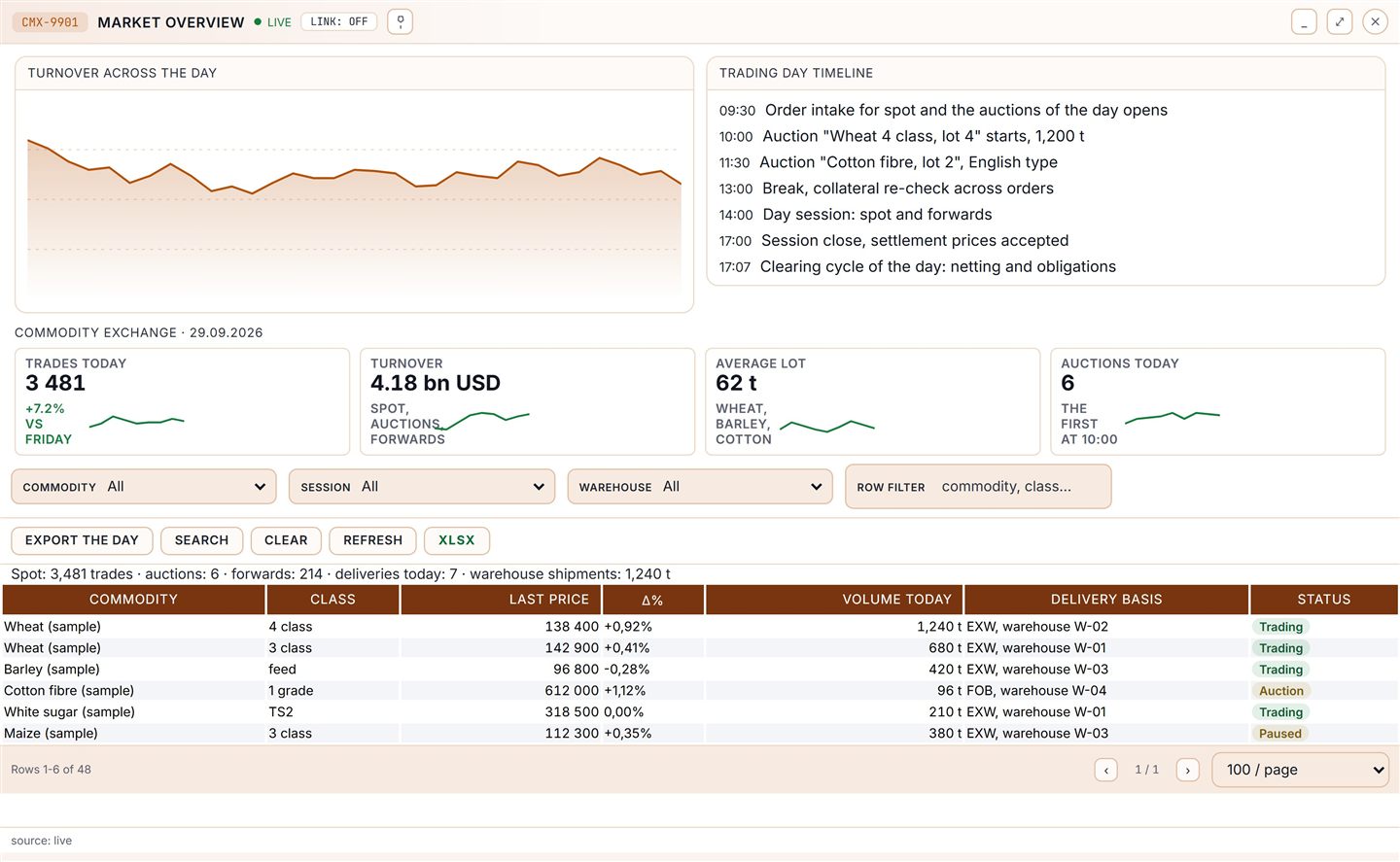
Market overview screen with trades and turnover
Market overview: trades, turnover and the course of the trading day
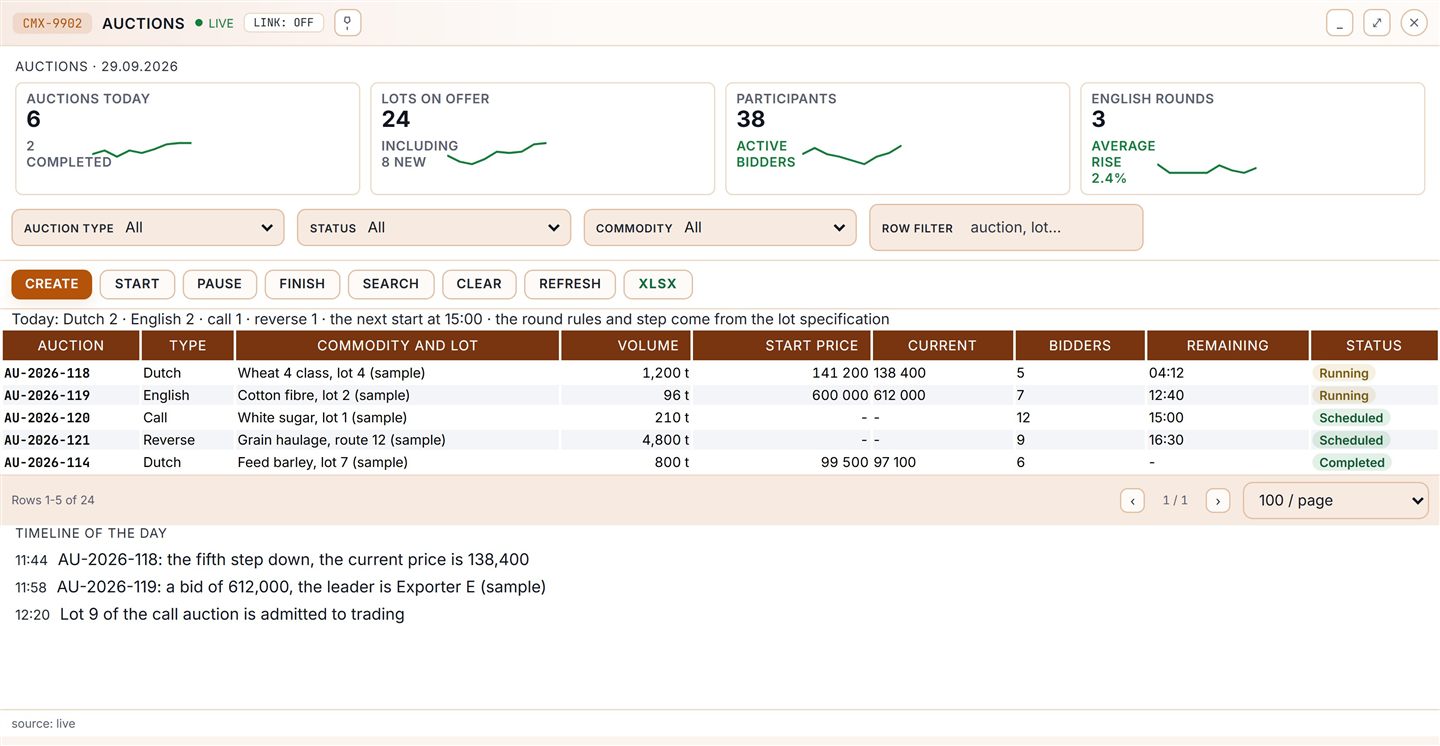
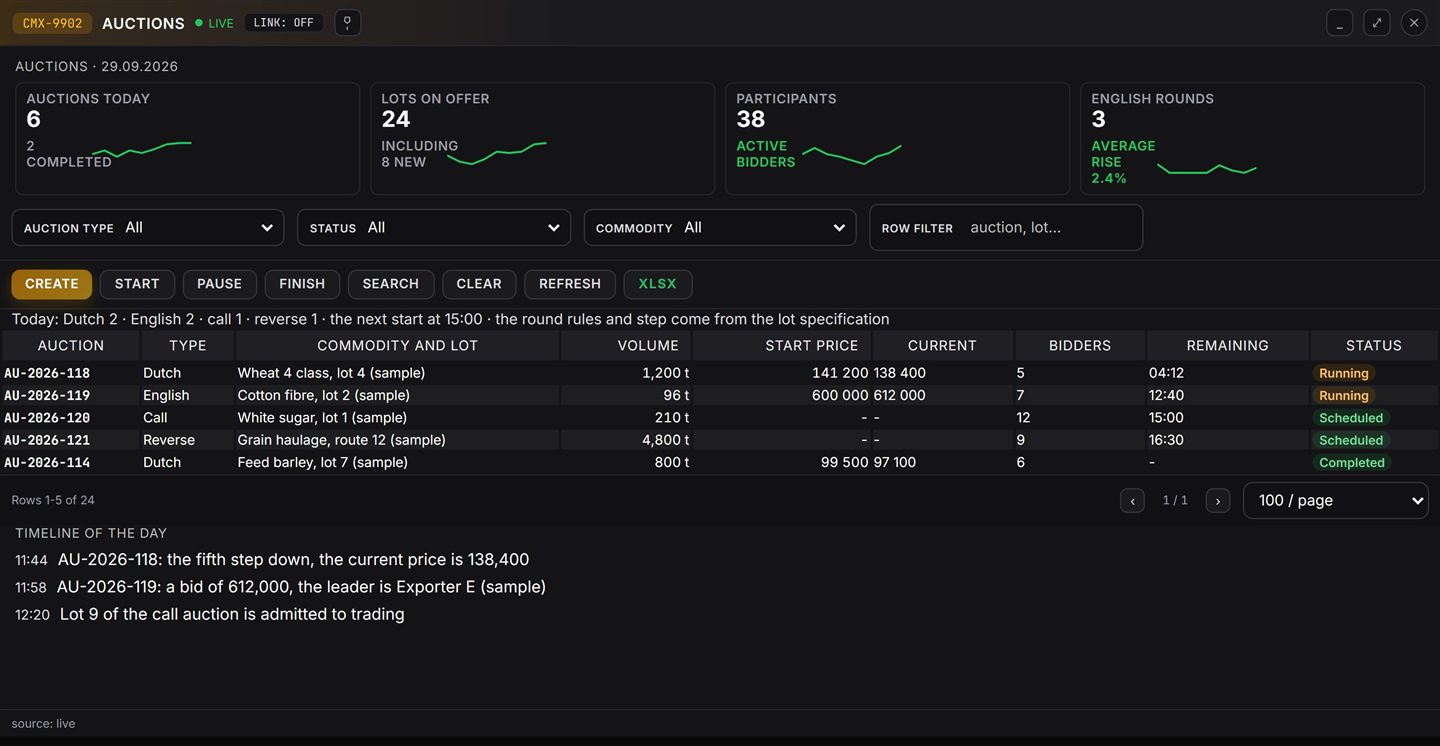
Auction desk screen with lots and timers
Auction desk: lots, participants and timers
Warehouses and warrants screen
Warehouses and warrants: transfer of rights and delivery
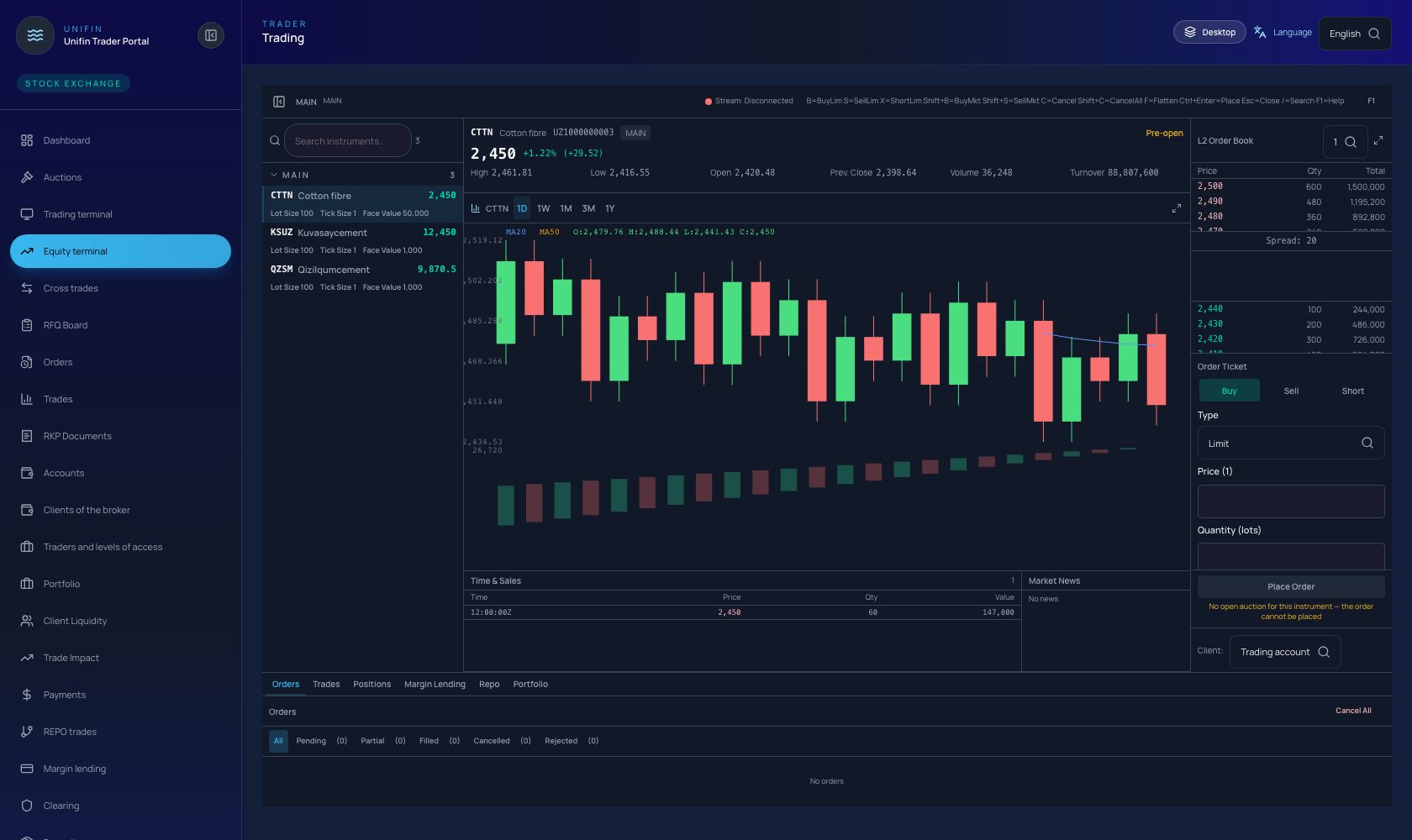
Trader terminal screen with quotes and the order ticket
Trader terminal: quotes, order entry and the tape across the trading suite
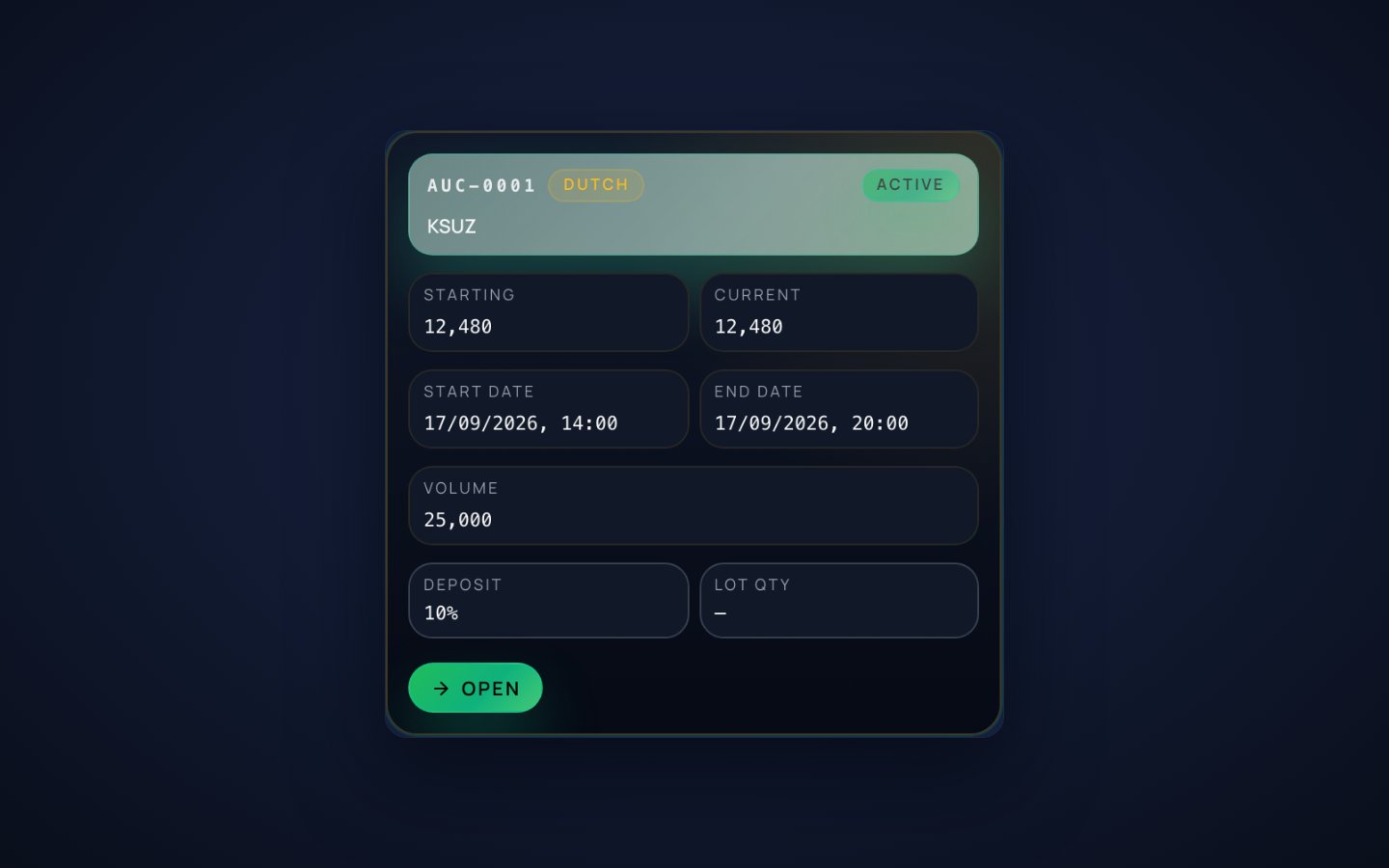
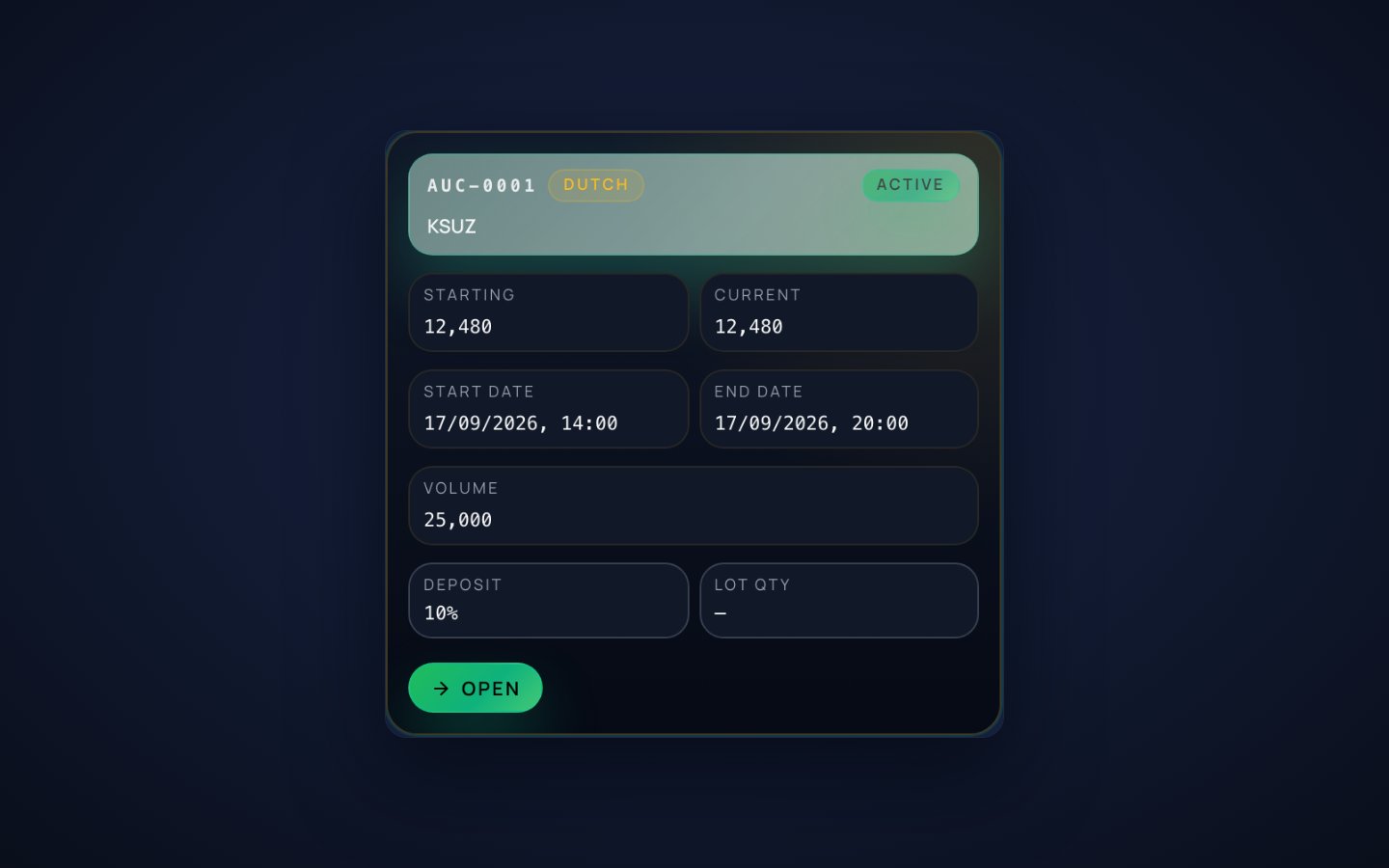
Auction card with the starting price, volume, deposit and the bid window
Auction card: starting price, volume, deposit and the bid window
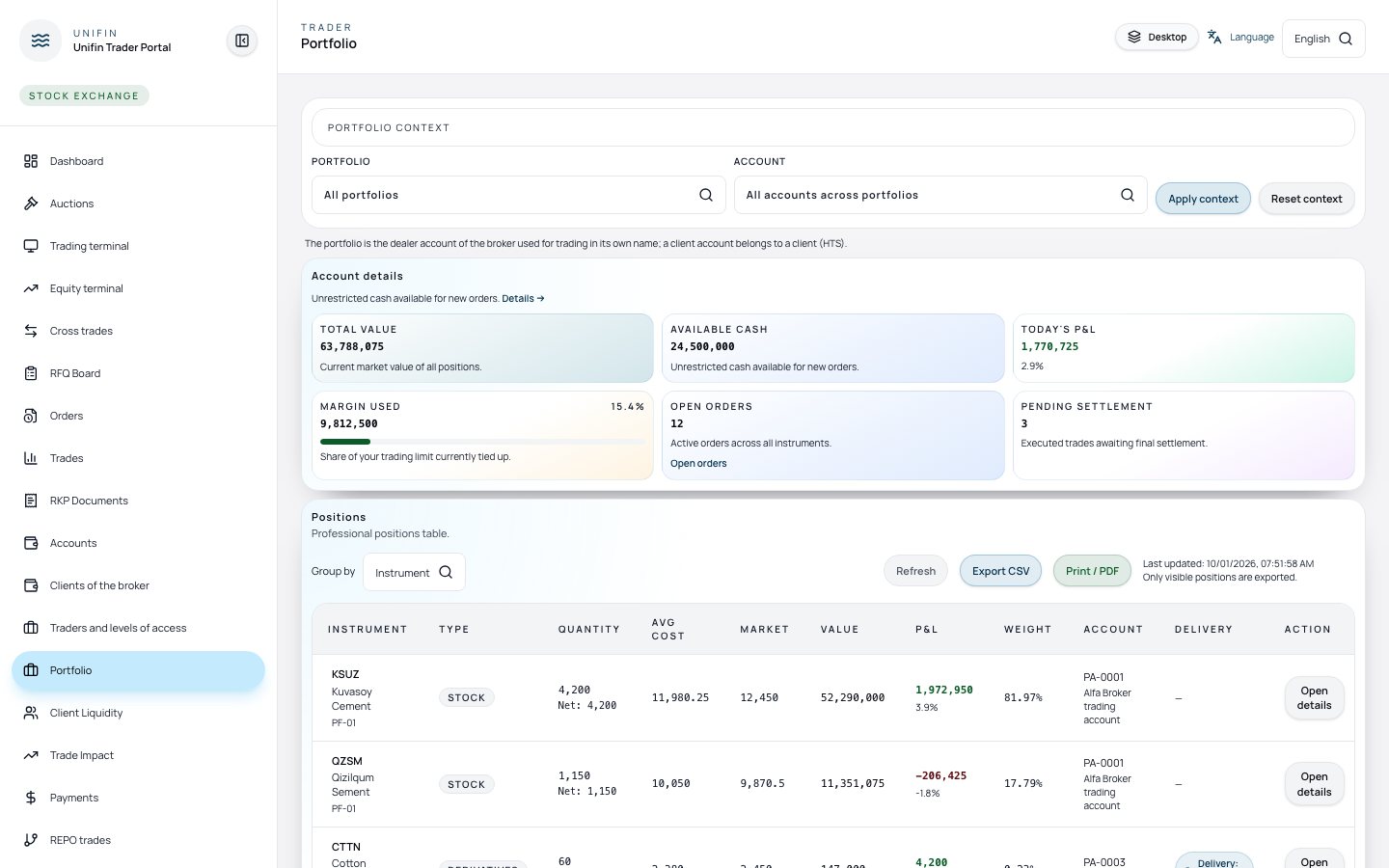
Portfolio screen with margin usage and the positions table
Portfolio: total value, margin usage and the positions table

How it works

From the lot to the settlement in five steps

The trade path: admission, bidding, delivery through warehouses and CSD.

  1. 1

    The lot is admitted

    The lot passes admission; participants post a deposit and enter.

  2. 2

    Bidding runs

    The desk collects bids; the best bid goes to the journal.

  3. 3

    The trade becomes an obligation

    The deal becomes an obligation; the buyer gets an instruction.

  4. 4

    The delivery moves

    The warrant transfers; rights are fixed on CSD accounts.

  5. 5

    Money and reports

    Money goes in bank runs; extracts come from live transaction data.

Industries

Industries it serves

The system works for commodity venues, their warehouses and elevators, the exporters, processors and brokers who trade through them.

Architecture

Architecture and access

The architecture follows the services of the solution. The auction engine, the book, versioned specifications and connectors to warehouses, CSD and the bank.

Service suite

Access gateway (FIX), auction engine, book and matching, specifications, clearing, delivery and journal.

External states stay external

Warehouses, CSD, bank, KYC and the regulator connect as adapters and reconciliations: their responsibility is not duplicated.

Three zones, active-active

Stateless services run in three zones; storages are reserved active-passive.

Add without touching the core

A new commodity or auction type connects through base services, without changes to the trading core.

AI layer

The AI layer summarises bids and drafts lot cards; people approve the auction day.

Architecture scheme The same architecture as a standalone page. Open the diagram separately

Readiness

Ready today, next in line

The suite runs the auction day; next: delivery and warehouse documents.

Ready today

  • Four auction types with rounds, timers and extension rules
  • Specifications with versions, deposits and admission rules
  • Warehouses, warrants, CSD commodity accounts and delivery windows
  • Clearing with novation and money legs in bank runs

Next in line

  • Elevator segment extension
  • Export documentation pack
  • Mobile views for warehouse operators (roadmap)

Releases

Release history

Quarterly releases from the foundation of the platform (2020); the commodity suite grows with the venue.

2025 Q4

  • Auction engine: Dutch, English, request and reverse rounds.

2026 Q1

  • Specifications with versions, deposits and admission rules.

2026 Q2

  • Warrants, CSD commodity accounts and delivery windows.

2026 Q3

  • Clearing sessions and bank runs for the commodity money legs.

Detailed description

Detailed description

The module map, the metrics and the delivery frame.

How the suite is assembled

Channels and clients
FIX 4.2 / 4.4 / 5.0, REST with mTLS, SFTP files, web portals
Edge and access
API gateway with 126 routes, Keycloak single sign-on, WAF and CSP
Platform core services
auction-ms warehouse-ms clearing-ms settlement-ms depository-ms AI agentic layer Services of the suite on the shared platform core
Data and events
PostgreSQL 17 per service, Redis 7, RabbitMQ 3.13 quorum queues, transactional outbox
Results and reporting
Portals, reports, regulator and partner channels

Technology stack

Runtime and backend: Java 21 (LTS), Spring Boot 3.5.16, Spring Cloud 2025.0.3, Gradle, Flyway 10.15.

Data: PostgreSQL 17 per service, Redis 7 with Sentinel, RabbitMQ 3.13 quorum queues, transactional outbox and DLQ replay.

Portals: Next.js 16.3.3, React 19, TypeScript 5; OpenTelemetry 1.31 to Jaeger.

Delivery: Kubernetes and Helm, Vault secrets, Prometheus and Grafana, Docker Compose for pilots.

Visualisation: Apache Superset 4 and ECharts 5 for dashboards and charts, Grafana for operations panels, Mermaid for documentation schemes and the portal diagrams.

Auctions and matching

  • Auction mechanisms: English, Dutch and closed formats per commodity group.
  • Lots, credit lines and guarantees: what a participant must show before bidding.
  • Match confirmation and trade formation with all terms fixed at once.
  • Price formation transparency: how the reference price of the session is built.

Warehouse receipts

  • Receipt as collateral and as a delivery instrument: pledge, block, transfer.
  • Quality disputes: sampling, examination and the commission decision record.
  • Warehouse ratings and the impact on admissible delivery bases.
  • Receipt history: every movement with the document behind it.

Settlement and logistics

  • Money legs through the settlement bank adapters with payment matching.
  • Delivery scheduling: volumes, transport windows and confirmations.
  • Export documents and compliance checks as configurable steps.
  • Day close: deliveries confirmed, receipts blocked, reports formed.

Architecture

  • Built from the platform core: auction-ms, warehouse-ms, clearing-ms, settlement-ms and depository-ms.
  • The suite works through platform contracts: one register of record, no shadow copies of the data.
  • Scaling adds nodes, not rewrites: stateful services grow with Patroni, RabbitMQ and Redis clusters.

Integrations and access

  • OpenAPI for every service: 978 documented endpoints behind 126 gateway routes, plus webhooks and SFTP where partners need files.
  • Single sign-on: Keycloak 26.1, OIDC and JWT, roles, MFA and API keys with quotas.
  • Evidence by default: the audit journal, idempotency keys on writes and a record for every disclosure.
Detailed description

Leave your contacts to open the detailed description and download the PDF with architecture, cases and delivery details.

Run a lot through the auction desk

One lot, one auction. We will set the specification and show the whole path from bidding to the settlement on the pilot stand.