UNIFINplatform

Solution

Unifin Depository

A depository is judged by the account book and the settlement day.
The suite runs depo accounts, instructions, DvP delivery, corporate actions and reporting.
Positions match the register and the trail runs to the receipt.

  • Depo accounts
  • DvP delivery
  • Corporate actions
All solutions

Live screens from the product terminals

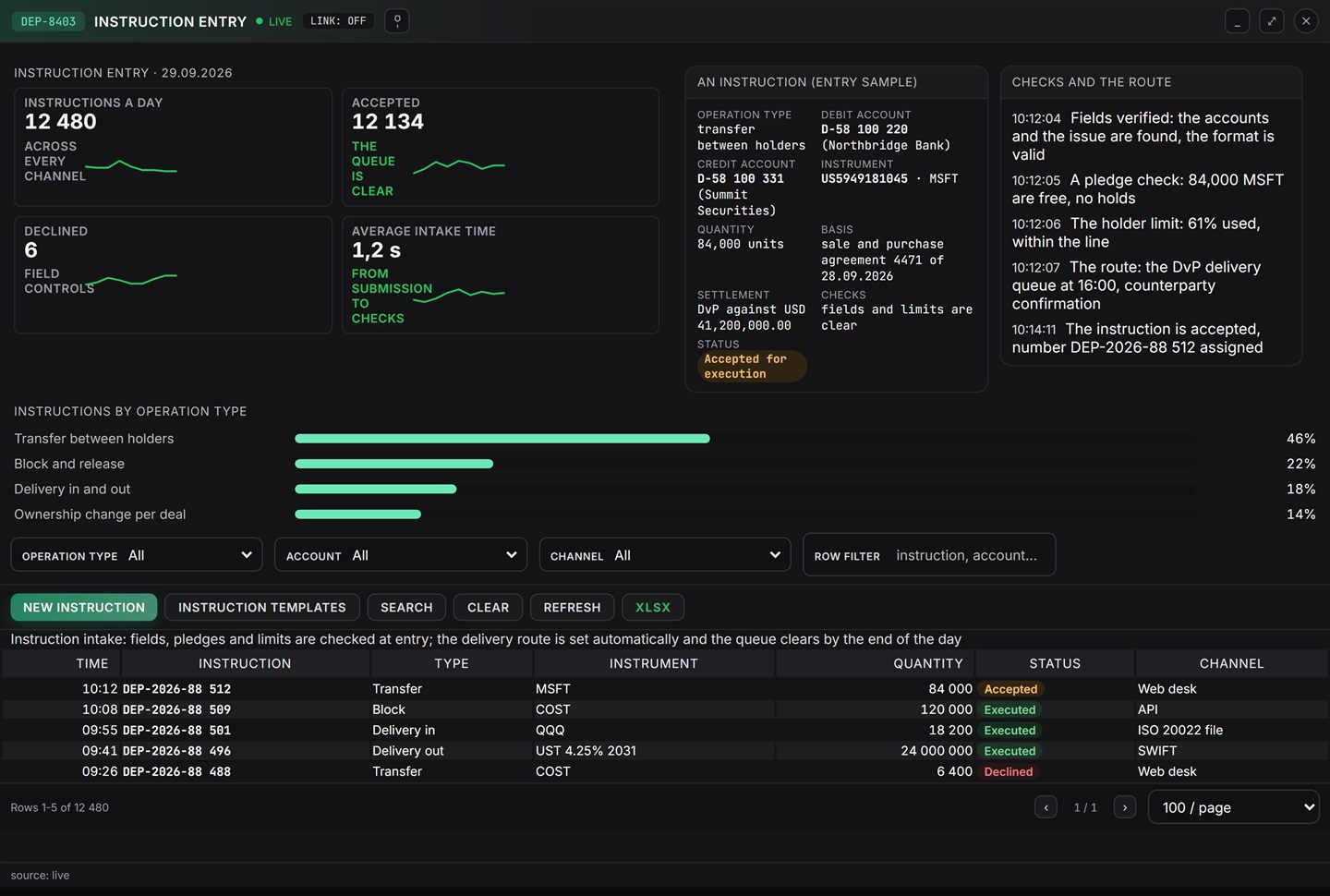
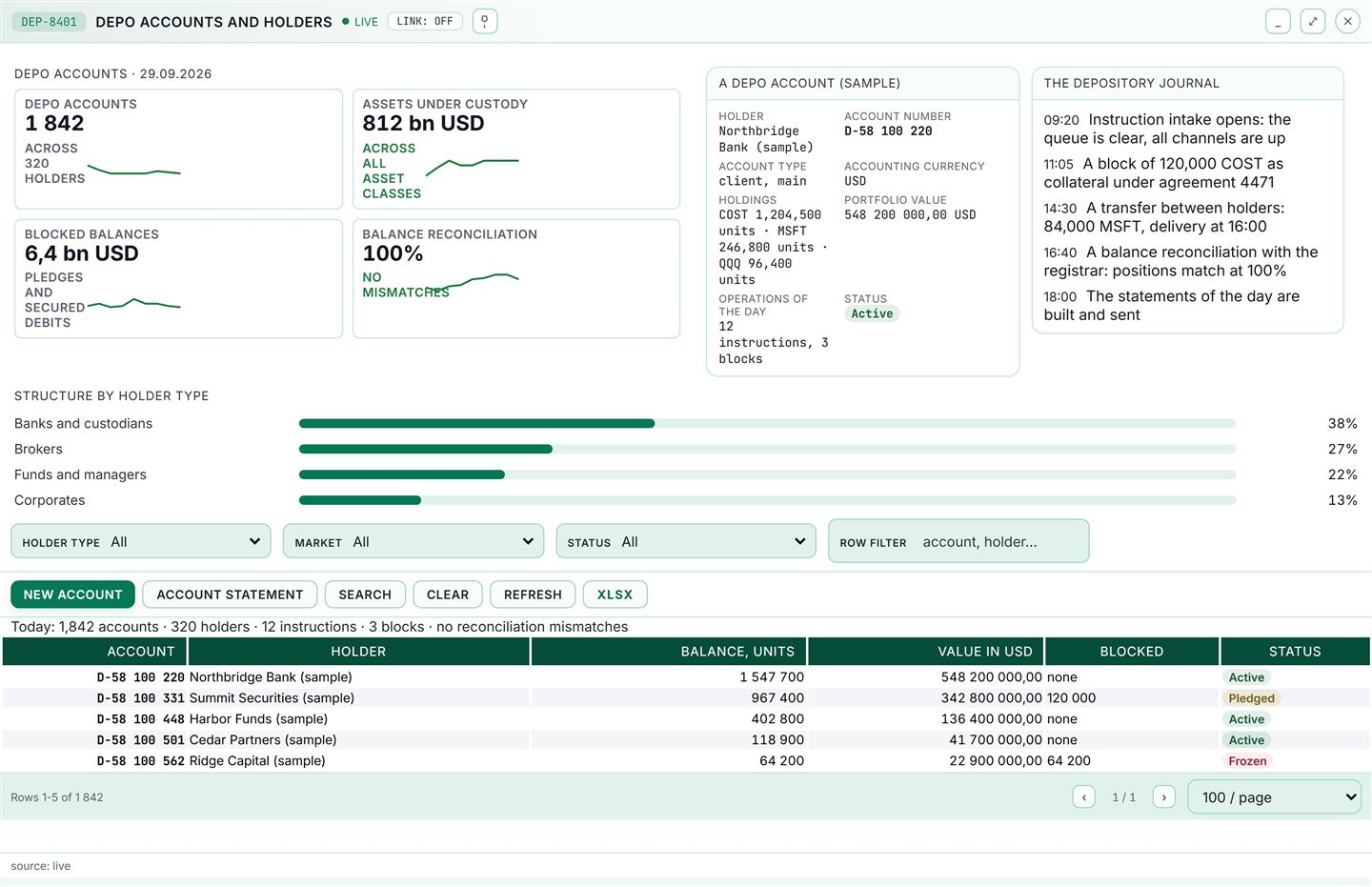
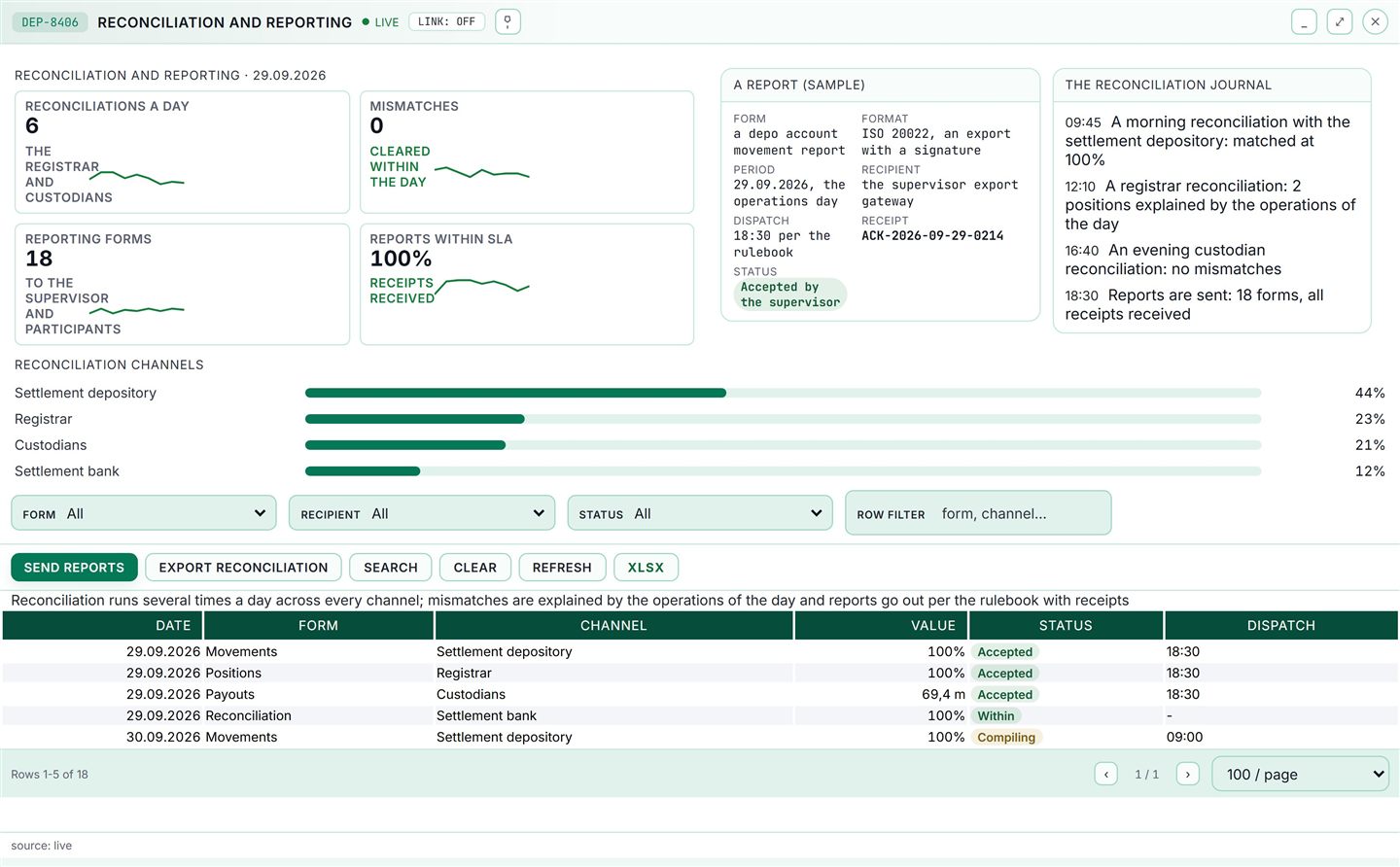
Instruction entry form with checks and the delivery route Instruction entry form with checks and the delivery route Depo accounts and holders screen with balances and blocks Depo accounts and holders screen with balances and blocks Reconciliation and reporting screen with channels and forms
Demo Unifin Depository Theme Open separately
Depo accounts and holders

This is an interface demonstration: the real solution will differ in colours and content for a specific project.

Functions at a glance

Business functions at a glance

From an account to a receipt.

Depo accounts and holders
Opens client accounts, keeps fields and statuses, shows positions and blocks
The account book is trusted by holders and auditors
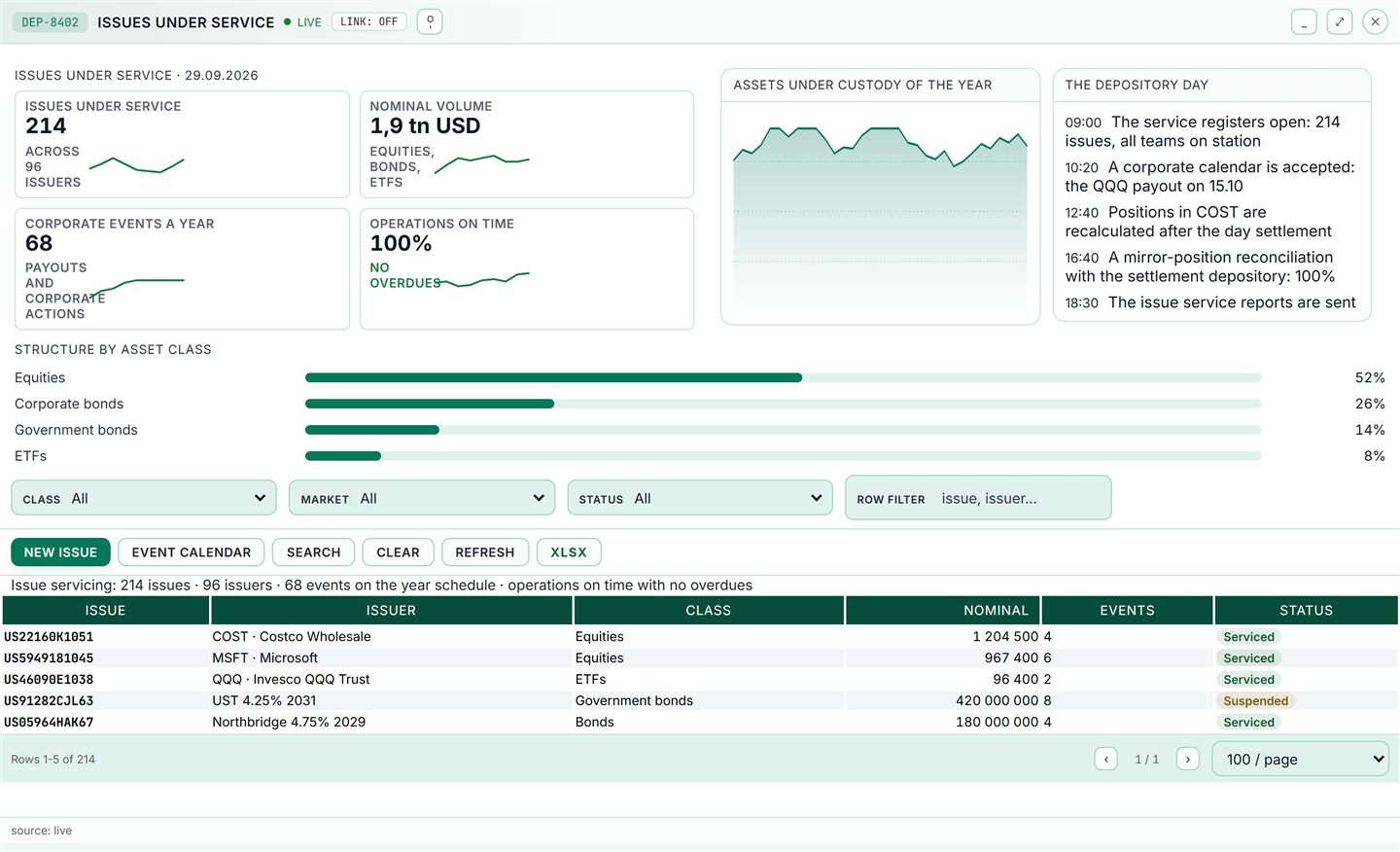
Issues under service
Keeps the issues and classes of the register with their event schedules
One serviced list for the whole register
Instruction intake
Accepts transfers, blocks and deliveries, runs field, pledge and limit checks
Instructions enter clean and route by themselves
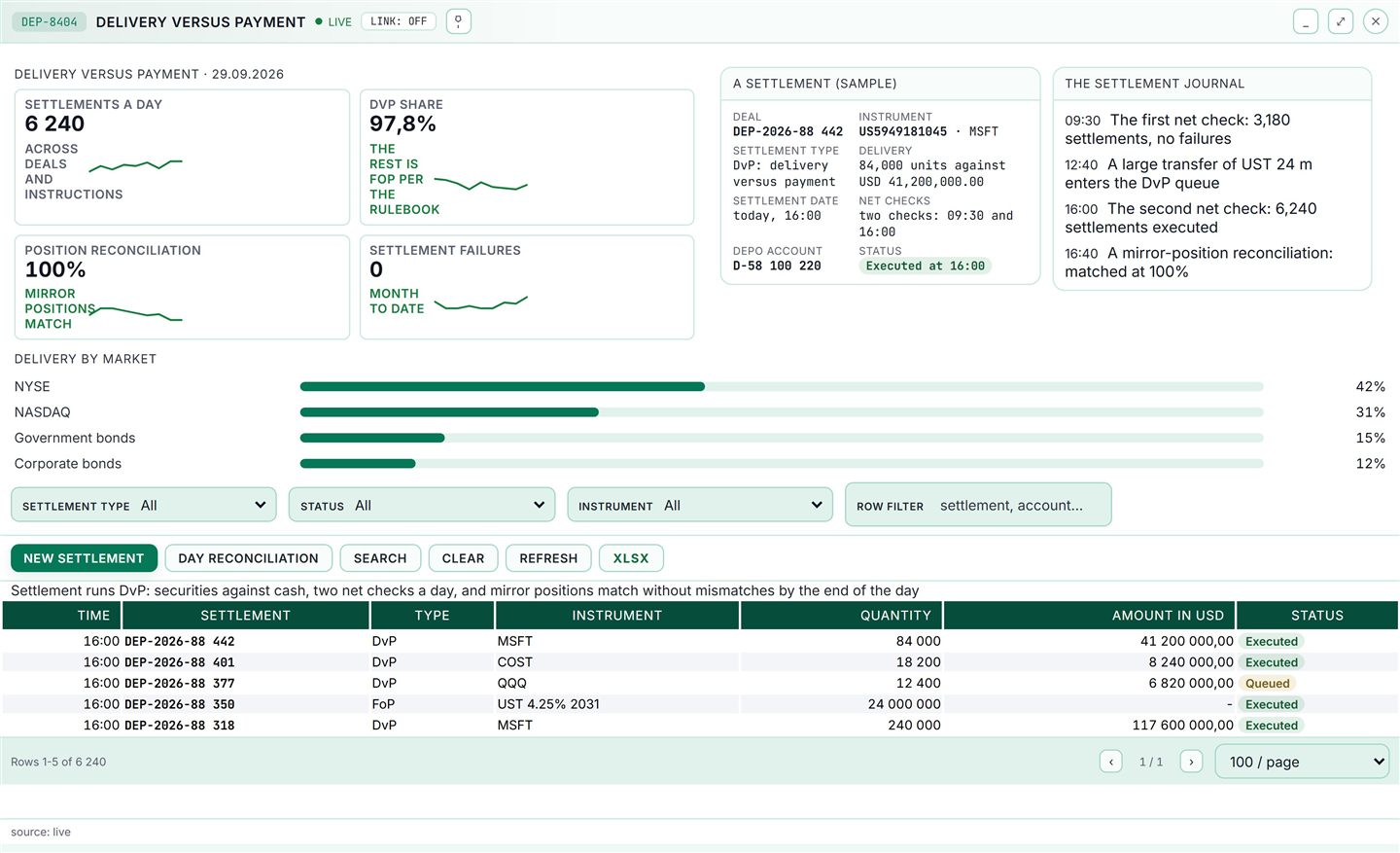
Delivery versus payment
Runs DvP delivery, net checks and mirrored positions with the settlement depository
The settlement day closes without breaks
Corporate actions and payouts
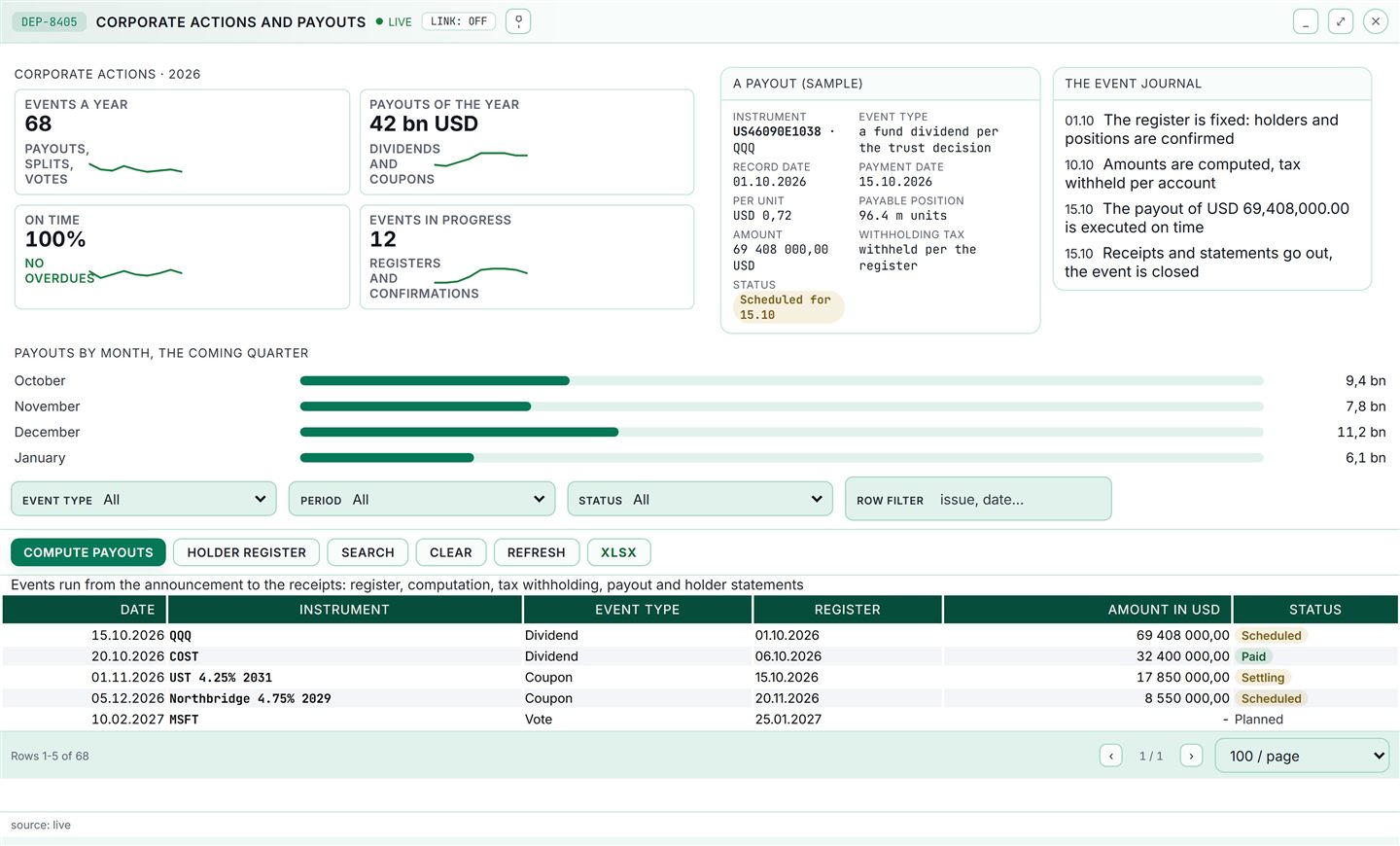
Runs registers, dividends, coupons, votes, withholding and receipts
No payout date is missed
Reconciliation
Reconciles with the depository, registrars, custodians and the bank several times a day
A mismatch is explained the same day
Reporting
Prepares regulator forms and holder statements from the live positions
The regulatory view matches the account book

What runs today

The account book, already running

Accounts, delivery and payouts: the live parts.

Accounts

Depo accounts and the holder register are the core.

Delivery

DvP delivery runs with reservations on positions.

Pledges

Pledges and blocks are registered on accounts.

Corporate actions

Corporate actions and entitlements drive payouts.

Reconciliation

Snapshots and CSD reconciliation run daily.

Roadmap

More corporate event types come next.

Solution description

Capabilities and overview

Key features

  • Depo accounts: opening, fields, statuses and holder cards
  • Holdings and blocks: pledges, holds and releases on the basis document
  • Issues under service: classes, nominals and event schedules
  • Instruction intake with field, pledge and holder limit checks
  • Channels: web desk, API, SWIFT and ISO 20022 files
  • Instruction templates and standing instructions
  • DvP delivery with net checks and mirrored positions
  • Corporate actions: registers, dividends, coupons, splits and votes
  • Withholding tax per account and payout receipts
  • Reconciliation with the depository, registrars and custodians
  • Regulator forms and holder statements
  • The journal keeps accounts, instructions, positions and events

Product overview

Unifin Depository is the UniFin platform depository suite for depositories, custodians and financial organisations that keep securities accounts.

The suite runs a holder path from account opening and instruction intake to DvP delivery, corporate actions and reporting.

The account book shows balances and blocks per holder; the settlement day shows net checks and mirrored positions against the settlement depository.

Corporate actions run from the register record date to the payout receipt, with withholding tax and holder statements.

The solution runs within the UniFin platform and connects to the settlement depository, registrars, custodians and the bank through standard channels.

What it delivers

What the solution delivers

Depo accounts and holders

Accounts are opened by hand and statuses live in different files, and a holder sees positions late. The solution opens accounts with checked fields, keeps statuses and shows balances and blocks per account. With the solution the account book is trusted by holders and auditors, and statements go out daily. In setup the holder cards and account types come as reference data, and statuses follow one route.

Issues under service

The serviced list is assembled from files, and an event slips past the schedule unnoticed. The solution keeps the issues and classes with their event schedules and highlights the day of the depository. With the solution one serviced list covers the whole register, and every event has an owner. In setup classes, nominals and schedules are set in configuration, and the calendar feeds the payout works.

Instruction intake

Instructions arrive in different formats, and a field problem surfaces at the end of the chain. The solution accepts instructions through the web desk, the API, SWIFT and ISO 20022 files. Field, pledge and limit checks run on the way in. With the solution instructions enter clean, and the route to delivery is set automatically. In setup templates and standing instructions cut the recurring types, and declines carry reason codes.

Delivery versus payment

The settlement day is reconciled by hand, and a divergence surfaces with the closing balance. The solution runs DvP delivery with two net checks a day and mirrored positions against the settlement depository. With the solution the day closes without breaks, and failures turn into cases with owners before the evening. In setup large deliveries queue with counterparty confirmation, and partial fills stay journaled.

Corporate actions and payouts

Payouts follow spreadsheets, and a holder learns about a record date at the last moment. The solution runs registers, dividends, coupons, splits and votes, with records fixed, taxes withheld and receipts sent. With the solution every payout lands on its date, and the event trail runs from the announcement to the receipt. In setup notices reach holders before the record date, and voting comes back into the journal.

Reconciliation

A mismatch with the register or the custodian surfaces at month end, and the party spends days unpicking it. The solution reconciles several times a day across the depository, registrars, custodians and the bank. With the solution breaks close the same day with an owner and a root cause. In setup every channel has its schedule and tolerance, and channel metrics stay visible.

Reporting

Regulator forms are assembled from extracts by hand, and reconciling them with the account book eats up team time. The solution prepares forms from the live positions and sends signed exports with receipts. With the solution the supervisor gets an answer on time, and the audit passes along a ready trail. In setup the form scope and the dispatch schedule are visible, and versions stay journaled.

Coverage

What it covers

The suite runs a route: account, instruction, delivery, event, receipt.

Accounts and holders

Opening, fields, statuses, holder cards, balances and blocks.

Issues under service

Classes, nominals, event schedules and the serviced register.

Instruction intake

Transfers, blocks, deliveries, checks, templates and channel routing.

Delivery versus payment

DvP delivery, net checks, mirrored positions and the fail queue.

Corporate actions

Registers, dividends, coupons, splits, votes and withholding.

Payouts and receipts

Payout dates, settlement bank entries, receipts and holder statements.

Reconciliation

Channel schedules, breaks with owners and root causes.

Reporting and audit

Regulator forms, signed exports, receipts and the five-year journal.

Stand

Screens of the solution

The account book, the serviced issues, the instruction form, delivery, corporate actions and reconciliation.

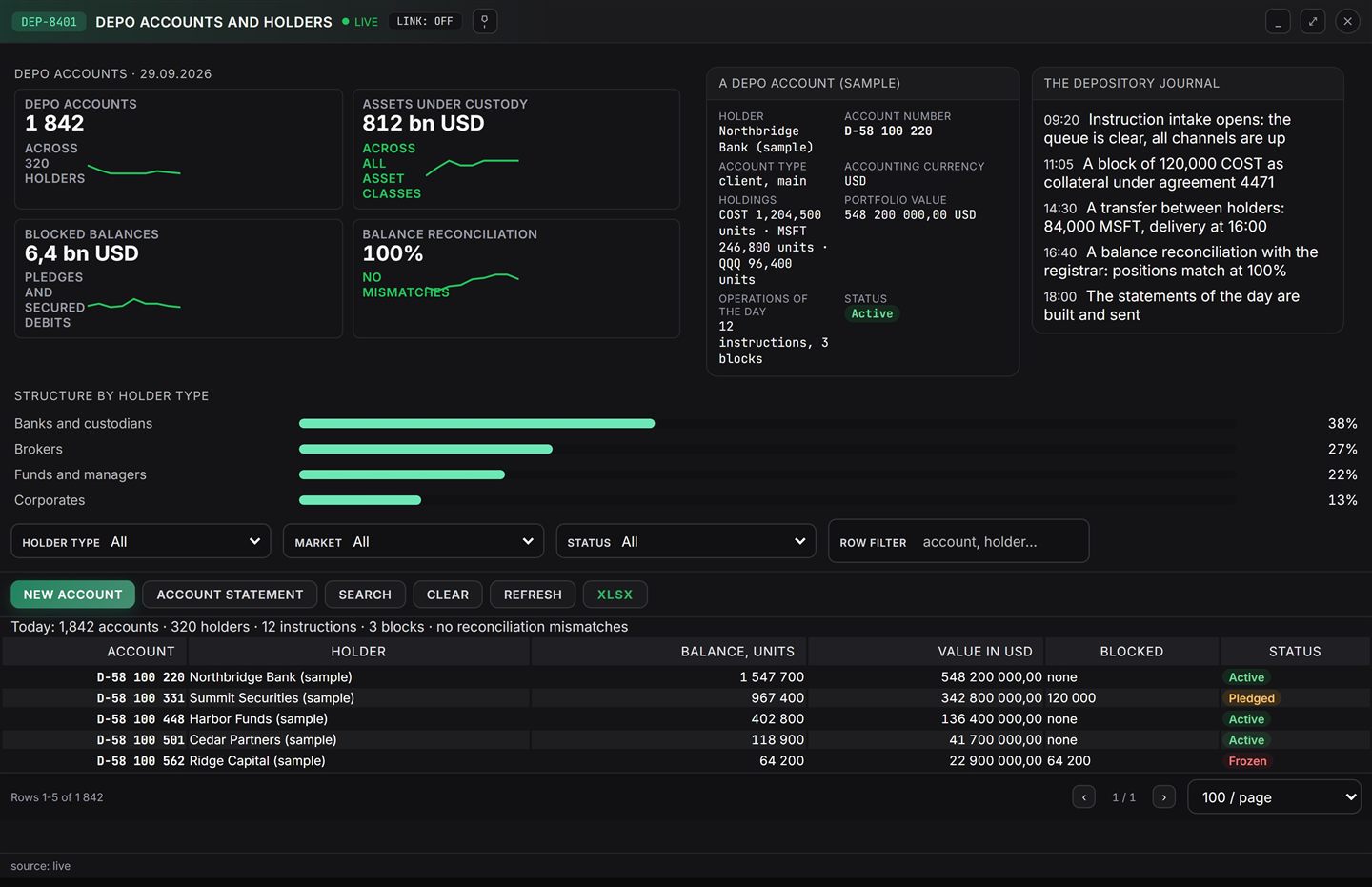
Depo accounts and holders screen with balances and blocks
Depo accounts and holders: balances, blocks and the positions per account
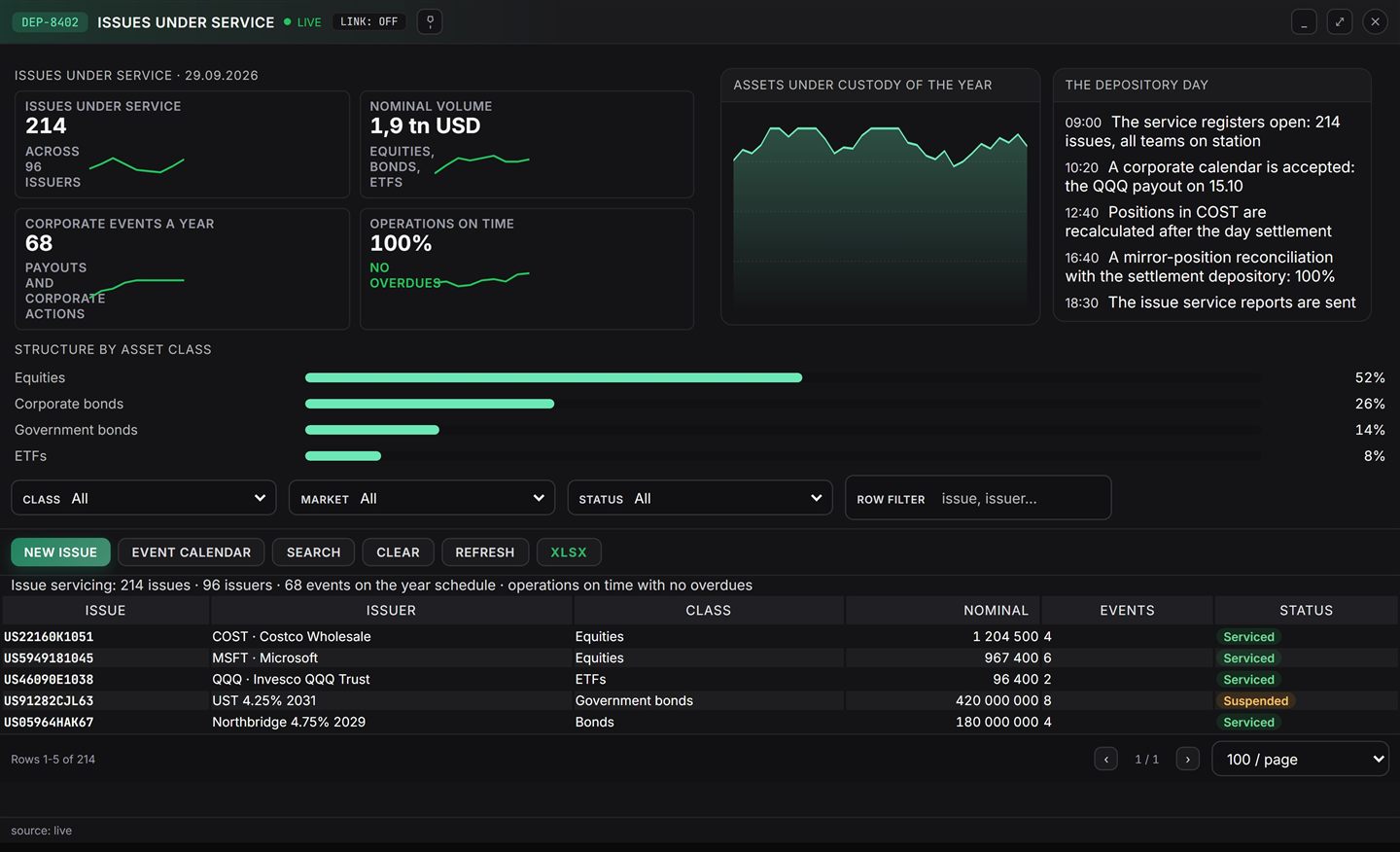
Issues under service screen with classes and the event schedule
Issues under service: classes, scheduled events and the depository day
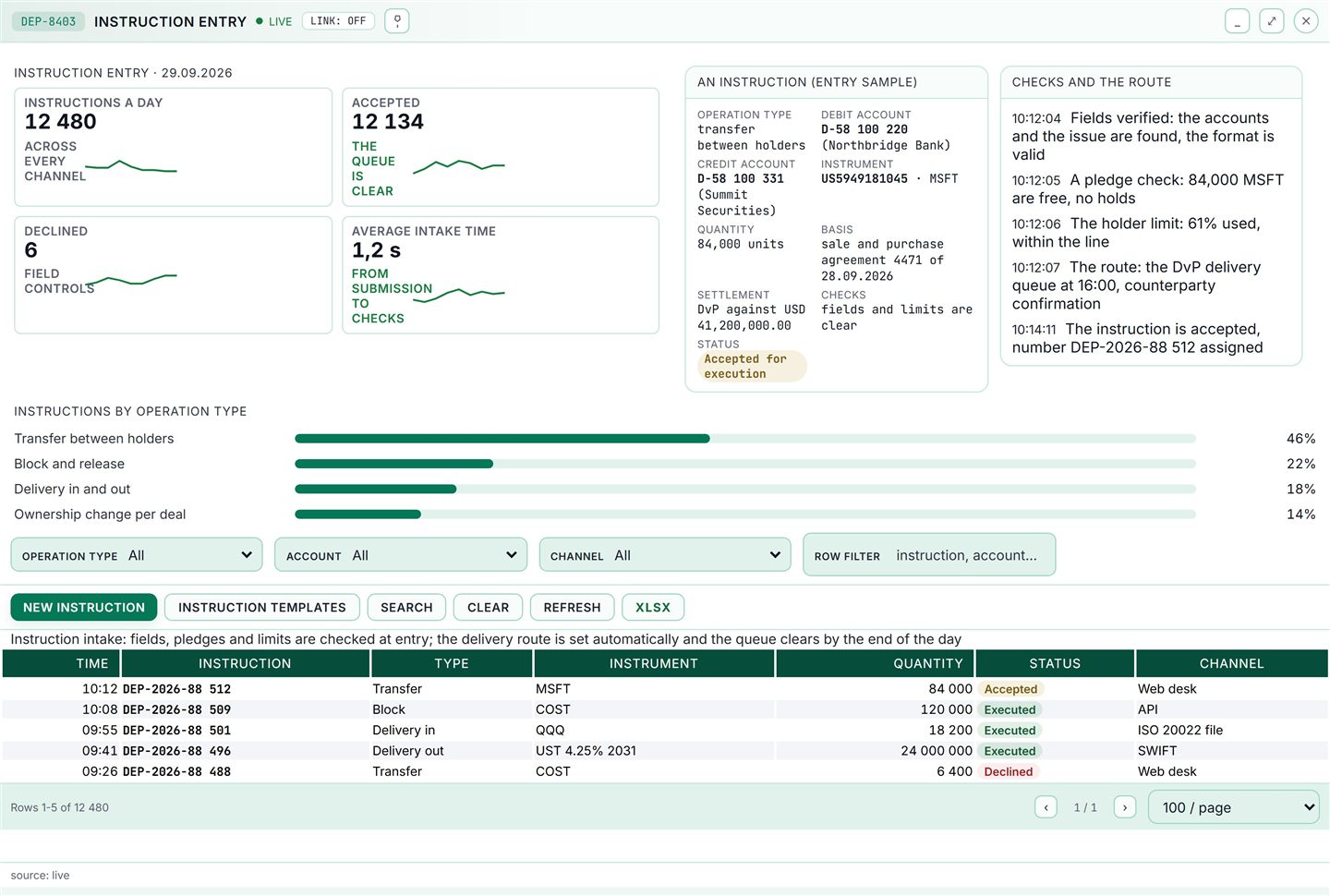
Instruction entry form with checks and the delivery route
Instruction entry: the form with field checks and the delivery route
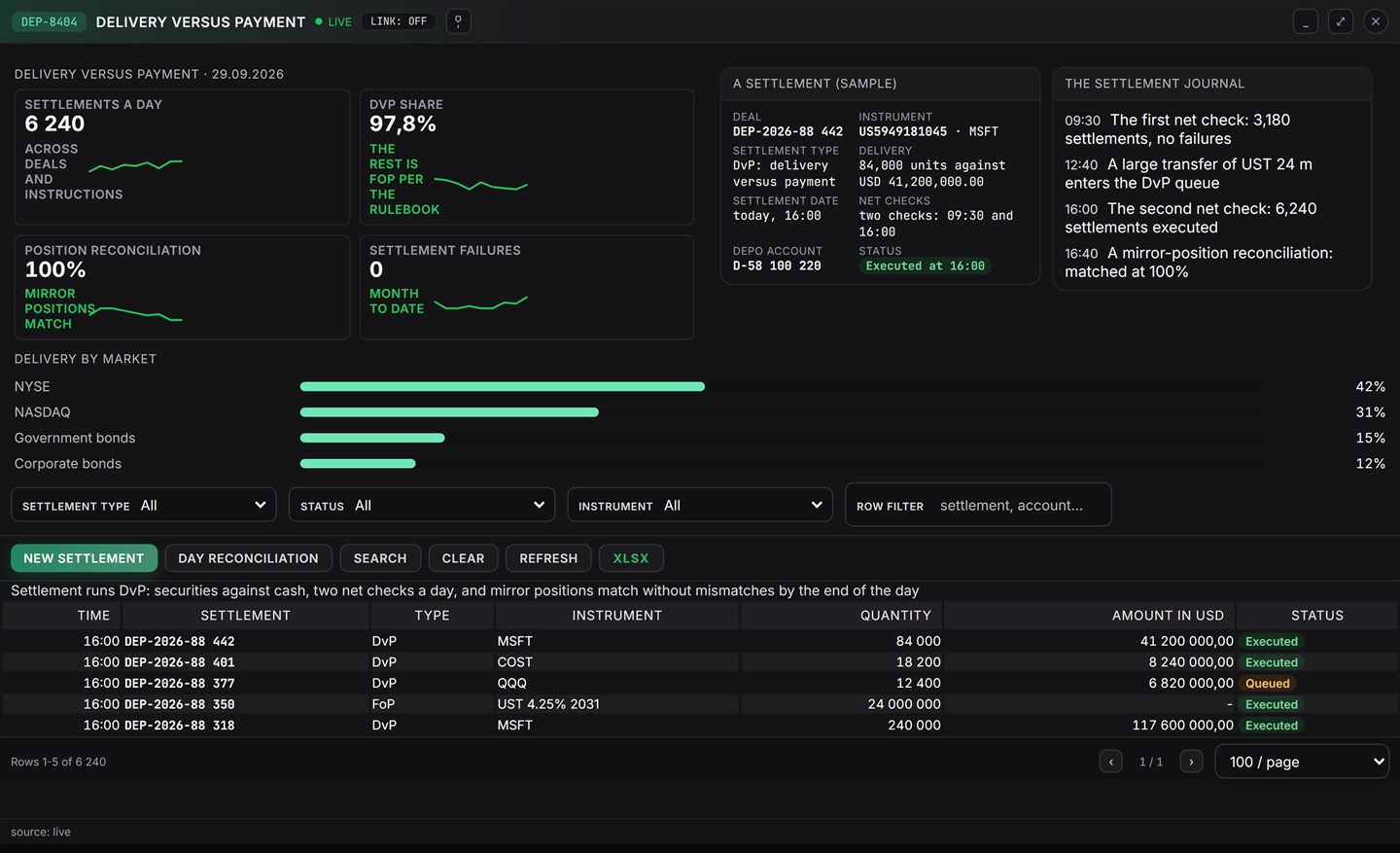
Delivery versus payment screen with net checks
Delivery versus payment: net checks and mirrored positions
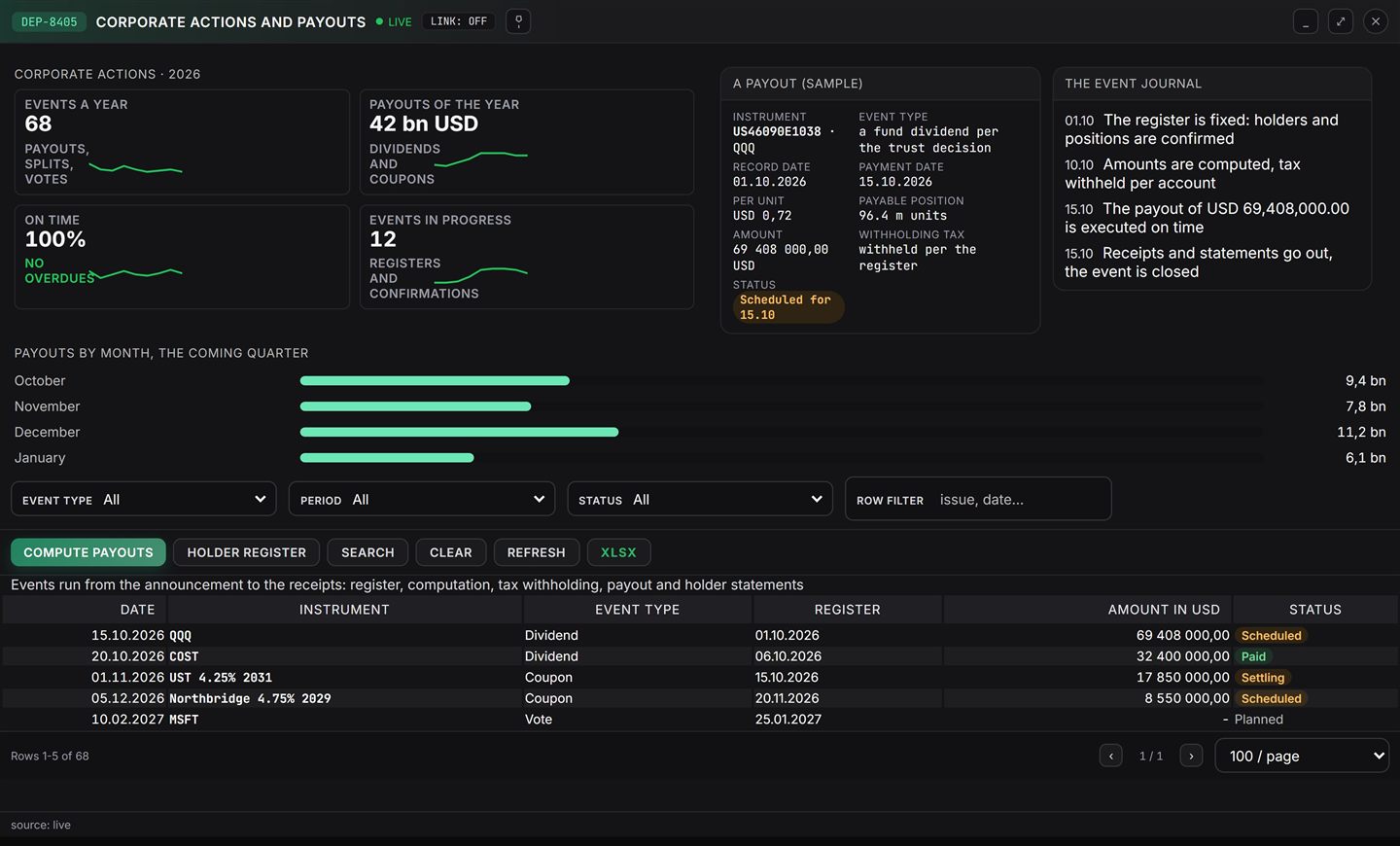
Corporate actions and payouts screen with register dates
Corporate actions and payouts: registers, withholding and receipts
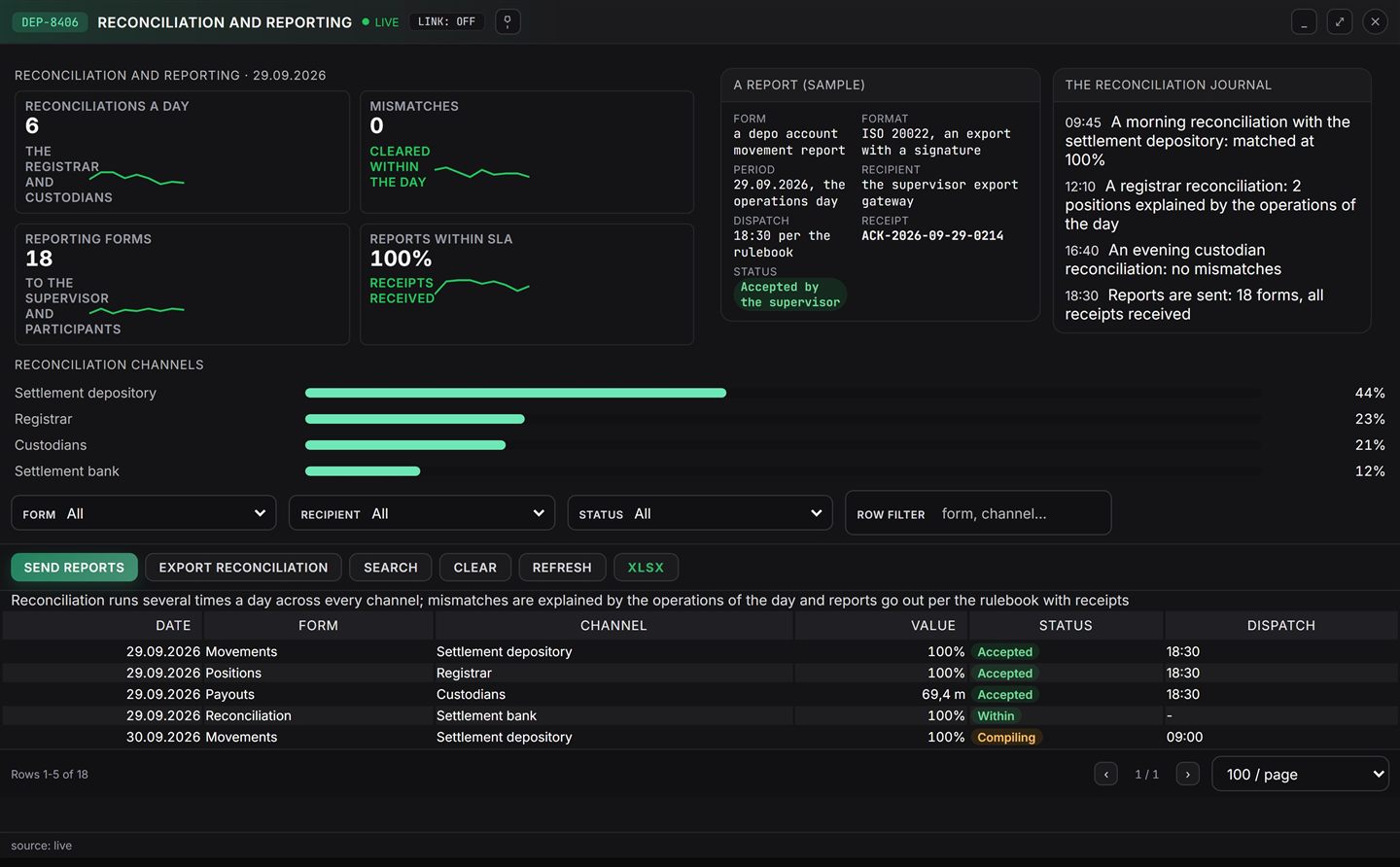
Reconciliation and reporting screen with channels and forms
Reconciliation and reporting: channels, forms and SLA

How it works

From an instruction to a receipt in five steps

The path of a holder operation: account, instruction, checks, delivery, receipt.

  1. 1

    The account is ready

    The holder card and the account open with checked fields.

  2. 2

    The instruction arrives

    The instruction enters through a channel; fields and limits pass.

  3. 3

    Delivery is queued

    DvP routes the delivery to the settlement window.

  4. 4

    Events run

    Registers fix the record date; notices go to holders.

  5. 5

    The day closes

    Reconciliation matches every channel; reports go out with receipts.

Industries

Industries it serves

The suite serves depositories and CSDs, custodial banks, brokers and asset managers, and issuers with their registrars.

Bank / payments

Settlement, payments and custody services for the market around the trading core.

CSD / depository

Custody, corporate actions and settlement discipline for classic and digital assets.

Architecture

Architecture and access

The architecture rests on the depository core and the portal. Accounts and holders, issues under service, instruction intake, DvP delivery, corporate actions and reporting.

Service suite

The depository portal, accounts and holders, instruction intake, DvP delivery, corporate actions and reporting.

External suites stay external

The settlement depository, registrars, custodians and the bank connect as connectors; responsibility is not duplicated.

Multi-region and DR

Active-active read with replicas and a DR region for Tier-0; Active-Passive clusters and replication are allowed.

Grow without touching the core

A new class, channel or form joins through reference data and connectors: the core stays still.

AI layer

The AI layer prepares the reconciliation digest and drafts holder letters from the register; people approve.

Architecture scheme The same architecture as a standalone page. Open the diagram separately

Readiness

Ready today, next in line

The base is in place; next: payout analytics and settlement risk services.

Ready today

  • Depo accounts and holders with balances, blocks and statements
  • Instruction intake with checks, templates and channel routing
  • DvP delivery with netting and mirror position controls
  • Corporate actions and payouts from the record date to the receipt

Next in line

  • Payout calendar analytics for issuer services
  • Settlement risk and fail prediction scores
  • Additional registrar routes and regulator formats (roadmap)

Releases

Release history

Quarterly releases from the foundation of the platform (2020); the depository suite launched in 2026.

2026 Q1

  • Depo accounts and holders with balances, blocks and statements.

2026 Q2

  • Instruction intake with checks, templates and channel routing.

2026 Q3

  • DvP delivery, netting and mirror position checks.

2026 Q4

  • Payout calendar analytics and settlement risk scores (plan).

Detailed description

Detailed description

The module map, the event calendar and the delivery frame.

How the suite is assembled

Channels and clients
FIX 4.2 / 4.4 / 5.0, REST with mTLS, SFTP files, web portals
Edge and access
API gateway with 126 routes, Keycloak single sign-on, WAF and CSP
Platform core services
depository-ms corporate-actions-ms reconciliation-ms AI agentic layer Services of the suite on the shared platform core
Data and events
PostgreSQL 17 per service, Redis 7, RabbitMQ 3.13 quorum queues, transactional outbox
Results and reporting
Portals, reports, regulator and partner channels

Technology stack

Runtime and backend: Java 21 (LTS), Spring Boot 3.5.16, Spring Cloud 2025.0.3, Gradle, Flyway 10.15.

Data: PostgreSQL 17, Redis 7 with Sentinel, RabbitMQ 3.13 with the transactional outbox.

Market connectivity: ISO 20022 for settlement messages, SWIFT MT for banks and signed file channels with the supervisor.

Portals: Next.js 16.3.3, React 19, TypeScript 5; Onest typography and two themes; Keycloak 26.1 for OIDC sign-in.

Delivery: Kubernetes and Helm, Vault secrets, Prometheus and Grafana, Docker Compose for pilots.

Evidence by default: accounts, instructions, positions, payouts and reconciliations are journaled for five years.

Depo accounts and holders

  • Accounts open with checked fields and clear statuses; the sample book runs 1,842 accounts across 320 holders.
  • Holder types split as banks and custodians 38%, brokers 27%, funds and managers 22%, corporates 13%.
  • Balances and blocks stay per account: a pledge of 120,000 COST releases only on the basis document.
  • Statements go out per account daily; a holder sees positions before the market opens.

Issues and instructions

  • A sample register holds 214 issues under service across 96 issuers: equities 52%, corporate bonds 26%, government bonds 14%, ETFs 8%.
  • Instructions arrive through the web desk, API, SWIFT and ISO 20022 files; fields, pledges and holder limits pass at entry.
  • The sample median intake is 1.2 seconds; a decline carries a reason code and a holder notice.
  • Templates and standing instructions speed recurring transfers; a manual instruction takes two approvals.

Delivery versus payment

  • The sample day settles 6,240 operations at a 97.8% DvP share, with net checks at 09:30 and 16:00.
  • Every settlement compares mirrored positions with the settlement depository; breaks month to date stay at zero.
  • Large deliveries queue with counterparty confirmation; partial fills and cancellations stay journaled.
  • A fail turns into a case with an owner and a deadline before the evening cut-off.

Corporate actions and payouts

  • The sample year runs 68 events and 42 bn USD of payouts: dividends, coupons, splits and votes.
  • A dividend pays per register: record 01.10, payment 15.10, tax withheld per account (sample).
  • Voting instructions pass from holders to the registrar; quorum and results come back into the journal.
  • Receipts and statements close the event; the trail runs from the announcement to the receipt.

Reconciliation and reporting

  • Six reconciliations a day cover the settlement depository, registrars, custodians and the settlement bank.
  • 18 reporting forms leave on schedule; movements export as ISO 20022 with signed files and receipts.
  • A mismatch is raised with an owner and a root cause; the day closes without carrying the break.
  • The journal keeps accounts, instructions, positions and events for five years for the audit.

Architecture

  • Built from the platform core: depository-ms, instruction intake, delivery and corporate-actions-ms behind a portal BFF.
  • The portal BFF keeps roles, routing and audit; a window knows only its own /api/v1 calls.
  • The settlement depository, registrars, custodians and the bank connect as connectors and reconciliations.
  • Scaling adds nodes: Patroni, RabbitMQ quorum queues and Redis clusters; stateless services run in three zones.
Detailed description

Leave your contacts to open the detailed description and download the PDF with architecture, cases and delivery details.

Ask about the depository suite

Bring one account book or one settlement day. We will show the path from an instruction to DvP delivery and from a record date to a payout receipt.