UNIFINplatform

Solution

Unifin Digital Assets

Tokenised assets enter capital markets through infrastructure, not through experiments.
The suite runs issuance, custody and trading: registry, admission, screening, DvP.
A bank or exchange gets a regulated circuit for digital instruments.

  • Registry lifecycle
  • Multi-custodian
  • DvP settlement
All solutions

Live screens from the product terminals

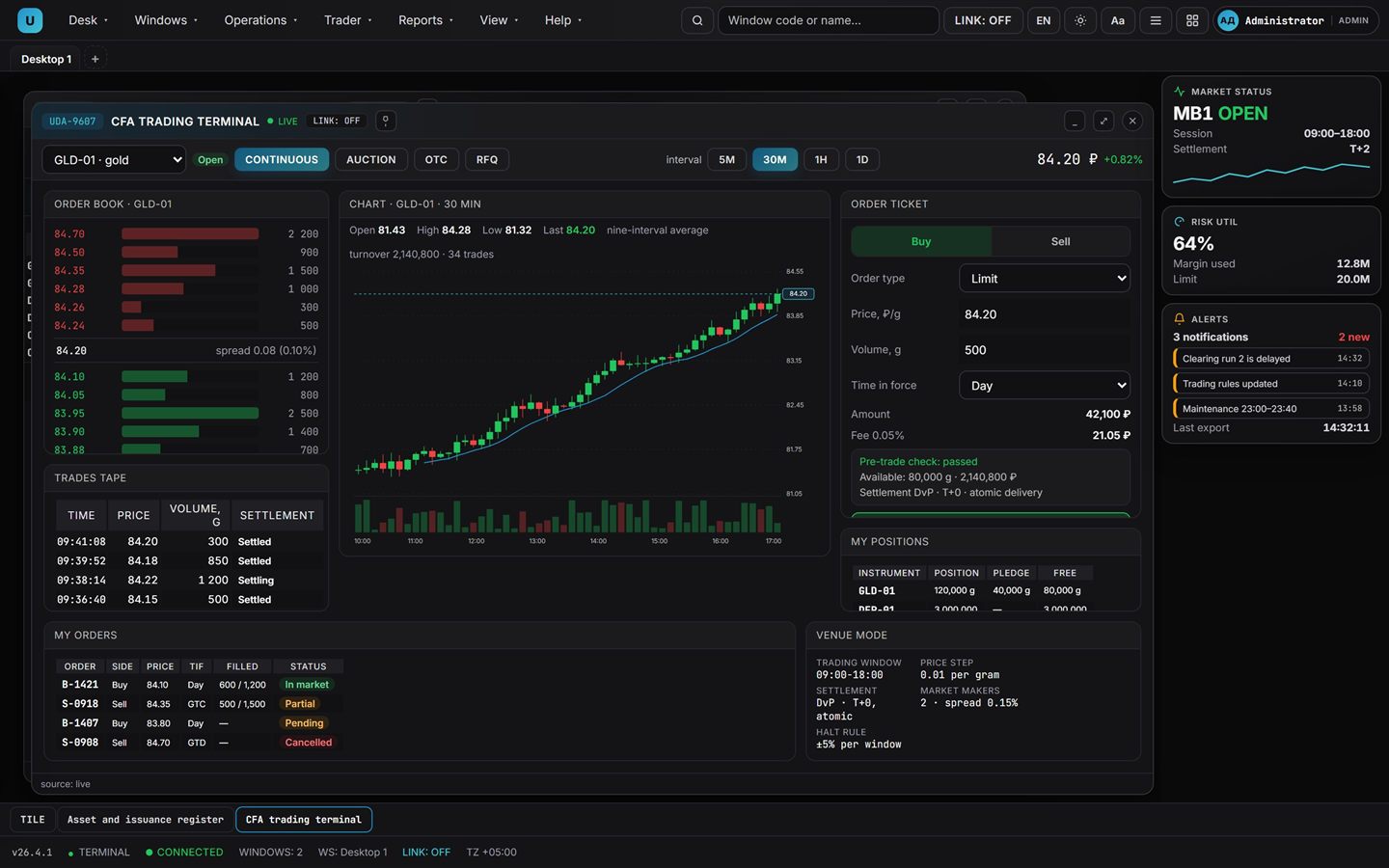
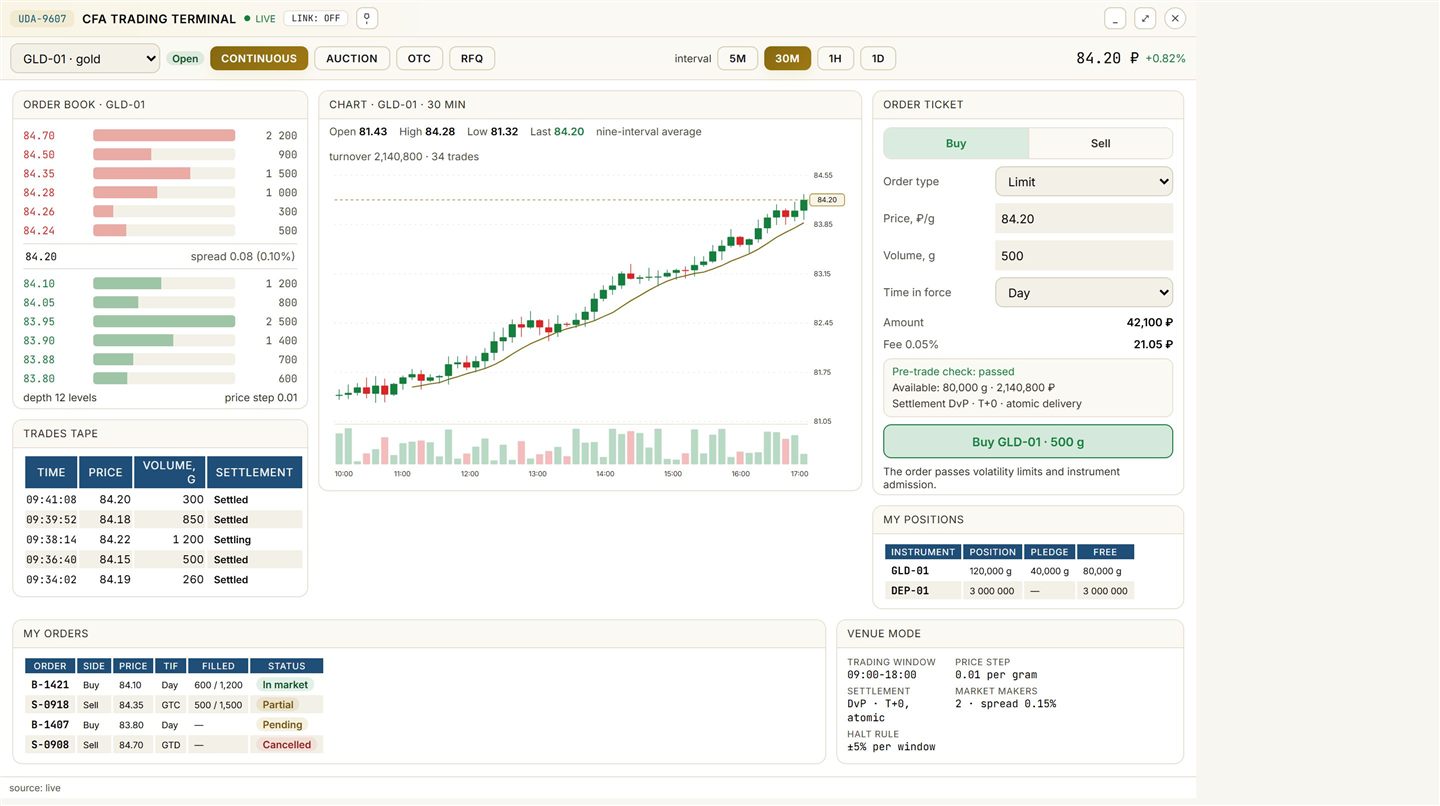
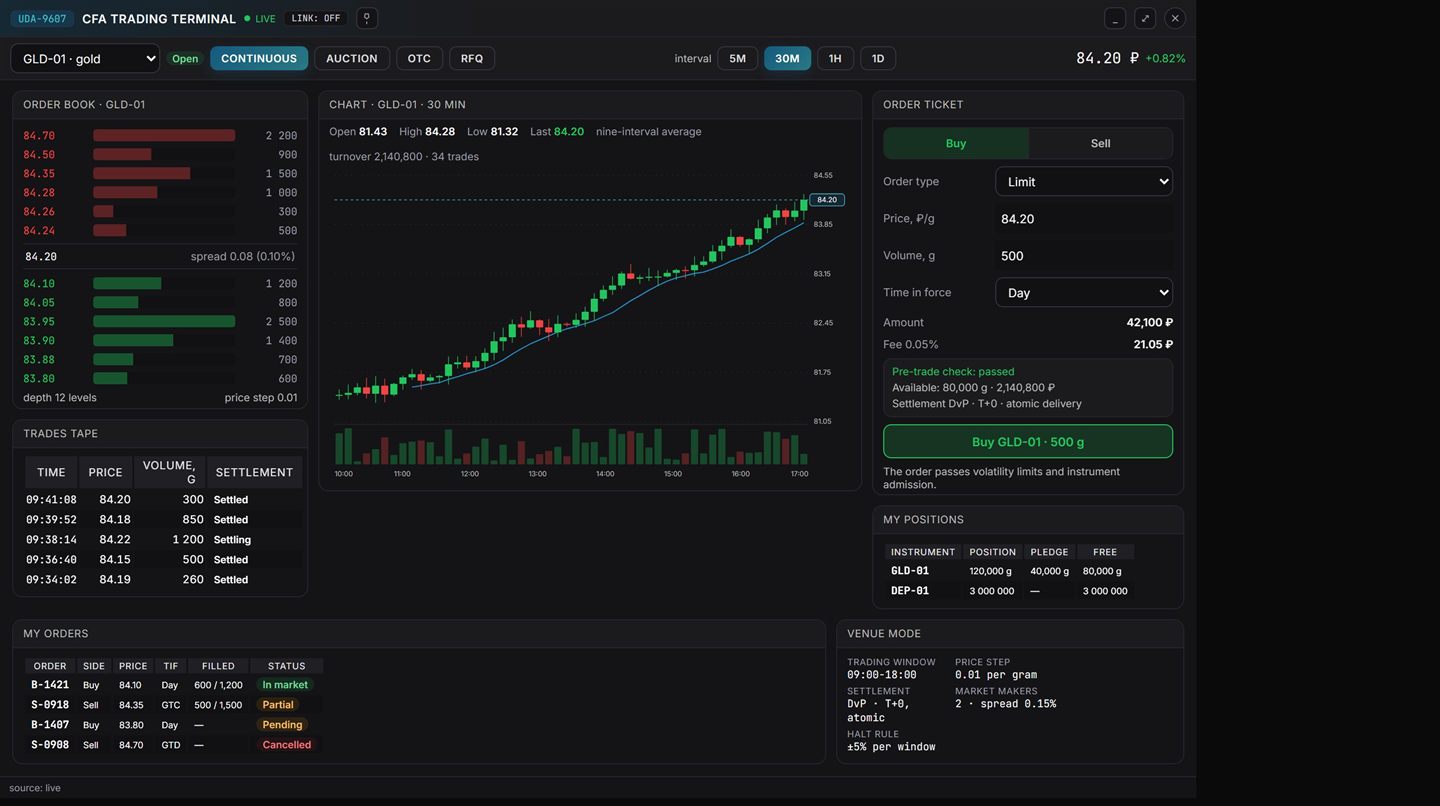
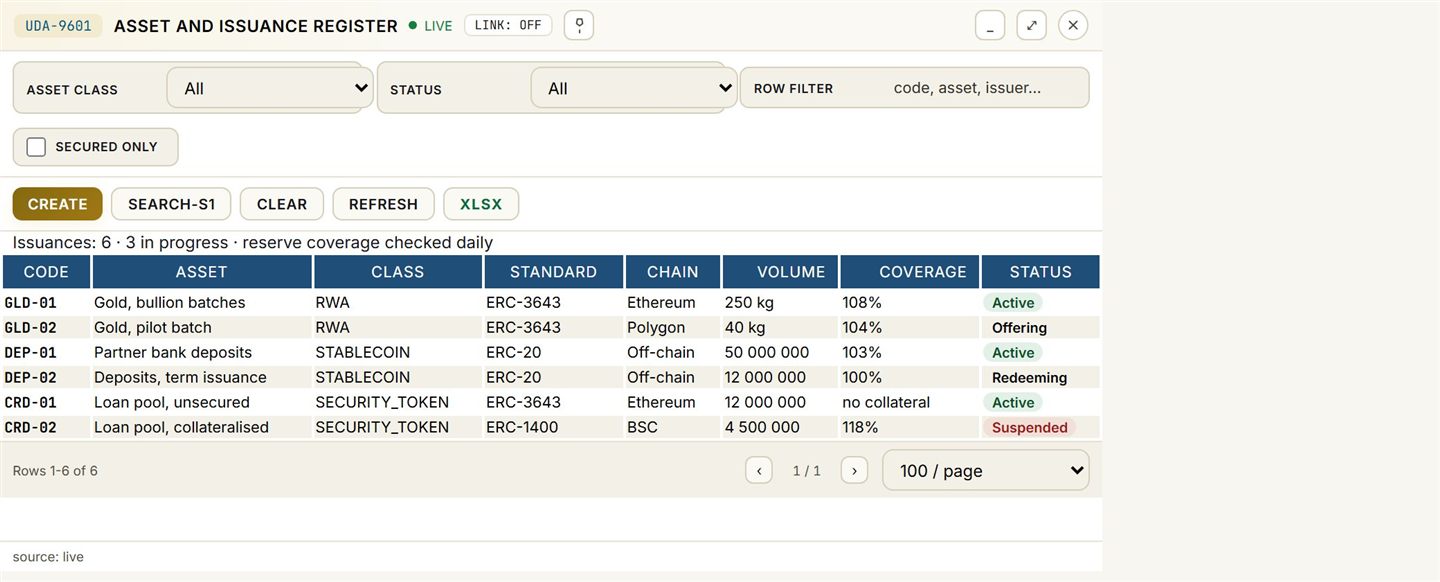
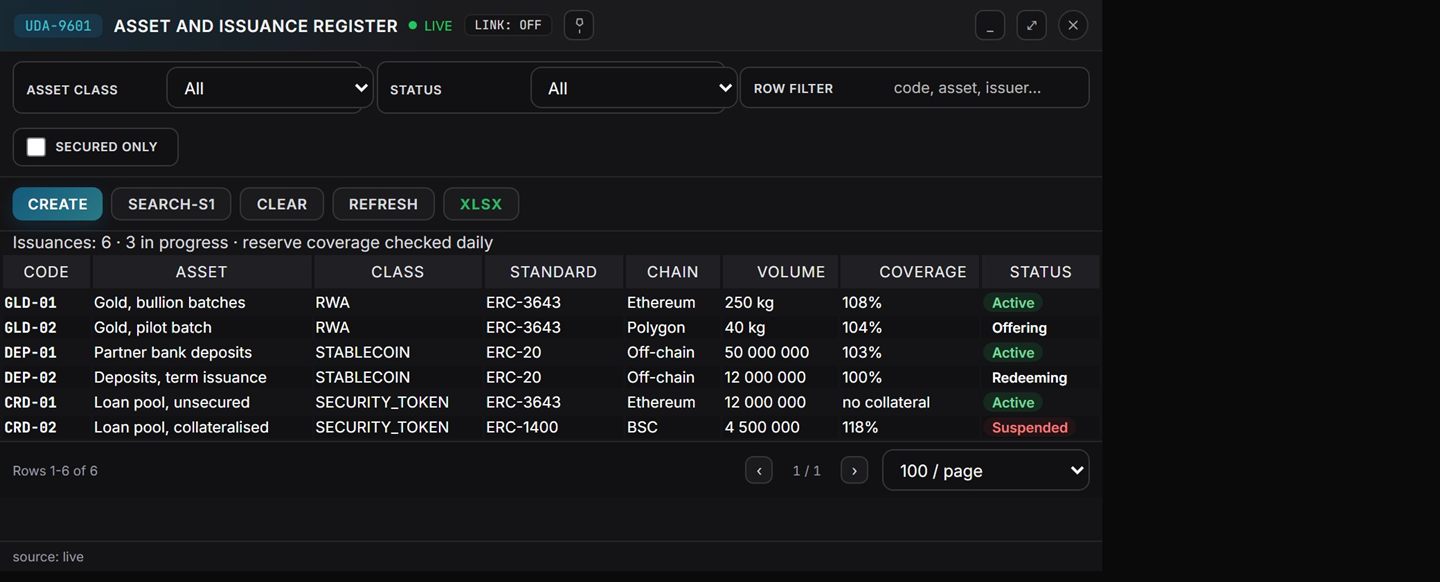
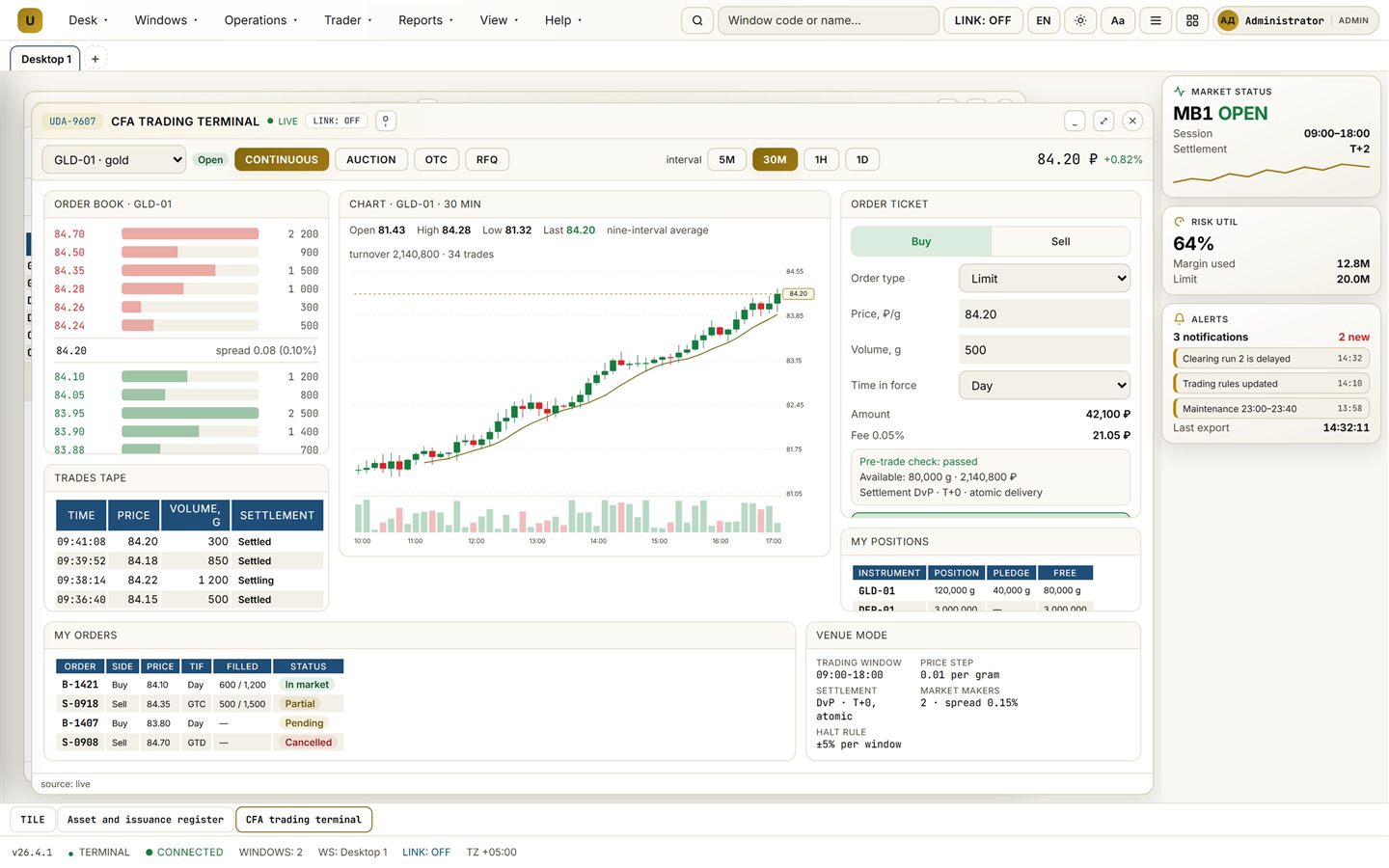
Platform desktop with the issue registry Platform desktop with the issue registry CFA trading terminal screen CFA trading terminal screen Asset registry screen with issue coverage
Demo Unifin Digital Assets Theme Open separately
Asset and issuance register

This is an interface demonstration: the real solution will differ in colours and content for a specific project.

Functions at a glance

Business functions at a glance

From issuance to issue servicing.

Issuance process
Runs the tokenisation request through stages and owners
The issue fixes parameters and reserves
Asset registry
Keeps class, standard, network and coverage of every issue
The state of each issue is visible in the moment
Custody per policy
Holds keys and tokens under the signing policy
Several custodians behind one view
Trading under limits
Runs the book, positions and limits
Trading runs under the role model
DvP settlement
Settles the token and money legs together
Settlement without manual fixes
Client onboarding
Runs the application, KYC and the custody wallet
Admission to trading without manual bridges
Issue servicing
Runs corporate actions on the same registry
Payouts and events follow market rules

Depository model

A depository beyond key storage

The pillars of a digital asset depository are in the suite.

Custody of keys

Keys and wallets under the signing policy: multi-signature and split-key schemes, MPC transport and cloud key modules.

Register of rights

Holders, balances and movements in a double-entry ledger, with client assets segregated from house assets.

Settlement

Deposits and withdrawals, transfers between clients, DvP pairs and batch payouts on one money path.

Corporate actions

Coupons, redemptions, mint and burn against reserves, holder votes: the full lifecycle of an issue.

Compliance

KYC and AML, Travel Rule messages, sanctions screening and FIU reporting inside the flow.

Assurance

Proof of reserves, daily reconciliation against the network, a WORM audit journal and defined service levels.

Solution description

Capabilities and overview

Key features

  • Issuance as a process: the tokenisation request by stages and owners
  • Asset registry: class, standard, network and issue coverage
  • Admission rules and screening before listing
  • Trading under limits: the order book and positions
  • DvP settlement: the token and money legs together
  • A bridge of several custodians with one accounting
  • Client onboarding: application, KYC and the custody wallet
  • Issue servicing: corporate actions on the same registry
  • A registry with a controlled asset lifecycle
  • Journal and audit for every operation with the asset
  • Register of rights: holders, balances and movements with client segregation
  • Signing policy: multi-signature and split-key custody
  • Proof of reserves and daily reconciliation against the network
  • Deployment: by configuration, within the UniFin platform

Product overview

Unifin Digital Assets is the digital asset depository suite of the UniFin platform: the CSD-equivalent circuit for tokenised instruments. A depository is more than key storage: it runs the register of rights, settlement, corporate actions, compliance and assurance over one ledger.

The suite runs issuance, custody and trading: registry, admission, screening, DvP settlement and corporate actions.

Keys and tokens live under the signing policy, and the custodian bridge keeps one accounting across several keepers.

The client passes onboarding with KYC and a wallet, trades run under limits, and settlement closes both legs.

In some markets the depository is a licensed regime of its own. In others it is a service under a VASP or custody licence. The suite is configured to the chosen model.

What it delivers

What the solution delivers

Issuance process

A digital asset issue is usually run over e-mail: the status of a request is invisible and documents get lost. The solution turns a tokenisation request into a process with a number, stages and owners. With the solution it is visible where the issue stands and what blocks the movement. In setup the stages and the decision history are visible, and the stage composition comes as reference data.

Asset registry

Issue records are usually kept in spreadsheets, and the change history lives with the staff. The solution keeps the class, standard, network and coverage of every issue with its state history. With the solution the registry is visible as a whole, and an answer on every asset is ready. In setup the movements and blocks are visible, and the classification and networks come as reference data.

Custody per policy

Keys and tokens usually live with different custodians, and there is no single picture. The solution holds keys and tokens under the signing policy, with several custodians behind one bridge. With the solution assets and cash are visible in one picture, and custodians are not reconciled by hand. In setup balances, addresses and withdrawals are visible for every custodian, and the signing policies are set in configuration.

Trading under limits

Digital asset trading is usually kept apart from the common books, and limits live somewhere else. The solution runs the order book, chart, positions and limits under the access role model. With the solution digital instruments trade on the same rails as classic ones. In setup the operations journal and the limits per role are visible, and the access rules are configured per segment.

DvP settlement

The token and the money legs are usually tied by hand, and a mismatch is fixed over e-mail. The solution settles both legs together, with replay and a dispute path for the odd cases. With the solution trades close without manual fixes, and every leg is visible. In setup the leg statuses and the dispute history are visible, and the settlement routes come from the setup.

Client onboarding

Onboarding a client for digital assets usually drags on: the application, KYC and the wallet go through different channels. The solution runs the application and documents, KYC and AML checks, the custody wallet and admission to trading. With the solution a client opens without manual bridges between systems. In setup the status of every check is visible, and the admission rules are part of the configuration.

Issue servicing

Coupons and events on digital assets are usually run apart from the classic register. The solution runs corporate actions on the same registry and money path as the rest of the portfolio. With the solution digital issues are serviced by market rules, with no second process. In setup the event calendar and the payouts are visible for every issue, and the processing rules are set in configuration.

Coverage

What it covers

The suite is assembled from platform services, tested apart.

Asset registry

digital-assets-ms: classes, standards, networks, coverage and the lifecycle of every issue.

Rights accounting

depository-ms: balances, movements, blocks and the holder register.

Listing and offering

listing-ms: admission rules, disclosure and the offering process.

Trading

trading-ms and collateral-ms: the order book, positions and limits under the role model.

Settlement

settlement-ms and payment-ms: the DvP pair of the token and money legs.

Corporate servicing

ca-ms: corporate actions on the same registry and the money path behind them.

Reconciliation and assurance

digital-assets-ms: proof of reserves, reconciliation runs with differences and the WORM audit journal.

Custodian bridge

Several custodians behind one view: accounts, addresses, balances.

Access

Keycloak and the access server with limits and the audit journal.

Stand

Screens of the solution

The platform desktop with the issue registry, the CFA terminal and the asset registry.

Platform desktop with the issue registry
Platform desktop: the issue registry and the CFA terminal
CFA trading terminal screen
CFA terminal: order book, chart, order and positions
Asset registry screen with issue coverage
Asset registry: class, standard, network and issue coverage

How it works

From the request to the settlement in five steps

The asset path: the request, the issue, admission, trading, settlement.

  1. 1

    The tokenisation request arrives

    The request becomes a process; documents and reserves are collected.

  2. 2

    The issue is fixed

    Parameters, classification, standard, network and coverage are recorded in the registry.

  3. 3

    Admission and screening pass

    Admission, disclosure and screening run before trading starts.

  4. 4

    Trading runs under limits

    The book and collateral work under the role model; actions journaled.

  5. 5

    DvP settles and servicing follows

    Both legs settle together; events run on the same path.

Industries

Industries it serves

The suite serves venues, digital asset depositories and CSDs that admit digital assets, banks that connect custody and payments. Issuers who bring assets to the market.

Bank / payments

Settlement, payments and custody services for the market around the trading core.

CSD / depository

Custody, corporate actions and settlement discipline for classic and digital assets.

Corporate / issuer

Market access for producers and issuers: auctions, deliveries, tokenised assets and data.

Architecture

Architecture and access

The suite is built on platform services without a new core, and the custodian side stays behind one bridge.

No new core

The digital-assets, depository, listing, trading, collateral, settlement, payment and ca services do the work.

Custodian bridge

Accounts, deposit addresses, balances, withdrawals and statuses come to one shape.

Access and limits

Keycloak for identity, the access server for limits and the journal.

Start checklist

Four decisions start the work: jurisdiction, roles, token standards and partner bank.

AI layer

The AI layer drafts issuance checklists and explains screening; people approve every step.

Architecture scheme The same architecture as a standalone page. Open the diagram separately

Readiness

Ready today, next in line

The suite is ready for a pilot; next: more asset classes.

Ready today

  • Asset registry with lifecycle, coverage and issue history
  • Issuance process with reserves and documents
  • Multi-custodian bridge with a single lifecycle view
  • Trading under limits and DvP settlement of both legs
  • Key perimeter: MPC transport, Shamir shards, multisig and cloud key modules
  • Compliance inside the flow: deposit and address screening, PEP, Travel Rule, goAML reports
  • Assurance: proof of reserves, reconciliation runs and the WORM audit journal

Next in line

  • Pilot on one asset class (gold), then deposit and lending packs
  • Networks next: Tron (USDT), Solana, TON
  • RWA pack: ERC-3643 with whitelist and on-chain identity, coupons and votes
  • Key round: own HSM, geo-distributed shards, SOC 2
  • Delivery: on-prem or a vendor model with a sub-custodian

Releases

Release history

Quarterly releases from the foundation of the platform (2020); the digital assets suite develops from 2026.

2026 Q1

  • Asset registry, issuance process and admission rules.

2026 Q2

  • Custodian bridge and the CFA trading terminal.

2026 Q3

  • DvP settlement, corporate servicing and the access server limits.

Detailed description

Detailed description

The module map, the metrics and the delivery frame.

How the suite is assembled

Channels and clients
FIX 4.2 / 4.4 / 5.0, REST with mTLS, SFTP files, web portals
Edge and access
API gateway with 126 routes, Keycloak single sign-on, WAF and CSP
Platform core services
digital-assets-ms listing-ms settlement-ms depository-ms AI agentic layer Services of the suite on the shared platform core
Data and events
PostgreSQL 17 per service, Redis 7, RabbitMQ 3.13 quorum queues, transactional outbox
Results and reporting
Portals, reports, regulator and partner channels

Technology stack

Runtime and backend: Java 21 (LTS), Spring Boot 3.5.16, Spring Cloud 2025.0.3, Gradle, Flyway 10.15.

Data: PostgreSQL 17 per service, Redis 7 with Sentinel, RabbitMQ 3.13 quorum queues, transactional outbox and DLQ replay.

Portals: Next.js 16.3.3, React 19, TypeScript 5; OpenTelemetry 1.31 to Jaeger.

Delivery: Kubernetes and Helm, Vault secrets, Prometheus and Grafana, Docker Compose for pilots.

Visualisation: Apache Superset 4 and ECharts 5 for dashboards and charts, Grafana for operations panels, Mermaid for documentation schemes and the portal diagrams.

Issuance and registry

  • Issuance programmes: decision, prospectus, tranches and the mint operation into the registry.
  • Registry snapshots restore the whole picture at any date for reporting and attestation.
  • Burn and redemption follow the rulebook of the programme with holder notifications.
  • Corporate actions on tokens use the same rails as securities: accruals, payouts, reports.

Custody and keys

  • Custody accounts for institutional holders with segregation and reporting.
  • Key management with hardware modules and role separation; no single operator can move assets.
  • Reserve attestation: what assets back the tokens and who confirms it.
  • Recovery procedures tested by operators, not only documented.

Trading and settlement

  • Admission of assets to trading with listing rules configured by the venue.
  • DvP on the platform: the token leg and the money leg close together.
  • Market making and liquidity programmes with measurable obligations.
  • Supervision and reporting: the venue sees the flow of its market as it happens.

Architecture

  • Built from the platform core: digital-assets-ms, listing-ms, settlement-ms and depository-ms.
  • The suite works through platform contracts: one register of record, no shadow copies of the data.
  • Scaling adds nodes, not rewrites: stateful services grow with Patroni, RabbitMQ and Redis clusters.

Integrations and access

  • OpenAPI for every service: 978 documented endpoints behind 126 gateway routes, plus webhooks and SFTP where partners need files.
  • Single sign-on: Keycloak 26.1, OIDC and JWT, roles, MFA and API keys with quotas.
  • Evidence by default: the audit journal, idempotency keys on writes and a record for every disclosure.
Detailed description

Leave your contacts to open the detailed description and download the PDF with architecture, cases and delivery details.

Bring an asset to the registry

Choose one asset class: we will run the pilot from the issuance request to the first DvP settlement on your stand.