UNIFINplatform

Solution

Unifin CoP

Financial intelligence loses time when cases travel by e-mail.
Case sharing moves into a managed channel: cases, statuses, deadlines and an access journal.
Information sharing is bounded and auditable: every case has an owner and a history.

  • Invitation-based exchange
  • Privacy-preserving matching
  • Regulator channel
All solutions

Live screens from the product terminals

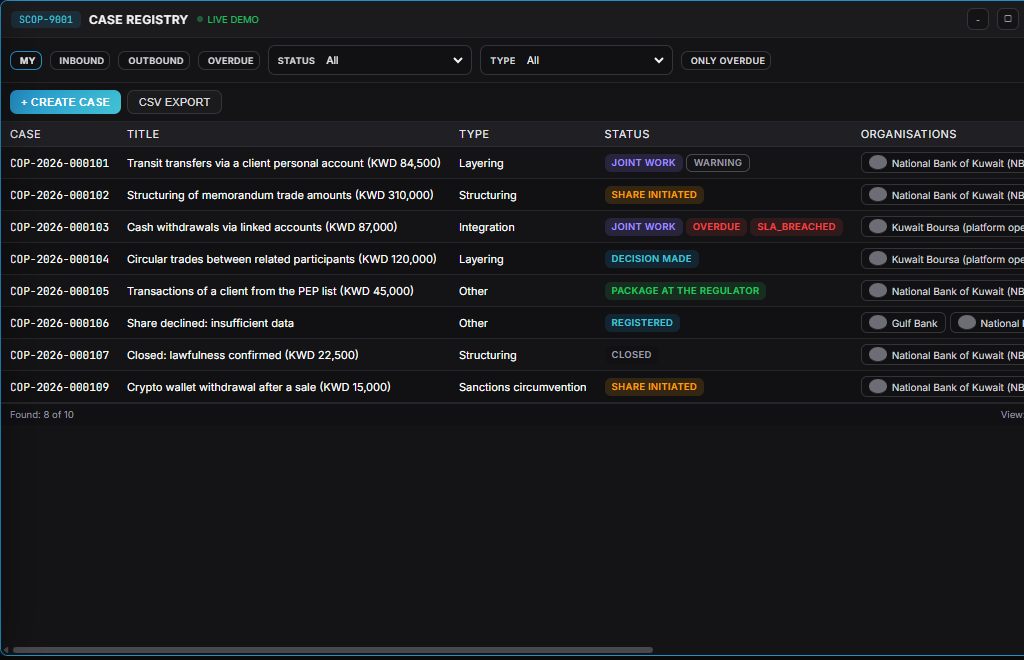
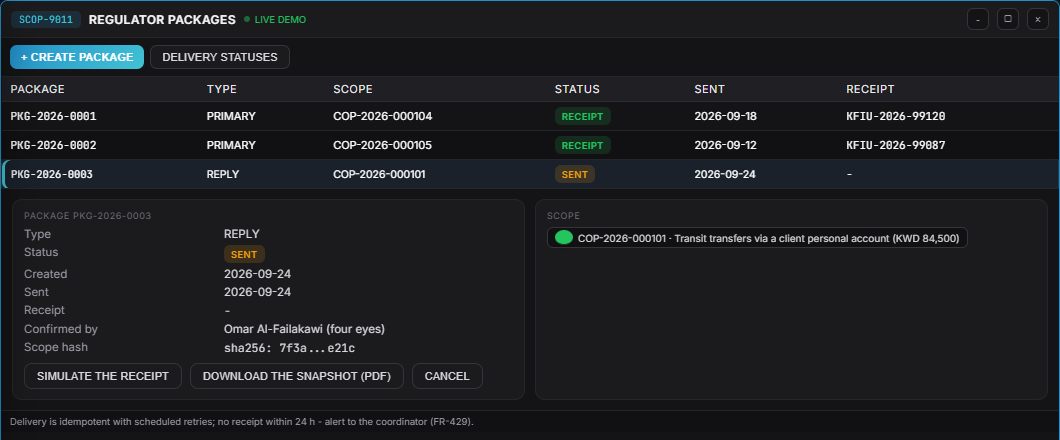
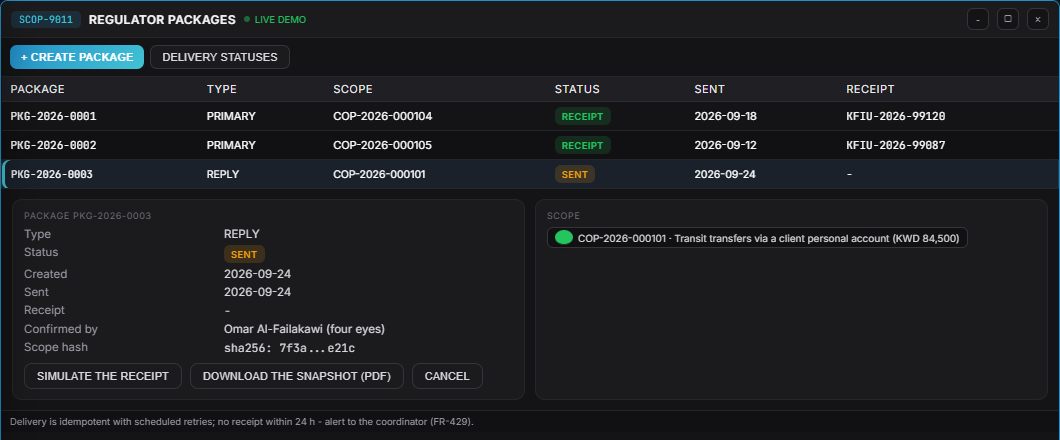
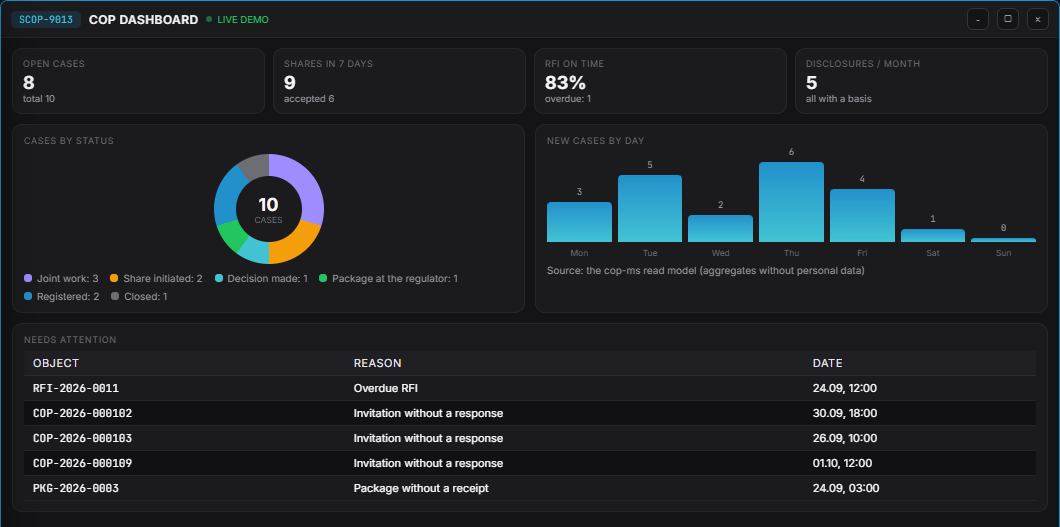
AML/CFT case registry screen AML/CFT case registry screen Regulator package registry screen Regulator package registry screen Supervision dashboard: case dynamics, deadlines and workload
Demo Unifin CoP
Case registry
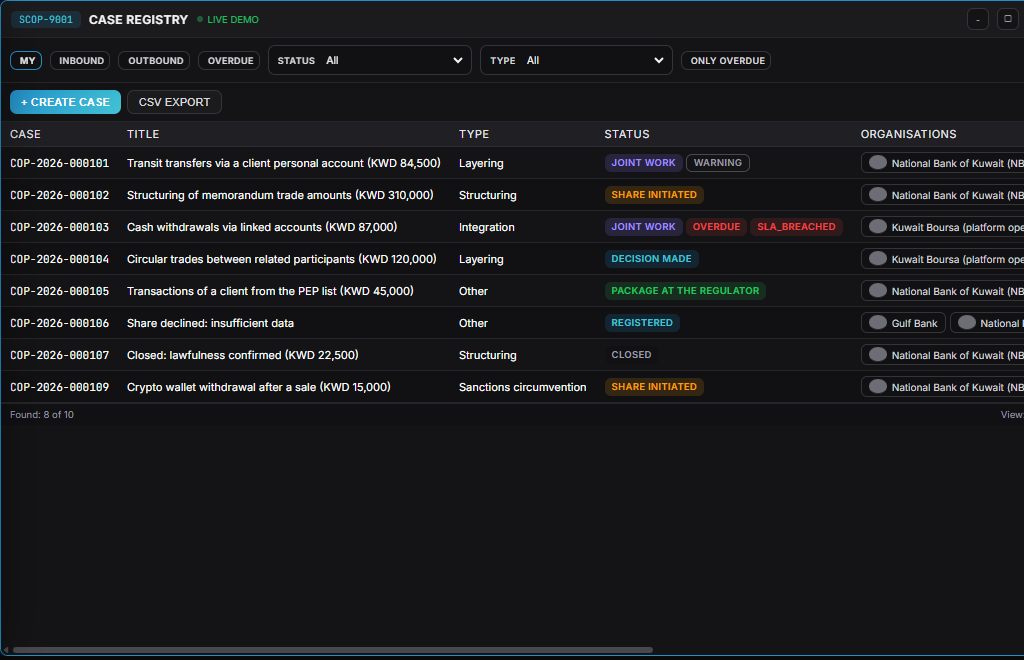
Case registry: statuses, types, participants and SLA clocks
Case registry
Case registry: statuses, types, participants and SLA clocks

This is an interface demonstration: the real solution will differ in colours and content for a specific project.

Functions at a glance

Business functions at a glance

From the case registry to regulator packages.

Case registry
Runs AML/CFT cases with statuses and SLAs
Overdue items surface before findings
Share and visibility
Opens a case by invitation with a visibility level
Each party sees only what it should
Information requests
Runs RFIs with templates, terms and escalation
Deadlines hold without manual reminders
Joint investigations
Runs a shared thread of decisions and files
One client, one case, no duplicated work
Typologies and subscriptions
Versions indicators and delivers them to subscribers
One library for all participants
Privacy-preserving matching
Matches cases on irreversible markers only
Matches without exposing the data
Regulator packages
Builds and sends packages with receipts
A supervisory dialogue on documents

What runs today

Case sharing, already running

Cases that travel safely: the live channel.

Registry

Cases open with envelopes and owners.

Sharing

Sharing runs with visibility levels.

RFI

Inbound invitations and RFI run in the channel.

Typologies

Typologies and subscriptions feed the work.

Regulator

Regulator packages keep the exchange bounded.

Roadmap

New jurisdictions come next.

Solution description

Capabilities and overview

Key features

  • AML/CFT case registry with statuses and SLAs
  • Invitation-based sharing with a visibility level
  • Information requests with templates, terms and escalation
  • Joint investigations: a shared thread of decisions and files
  • Typology library with versions and subscriptions
  • Case matching on irreversible markers without personal data
  • Regulator packages with dispatch receipts
  • Access journal for every disclosure and decision
  • Dashboards across volumes, statuses and deadlines
  • The legal frame of sharing is configured by agreements
  • Sharing between organisations without a common database
  • Deployment: by configuration, within the UniFin platform

Product overview

Unifin CoP is the UniFin platform AML/CFT case-sharing suite for market operators, banks and brokers.

The suite runs cases, invitations, information requests and joint investigations in one managed channel.

Sharing is bounded by the visibility level: each party sees only the declared projection, and every disclosure stays in the journal.

Typologies are versioned and delivered to subscribers, while matching runs on irreversible markers without personal data.

The solution runs within the UniFin platform and is configured to the sharing rules.

What it delivers

What the solution delivers

Case registry

AML/CFT cases usually live in e-mail and folders, and deadlines are tracked by hand. The solution runs a case registry with types, priorities and SLAs. With the solution an overdue item is visible before it becomes a finding. In setup duplicates and the case history are visible, and the types and terms come as reference data.

Share and visibility

Information is usually shared between organisations by letter, and the scope of disclosure is not recorded. The solution opens a case by invitation with a visibility level and a recipient projection. With the solution exactly what is required is disclosed, and the step is confirmed with second eyes. In setup the sharing journal and invitation decisions are visible, and the visibility levels are set in configuration.

Information requests

Information requests usually go out as letters, and deadlines are tracked in a spreadsheet. The solution runs requests with templates, terms, extensions and escalation in an append-only thread. With the solution deadlines are held without manual reminders. In setup the status of every request and the extension history are visible, and the templates are configured per segment.

Joint investigations

Investigations usually run in parallel: several organisations collect the same facts. The solution runs a shared thread with attachments, decisions and deadlines. With the solution work runs on one case, and fact-finding is not duplicated. In setup decisions and attachments for every case are visible, and the participant list comes as reference data.

Typologies and subscriptions

Typologies are usually distributed as files, and versions diverge between organisations. The solution versions indicators centrally and delivers them to subscribers. With the solution one typology library applies without checking versions. In setup the four-eyes publication and replacement notes on deprecation are visible, and the subscriptions come from the setup.

Privacy-preserving matching

Matching cases usually requires exposing personal data before a legal basis is found. The solution matches cases on irreversible markers without exposing the data. With the solution matches are found without leaving the legal boundaries. In setup the disclosure journal and the bases are visible, and the matching rules are part of the configuration.

Regulator packages

Regulator packages are usually assembled by hand, and the composition cannot be reconstructed. The solution builds a package with a composition snapshot and tracks receipts. With the solution the package is sent, and the authority response is followed. In setup the status and the composition of every package are visible, and the templates are set in configuration.

Coverage

What it covers

Modules cover the exchange end to end; boundaries stay visible.

Case registry

Creation wizard, statuses, types, priorities and the duplicate check before a case opens.

Sharing and visibility

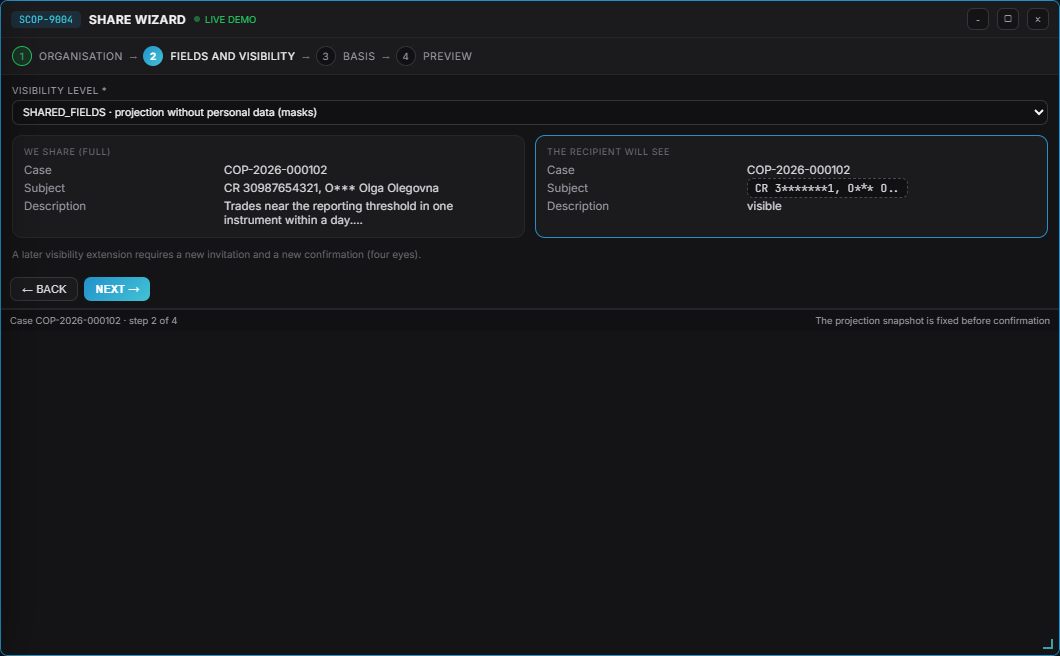
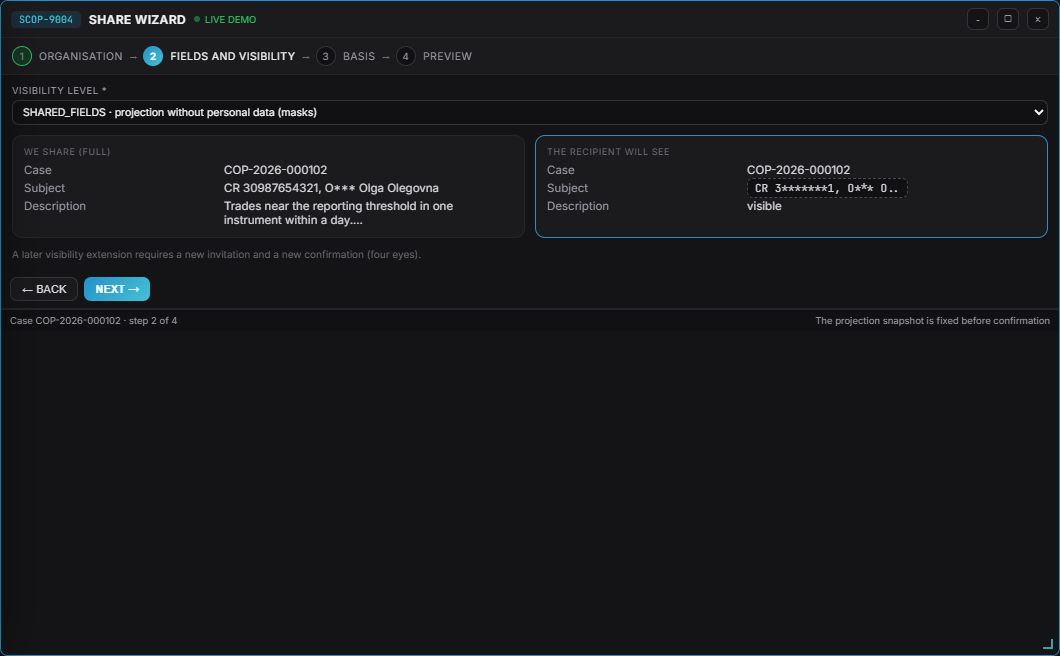
Share wizard with visibility levels, the recipient projection and second eyes.

Inbound invitations

Accept or decline with a reason; the sharing journal records every decision.

RFI

Templates, checklists, terms, extensions and the full request thread.

Typologies and subscriptions

Indicator library with versions, four-eyes publication and subscription delivery.

Regulator packages

Draft, send and receipt tracking for packages to the competent authority.

Audit journal

Access, disclosure, sharing, RFI and admin journals with export under watermark.

Dashboards

SLA and workload dashboards with overdue analytics by case type.

Stand

Screens of the solution

The case registry, the sharing wizard and the regulator packages.

AML/CFT case registry screen
Case registry: statuses, types, participants and SLA clocks
Case sharing wizard screen
Sharing wizard: visibility level and the recipient projection
Regulator package registry screen
Regulator packages: drafts, sending and receipts

How it works

From red flag to the joint case in five steps

The path of a case: detection, creation, sharing, joint work, package.

  1. 1

    A red flag appears

    A signal marks a pattern; the registry checks duplicates.

  2. 2

    The case is created

    The wizard records the source and subjects; the SLA clock starts.

  3. 3

    Sharing is requested

    The wizard shows the projection and asks for second eyes.

  4. 4

    The organisations work together

    RFI runs with deadlines; markers match without third-party exposure.

  5. 5

    The package goes to the regulator

    The summary becomes a package with a snapshot and a receipt.

Industries

Industries it serves

The suite serves the market operator, banks and brokers in their AML/CFT duties and the competent authority as the receiving side.

Exchange / venue

Trading, supervision, market data and post-trade on one governed core, launched by configuration.

Bank / payments

Settlement, payments and custody services for the market around the trading core.

Regulator / supervisor

Surveillance evidence, market analytics and reporting built from live transaction data.

Architecture

Architecture and access

The suite connects organisations without merging their data: each party keeps its store, the platform carries the process.

Bilateral visibility

Two organisations see a shared case; the third does not, as visibility belongs to the case.

Legal boundaries in code

Disclosure requires a basis from the catalogue and produces a journal record with a TTL where needed.

Append-only audit

Access, disclosure and sharing journals are append-only with export under watermark for inspectors.

Platform services

Identity, notifications and documents come from the platform; the suite adds case and sharing services.

AI layer

The AI layer drafts match explanations and summarises case histories; people approve every step.

Architecture scheme The same architecture as a standalone page. Open the diagram separately

Readiness

Ready today, next in line

The concept and the prototype are complete; build waves start after approval.

Ready today

  • Product frame: modules and business cases
  • Screen prototype: operation forms and end-to-end scenarios
  • Estimates for the implementation waves

Next in line

  • Wave W1: case registry, sharing and the audit journal
  • Wave W2: RFI, typologies and subscriptions
  • Wave W3: regulator packages and privacy-preserving matching

Releases

Release history

The suite is designed in 2026 and joins the platform waves with the first pilot.

2026 Q3

  • Concept, business cases and the screen prototype; estimates for the waves.

2026 Q4

  • Planned: wave W1 with the case registry and sharing (plan).

Detailed description

Detailed description

The visibility model, the journal design and the delivery frame.

How the suite is assembled

Channels and clients
FIX 4.2 / 4.4 / 5.0, REST with mTLS, SFTP files, web portals
Edge and access
API gateway with 126 routes, Keycloak single sign-on, WAF and CSP
Platform core services
case services notification-ms docflow-ms audit journal AI agentic layer Services of the suite on the shared platform core
Data and events
PostgreSQL 17 per service, Redis 7, RabbitMQ 3.13 quorum queues, transactional outbox
Results and reporting
Portals, reports, regulator and partner channels

Technology stack

Runtime and backend: Java 21 (LTS), Spring Boot 3.5.16, Spring Cloud 2025.0.3, Gradle, Flyway 10.15.

Data: PostgreSQL 17 per service, Redis 7 with Sentinel, RabbitMQ 3.13 quorum queues, transactional outbox and DLQ replay.

Portals: Next.js 16.3.3, React 19, TypeScript 5; OpenTelemetry 1.31 to Jaeger.

Delivery: Kubernetes and Helm, Vault secrets, Prometheus and Grafana, Docker Compose for pilots.

Visualisation: Apache Superset 4 and ECharts 5 for dashboards and charts, Grafana for operations panels, Mermaid for documentation schemes and the portal diagrams.

Visibility model

  • Two visibility levels for sharing: the case or the case with disclosed subjects.
  • The projection preview shows the recipient exactly what they will see before sending.
  • Bilateral visibility: an organisation in the middle of the process never sees the case.
  • Disclosures carry a legal basis from the catalogue and an expiry date where required.

Journals

  • Append-only access journal: who read the case, which fields and when.
  • Sharing journal: invitations, acceptances, declines with reasons and reminders.
  • RFI journal: questions, answers, extensions and the SLA state of each request.
  • Export under watermark for inspectors, with the export itself recorded.

Delivery frame

  • Pilot connects two organisations and one real case end to end.
  • Adapters to the case systems of participants via platform services.
  • Typology content pack for the local regime is part of the delivery.
  • Source code handover as an option with a separate fee, with the visibility and journal design documented.

Architecture

  • Built from the platform core: the case services, notification-ms, docflow-ms and the audit journal.
  • The suite works through platform contracts: one register of record, no shadow copies of the data.
  • Scaling adds nodes, not rewrites: stateful services grow with Patroni, RabbitMQ and Redis clusters.

Integrations and access

  • OpenAPI for every service: 978 documented endpoints behind 126 gateway routes, plus webhooks and SFTP where partners need files.
  • Single sign-on: Keycloak 26.1, OIDC and JWT, roles, MFA and API keys with quotas.
  • Evidence by default: the audit journal, idempotency keys on writes and a record for every disclosure.
Detailed description

Leave your contacts to open the detailed description and download the PDF with architecture, cases and delivery details.

Share one case on the platform

Bring a case and a partner organisation. We will run the exchange, the RFI and the package to the regulator on the pilot stand.