UNIFINplatform

Solution

Unifin Trade USSD AI

Half the market still trades by phone call, not by app.
The suite opens the exchange over USSD: menu, orders and quotes on one text screen.
AI turns wording and voice into checked intents; the desk sees every session.

  • The *555# command tree
  • AI intent parsing
  • No internet needed
  • Provider-agnostic entry port
All solutions

Live screens from the product terminals

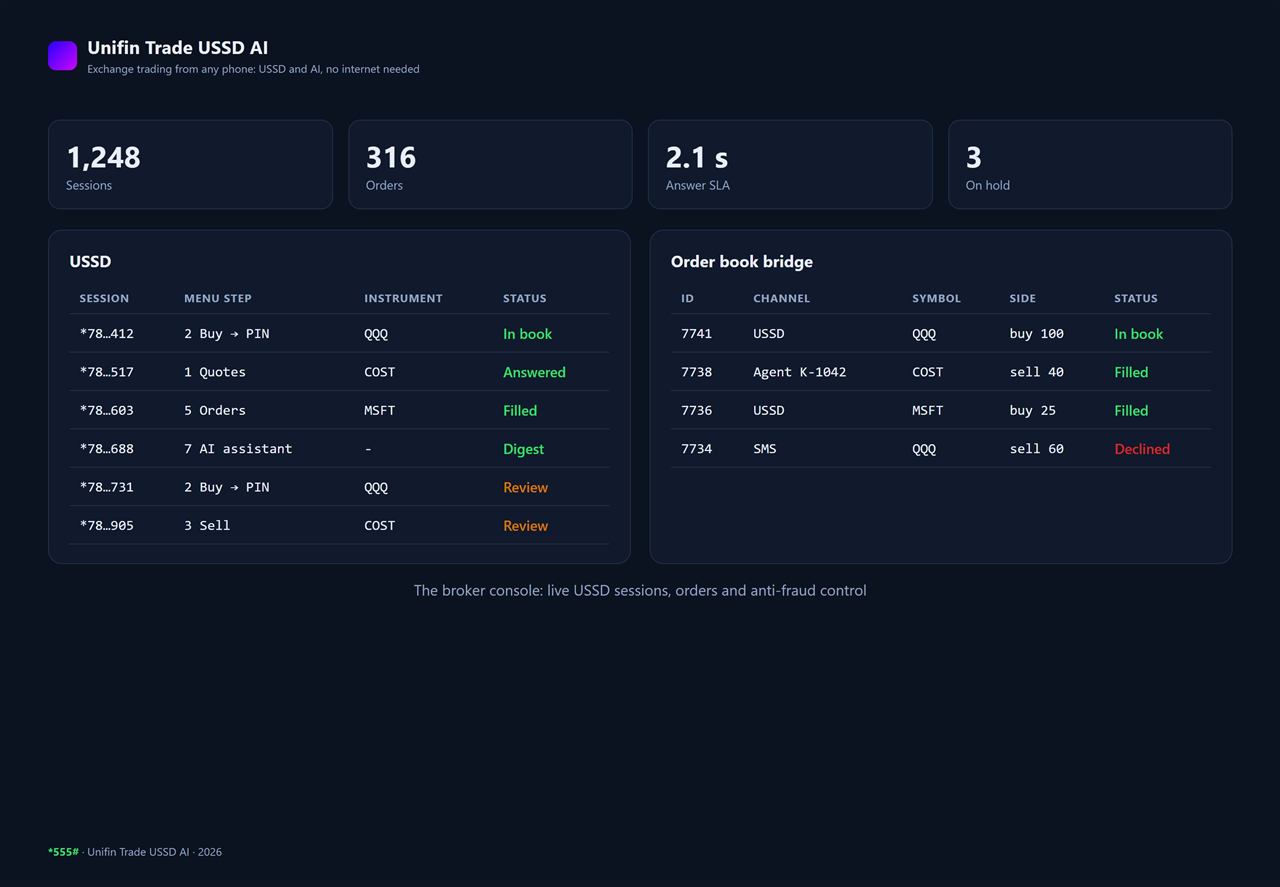
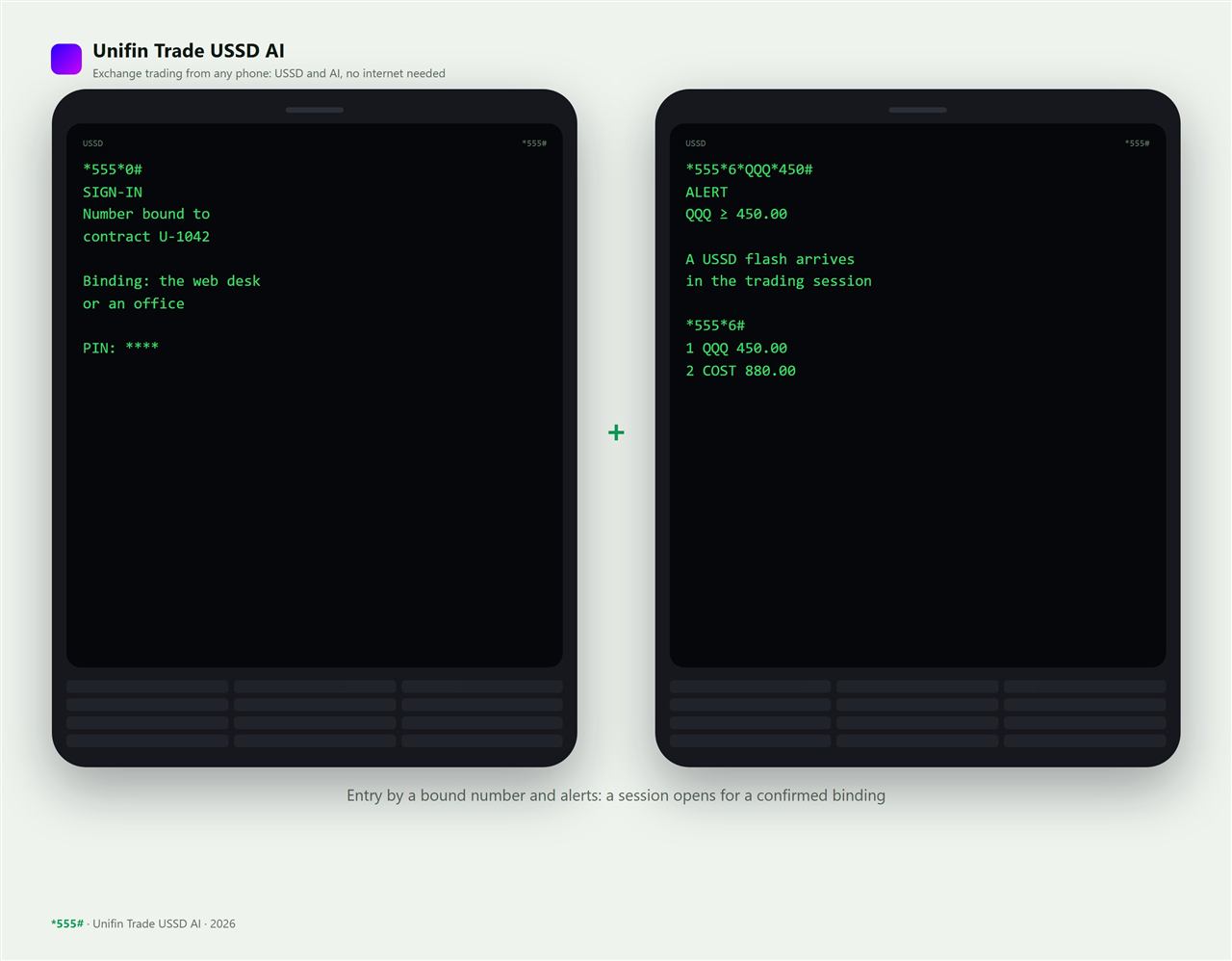
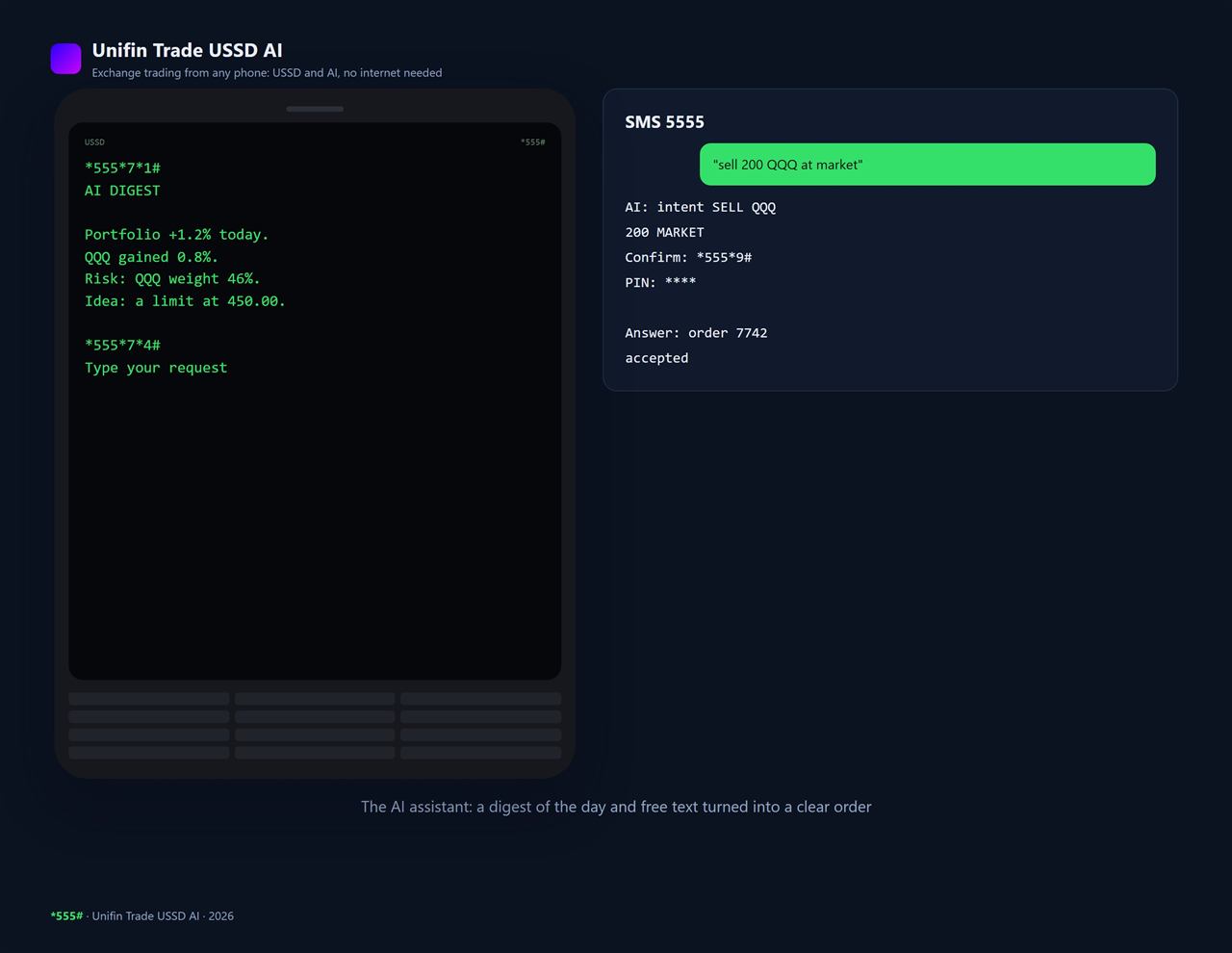
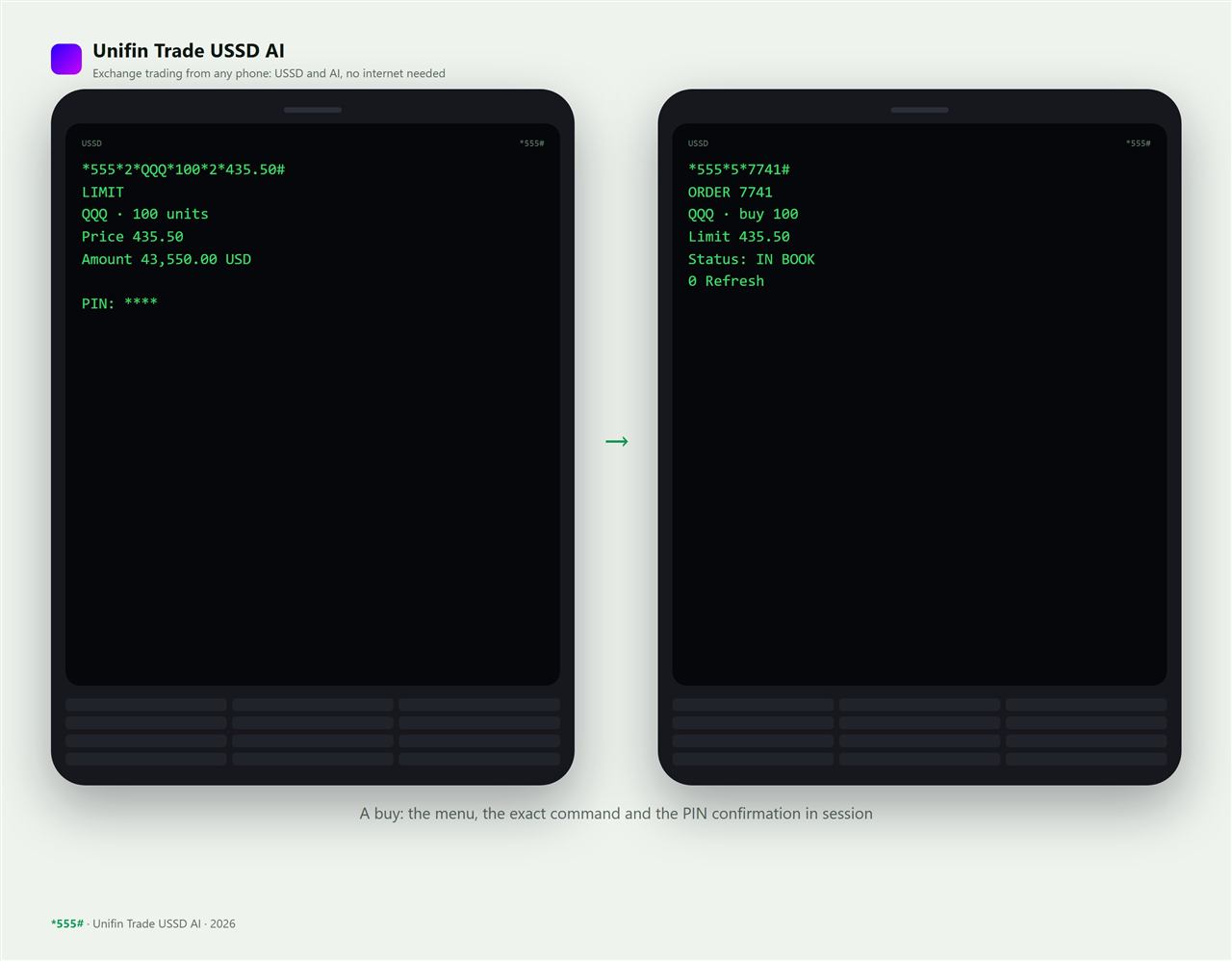
The session console with tables of sessions and orders The session console with tables of sessions and orders The bound-number entry screen and a price alert setup An AI digest screen and a free-text order parsed into an intent A three-step USSD buy flow with a PIN confirmation
Demo Unifin Trade USSD AI
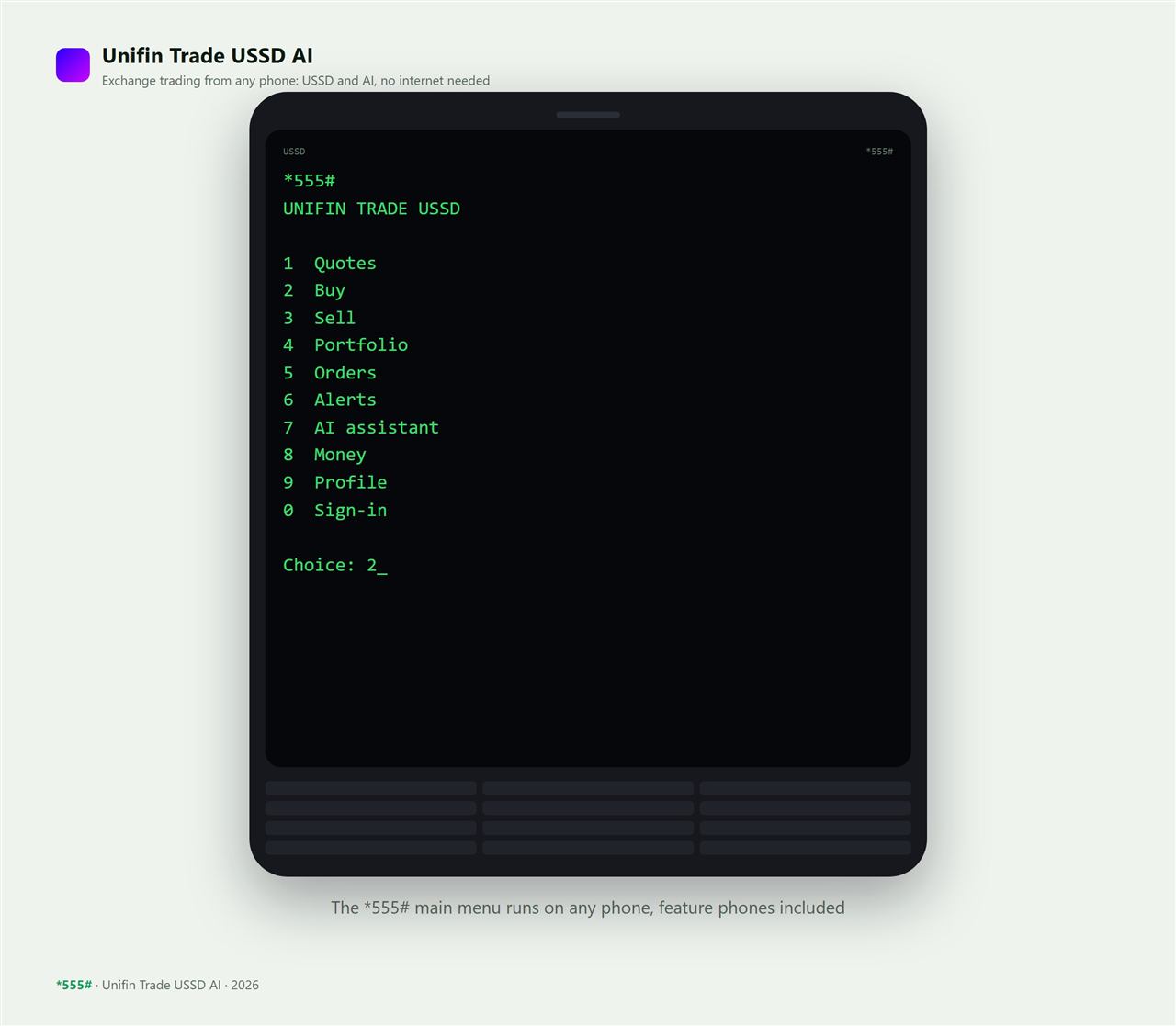
The *555# main menu on a feature
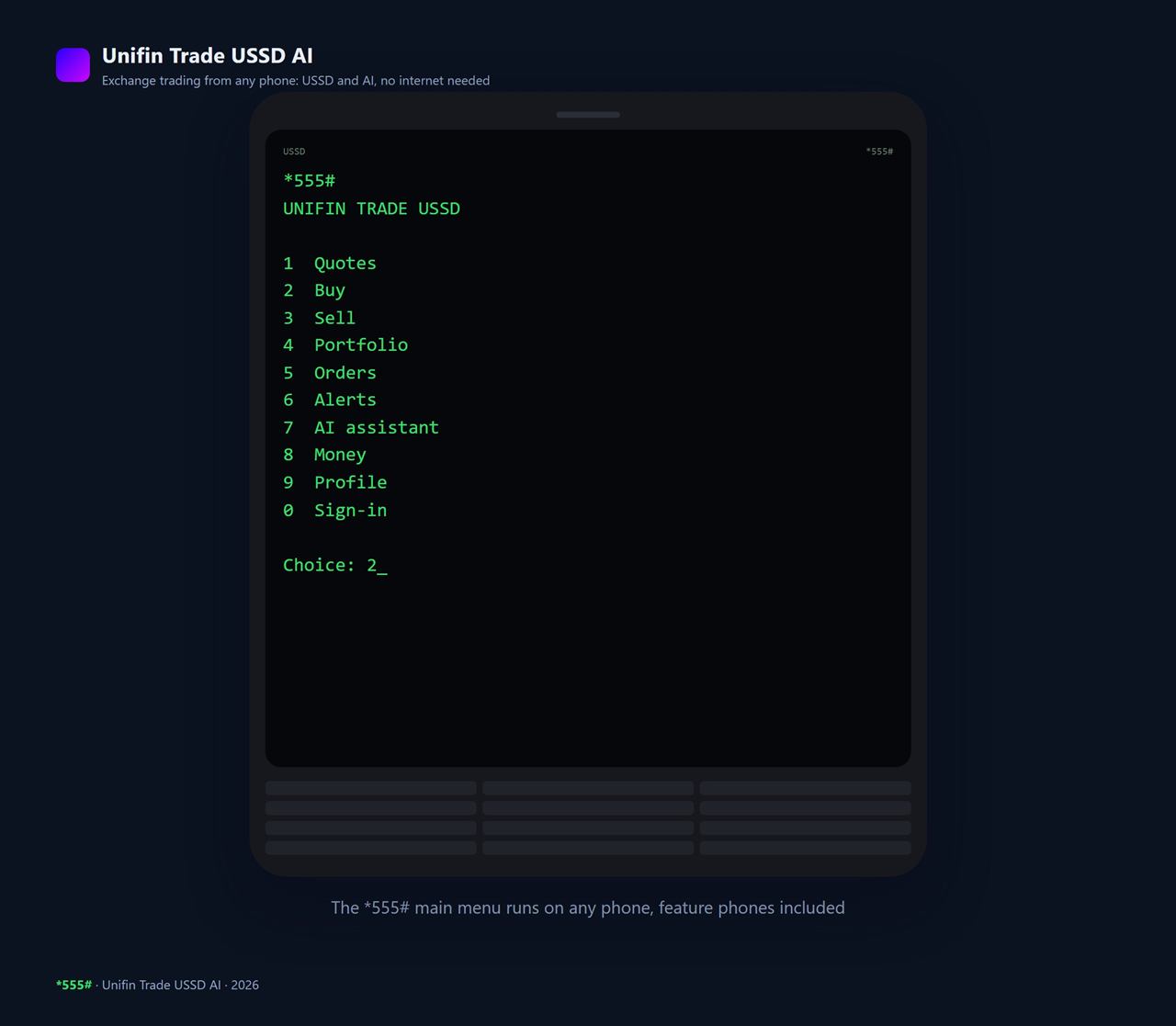
The *555# main menu on a feature phone: ten trading sections
The *555# main menu on a feature
The *555# main menu on a feature phone: ten trading sections

This is an interface demonstration: the real solution will differ in colours and content for a specific project.

Functions at a glance

Business functions at a glance

From a dialled code to a settlement receipt.

Quotes and search
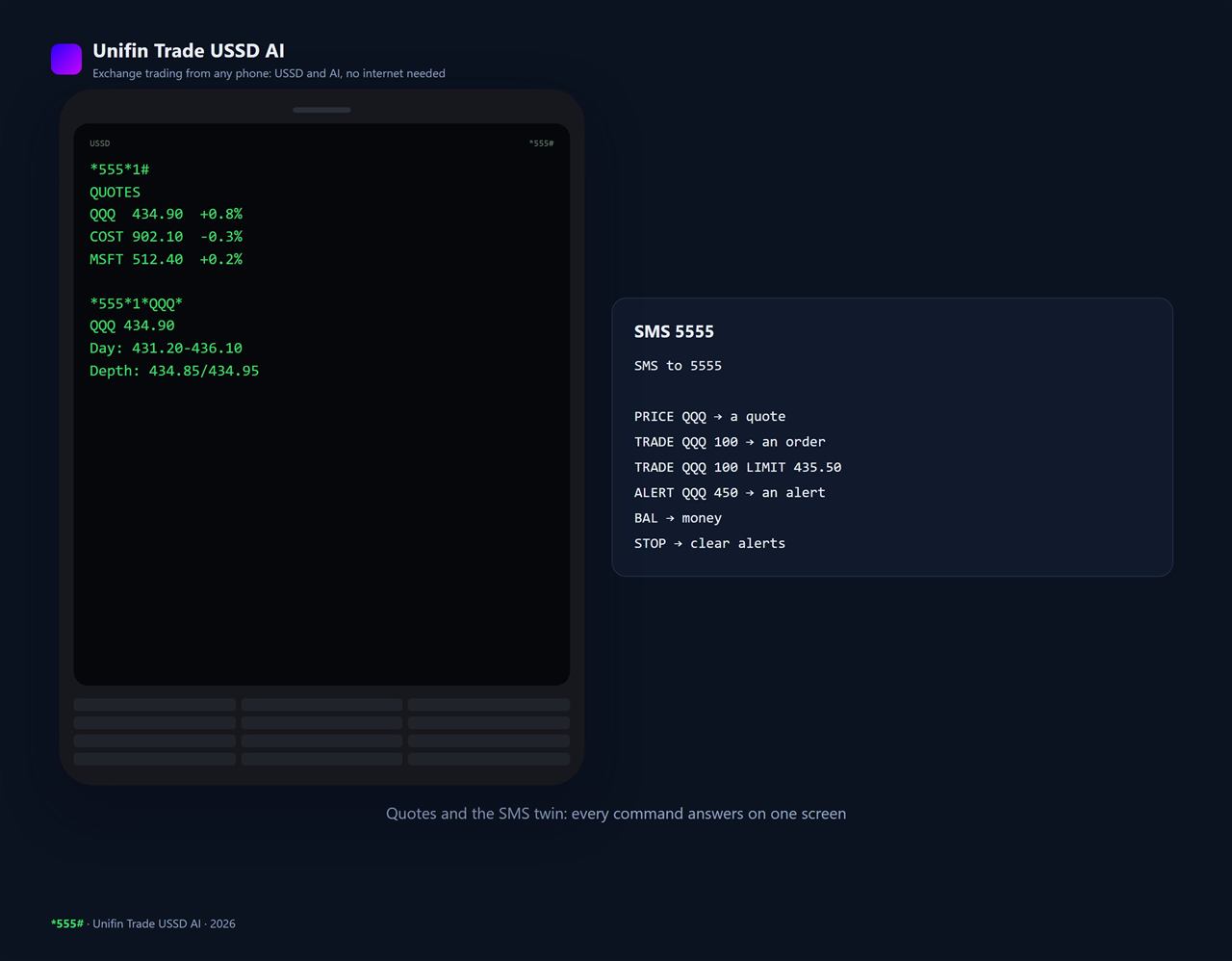
Answers with quotes, day ranges and depth through *555*1# and SMS PRICE
A price is known in seconds, without internet
Buy and sell
Takes market and limit orders with a PIN confirmation inside the session
A trade is placed from any phone
Orders and statuses
Shows the order book of the holder and cancels by command
Every order has a visible status
Portfolio and money
Shows positions, cash and top-up routes in one screen
The picture is clear without a branch visit
Alerts and flashes
Sets price alerts and sends USSD flashes into the session
The holder reacts without watching the screen
The AI assistant
Parses free text and voice into intents, drafts digests and checks limits
Low-literacy clients trade with confidence
Agents and binding
Runs agent desks *556#, number binding outside USSD and card issuance
The network sells where branches cannot reach

What runs today

The USSD circuit, built

The service is built on the platform rails; the pilot is next.

Menu tree

The *555# command tree covers quotes, orders and money.

AI intents

Free text and voice become checked intents.

No internet

The channel needs no app and no data plan.

Broker desk

The broker desk watches every session.

Confirmations

Operations confirm through the platform circuit.

Pilot

The ussd-ms service is built; the pilot on a live short code is next.

Solution description

Capabilities and overview

Key features

  • The *555# menu: ten sections, works on feature phones
  • Orders: *555*2*QQQ*100*2*435.50# with a PIN in session
  • Quotes: *555*1#, *555*1*QQQ#, *555*1*QQQ*2# and SMS PRICE
  • Order control: *555*5#, *555*5*7741#, *555*5*7741*9#
  • Portfolio and money: *555*4#, *555*4*1#, *555*4*2#, *555*8#
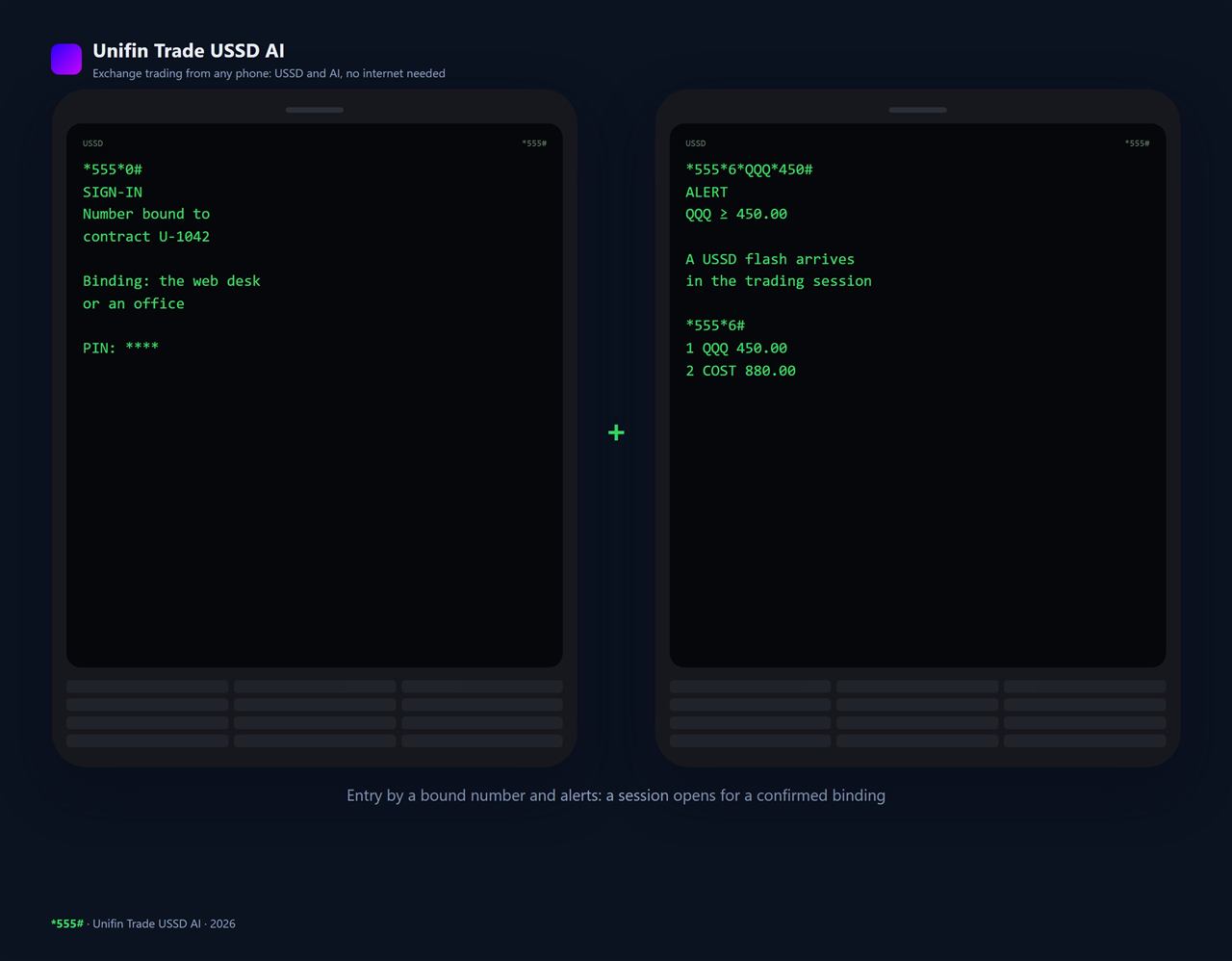
  • Alerts: *555*6*QQQ*450#, *555*6*12*9# and SMS ALERT
  • AI assistant: *555*7*1# digest, *555*7*4# free text, IVR 5557
  • Profile and sessions: *555*9*1# PIN, *555*9*2# session control
  • Agent desk: *556# with a client code for assisted orders
  • Entry port: aggregator-first, a direct MNO plugs in as an adapter
  • Binding: *555*0# shows the status, the web desk confirms it
  • Anti-fraud: SIM-swap checks, holds and a five-year journal
  • Deployment: by configuration, within the UniFin platform

Product overview

Unifin Trade USSD AI brings exchange trading to feature phones: USSD works without internet, apps and smartphones.

The command tree starts at *555# and covers quotes, orders, portfolio, money, alerts, AI help, profile and number binding.

Every order carries a PIN confirmation inside the session and passes holder limits. It leaves for the exchange through the trading domain over FIX 4.4.

The AI layer turns typed or spoken wording into intents, drafts one-screen digests and flags unusual sessions for the desk.

The solution runs inside the UniFin platform. The entry is a port: an aggregator first, a direct MNO as an adapter. Top-ups and withdrawals run through mobile wallets and payment services.

What it delivers

What the solution delivers

The full command tree

Trading menus live on paper cards and word of mouth, and one wrong digit loses the session. The *555# tree covers ten sections and 24 commands, each answered on one screen. With the solution a holder finds a section without training. In setup the tree, the languages and the limits run from one configuration.

An order from any phone

Branch orders need a visit or a call, and a market order waits for the desk. A market order is *555*2*QQQ*100*1#, and a limit order fixes the price. The PIN confirms inside the session. With the solution a trade is placed from any phone, and holder limits are checked before the exchange. In setup the daily value cap comes as reference data.

Quotes on one screen

A price check today is a call, and the day range arrives second-hand. *555*1# answers with the top list and *555*1*QQQ# with the instrument card; depth comes on demand. SMS PRICE works without a session. With the solution the price is known in seconds. In setup the quote sources and refresh rates come as reference data.

The AI assistant: text and voice

Free wording, typos and mixed languages break menu flows. *555*7*4# and the IVR 5557 line turn typed or spoken wording into a checked intent. The system reads it back and asks for the PIN. With the solution a client with low literacy reaches the same order path. In setup the intent dictionary grows from the sessions the desk approves.

AI digest and smart alerts

A holder sees positions only by walking the menu, and flat alerts annoy. *555*7*1# brings a one-screen digest, and *555*6*QQQ*450# sets an alert. The AI keeps the digest short and the alert meaningful. With the solution the holder reads one screen a day. In setup digest topics and alert rules are configured per segment.

Agents and number binding

A new client needs a branch, and an agent works on trust and paper. The number binding is confirmed in the participant web desk or at an office. *555*0# shows the status of that binding, and the *556# desk places assisted orders under a client code. With the solution the network sells where branches cannot reach. In setup the agent network, KYC and the quarantine of a fresh binding follow one rulebook.

Security and anti-fraud

A shared phone and a plain PIN string are easy prey for SIM-swap fraud. The PIN enters inside the session, and five failed attempts block money steps for thirty minutes. Above the threshold the operation steps up to a one-time code through confirmation-ms. The AI holds unusual sessions for the desk. With the solution fraud meets a hold, not a payout. In setup session lifetime, step-up thresholds and hold rules stay under one policy.

Coverage

What it covers

The command tree of the suite: every section with its exact syntax.

Quotes: *555*1#

Top list, *555*1*QQQ# card, *555*1*QQQ*2# depth, SMS PRICE QQQ.

Buy: *555*2*

Market *555*2*QQQ*100*1#, limit *555*2*QQQ*100*2*435.50#, PIN in session.

Sell: *555*3*

The same parameters as a buy, with the sell side checks.

Orders: *555*5*

List *555*5#, status *555*5*7741#, cancel *555*5*7741*9#.

Portfolio: *555*4*

Summary *555*4#, positions *555*4*1#, money *555*4*2#, history *555*4*3#.

Money: *555*8*

Balance *555*8#, top-up *555*8*1#, withdrawal *555*8*2#, SMS BAL.

Alerts: *555*6*

List *555*6#, set *555*6*QQQ*450#, remove *555*6*12*9#, SMS ALERT, STOP.

AI: *555*7*

Digest *555*7*1#, risk *555*7*2#, analysis *555*7*3*QQQ#, free text *555*7*4#.

Stand

Screens of the solution

The *555# menu, the buy flow, quotes, the AI assistant and the broker console.

The USSD main menu on a feature phone screen
The *555# main menu on a feature phone: ten trading sections
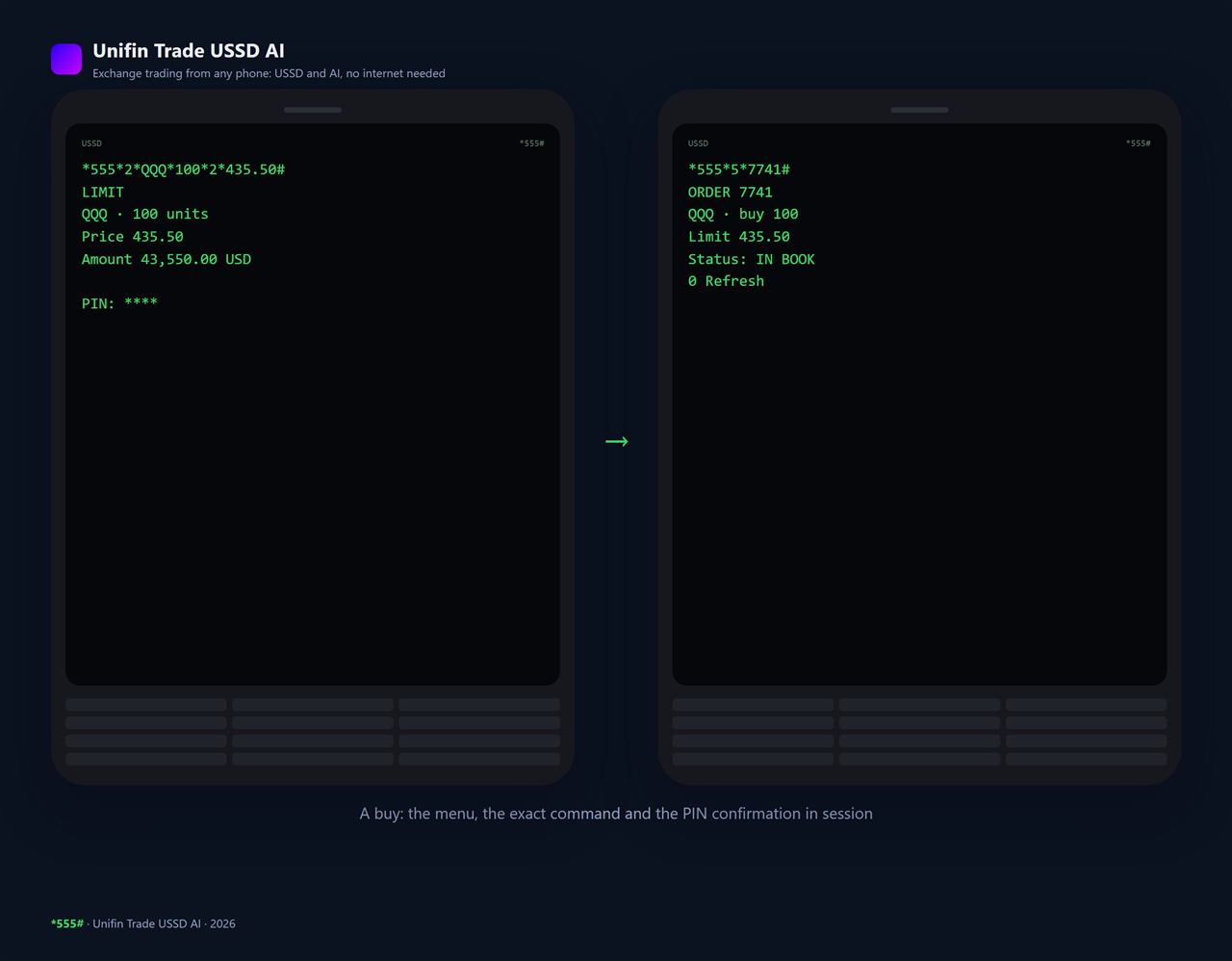
A three-step USSD buy flow with a PIN confirmation
A buy: the menu, the parameterised command and the PIN in session
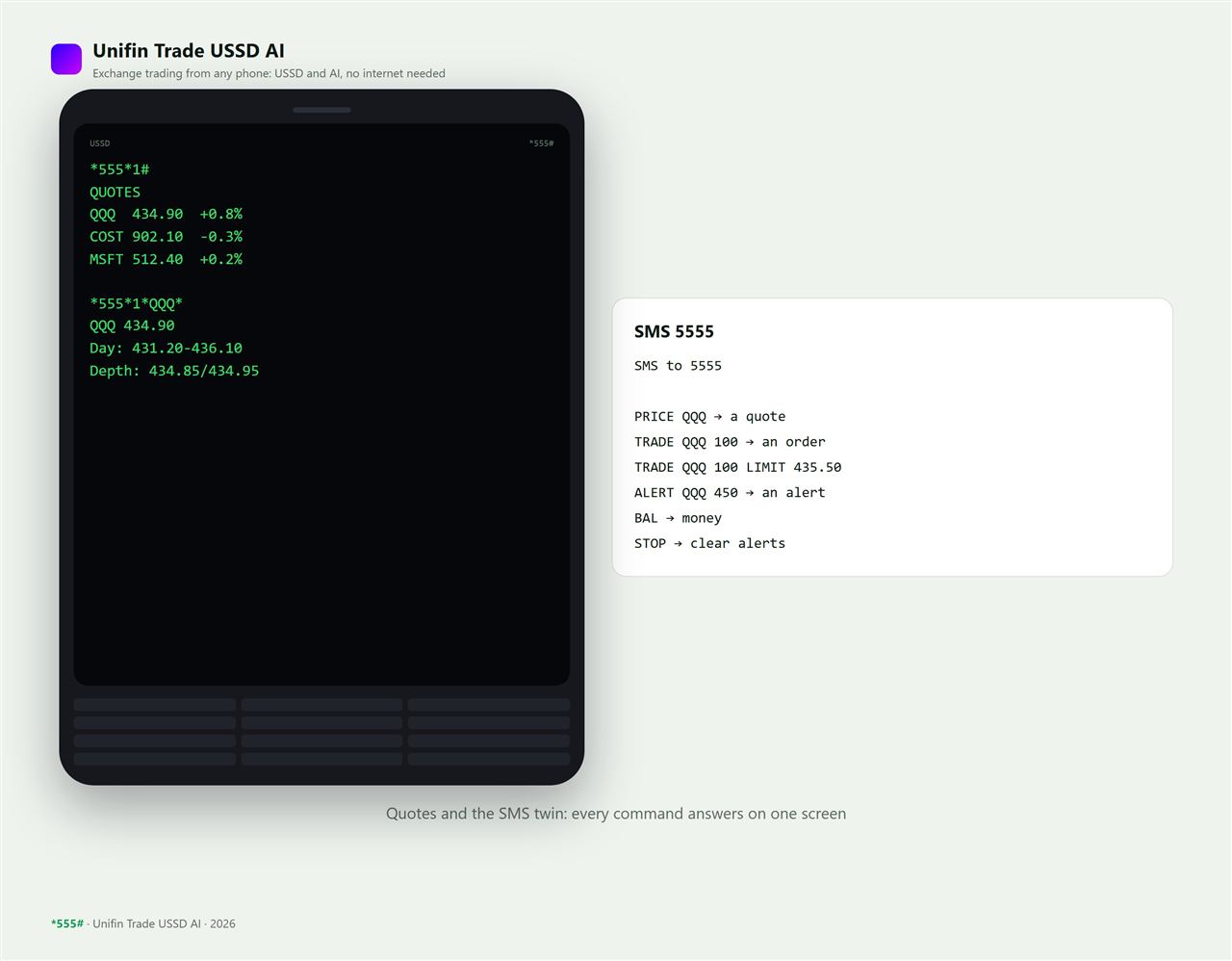
A USSD quotes screen next to the SMS command set
Quotes and the SMS twin: commands answer on one screen
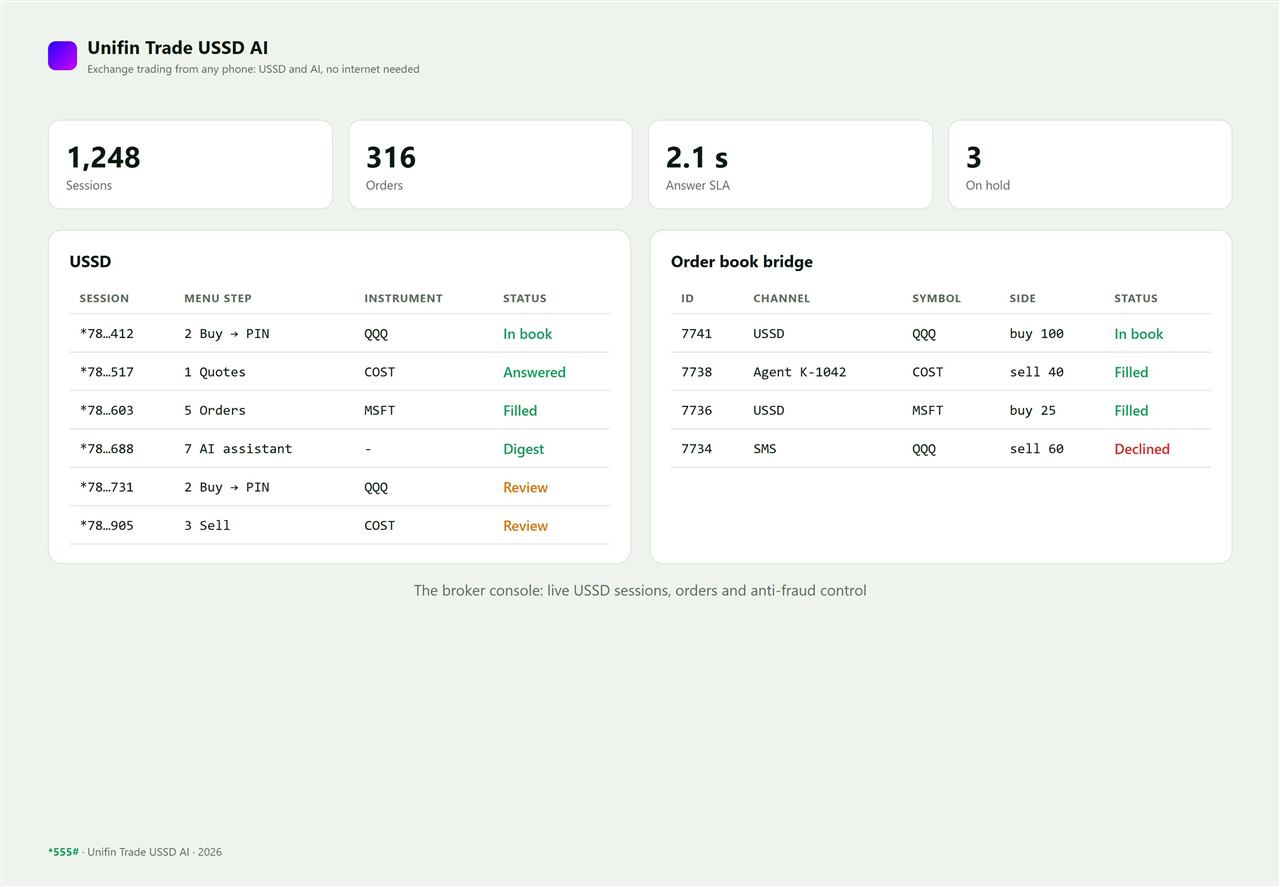
The session console with tables of sessions and orders
The broker console: live USSD sessions, orders and anti-fraud control
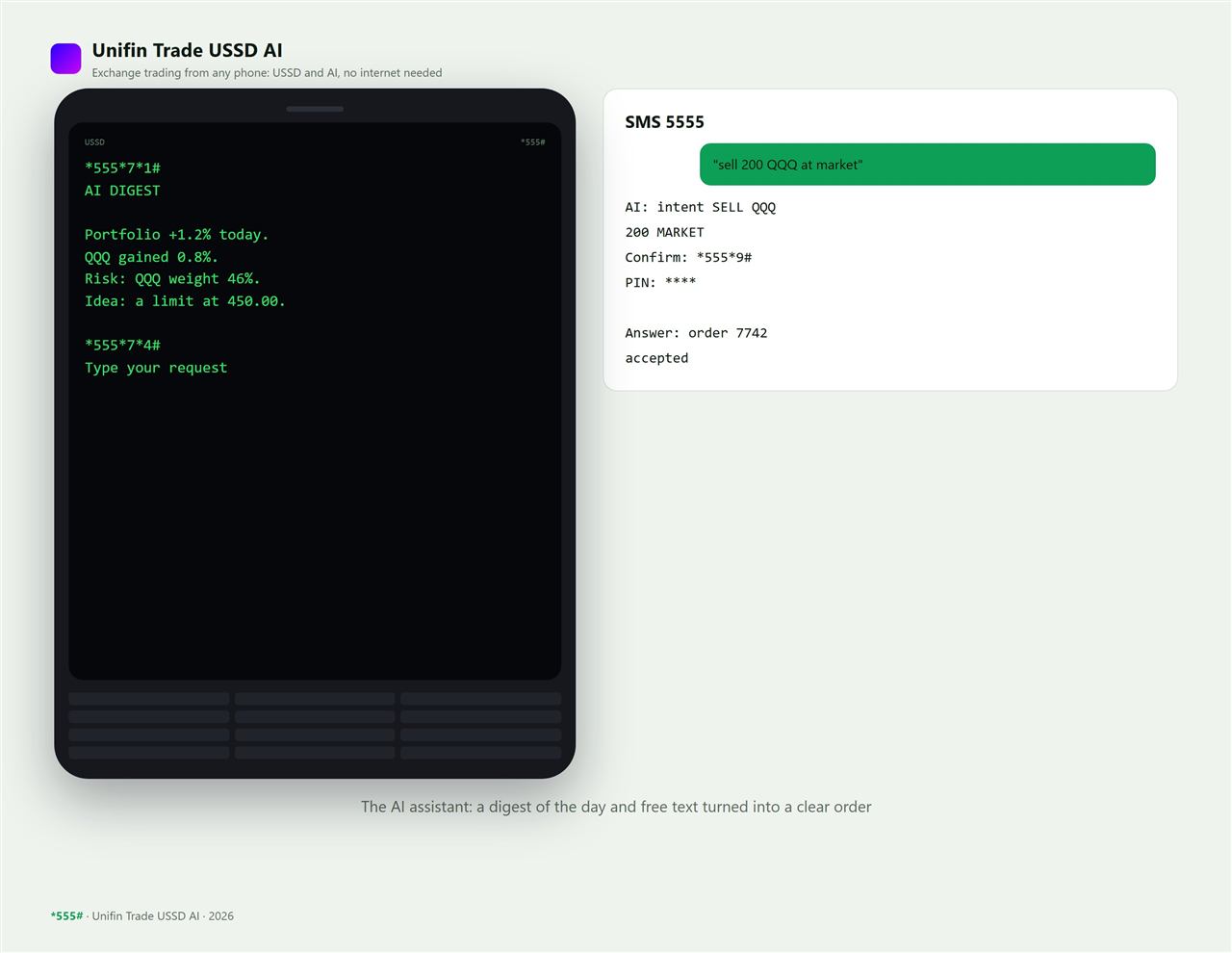
An AI digest screen and a free-text order parsed into an intent
The AI assistant: a digest and free text turned into an order
The bound-number entry screen and a price alert setup
Entry by a bound number and alerts: a session opens for a confirmed binding

How it works

From a dialled code to a receipt in five steps

The path of a holder order: dial, quote, order, AI check, receipt.

  1. 1

    The code is dialled

    The holder dials *555#; the session opens on any phone.

  2. 2

    The quote answers

    *555*1*QQQ# returns the card and the depth.

  3. 3

    The order is placed

    *555*2*QQQ*100*2*435.50# passes limits and asks for the PIN.

  4. 4

    AI checks the intent

    Wording becomes a read-back intent; unusual sessions go on hold.

  5. 5

    The receipt arrives

    The fill is confirmed by USSD flash and SMS.

Industries

Industries it serves

The suite serves banks and agent networks, brokers, exchanges and CSDs, and asset managers reaching retail clients.

Broker / investment firm

Client access and risk control on the same rails as the venue: terminals, mobile and pre-trade limits.

Bank / payments

Settlement, payments and custody services for the market around the trading core.

Architecture

Architecture and access

The architecture rests on the ussd-ms channel service. It runs on port 8236 with sessions in Redis; trading-ms holds orders, market-data-ms quotes and payment-ms money.

The ussd-ms channel service

Entry adapter, menu engine and sessions in Redis; ussd-ms never holds money.

External suites stay external

A USSD aggregator, mobile money, the exchange and the KYC provider connect as channels.

Multi-region and DR

Active-active sessions with replicas and a DR region for Tier-0; the gateway fails over.

Grow without touching the core

A new command, language or agent joins through configuration: the core stays still.

AI layer

The AI layer turns wording into intents, drafts one-screen digests and flags unusual sessions.

Architecture scheme The same architecture as a standalone page. Open the diagram separately

Process scheme

Market participants in a *555# session

The holder, the agent and the broker console: session steps, menu branches and the access, risk and threshold controls.

Process scheme Solid arrows are session steps, dashed ones are messages and branches. Open the scheme separately

Readiness

Ready today, next in line

The base is in place; next: voice flows and more markets.

Ready today

  • The *555# tree with 24 commands and the SMS twin
  • Entry by a bound number and the quarantine of a fresh binding
  • Orders with limits and the PIN confirmation in session
  • The AI assistant: digests, free text and voice intents
  • The anti-fraud desk with holds and the session journal

Next in line

  • Multi-language voice flows and dialect support
  • Cross-market orders: bonds and FX on the same tree
  • Agent scoring and liquidity insights (roadmap)

Releases

Release history

Quarterly releases from the foundation of the platform (2020); the USSD suite launched in 2026.

2026 Q1

  • The *555# tree, quotes and the SMS twin.

2026 Q2

  • Orders with limits and the PIN confirmation in session.

2026 Q3

  • The AI assistant: digest, free text and the voice intent line.

2026 Q4

  • Multi-language voice flows and cross-market orders (plan).

Detailed description

Detailed description

The command reference, the AI cases and the delivery frame.

How the suite is assembled

Channels and clients
FIX 4.2 / 4.4 / 5.0, REST with mTLS, SFTP files, web portals
Edge and access
API gateway with 126 routes, Keycloak single sign-on, WAF and CSP
Platform core services
ussd-ms the menu engine market-data-ms trading-ms payment-ms · money port confirmation-ms AI agentic layer Services of the suite on the shared platform core
Data and events
PostgreSQL 17 per service, Redis 7, RabbitMQ 3.13 quorum queues, transactional outbox
Results and reporting
Portals, reports, regulator and partner channels

The USSD gateway and sessions

  • The session opens on *555# from any phone: feature phones, shared phones and phones without data plans all work.
  • A session lives 180 seconds; a step that stalls folds back to the menu without losing the typed parameters.
  • The entry is a port: the aggregator connects first; a direct MNO short code plugs in as another adapter without core changes. A dropped session resumes from the last confirmed step.
  • The router keeps USSD, SMS, IVR and push on one policy: one holder, one limit set, one journal.

The full command reference

  • The main tree: *555# with sections 1 quotes, 2 buy, 3 sell, 4 portfolio, 5 orders, 6 alerts, 7 AI, 8 money, 9 profile, 0 sign-in and binding.
  • Quotes: *555*1#; *555*1*QQQ# for the card; *555*1*QQQ*2# for depth; SMS PRICE QQQ without a session.
  • Orders: *555*2*QQQ*100*1# market buy; *555*2*QQQ*100*2*435.50# limit; *555*3* for sell; SMS TRADE QQQ 100 LIMIT 435.50.
  • Control: *555*5# the list; *555*5*7741# the status; *555*5*7741*9# the cancel; *555*4# portfolio and *555*8# money.
  • Alerts and AI: *555*6*QQQ*450#; *555*6*12*9#; *555*7*1# digest; *555*7*4# free text; the agent desk *556*1*K-1042#.

Orders and the exchange bridge

  • A parsed order passes holder limits, the daily value cap and the price collar before it leaves for the exchange.
  • The bridge speaks FIX 4.4: a market order answers with a fill or a rejection in one session step.
  • Limit orders rest in the book; the status is reachable by *555*5*7741# and the fill arrives by USSD flash.
  • The final screen of a session carries the order number and the status: in book, filled, declined or on hold.

Money, agents and the number binding

  • Money lives on the same tree: *555*8# the balance, *555*8*1# the top-up route, *555*8*2# a withdrawal request.
  • An agent places assisted orders on *556# under a client code; the client still confirms with a PIN.
  • The binding lives outside USSD: the number is confirmed in the participant web desk or at an agent point; *555*0# shows its status and a session opens only for a bound number.
  • Money runs through payment-ms: the mobile money port settles top-ups and withdrawals with idempotency per session operation and reconciliation of unknown outcomes.

The AI layer and its cases

  • Free text becomes an order: "sell 200 QQQ at market" turns into a read-back intent and a PIN request on *555*9#.
  • Voice on the IVR line 5557: the AI recognises the intent, reads it back and moves the confirmation into USSD.
  • The digest *555*7*1# fits the day into one screen: portfolio move, the leader, concentration risk and one idea.
  • Anti-fraud: the AI holds a session on SIM-swap signs, a changed pattern or an unusual size until the desk approves.
  • Typos and mixed languages are read as intent: "*555*2*QQQ*апельсин#" returns a clarification step, not a dead end.

Security and compliance

  • The PIN enters inside the session, never in the dial string; five misses block money steps for thirty minutes (the auth-ms brute-force pattern) and above thresholds the operation steps up to a one-time code through confirmation-ms.
  • The number binds only outside USSD; a fresh binding sits in quarantine, and money steps fail closed when checks or limits are unavailable.
  • Every step carries a signed session token; a replayed or spoofed step is rejected by the core.
  • The journal keeps sessions, orders, holds and approvals for five years; exports are signed for audit.
  • Supervisor reports leave on schedule: order flow, complaint cases and the anti-fraud register.

Stack and scale

  • Runtime: Java 21, Spring Boot 3.5; ussd-ms (port 8236, the ussd_ms schema) keeps sessions in Redis and journals in PostgreSQL 17.
  • Connectivity: the USSD entry port (an aggregator first, a direct MNO adapter next), the mobile money providers, FIX 4.4 to the exchange, ISO 20022 and the agent card rails to the bank.
  • Scale: stateless session pods in three zones; a gateway failover reassigns sessions without losing the day.
  • Observability: step latency and drop-off by menu section, hold reasons and alert delivery metrics stay on one board.
Detailed description

Leave your contacts to open the detailed description and download the PDF with architecture, cases and delivery details.

Ask about USSD trading

Bring one holder journey or one agent point. We show the path from *555# to a filled order and from a binding to the first trade.