UNIFINplatform

Solution

Unifin Fund Master

A fund earns on decisions, and decisions need the book and the price of execution.
The fund book, the algo order and the venue choice work as one circuit.
Valuation closes the day and breaks the result down by factor, with the residual published.

  • The fund book
  • Algo execution
  • Hybrid routing
All solutions

Live screens from the product terminals

Fund book screen with the position by asset class Fund book screen with the position by asset class Valuation and P&L screen with the factor breakdown Schedule screen with slice progress and child orders Schedule screen with slice progress and child orders
Demo Unifin Fund Master
Fund book
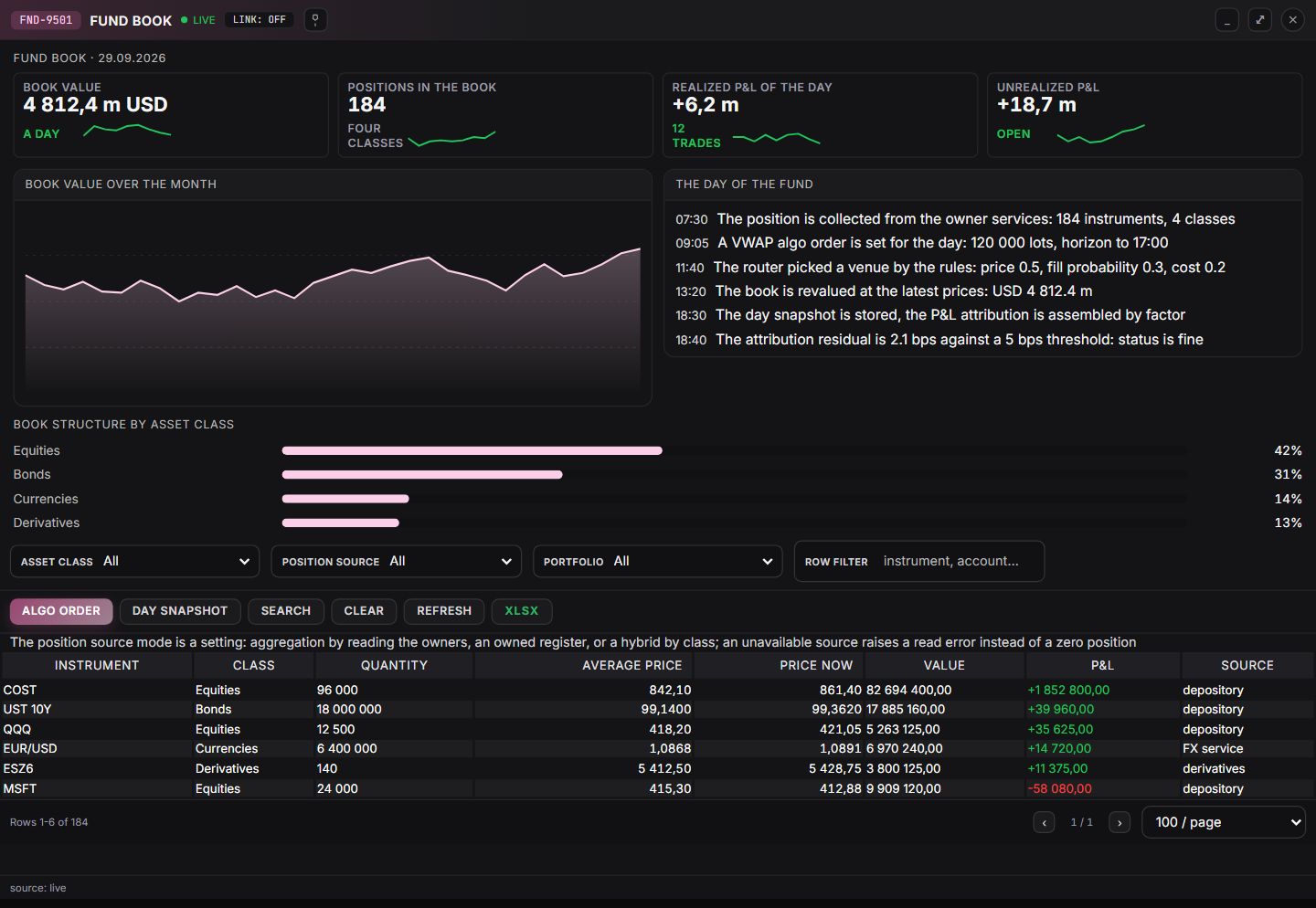
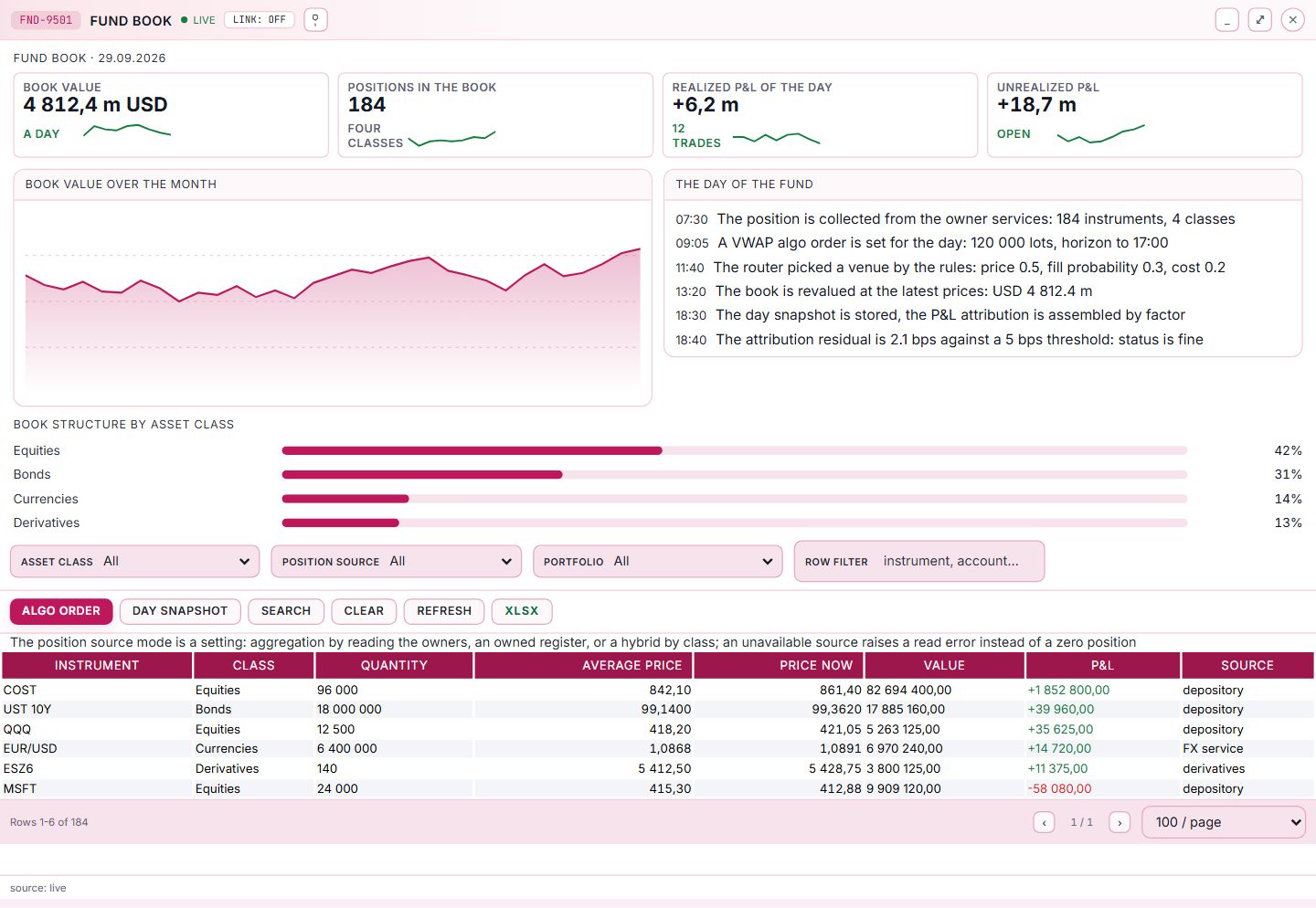
Fund book: the position by asset class, the book value of the month and the events of the day
Fund book
Fund book: the position by asset class, the book value of the month and the events of the day

This is an interface demonstration: the real solution will differ in colours and content for a specific project.

Functions at a glance

Business functions at a glance

From the fund book to the result of the day.

Fund book
Collects the position across asset classes from one answer
One position instead of assembled extracts
Algo execution
Slices a large order on a schedule and sends child orders
A large quantity filled without moving the price
Execution strategies
Runs VWAP by the volume profile, TWAP and POV
The execution style fits the task and the market
Hybrid routing
Picks a venue by the rules of reference data
A new venue connects without a release
Valuation and P&L
Values the book and computes the result of the day
The result of the day is ready at the close
Factor attribution
Breaks the result down by factor and publishes the residual
The client sees where the result came from
Limits and stops
Checks participation, price and size before execution
Nobody breaches a limit silently

What runs today

The fund circuit, already running

The book, the algo order and the result of the day.

Fund book

The position across classes is in one view.

Algo orders

The slicing schedule runs for the day.

Router

The venue choice runs by the rules of reference data.

Result

Valuation and the P&L of the day are part of the desk.

Factors

The factor breakdown runs with the residual in view.

Roadmap

Fund accounting and NAV publication stay out of scope.

Solution description

Capabilities and overview

Key features

  • The fund book across asset classes from a single answer
  • Algo orders with a slicing schedule: VWAP, TWAP and POV
  • Child orders to the trading service with an idempotent key
  • Stop conditions: a limit breach, a venue reject, thin liquidity
  • Hybrid routing: the own venue and external FIX sessions
  • Venue rules and weights kept in versioned reference data
  • Valuation, realized and unrealized P&L with FX revaluation
  • A P&L breakdown by factor with a published residual
  • Cross-factor disclosure: vanna, volga, rho, carry, cross-gamma
  • Fund limits on participation, price and size
  • Roles of traders, operators, portfolio managers and auditors
  • Audit of algo orders, router decisions and book operations

Product overview

Unifin Fund Master is the buy-side workstation of the UniFin platform for funds and asset managers.

The solution answers one question first: what position does the fund hold? The book comes from an owned register, from the owner services, or from a hybrid by asset class.

A large order is split on a schedule. VWAP follows the volume profile of the window. TWAP works in equal shares, and POV takes a share of the market volume.

Every slice goes to a venue picked by the rules of reference data. Connecting an external session or changing the weights needs no release.

The day closes with valuation, realized and unrealized P&L, FX revaluation and a factor breakdown; the residual is published instead of smoothed.

What it delivers

What the solution delivers

Fund book

A fund position is usually assembled by hand from several systems, and the gaps show up at reconciliation. The solution returns the book in one answer with the source of every part and the time of collection. With the solution the position is visible the moment it is asked for, and no silent zero hides a missing source. In setup the source mode is a setting: an owned register, aggregation by reading the owners, or a hybrid by asset class.

Algo execution

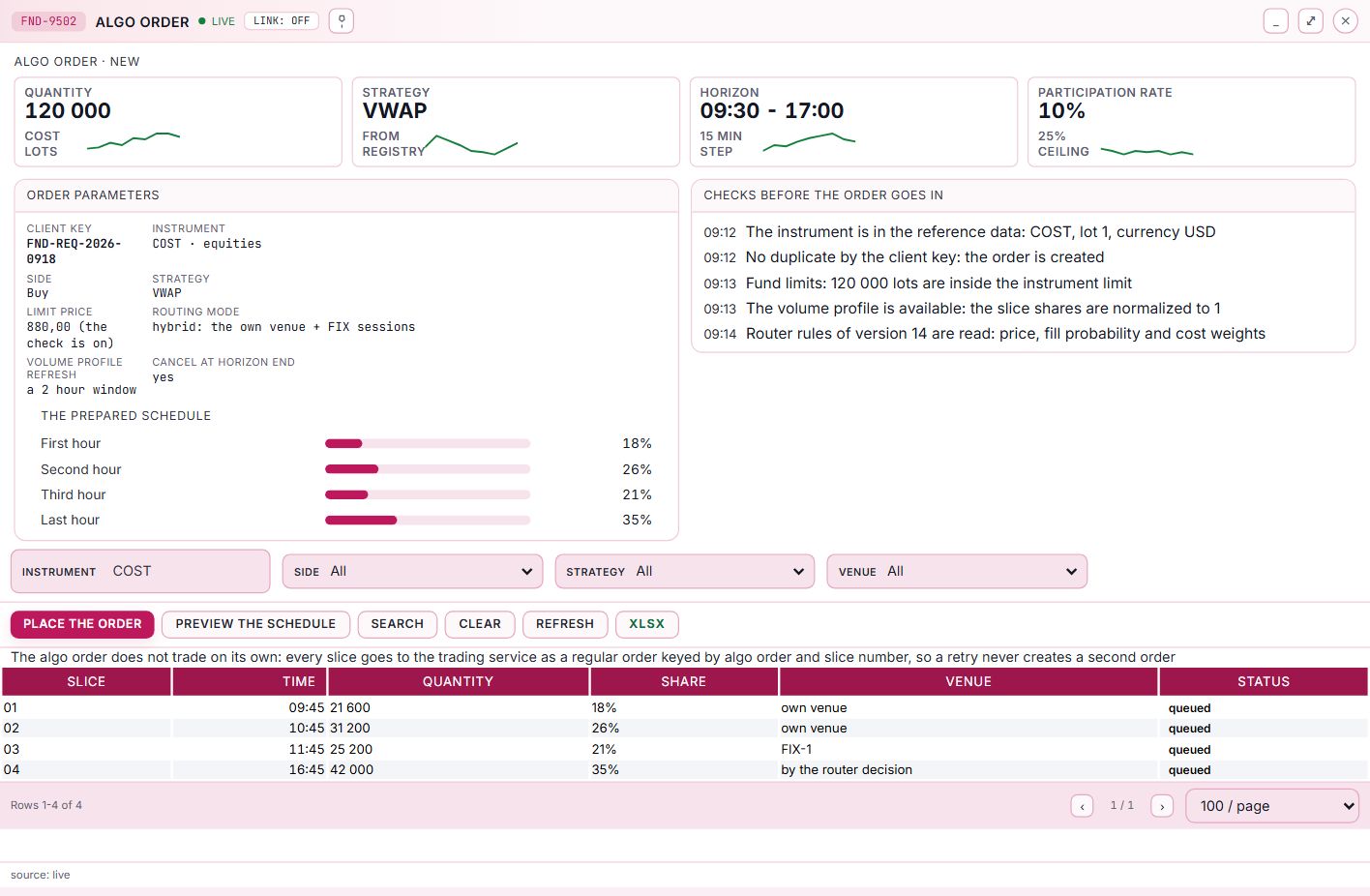
A large order sent as a single trade moves the price against the fund. The solution slices the order on a schedule and sends child orders to the trading service, keeping the average price under control. With the solution a large quantity fills close to the market price, and the slice journal shows how. In setup the slice step, the horizon, the participation rate and the retries come from configuration. Every slice carries an idempotent key.

Execution strategies

One execution style fits every order equally badly. The solution runs VWAP by the volume profile of the window. TWAP works in equal shares, and POV takes a share of the market volume. With the solution more volume trades where the market trades more, and the style changes with the task. In setup the strategy comes from a registry and the volume window is a setting. A zero profile falls back to an even distribution with an explicit flag.

Hybrid routing

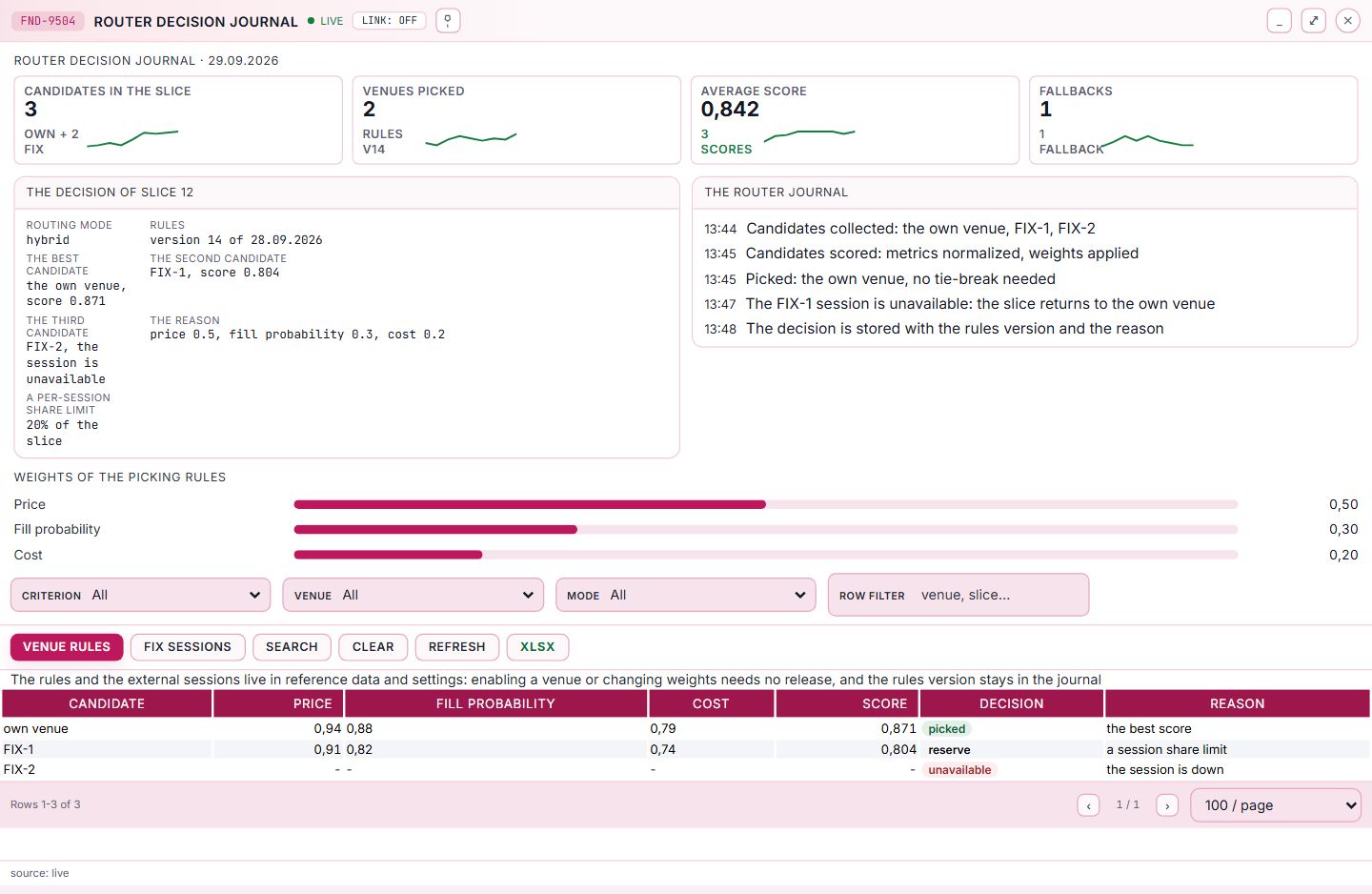
The choice between the own venue and an external one is usually hardcoded, and a new session becomes a project. The solution keeps venue rules in reference data and scores candidates by price, fill probability and cost. With the solution a session connects in days, and every decision is explainable after the fact. In setup the weights, the sessions and the fallback to the own venue are configuration. The rules version stays in the decision journal.

Valuation and P&L

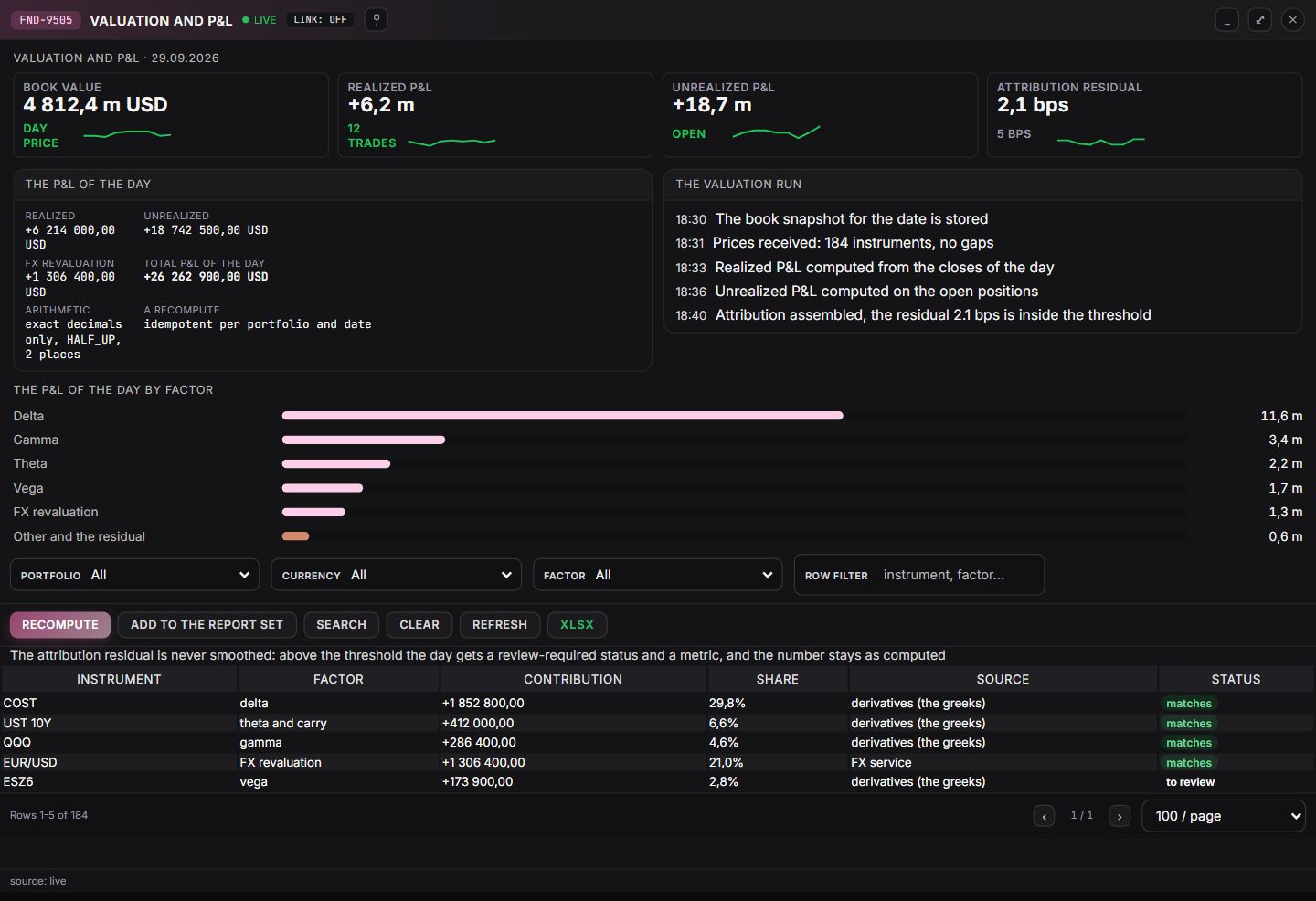
The result of the day usually appears a day later, when nothing can be fixed. The solution values the book at the latest prices and computes the realized and unrealized result with FX revaluation. With the solution the result of the day is visible at the close. A missing price fails the run instead of returning a zero. In setup the valuation time, the rounding and the recompute schedule are settings, and a recompute never doubles the day.

Factor attribution

A result without a breakdown cannot be explained to a client. The solution spreads the P&L of the day across delta, gamma, theta, vega, FX and carry. It publishes the part it cannot explain. With the solution the client sees where the result came from. The unexplained part is a metric rather than a hidden number. In setup the residual threshold decides when a day needs review, and the factor set is configuration.

Limits and stops

A limit usually comes to mind after the trade, when the breach has already happened. The solution checks participation, price and size before the order goes in, and pauses execution with a reason. With the solution execution stays inside the risk boundaries, and every stop leaves a trace. In setup the limits, the retries and the per-session share come from configuration, and a cancel cascades over the unfilled slices.

Coverage

What it covers

One route: the book, the algo, the venue, the result.

Fund book

Positions by instrument, class and currency, with the source of each part.

Position source

An owned register, aggregation from the owners, or a hybrid by class.

Algo order

The parent order, the strategy, the horizon, the price limit, the rate.

Slicing schedule

VWAP by the volume profile, TWAP in equal shares, POV at a rate.

Child execution

Child orders to the trading service, aggregates, retries and stop conditions.

Hybrid router

Venue rules with weights, external FIX sessions, a fallback, a journal.

Valuation and P&L

Book valuation, realized and unrealized results, FX revaluation and a snapshot.

Factors and limits

A breakdown by factor, cross-effects behind a flag, fund limits.

Stand

Screens of the solution

The fund book, the algo order and the valuation of the day.

Fund book screen with the position by asset class
Fund book: the position by asset class, the book value of the month and the events of the day
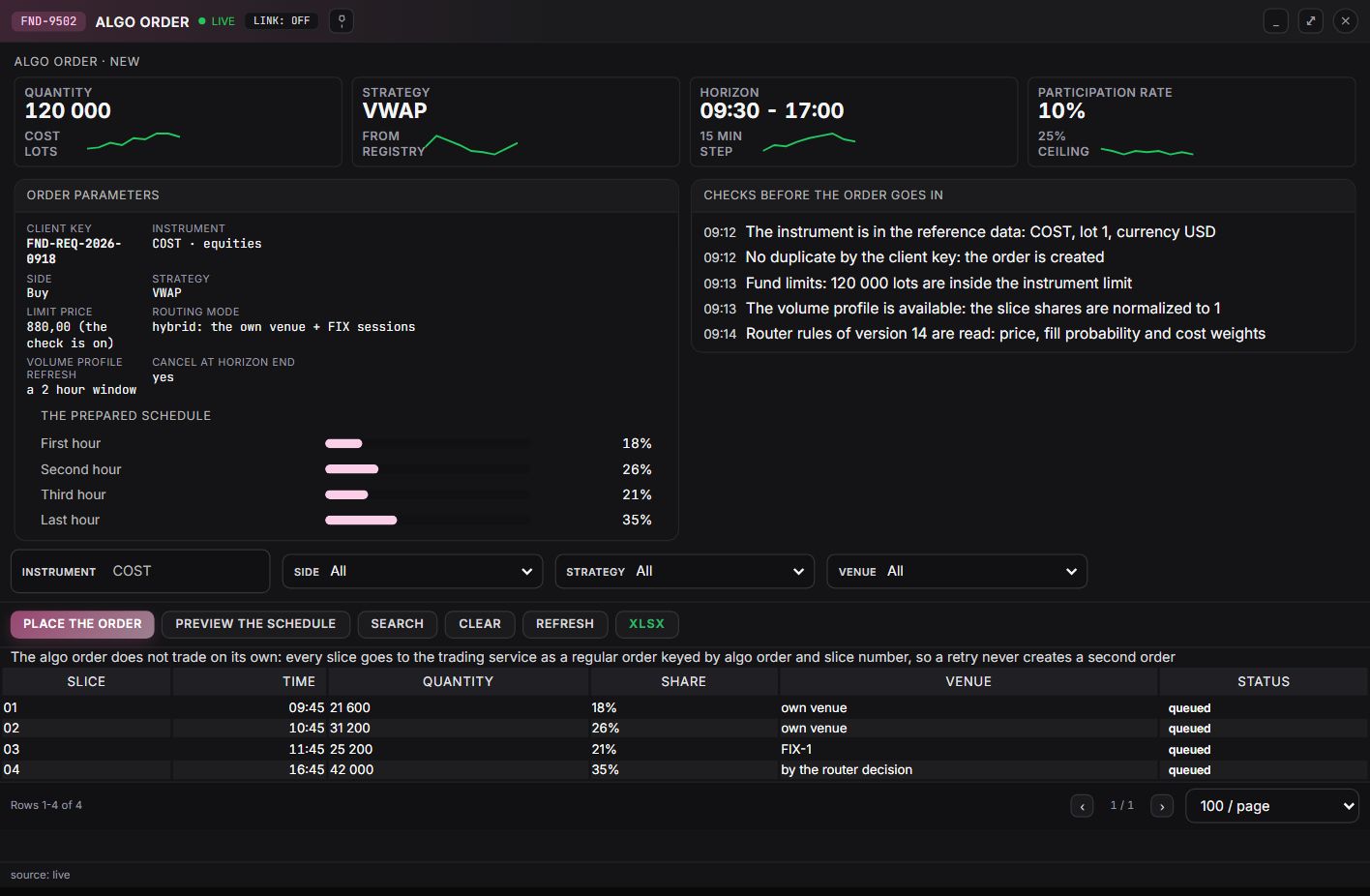
Algo order entry screen with the slicing schedule
Algo order entry: the parameters, the prepared slicing schedule and the checks before placement
Schedule screen with slice progress and child orders
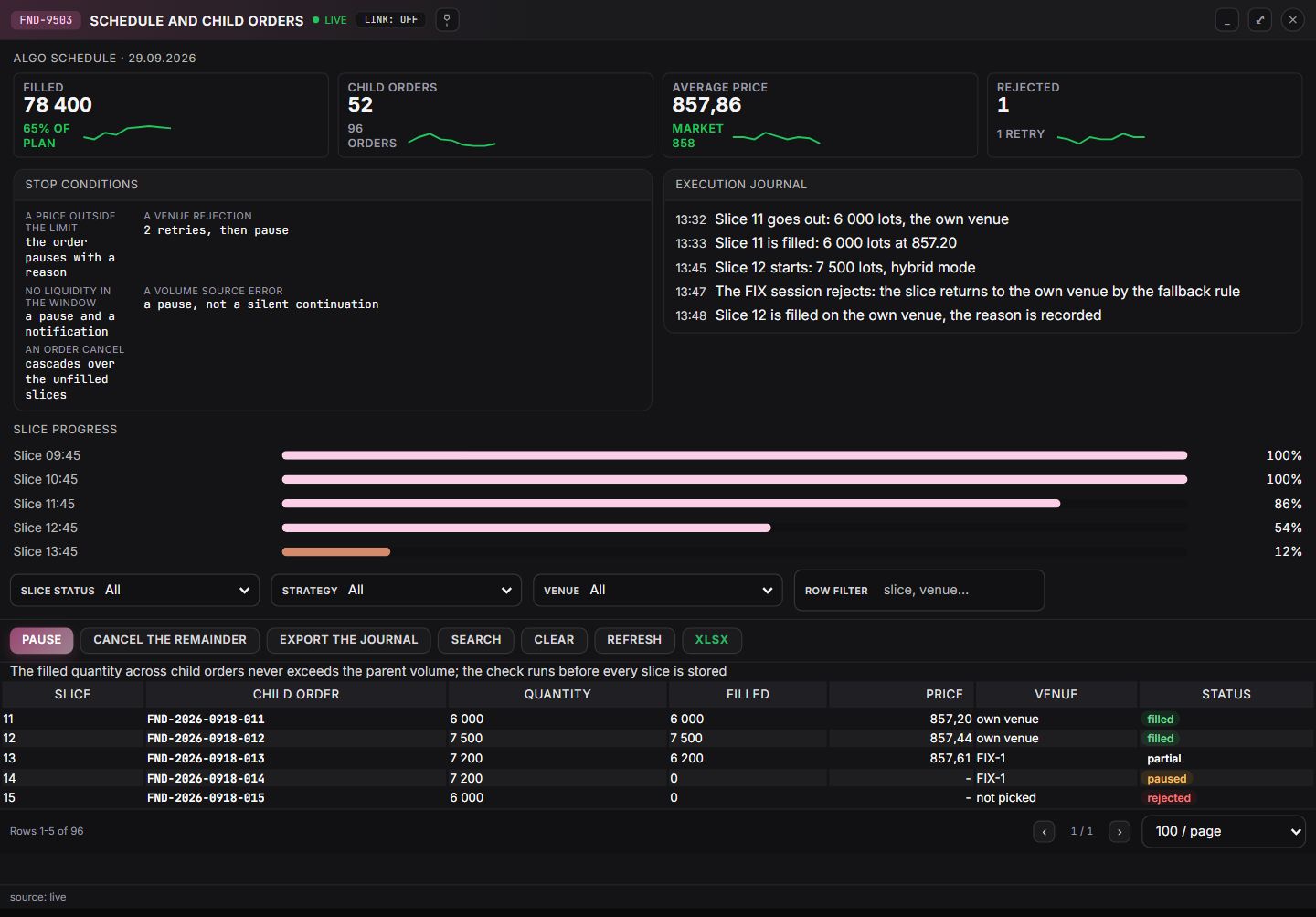
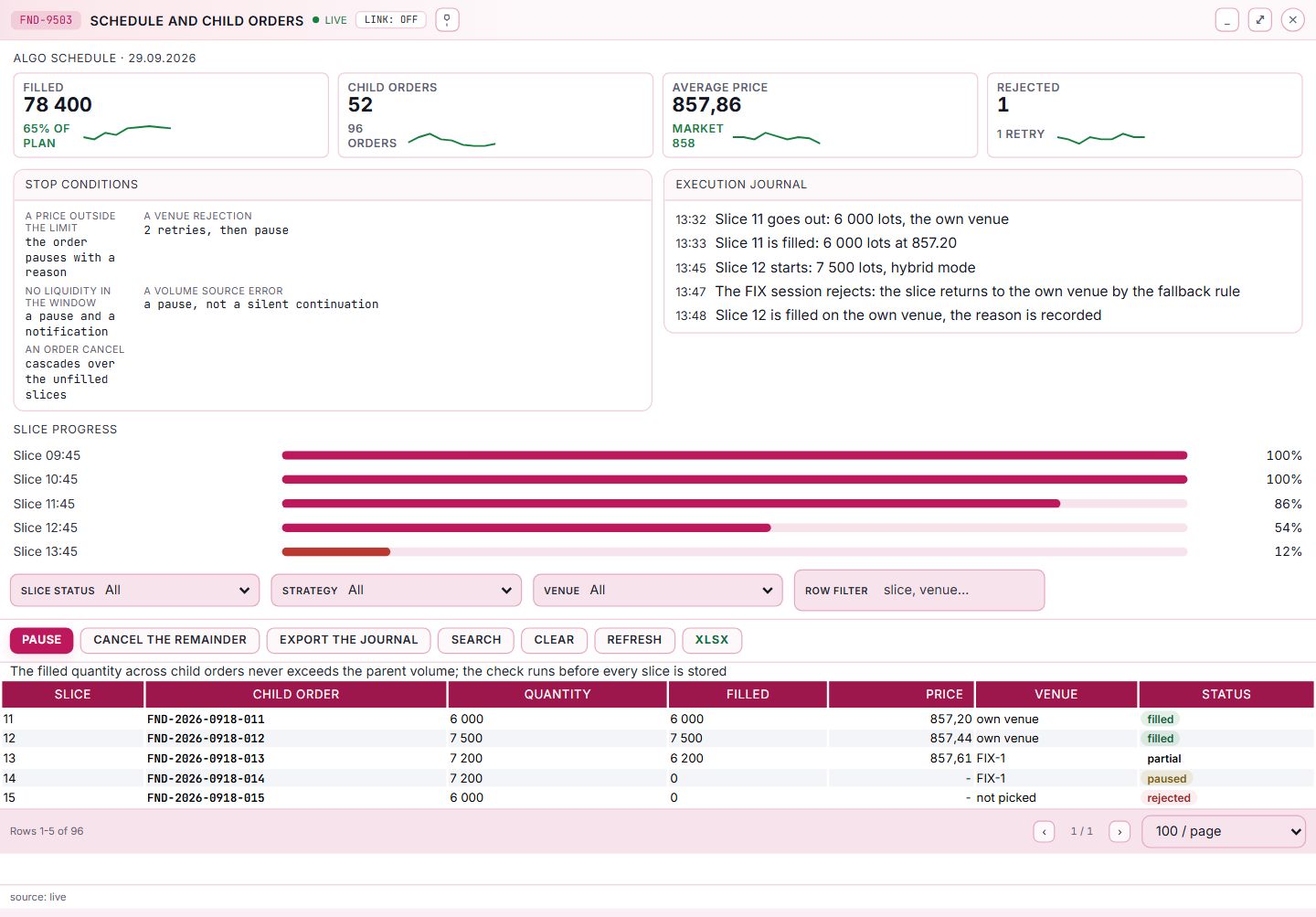
Schedule and child orders: slice progress, stop conditions and the execution journal
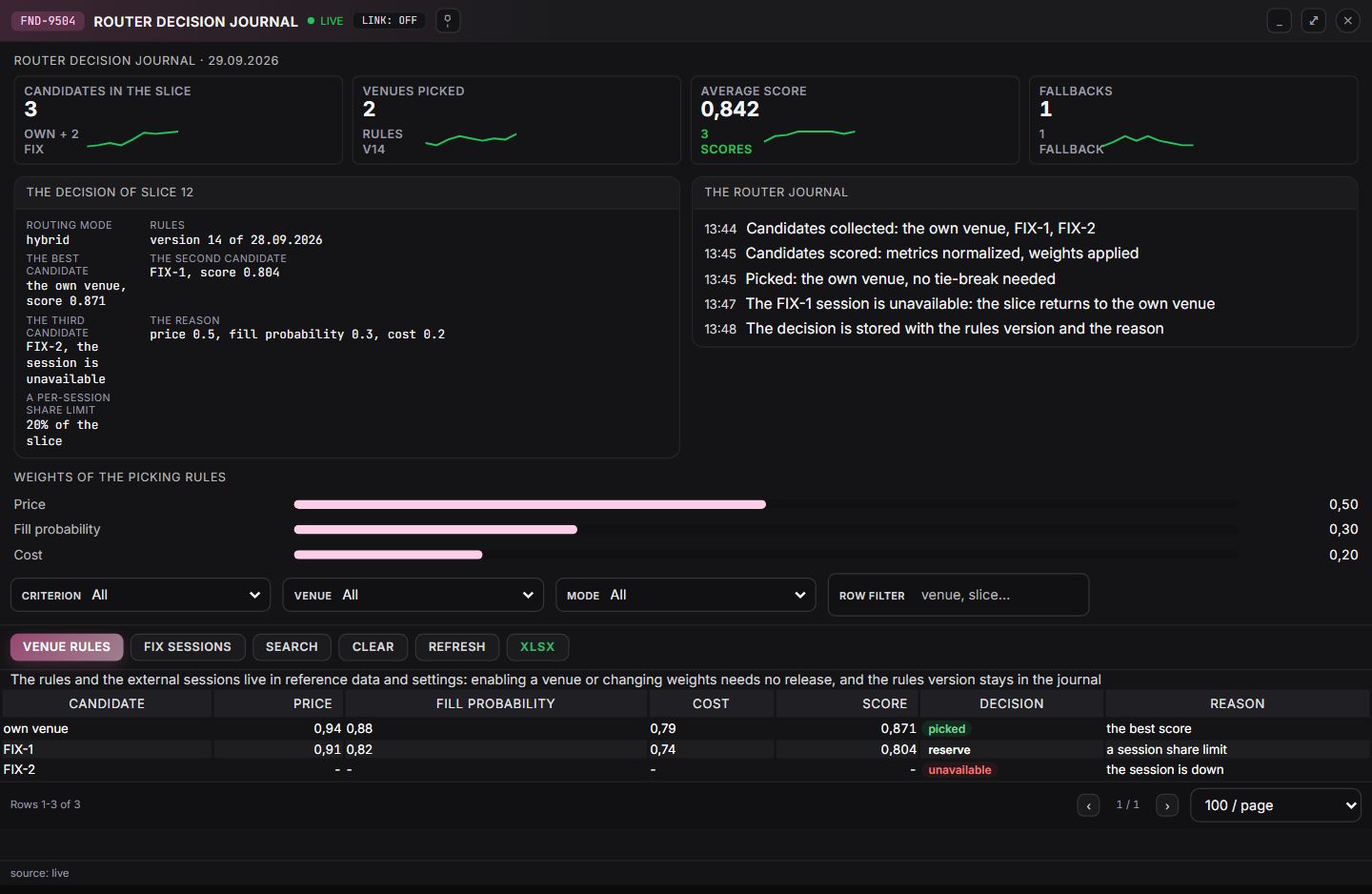
Router decision journal screen with venue candidates
Router decision journal: the rule weights, the decision of a slice and the venue candidates
Valuation and P&L screen with the factor breakdown
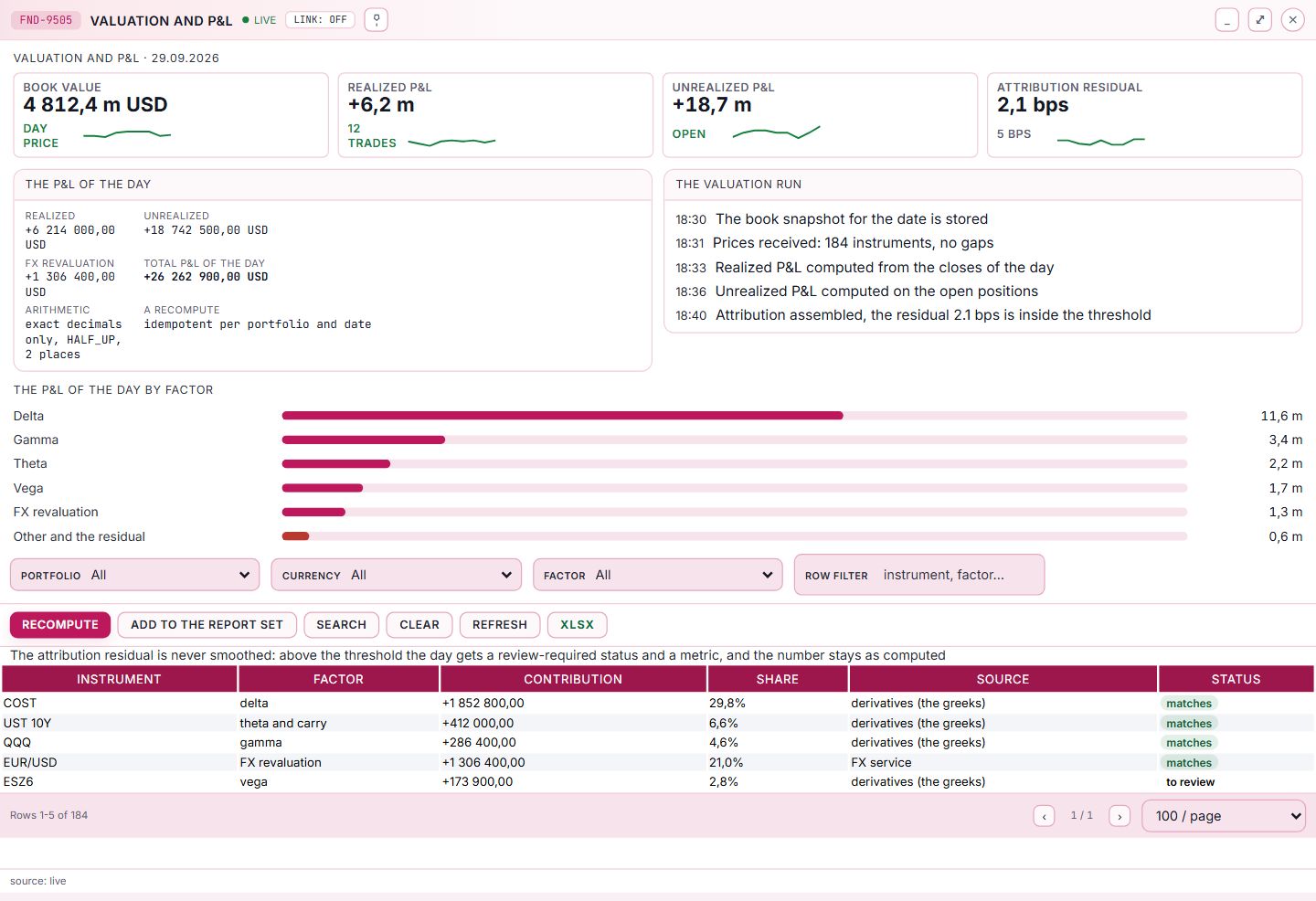
Valuation and P&L: the composition of the result of the day, the factor breakdown and the attribution residual
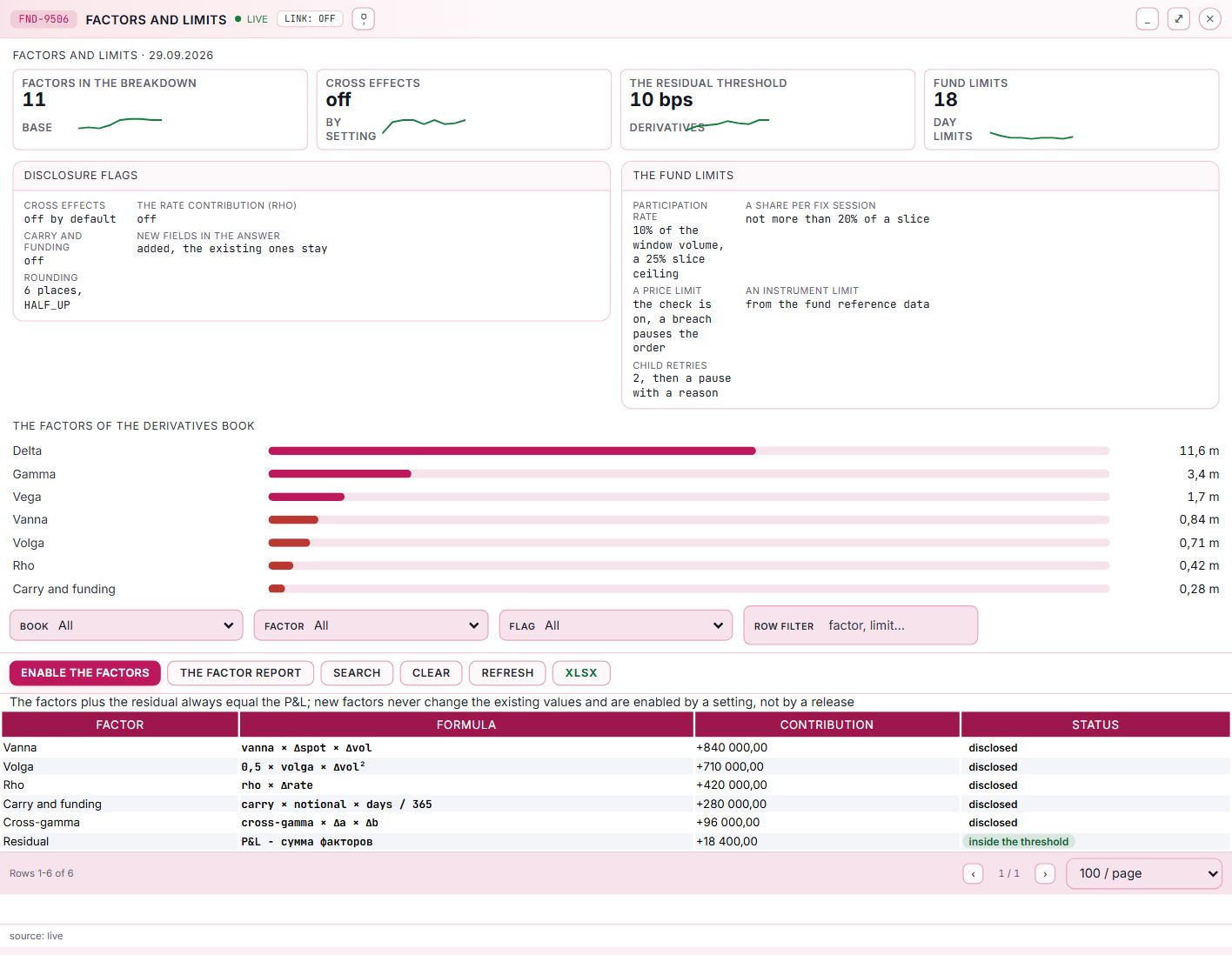
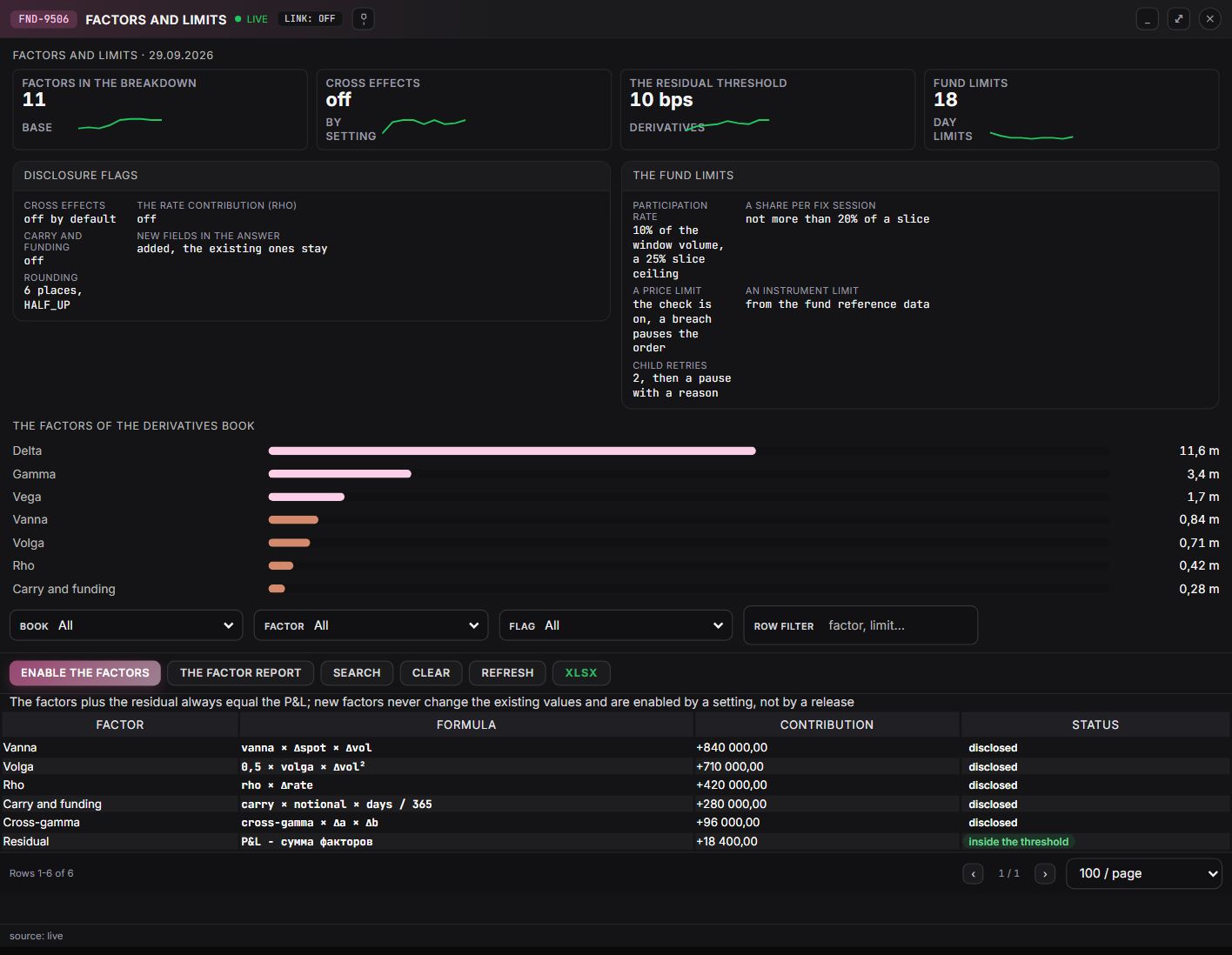
Factors and limits screen with cross-factor formulas
Factors and limits: the cross-factor disclosure with formulas, the enable flags and the fund limits

How it works

From a book to a factor breakdown in five steps

One fund day: the book, the algo order, the venue, the result.

  1. 1

    The book is consolidated

    The position is collected by class; every part names its source.

  2. 2

    The algo order is placed

    The schedule is built, the checks pass, the slices are ready.

  3. 3

    The venue is picked

    Candidates are scored by the rules; the decision carries a reason.

  4. 4

    The result is computed

    The book is valued, the realized and unrealized results are split.

  5. 5

    The day is explained

    The factor breakdown sums to the result; the residual is published.

Industries

Industries it serves

The solution serves asset managers and funds first. It also serves brokers executing client orders, family offices and in-house investment desks.

Broker / investment firm

Client access and risk control on the same rails as the venue: terminals, mobile and pre-trade limits.

Bank / payments

Settlement, payments and custody services for the market around the trading core.

Asset manager / fund

Analytics, indices and hedging instruments for portfolio and research teams.

Architecture

Architecture and access

The buy-side core: the book, algo execution, the router and the result of the day.

Service suite

The algo service, the portfolio service, the fund portal and the gateway.

Reuse of the platform

The trading service, market data, reference data and the FIX gateway are reused through their contracts.

No money on the path

Execution never creates money or writes to the ledger. The only output is an order.

Extend without touching the core

A venue, a strategy or a factor joins through reference data and a flag.

AI layer

The AI layer drafts the execution note and flags a residual above the threshold.

Architecture scheme The same architecture as a standalone page. Open the diagram separately

Readiness

Ready today, next in line

Next: portfolio optimisers and a deeper client reporting.

Ready today

  • The fund book from one answer with a source breakdown and a day snapshot
  • Algo orders with VWAP, TWAP and POV and child orders to the trading service
  • Hybrid routing across the own venue and external FIX sessions
  • Valuation, realized and unrealized P&L and a breakdown by factor

Next in line

  • A portfolio-level execution optimiser across several algo orders
  • A deeper client reporting pack on the book and the result (plan)
  • More venue connectors and an execution quality report (roadmap)

Releases

Release history

Quarterly releases from the foundation of the platform (2020); the buy-side circuit launched in 2026.

2026 Q3

  • The fund book: the position across asset classes and the day snapshot.

2026 Q4

  • Algo orders with VWAP, TWAP and POV and child orders to the trading service.

2027 Q1

  • Hybrid routing: venue rules, external FIX sessions and the decision journal.

2027 Q2

  • The factor breakdown with cross-effects behind a flag (plan).

Detailed description

Detailed description

The module map, the execution rules and the delivery frame.

How the suite is assembled

Channels and clients
FIX 4.2 / 4.4 / 5.0, REST with mTLS, SFTP files, web portals
Edge and access
API gateway with 126 routes, Keycloak single sign-on, WAF and CSP
Platform core services
algo-ms portfolio-ms trading-ms market-data-ms derivatives-ms AI agentic layer Services of the suite on the shared platform core
Data and events
PostgreSQL 17 per service, Redis 7, RabbitMQ 3.13 quorum queues, transactional outbox
Results and reporting
Portals, reports, regulator and partner channels

Technology stack

Runtime and backend: Java 21 (LTS), Spring Boot 3.5.16, Spring Cloud 2025.0.3, Gradle, Flyway 10.15.

Data: PostgreSQL 17, Redis 7 with Sentinel, RabbitMQ 3.13 with the transactional outbox.

Execution formats: FIX 4.2/4.4/5.0 with the algo tags 847, 848 and 849; OpenAPI for every service.

Portals: Next.js 16.3.3, React 19, TypeScript 5; Onest typography and two themes; Keycloak 26.1 for OIDC sign-in.

Delivery: Kubernetes and Helm, Vault secrets, Prometheus and Grafana; on-premise deployment for funds.

Evidence by default: algo orders, router decisions, valuations and exports are journaled with the rules version.

Fund book

  • The book answers one question: what position does the fund hold? Positions come by instrument, asset class and currency.
  • The source mode is a setting: an owned register, aggregation by reading the owner services, or a hybrid by asset class.
  • Every answer carries the source of each part and the time of collection, and a partial book is marked as incomplete.
  • An unavailable source raises a read error with a code instead of a zero position, and the day snapshot reproduces the book for a date.

Algo execution

  • A parent algo order carries the instrument, side, quantity, strategy, horizon, price limit and participation rate.
  • The schedule splits the order into slices: VWAP follows the volume profile of the window, TWAP works in equal shares, POV takes a share of the market volume.
  • Every slice goes to the trading service as a regular child order with an idempotent key, so a retry never duplicates an order.
  • Stop conditions pause the order with a reason: a price outside the limit, a venue rejection after retries, no liquidity, a volume source error.
  • A cancel is cascading and idempotent: unfilled slices go with the parent, and the journal keeps the reason of every stop.

Hybrid router

  • The router picks a venue for every slice: the own venue and the external FIX sessions configured for the fund.
  • Candidates are scored by price, fill probability and cost; the weights sum to one and the order is deterministic by venue code.
  • The three modes internal, external and hybrid set the routing policy, and an unavailable external session falls back to the own venue with the reason recorded.
  • Rules and sessions live in reference data with a version: enabling a venue or changing the weights needs no release.

Valuation, P&L and attribution

  • The book is valued at the latest prices, and the result of the day is split into realized, unrealized and FX parts.
  • The factor breakdown spreads the result across delta, gamma, theta, vega, FX and carry; the greeks come from the derivatives service.
  • The part the factors cannot explain is published as a residual; above the threshold the day gets a review-required status.
  • Cross-effects of the derivatives book (vanna, volga, rho, carry, cross-gamma) are disclosed behind a setting and never change the existing values.
  • A recompute is idempotent per portfolio and business date, and a missing price fails the run instead of returning a zero valuation.

Limits and audit

  • Fund limits cover participation, price and quantity, and a share of a slice per external session.
  • Execution never creates money and never writes to the ledger: the only output of the algo service is an order to the trading service.
  • Algo orders, router decisions and book operations are journaled for audit, including the rules version of every decision.
  • External FIX clients send an algo instruction in tags 847, 848 and 849, and the attributes return in the execution report.

Architecture

  • Built on the platform core: algo-ms, portfolio-ms, trading-ms, market-data-ms and derivatives-ms behind a gateway.
  • The gateway keeps roles, routing and audit; a window knows only its own /api/v1 calls.
  • Venues, the FIX gateway and the market data store connect as transports and reference data.
  • Scaling adds nodes: PostgreSQL with replication, RabbitMQ quorum queues and Redis clusters; services stay stateless.
Detailed description

Leave your contacts to open the detailed description and download the PDF with architecture, cases and delivery details.

Ask about the buy-side circuit

We will show the path from the book to the algo order and from the venue choice to the result. We will also walk from the residual to a factor.