UNIFINplatform

Solution

Unifin Market Data Lense

Market data is a product business, and it must be accounted like one.
The suite keeps the catalogue, entitlements, delivery, usage and the money.
Every kilobyte has an owner and a price: invoices follow facts.

  • Product catalogue
  • Entitlements and delivery
  • Metering and billing
All solutions

Live screens from the product terminals

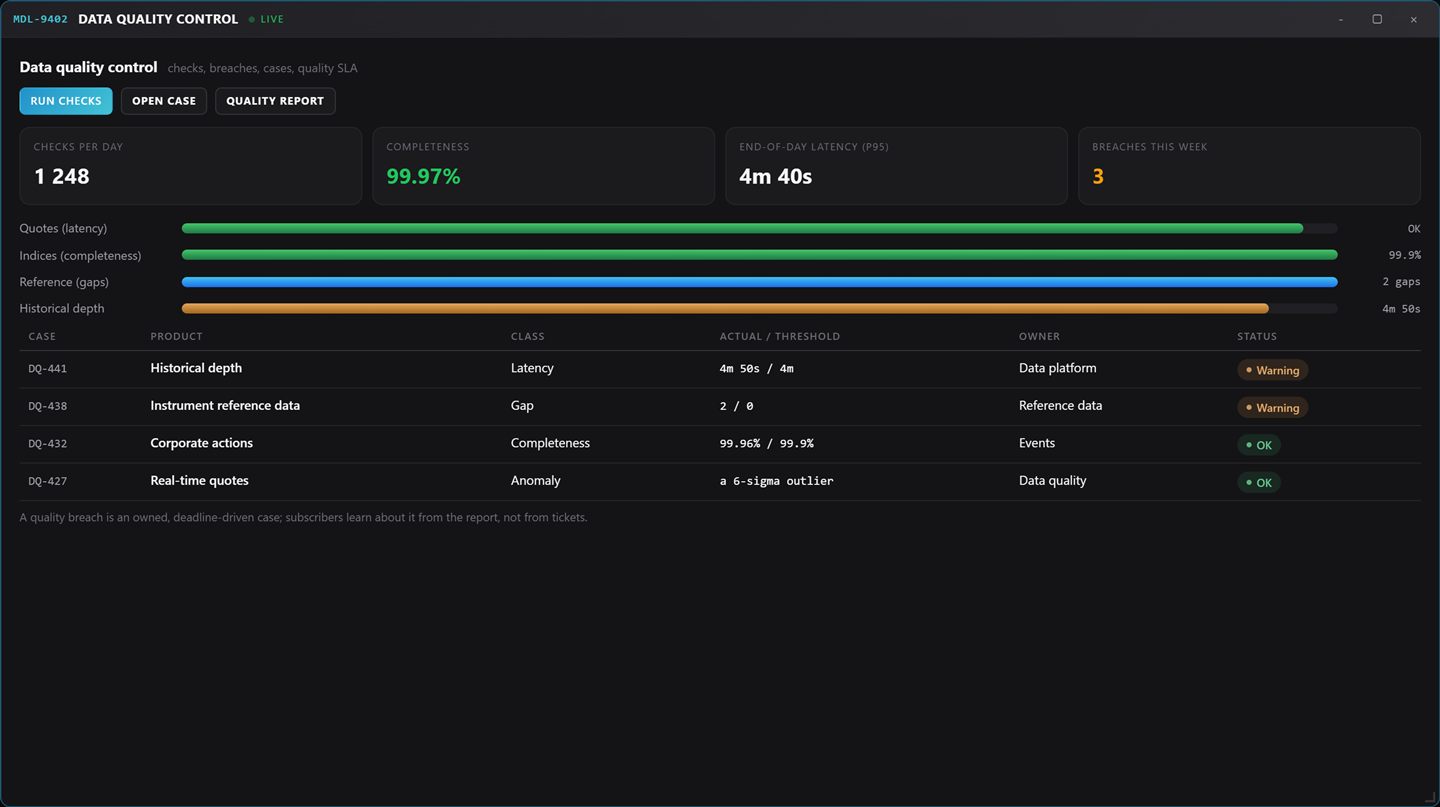
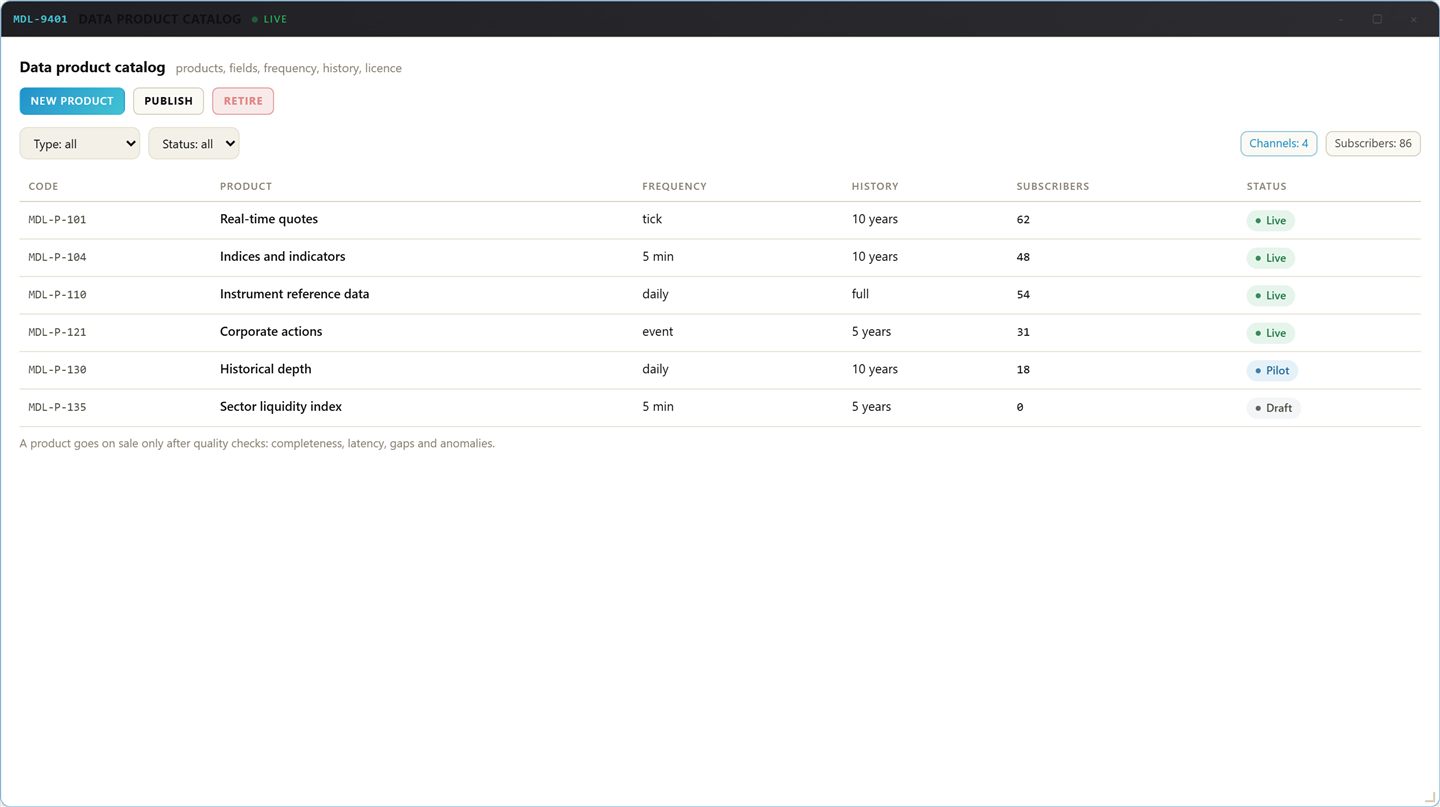
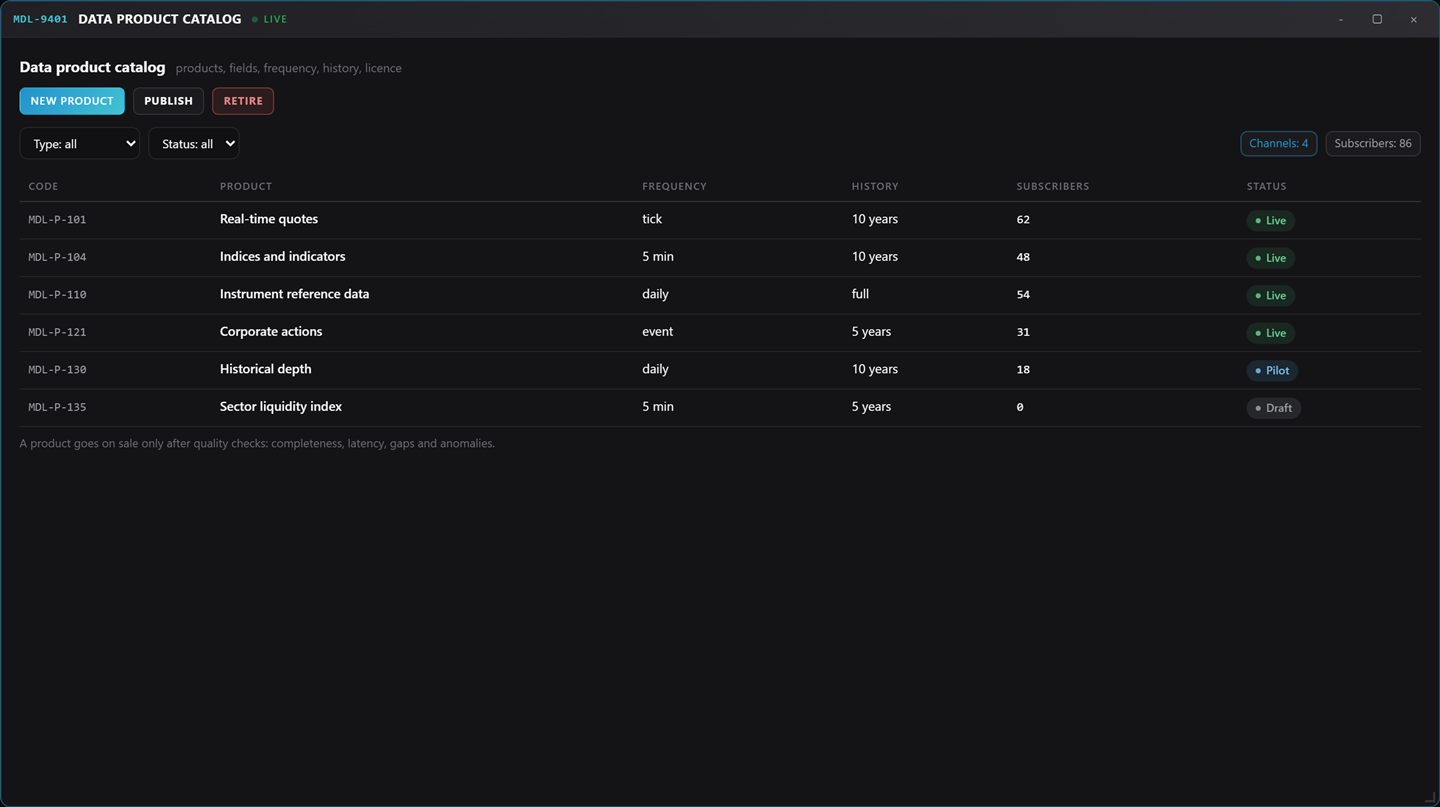
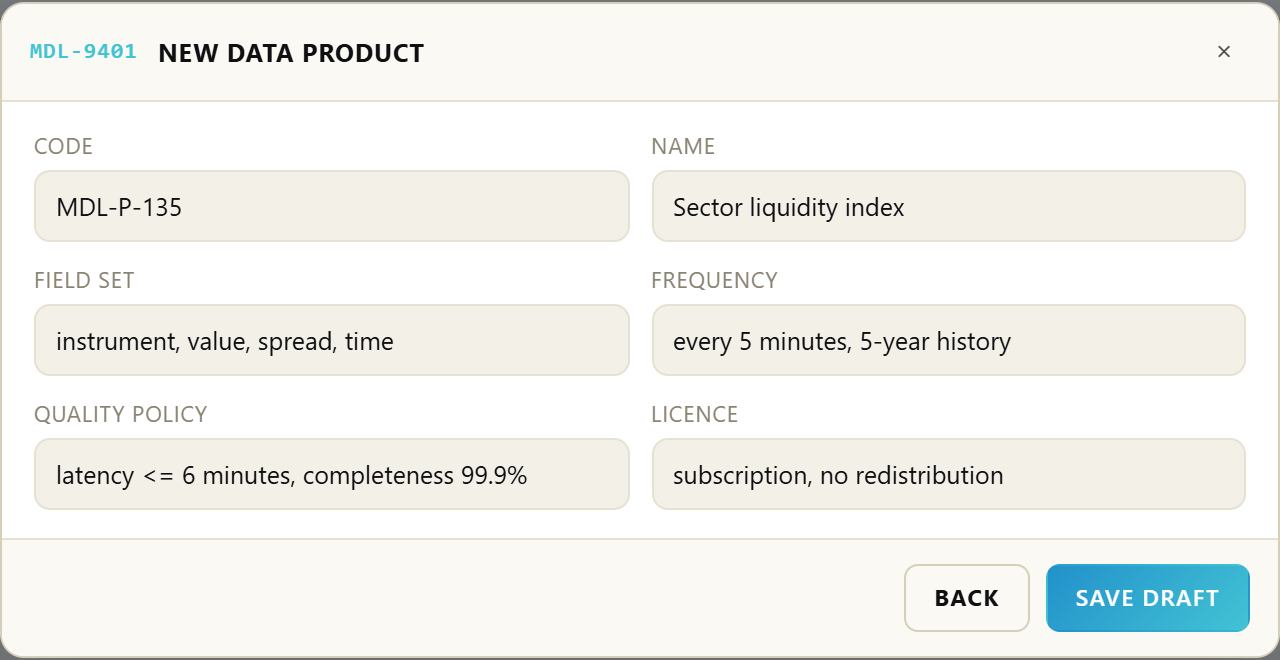
Feed quality control screen Feed quality control screen Market data product catalogue screen Market data product catalogue screen New data product: creating the feed and delivery parameters
Demo Unifin Market Data Lense
Product catalogue
Product catalogue: feeds, depth, latency and public codes
Product catalogue
Product catalogue: feeds, depth, latency and public codes

This is an interface demonstration: the real solution will differ in colours and content for a specific project.

Functions at a glance

Business functions at a glance

From the product catalogue to vendor reconciliation.

Product catalogue
Runs feed cards with codes and versions
A product becomes sellable through publication
Orders and subscriptions
Runs requests, contracts and renewals
Terms are clear for client and operator
Entitlements
Issues permanent and temporary rights with dates
The entitlement list stays clean
Delivery
Runs channels, sessions and redistribution
It is visible who consumes what, via which channel
Quality control
Catches gaps, delays and outliers of feeds
The incident opens before the consumer calls
Metering and billing
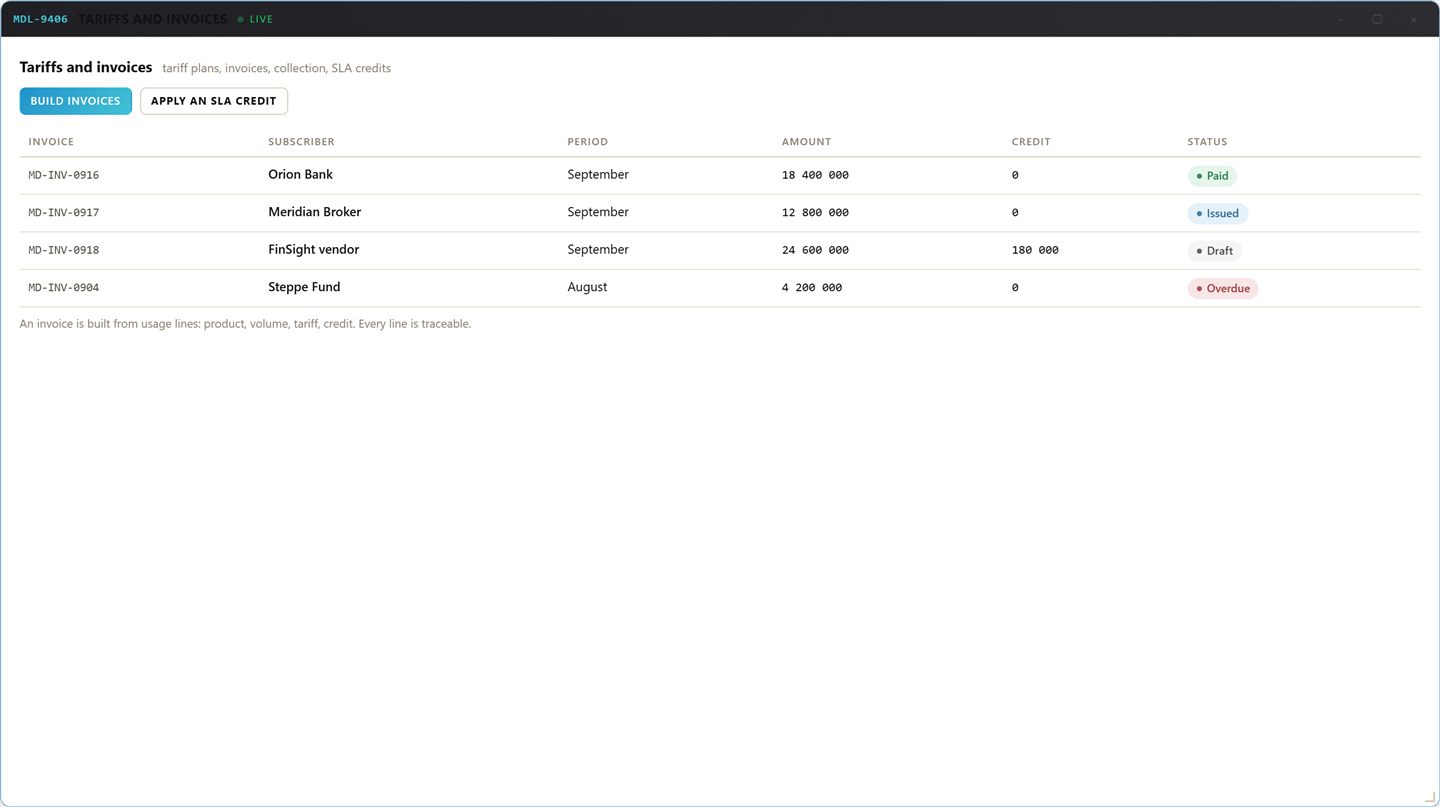
Counts consumption and forms the invoices
An invoice is explained by facts, not letters
Vendor reconciliation
Reconciles codes, volumes and amounts with vendors
Operator payments match the delivery

What runs today

Catalogue to invoice, already running

Catalogue to invoice: the live circuit.

Catalogue

The product catalogue manages changes.

Entitlements

Orders, subscriptions and entitlements are wired.

Delivery

Delivery and quality checks run in the circuit.

Metering

Usage metering counts every kilobyte.

Billing

Invoices follow facts and insights.

Roadmap

Redistribution packs are next.

Solution description

Capabilities and overview

Key features

  • Product catalogue: feed cards with codes and versions
  • Orders and subscriptions: requests, contracts and renewals
  • Entitlements: permanent and temporary rights with dates
  • Delivery: channels, sessions and redistribution
  • Quality control: gaps, delays and outliers
  • Consumption metering and invoices for data
  • Reconciliation of codes, volumes and amounts with vendors
  • A tariff engine for packages and delivery terms
  • Insight reports on consumption from a single source
  • Roles of vendor and consumer with separated access
  • Journal of orders, entitlements and deliveries
  • Deployment: by configuration, within the UniFin platform

Product overview

Unifin Market Data Lense is the UniFin platform market data business suite for exchanges, vendors and data consumers.

The suite keeps the catalogue, subscriptions, entitlements, delivery, consumption and the money: from a request to an invoice.

Every kilobyte has an owner and a price: invoices follow metering facts, and vendor reconciliation closes the period.

Quality control catches feed gaps and delays before a client notices them.

The solution runs standalone or as part of the UniFin platform and connects new feeds through adapters.

What it delivers

What the solution delivers

Product catalogue

The catalogue usually lives in presentations, and deal terms are clarified by e-mail. The solution runs feed cards with depth, latency, history window and a public code. With the solution the product sells with clear terms. In setup the versions and the four-eyes publication are visible, and the product composition comes as reference data.

Orders and subscriptions

Orders are usually accepted by e-mail, and the terms are retold from scratch. The solution runs requests, contracts, renewals and suspensions. With the solution the state of every subscription is visible, and renewals are not missed. In setup the entitlement classes and contract terms are visible, and the renewal rules come as reference data.

Entitlements

Entitlements are usually issued by hand, and forgotten access lives for years. The solution issues permanent and temporary rights with validity dates. With the solution there is no excess access. In setup the review report before renewal is visible, and the terms are set in configuration.

Delivery

Delivery is usually not tracked, and a channel overload surfaces through complaints. The solution runs channels, sessions and redistribution rules. With the solution it is visible who consumes what and through which channel. In setup connection states and the decision journal are visible, and the redistribution rules are configured per segment.

Quality control

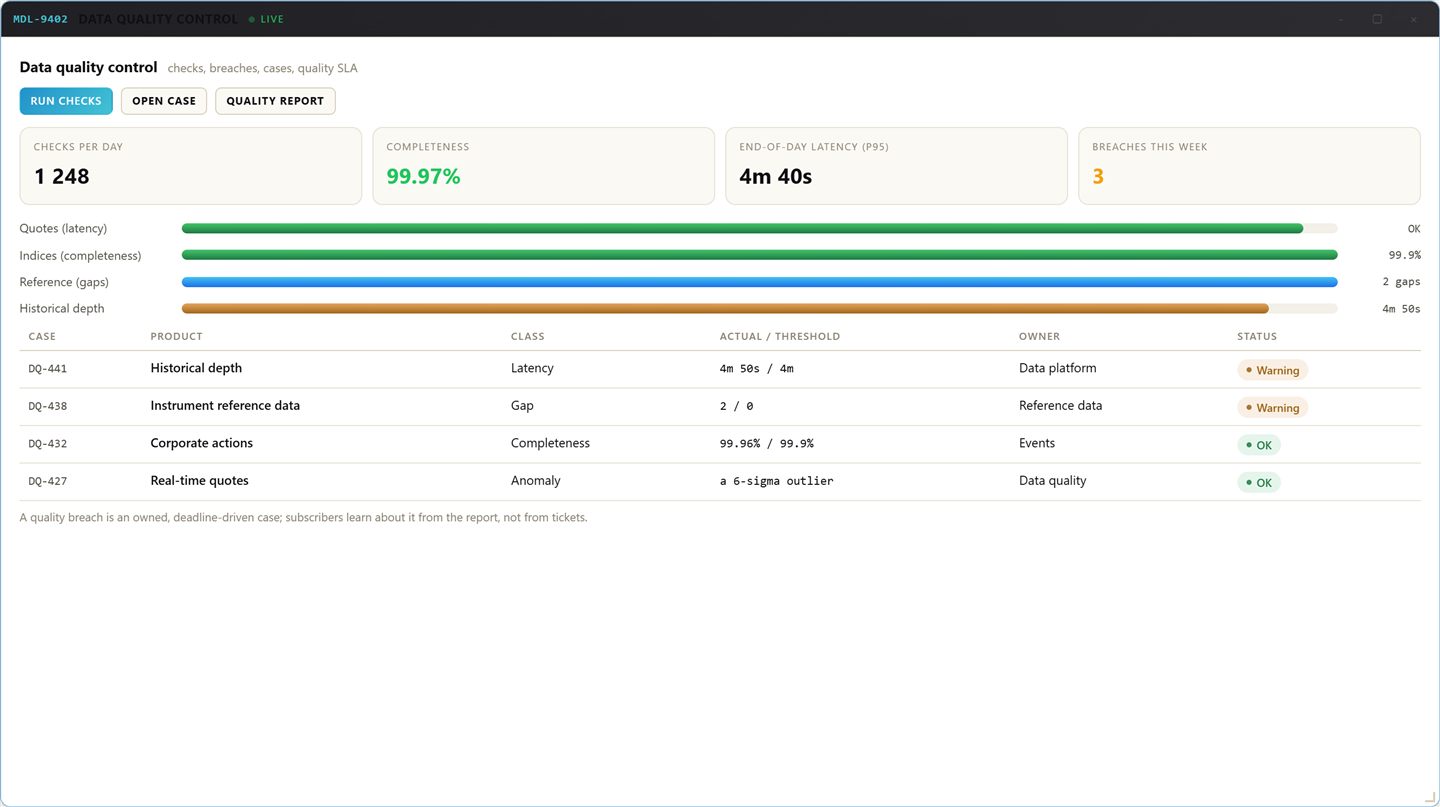
Feed quality is usually checked at random, and a gap is noticed through client questions. The solution catches gaps, delays and outliers against the schedule. With the solution the incident opens before the consumer calls. In setup the SLA analytics of every feed is visible, and the thresholds come from the setup.

Metering and billing

Consumption is usually counted once a month from logs, and anomalies surface after the invoice. The solution measures displays, non-display use and volumes continuously. With the solution the invoice is explained with facts, and deviations are found early. In setup the tariff versions and usage snapshots are visible, and the tariffs are part of the configuration.

Vendor reconciliation

Vendor reconciliation usually turns into correspondence, and disputes drag for months. The solution reconciles codes, volumes and amounts with vendors daily. With the solution the periods close without mismatches. In setup the reconciliation statements and code-level breaks are visible, and the reconciliation rules are set in configuration.

Coverage

What it covers

The suite runs the data business; vendor feeds are the truth.

Catalogue and changes

Product cards, versions and codes; changes go through review.

Orders and subscriptions

From request to contract: terms, entitlement classes, renewal and suspension.

Entitlements

Permanent and temporary rights with validity; review report before renewal.

Delivery

Channels and sessions, connection states and redistribution control.

Quality

Monitoring of gaps, delays and outliers with incidents and SLA analytics.

Metering

Continuous usage accounting: displays, non-display use and volumes per subscriber.

Billing

Tariffs from one registry, invoices, payments, disputes and reports for vendors.

Insights

Market insight reports for issuers and clients; demand analytics for the product team.

Stand

Screens of the solution

The product catalogue, feed quality control and tariffs with invoices.

Market data product catalogue screen
Product catalogue: feeds, depth, latency and public codes
Feed quality control screen
Feed quality control: gaps, delays and incidents
Tariff and invoice screen
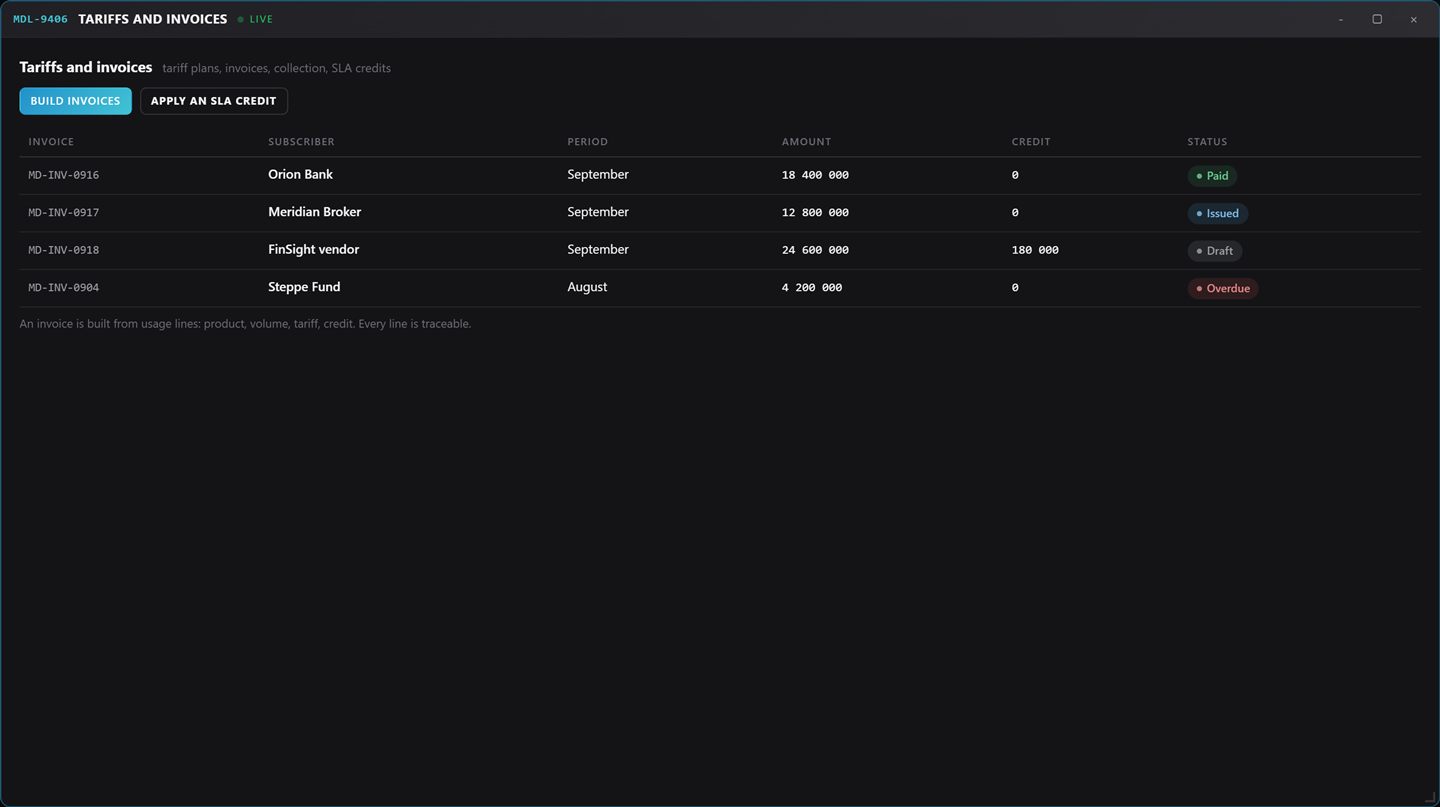
Tariffs and invoices: usage snapshots and collection statuses

How it works

From the order to the proven invoice in five steps

The path of a subscription: request, entitlement, delivery, metering and billing.

  1. 1

    The order arrives

    A client orders a product; the catalogue gives terms and class.

  2. 2

    The entitlement opens

    The right is issued with validity; reviews keep the list clean.

  3. 3

    Delivery starts

    The session comes up; the journal records consumption per channel.

  4. 4

    Metering counts

    Usage is measured continuously; anomalies surface before the invoice.

  5. 5

    Billing and reconciliation close

    The engine forms the invoice; disputes close with evidence.

Industries

Industries it serves

The suite works for exchanges and data operators, and for brokers, banks and vendors that consume or redistribute market data.

Architecture

Architecture and access

The suite sits between vendor feeds and subscriber bills: catalogue, delivery, control and money.

Service suite

Catalogue, order, entitlement, delivery, quality, metering, billing and reconciliation services on the platform base.

Deterministic money

Tariff versions and usage snapshots pin every amount; the same inputs always give the same invoice.

External sources

Vendor feeds, content and the general ledger connect as adapters with daily reconciliation.

Roles and audit

Catalogue publications, entitlements and tariff changes carry four-eyes approval and the full audit trail.

AI layer

The AI layer summarises quality incidents and explains entitlements; people approve.

Architecture scheme The same architecture as a standalone page. Open the diagram separately

Readiness

Ready today, next in line

The concept and the prototype are complete; build waves start after approval.

Ready today

  • Product frame: modules and business cases
  • Screen prototype: operation forms and end-to-end scenarios
  • Estimates for the implementation waves

Next in line

  • Wave W1: catalogue, orders and entitlements
  • Wave W2: delivery, quality and metering
  • Wave W3: billing, insights and vendor reconciliation

Releases

Release history

The suite is designed in 2026 and joins the platform release waves with the first pilot.

2026 Q3

  • Concept, business cases and the screen prototype; estimates for the waves.

2026 Q4

  • Planned: wave W1 with the catalogue and entitlements (plan).

Detailed description

Detailed description

The entitlement model, metering design and the delivery frame.

How the suite is assembled

Channels and clients
FIX 4.2 / 4.4 / 5.0, REST with mTLS, SFTP files, web portals
Edge and access
API gateway with 126 routes, Keycloak single sign-on, WAF and CSP
Platform core services
market-data-ms subscriptions reporting-ms delivery channels AI agentic layer Services of the suite on the shared platform core
Data and events
PostgreSQL 17 per service, Redis 7, RabbitMQ 3.13 quorum queues, transactional outbox
Results and reporting
Portals, reports, regulator and partner channels

Technology stack

Runtime and backend: Java 21 (LTS), Spring Boot 3.5.16, Spring Cloud 2025.0.3, Gradle, Flyway 10.15.

Data: PostgreSQL 17 per service, Redis 7 with Sentinel, RabbitMQ 3.13 quorum queues, transactional outbox and DLQ replay.

Portals: Next.js 16.3.3, React 19, TypeScript 5; OpenTelemetry 1.31 to Jaeger.

Delivery: Kubernetes and Helm, Vault secrets, Prometheus and Grafana, Docker Compose for pilots.

Visualisation: Apache Superset 4 and ECharts 5 for dashboards and charts, Grafana for operations panels, Mermaid for documentation schemes and the portal diagrams.

Entitlement model

  • Entitlement classes: display, non-display, derived data and redistribution rights.
  • Permanent and temporary rights with validity dates; the review report runs before renewal.
  • The client sees what their terminals consume; the operator sees the whole perimeter.
  • Suspensions and reinstatements follow the contract terms and are journaled.

Metering design

  • Usage accounting is continuous: sessions, displays, requests and volumes.
  • Snapshots pin every invoice: the same period always recalculates to the same amount.
  • Anomaly detection: consumption jumps and improbable patterns surface before billing.
  • Vendor reports by code and volume, ready for reconciliation meetings.

Insights and delivery

  • Market insight reports for issuers and clients built from the same data hub.
  • Demand analytics for the product team: what is ordered, used and abandoned.
  • The pilot puts one product and one subscriber through the full cycle.
  • Source code handover as an option with a separate fee, with the entitlement and metering design documented.

Architecture

  • Built from the platform core: market-data-ms, the subscription services, reporting-ms and the delivery channels.
  • The suite works through platform contracts: one register of record, no shadow copies of the data.
  • Scaling adds nodes, not rewrites: stateful services grow with Patroni, RabbitMQ and Redis clusters.

Integrations and access

  • OpenAPI for every service: 978 documented endpoints behind 126 gateway routes, plus webhooks and SFTP where partners need files.
  • Single sign-on: Keycloak 26.1, OIDC and JWT, roles, MFA and API keys with quotas.
  • Evidence by default: the audit journal, idempotency keys on writes and a record for every disclosure.
Detailed description

Leave your contacts to open the detailed description and download the PDF with architecture, cases and delivery details.

Put your data business into one suite

Bring one product and one subscriber: we will run the order, delivery, metering and the invoice on the pilot stand.