UNIFINplatform

Solution

Unifin Trade

Execution quality is the product of a trading desk.
The OMS keeps equities, bonds, currencies and derivatives on one desk with routing.
A day of trades is measured against benchmarks, so the desk explains results with numbers.

  • Asset classes
  • Routing
  • Currency pairs
All solutions

Live screens from the product terminals

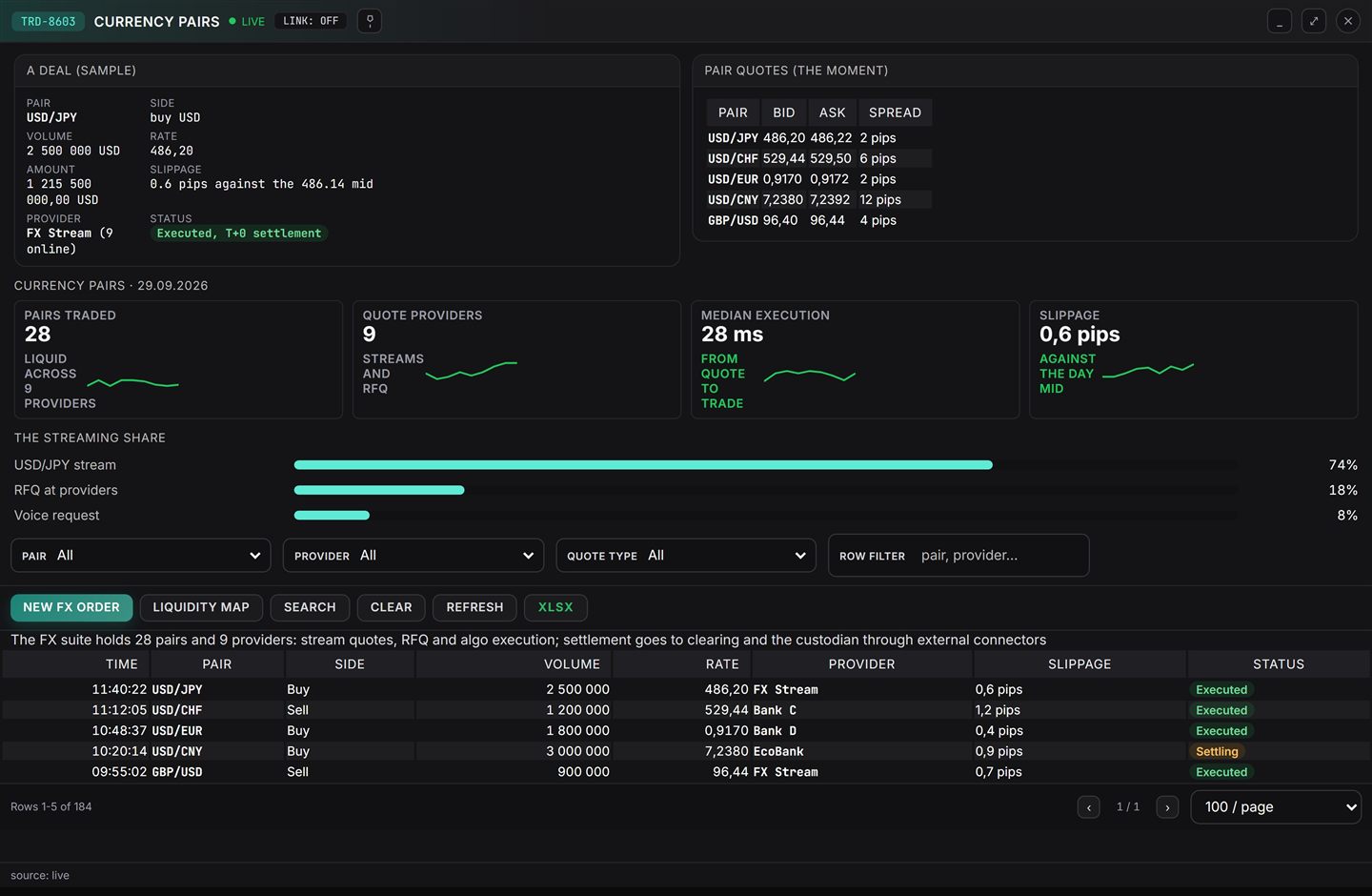
Trading desk screen with multi-asset orders Trading desk screen with multi-asset orders Smart order routing screen with venue scores Smart order routing screen with venue scores Currency pairs screen with streaming quotes
Demo Unifin Trade Theme Open separately
Trading desk
Trading desk

This is an interface demonstration: the real solution will differ in colours and content for a specific project.

Functions at a glance

Business functions at a glance

From the trading desk to external settlement.

Trading desk
Keeps orders, replacements and cancellations across all asset classes
One desk for equities, bonds, FX and commodities
Order routing
Compares venues and splits the volume by the rules
Execution without manual venue picking
FX pairs
Collects provider quotes, runs FX trades
A competitive rate, slippage under control
Book and quotes
Shows venue depth and spread signals
Liquidity visible before the trade
Execution and TCA
Computes deviations from VWAP, TWAP and arrival
Execution quality proven in numbers
Pre-trade control
Checks limits, collars and lists before an order goes out
No order leaves outside the rules
External settlement
Sends settlement instructions out and returns receipts
Settlement returns with receipts

What runs today

One desk, already running

One desk for four asset classes: the live parts.

One desk

Equities, bonds, FX and derivatives trade from one OMS.

OTC lifecycle

Offers, amendments and cancellations run by the lifecycle.

Repo

Repo trades and prolongations are part of the desk.

Routing

Smart order routing picks the venue; RFQ serves OTC.

TCA

Execution is measured against benchmarks with TCA.

Roadmap

Scheduled execution algorithms are next in line.

Solution description

Capabilities and overview

Key features

  • One desk for equities, bonds, currencies and derivatives
  • Smart order routing with rules and weights
  • Currency pairs: streaming quotes from providers
  • The consolidated order book across venues
  • Execution and TCA: VWAP, TWAP and arrival
  • Pre-trade control: limits, corridors and lists
  • Algorithms: TWAP, VWAP, POV and iceberg
  • Instructions to clearing, the CSD and the custodian
  • Execution quality reports to the committee and the regulator
  • Roles of the desk, compliance and operations
  • Journal of orders, routes and decisions
  • Deployment: by configuration, within the UniFin platform

Product overview

Unifin Trade is the UniFin platform OMS for banks, brokers and funds that need execution quality across all asset classes.

The suite runs orders and routing across venues, currency pairs, the consolidated book, execution and TCA.

Every route is explainable: rules and weights show why the volume went to the chosen venues.

Pre-trade control checks limits, corridors and lists before an order goes out, and settlement leaves through connectors.

The solution runs within the UniFin platform and connects venues and providers through connectors.

What it delivers

What the solution delivers

Trading desk

Orders for different asset classes usually live in different systems, and the desk assembles the picture of the day by hand. The solution keeps orders, replacements, cancellations and trades for every class in one blotter. With the solution the trading day is visible as a whole, with no spreadsheets stitched across desks. In setup the fields, statuses and filters come as reference data without code changes.

Order routing

The route is usually picked by a trader, and explaining the venue choice after the fact is hard. The solution compares venues by price, fill probability, cost and latency and splits the volume by rules. With the solution the route is explainable, and the saving against the worst option is visible. In setup the scores of every venue are visible on the order card, and the rule weights are set in configuration.

FX pairs

Provider rates are usually compared by hand, and slippage surfaces at the end of the day. The solution collects provider quotes, runs FX trades and computes the deviation from the median right away. With the solution exposure closes at a competitive rate, and slippage stays in control. In setup the pairs, the limits and the execution history are visible, and the request rules are configured per segment.

Book and quotes

Venue depth is usually checked one screen at a time, and an imbalance is found after the move. The solution brings the depth of the venues into one picture and highlights the spread and imbalance. With the solution liquidity is visible before the trade, and the price needs no chasing. In setup watchlists and signal thresholds come from the setup.

Execution and TCA

Execution quality is usually discussed by feel, and a committee gets intuition instead of evidence. The solution computes deviations from VWAP, TWAP and arrival and builds execution quality reports. With the solution the result is explained in numbers, and it is visible where the route or the algorithm deserves a change. In setup the split by venue and algorithm is visible, and the benchmarks and report schedule are part of the configuration.

Pre-trade control

Limits are usually checked after the order, when the breach has already happened. The solution checks limits, price corridors and restricted lists before an order goes out and rejects it with a reason. With the solution risk stays within the rules, and incidents are not unpicked after the fact. In setup the decision journal with the rejection reason is visible, and the rules and lists are set in configuration.

External settlement

Settlement instructions usually go out by mail, and the status of an instruction is invisible during the day. The solution releases instructions to clearing and to the custodian, and returns receipts into the blotter. With the solution the instruction status is visible while the day runs, and a failed leg opens a case. In setup the counterparties and the receipt rules come as reference data.

Coverage

What it covers

Orders pass checks, get an explainable route and land in a review.

The desk and the OMS

Asset classes, order intake, amend and cancel, fills, positions and the order journal.

Smart order routing

Venues, four rules with weights and splits by volume on the order card.

The FX suite

Pairs from providers, streaming quotes, RFQ, algo streams and slippage control.

The book and quotes

Depth across venues, spread and imbalance signals, watchlists.

Execution and TCA

VWAP, TWAP and arrival benchmarks, algo reports and route efficiency.

Pre-trade control

Limits per order, restricted lists, price collars and venue limits.

External settlement

Instructions reach clearing and the custodian; receipts return.

Journal and audit

Every order, fill, decline and report is kept in the event journal.

Stand

Screens of the solution

The trading desk, orders and routing, the trader terminal, auction bidding and the portfolio after the session.

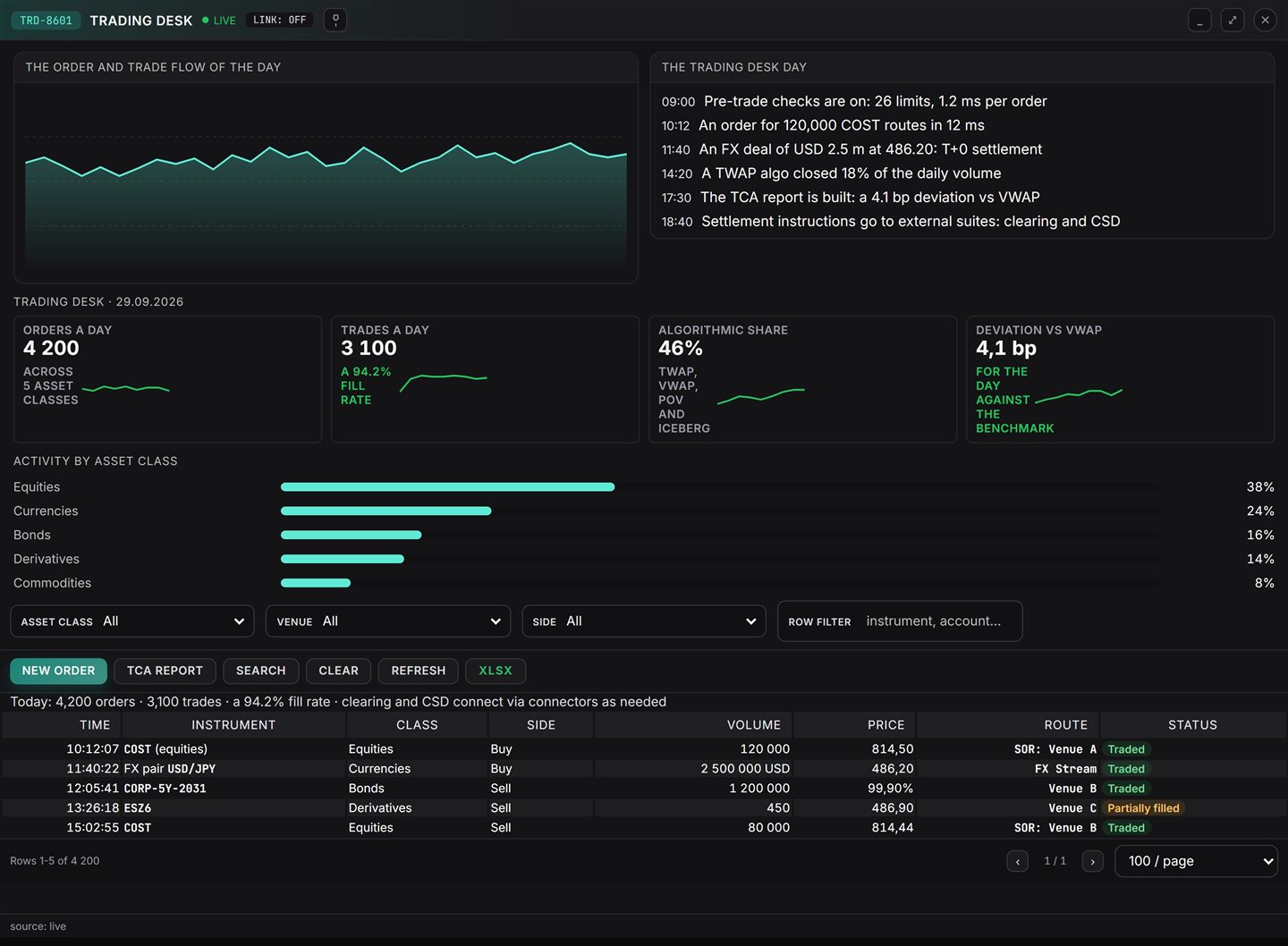
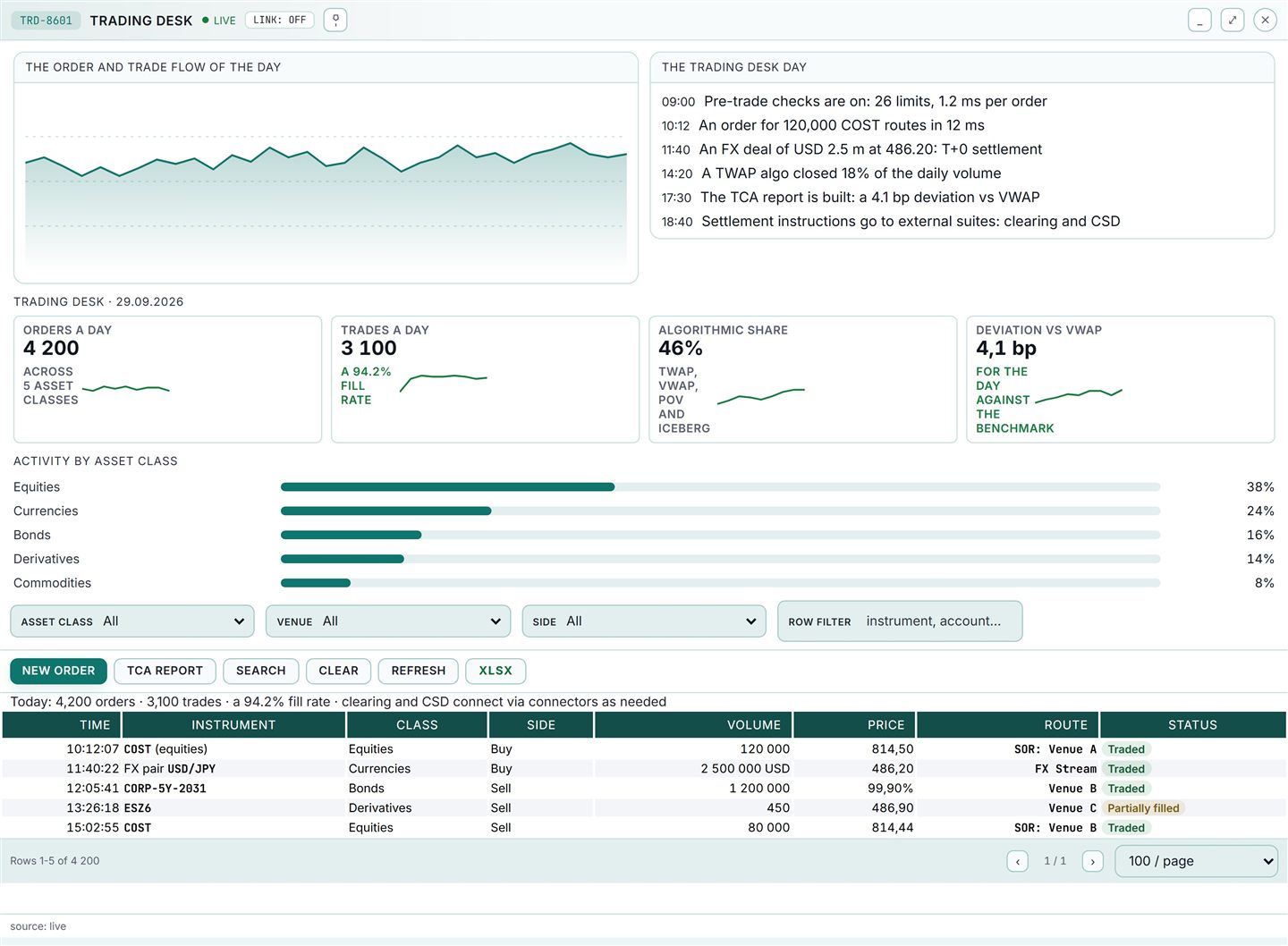
Trading desk screen with multi-asset orders
Trading desk: orders across five asset classes, routes and statuses
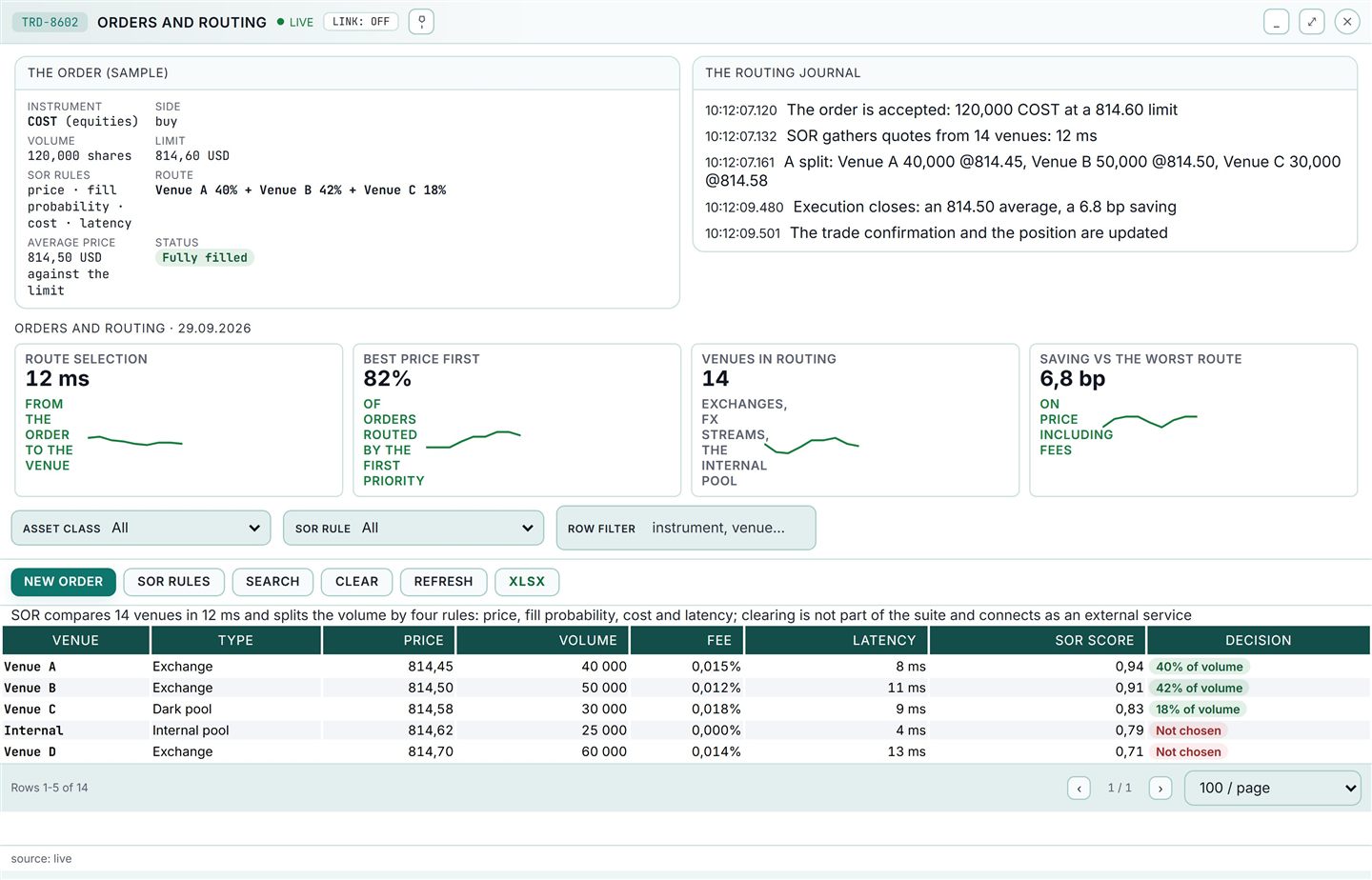
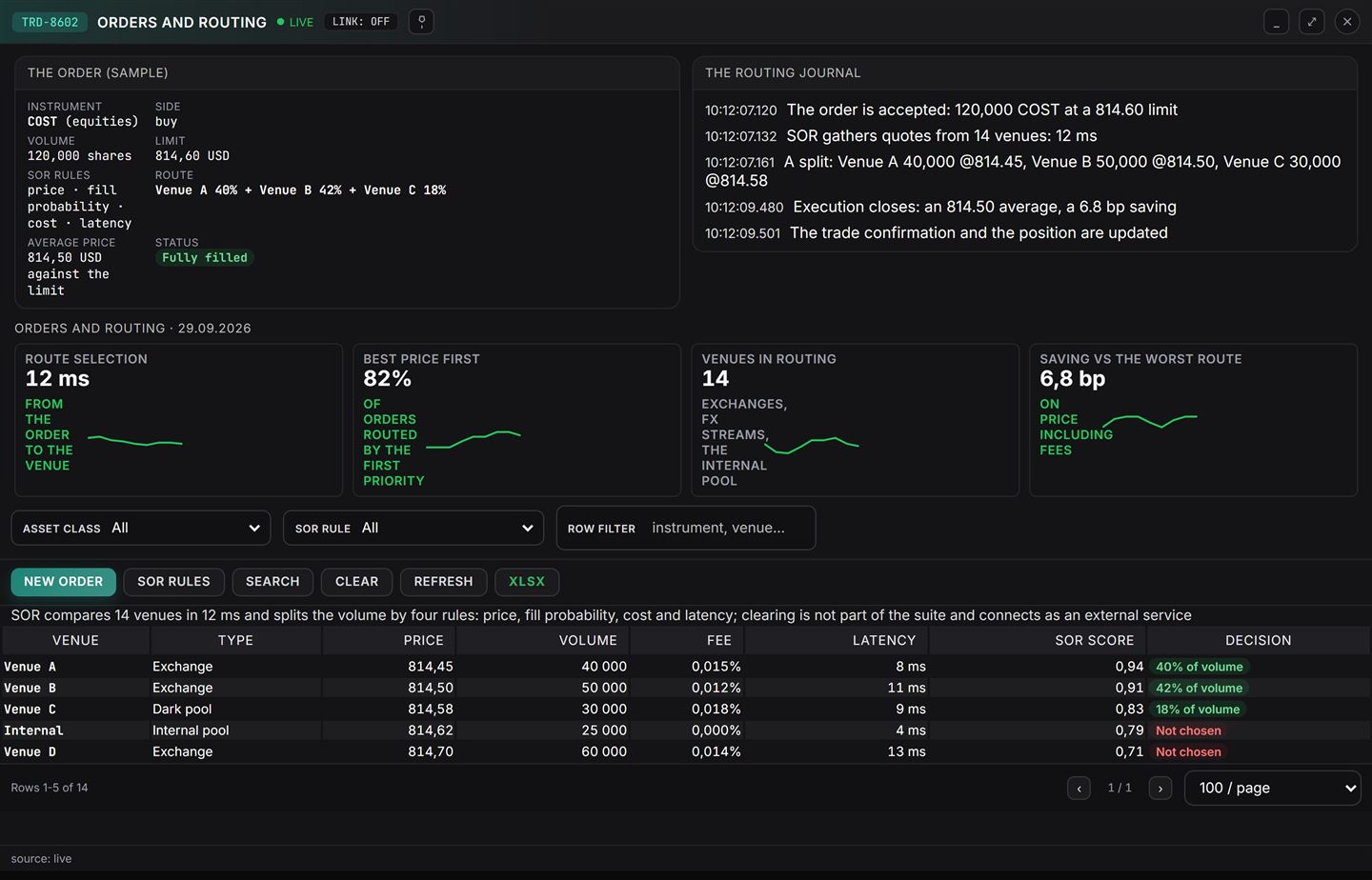
Smart order routing screen with venue scores
Orders and routing: venue scores and the SOR split
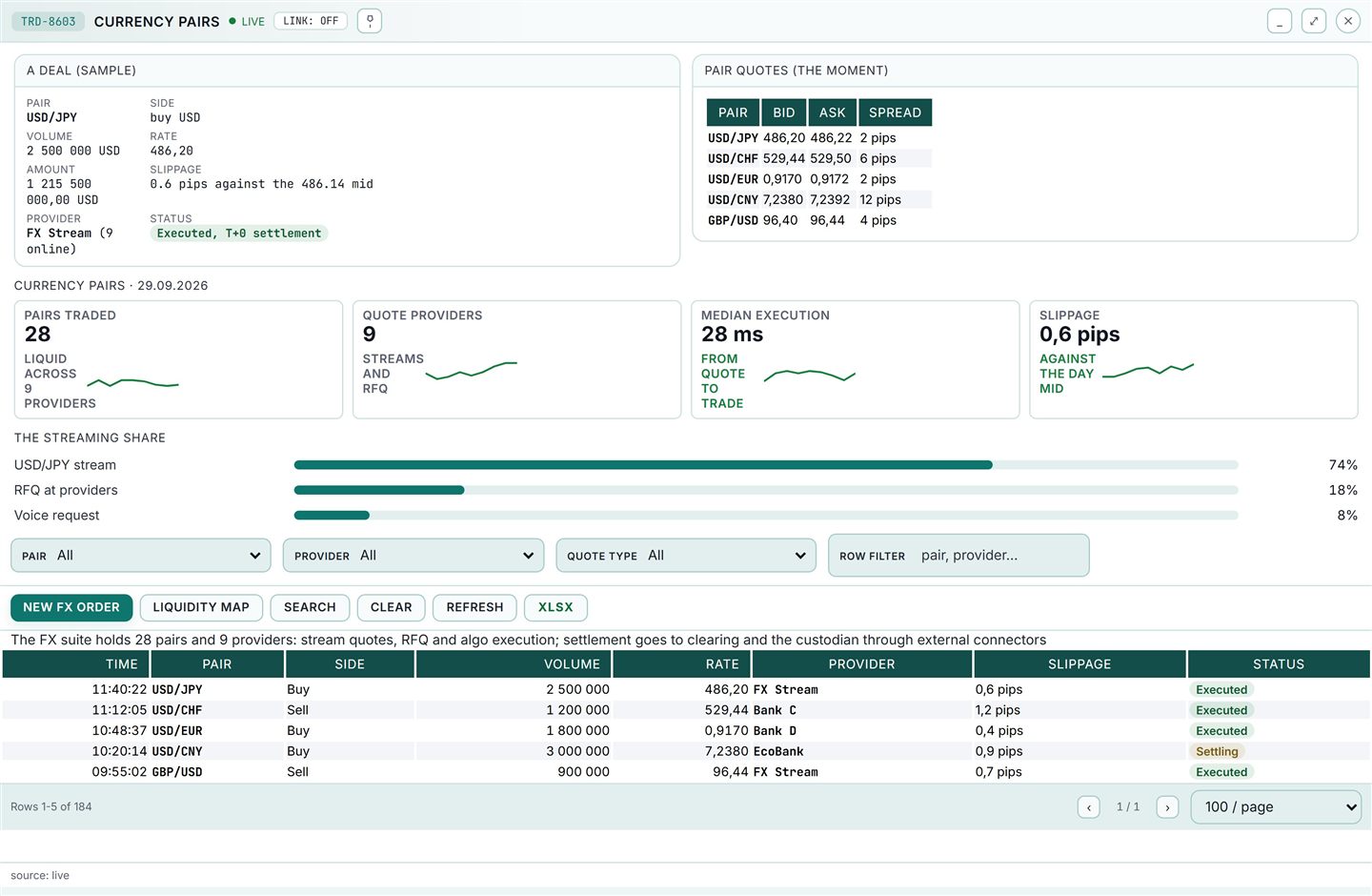
Currency pairs screen with streaming quotes
Currency pairs: streaming quotes, RFQ and FX trades
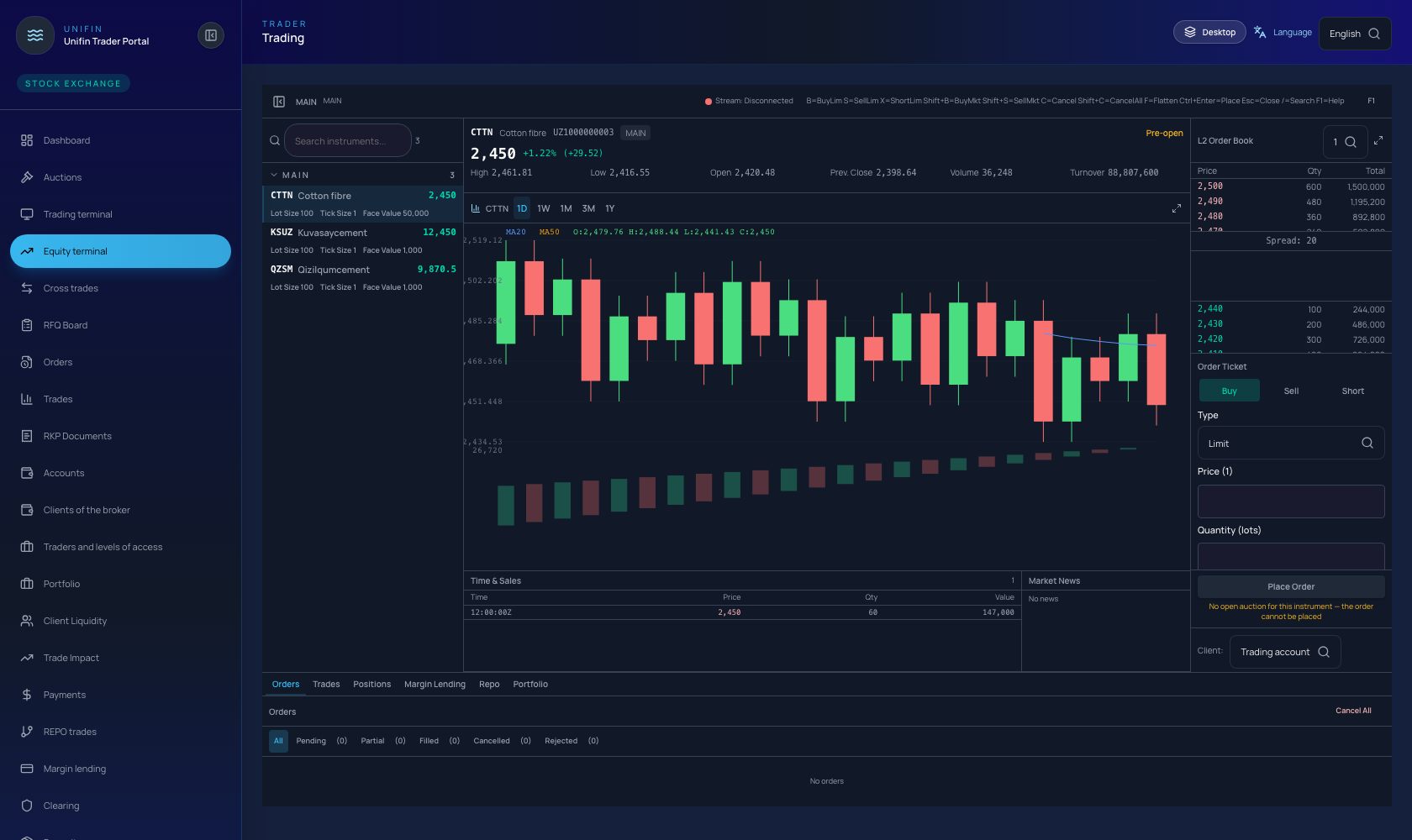
Trader terminal screen with the watchlist and the order ticket
Trader terminal: watchlist, order ticket and live quotes
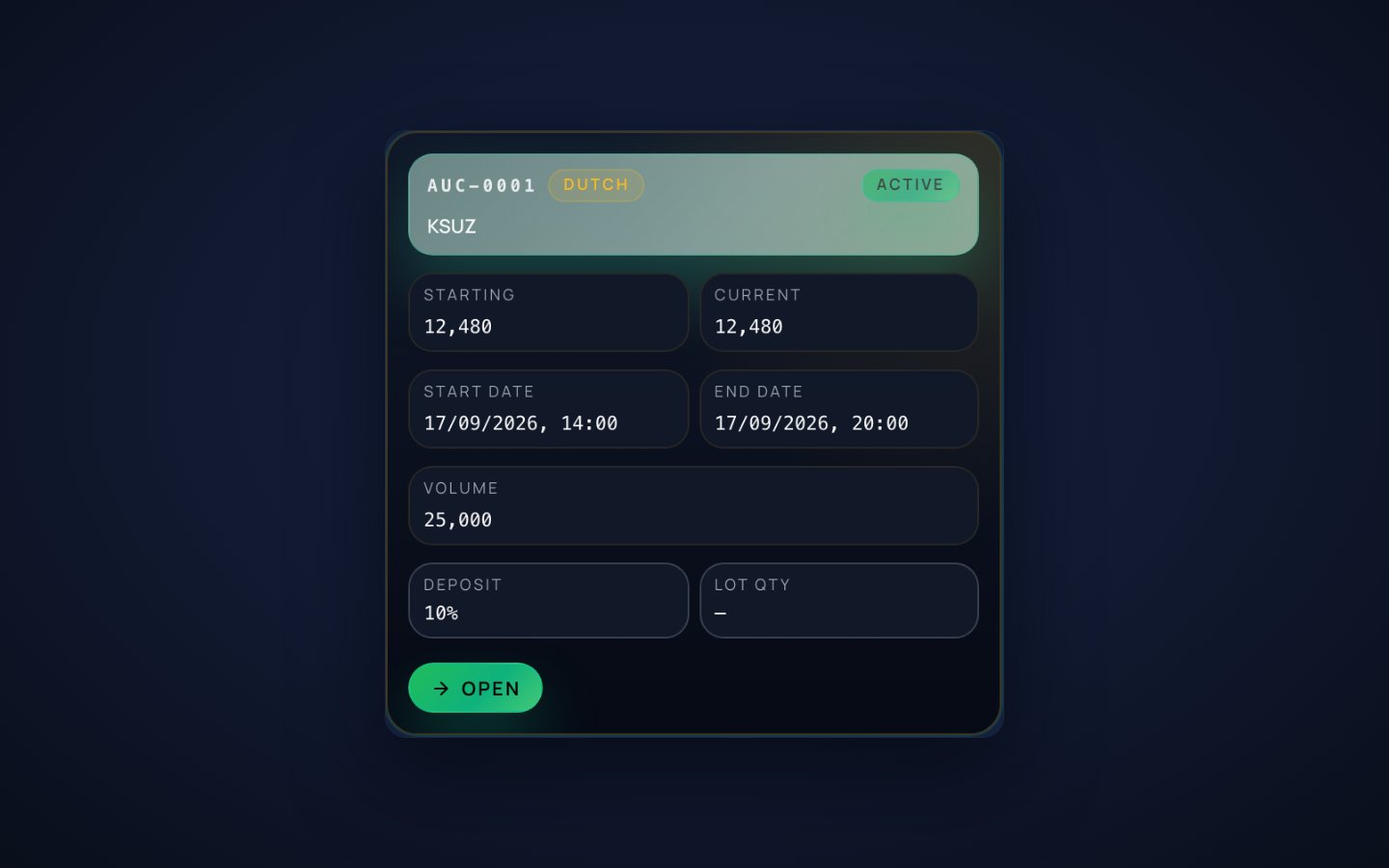
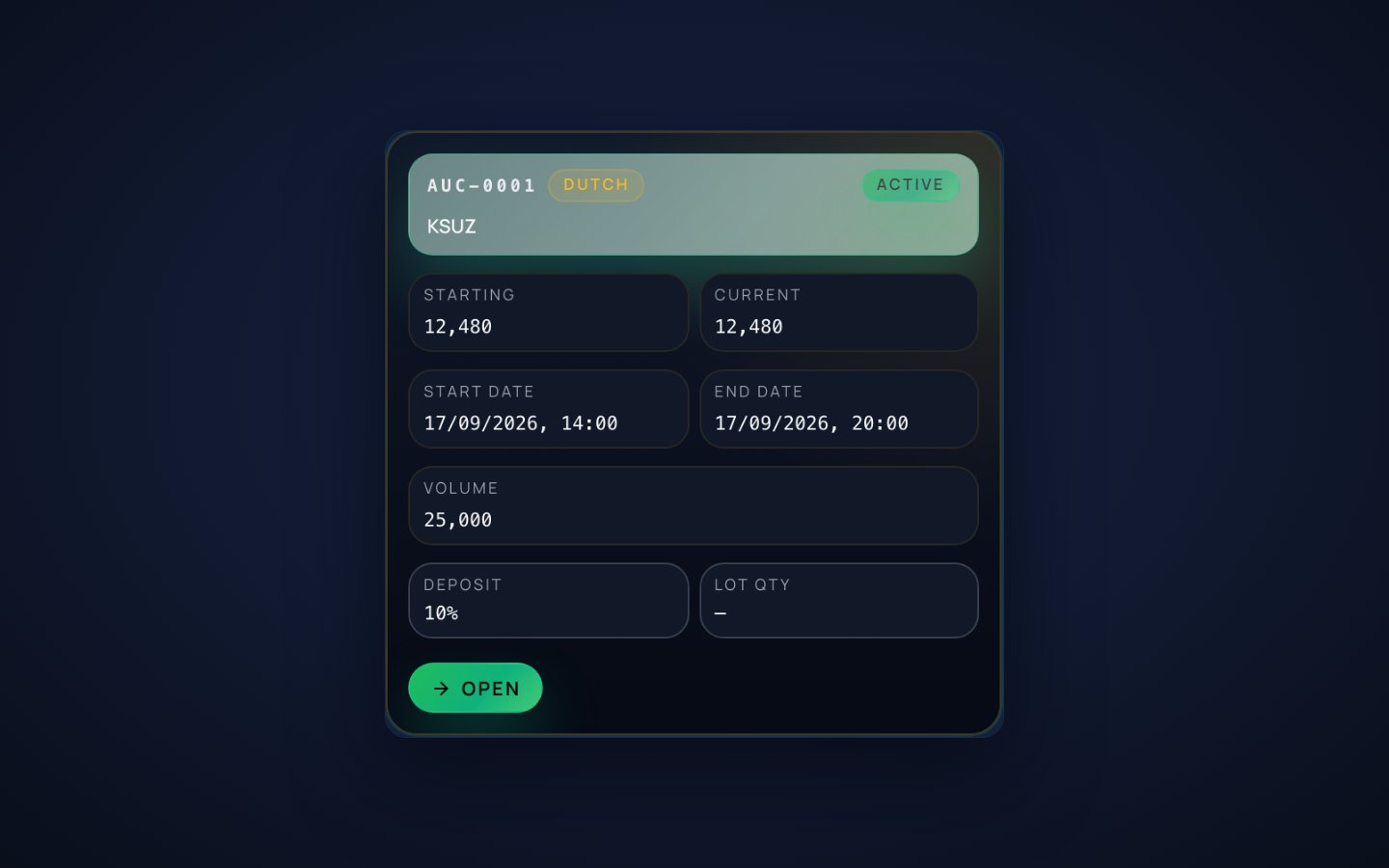
Auction bidding card with the starting price, deposit and the bid window
Auction bidding: starting price, deposit and the bid window
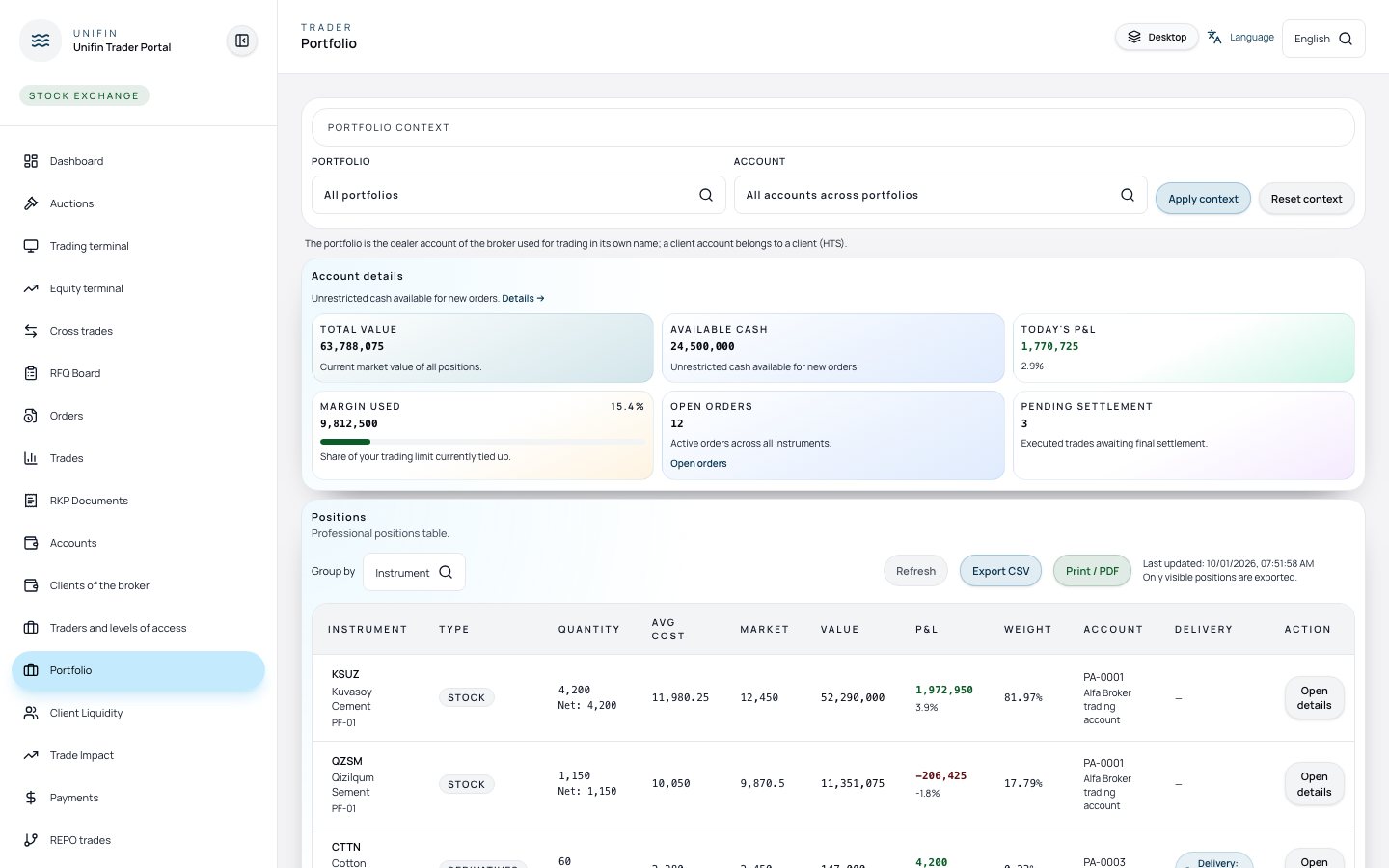
Portfolio screen with profit and loss, margin and positions
Portfolio after the session: profit and loss, margin and positions

How it works

From an order to a review in five steps

The path of one order: intake, checks, route, fills, review.

  1. 1

    The order arrives

    An order with a price limit arrives; assets use one card.

  2. 2

    Checks pass

    Limits pass first; concentration and price collar stay in the rules.

  3. 3

    SOR routes the volume

    SOR compares venues; volume splits by price and fill probability.

  4. 4

    Fills come back

    Fills return with an average price; the worst-route saving is shown.

  5. 5

    TCA closes the day

    VWAP and arrival deviations are computed; settlement reaches clearing.

Industries

Industries it serves

The suite serves banks and brokers, asset managers and funds, corporate treasuries, and venue operators with internal pools.

Exchange / venue

Trading, supervision, market data and post-trade on one governed core, launched by configuration.

Asset manager / fund

Analytics, indices and hedging instruments for portfolio and research teams.

Corporate / issuer

Market access for producers and issuers: auctions, deliveries, tokenised assets and data.

Fintech / data

Data products, AI services and API-first access to build on the platform.

Architecture

Architecture and access

The architecture rests on the trading core and the portal. The desk and the OMS, orders and SOR, the FX suite, the book and quotes, execution and TCA, pre-trade control.

Service suite

Portal, BFF, desk and OMS, smart order routing, the FX suite, execution and TCA, pre-trade control.

External suites stay external

Venues and FX providers, clearing, the CSD and custodian connect as connectors; the suite does not clear.

Multi-region and DR

Active-active reads and a DR region for Tier-0; cluster and database replication are supported.

Extend without touching the core

A new venue or SOR rule joins through configuration: the core stays still.

AI layer

The AI layer sums up the day and drafts the TCA note; people approve every change.

Architecture scheme The same architecture as a standalone page. Open the diagram separately

Readiness

Ready today, next in line

The base is in place; next: smart slicing and pre-trade what-if simulation.

Ready today

  • A multi-asset desk: the orders and trades of a day across every asset class
  • Smart order routing across venues with best-route selection
  • Currency pairs from providers with streaming quotes and fill control
  • Execution and TCA: VWAP, TWAP and arrival benchmarks, quality reports

Next in line

  • Cross-venue smart slicing with a schedule-aware split
  • Pre-trade what-if simulation for large orders
  • Additional venue and FX provider connectors (roadmap)

Releases

Release history

Quarterly releases from the foundation of the platform (2020); the trading suite launched in 2026.

2026 Q1

  • The multi-asset desk, orders and pre-trade control.

2026 Q2

  • Currency pairs with pluggable providers and smart order routing.

2026 Q3

  • The routing decision journal and the execution quality review.

2026 Q4

  • Cross-venue smart slicing and pre-trade what-if simulation (plan).

Detailed description

Detailed description

The module map, the SOR rule book and the delivery frame.

How the suite is assembled

Channels and clients
FIX 4.2 / 4.4 / 5.0, REST with mTLS, SFTP files, web portals
Edge and access
API gateway with 126 routes, Keycloak single sign-on, WAF and CSP
Platform core services
trading-ms market-data-ms risk-ms reference-data-ms AI agentic layer Services of the suite on the shared platform core
Data and events
PostgreSQL 17 per service, Redis 7, RabbitMQ 3.13 quorum queues, transactional outbox
Results and reporting
Portals, reports, regulator and partner channels

Technology stack

Runtime and backend: Java 21 (LTS), Spring Boot 3.5.16, Spring Cloud 2025.0.3, Gradle, Flyway 10.15.

Data: PostgreSQL 17, Redis 7 with Sentinel, RabbitMQ 3.13 with the transactional outbox.

Market connectivity: FIX 4.4/5.0 for venues, FIX FX for currency streams and ISO 20022 for settlement.

Portals: Next.js 16.3.3, React 19, TypeScript 5; Onest typography and two themes; Keycloak 26.1 for OIDC sign-in.

Delivery: Kubernetes and Helm, Vault secrets, Prometheus and Grafana, Docker Compose for pilots.

Evidence by default: orders, fills, routing decisions, declines and reports are journaled for five years.

The desk and orders

  • One blotter for five asset classes: equities, bonds, currencies, derivatives and commodities; 4,200 orders and 3,100 trades a day.
  • Pre-trade checks pass in 1.2 ms: 26 limits covering position, concentration, cash, the venue and the price collar.
  • Amend and cancel keep a version journal; a manual volume or price change takes a second approval.
  • Declined orders run at 0.7% of the day and all are reviewed the same day with a reason.

Smart order routing

  • SOR compares 14 venues in 12 ms by four rules: price, fill probability, cost and latency.
  • The best route goes first on 82% of orders; the saving against the worst route is 6.8 bp.
  • A 120,000 COST order splits 40/42/18 across three venues and fills at an 814.50 average against an 814.60 limit.
  • The order card keeps venue scores, the split and the outcome: the decision is explainable to compliance.

Currency pairs

  • 28 pairs from 9 providers with streaming quotes, RFQ and algo streams; the median fill is 28 ms.
  • EUR/USD for USD 2.5 m fills at 1.0868 against the 1.0862 mid, a 0.6 pip slippage.
  • Slippage, spread and the streaming share go into the FX journal and the day report.
  • Settlement runs T+0 for major pairs and T+2 as agreed, delivery versus payment via the custodian.

Execution and TCA

  • Three benchmarks: VWAP 4.1 bp, TWAP 2.3 bp and arrival 1.8 bp against an 8 bp target.
  • Twelve TCA reports a day by desk, instrument and algo; the history is five years long.
  • An 8.4 bp outlier raised a review; the price-rule weight was reconsidered and the next orders gave 3.2 bp.
  • Exchange receipts and position reconciliations stay with the order card.

Architecture

  • Built from the platform core: trading-ms, market-data-ms, risk-ms and reference-data-ms behind a portal BFF.
  • The portal BFF keeps roles, routing and audit; a window knows only its own /api/v1 calls.
  • Venues and FX providers (FIX), clearing, the CSD and the custodian connect as connectors; the suite does not clear.
  • Scaling adds nodes: Patroni, RabbitMQ quorum queues and Redis clusters; stateless services run in three zones.
Detailed description

Leave your contacts to open the detailed description and download the PDF with architecture, cases and delivery details.

Ask about the trading suite

Bring one trading day. We will show the path from an order to a route and from an FX fill to a TCA review.